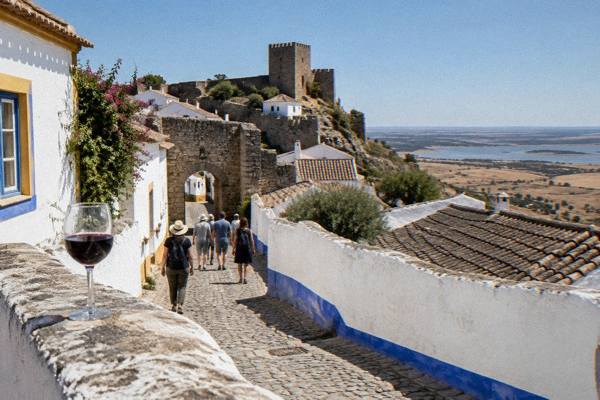
Alentejo Castles And Villages: The Fortified Towns You Can Reach From Évora
The Alentejo around Évora is castle country: hilltop keeps, walled villages and frontier fortresses strung across the plain. Here is what each one is and how to plan the route.
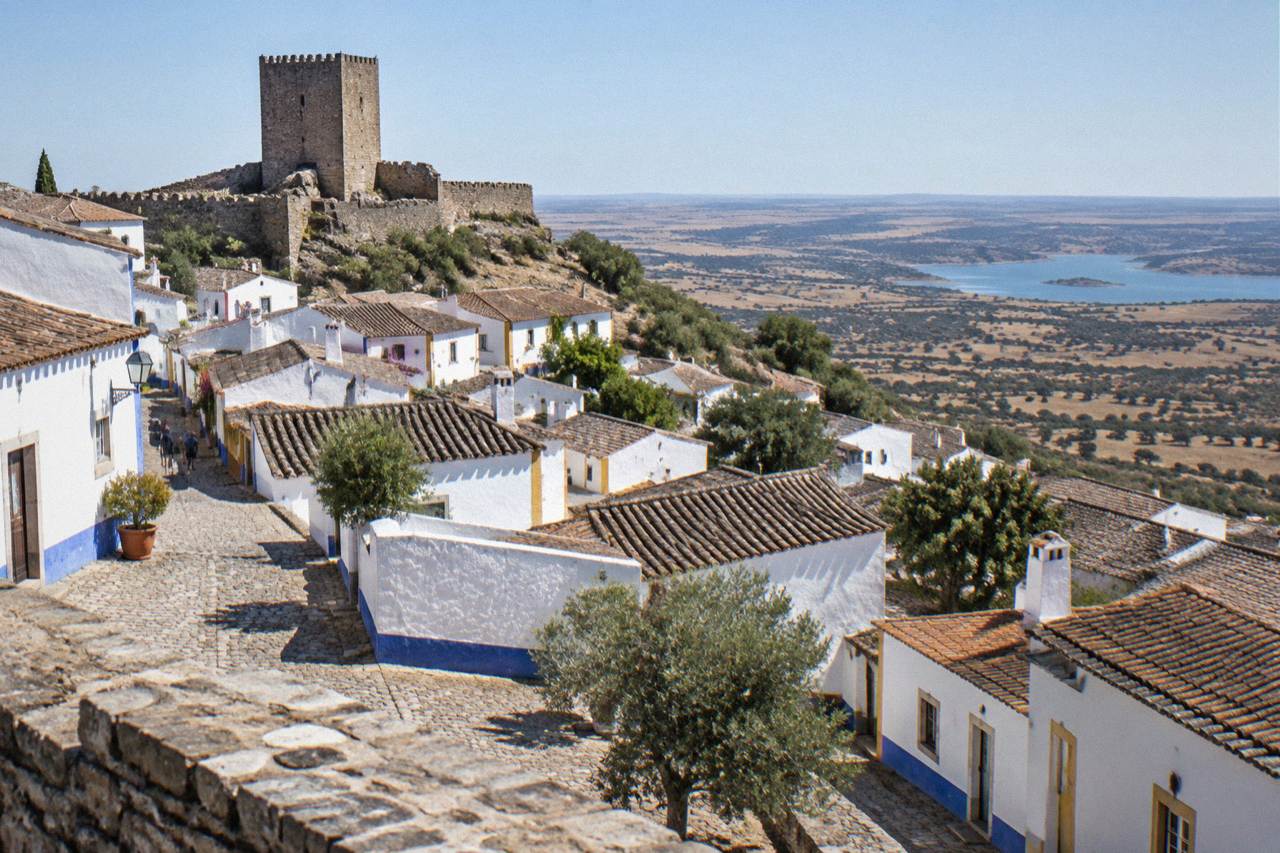
Short answer
The Alentejo's best castle days from Évora are the walled hill villages of Monsaraz and Marvão, the marble towns of Estremoz and Vila Viçosa, and the great frontier fortress city of Elvas, with Évora's own medieval walls as the base for all of them.
The Alentejo is castle country, and Évora, the inland capital of Portugal's Alentejo region, sits in the middle of it. The name Alentejo is usually explained as "beyond the Tagus", the great river that separates this rolling, sparsely settled plain from the rest of the country, and the plain beyond it spent centuries as a frontier. Christian and Moorish forces contested it, then Portuguese and Castilian armies did, and every hill worth defending carries the evidence: a keep, a curtain wall, a watchtower, a whole town folded inside stone. The result today is one of the densest concentrations of small fortified settlements in Europe, and almost all of them lie within a comfortable drive of Évora.
This guide walks through the castle towns and walled villages of the region, what each one actually is, and how to string them together. For the wider picture of the region, start with the Alentejo travel guide, and for the question of whether the region repays the trip at all, see is Alentejo worth visiting.
What Is The Alentejo Castle Country Around Évora?
The Alentejo around Évora is a frontier landscape: after Moorish rule in Évora ended in 1165, the region became a contested border march, and the towns that grew on its hills, Monsaraz, Estremoz, Vila Viçosa, Elvas, Marvão, Évoramonte, each fortified themselves with walls, keeps and gate towers whose stones still stand today. Évora itself grew rich enough to be inscribed by UNESCO in 1986, and the smaller towns kept their military silhouettes.
The historical logic is simple. Évora's Moorish period ended in 1165, and the new Portuguese crown then had to hold a vast, exposed plain against rivals both internal and external. Hilltops were fortified; villages migrated uphill behind walls; watchtowers relayed signals across distances that look impossible today until you stand on one and see the next tower plain on the horizon. The frontier with Spain in particular hardened around Elvas and Marvão in the east, and that belt of fortification is the reason the region's eastern edge carries the biggest military architecture.
What surprises many visitors is how intact it all is. Évora was largely undamaged by the 1755 Lisbon earthquake that flattened so much of central Portugal, and UNESCO's criterion (iv) calls the city the finest example of a city of the golden age of Portugal for exactly that reason. The same relative neglect that preserved Évora's streets preserved the small towns around it: they were never rich enough to rebuild, so the medieval cores stayed.
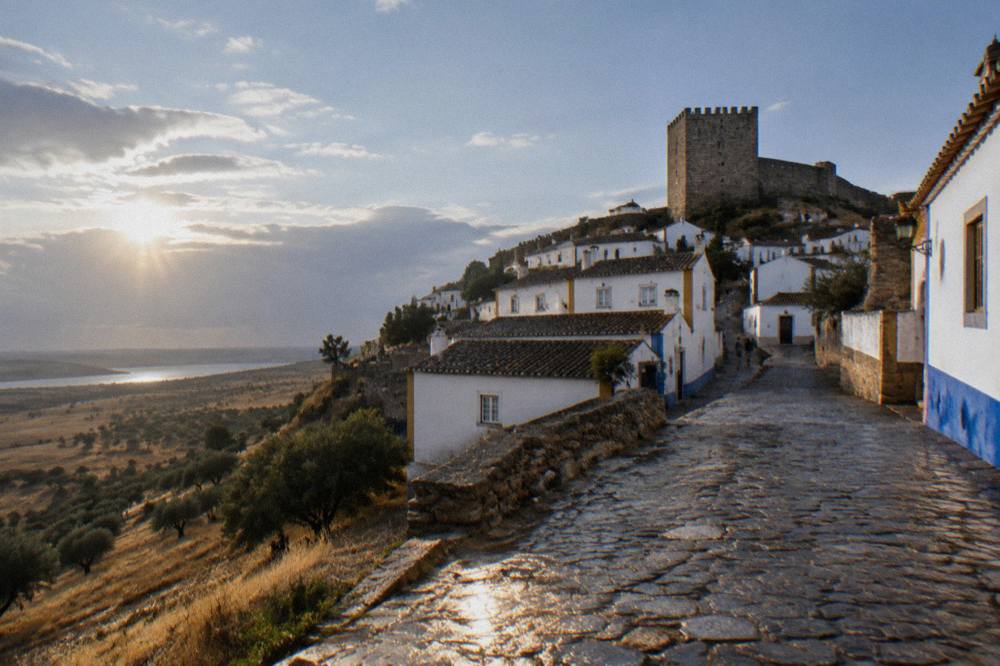
The region today is quiet, agricultural and thinly populated. Évora municipality counted about 53,000 residents at the 2021 Census, and the surrounding towns are far smaller. That is the appeal: a castle circuit here is not a queue and a coach park, it is a hill, a wall, a view and a long lunch. The Alentejo food guide deserves a read before any of it, because the castle towns are also the region's best table.
Which Castles And Walled Towns Can You Reach From Évora?
The castle towns within reach of Évora are, going outward: Évoramonte and Arraiolos, about 20 km away in the case of Arraiolos, then Estremoz about 45 km, Monsaraz about 40-45 km, Vila Viçosa about 60 km, Elvas about 80 km and Marvão about 120 km, each a distinct kind of day out, from a half-day village stroll to a full frontier-fortress excursion.
Those rounded distances are the honest way to describe them; exact driving figures depend on route and roadworks, and no single number serves every traveller. What matters more is the character of each place, which differs sharply:
| Town | Roughly From Évora | What It Is | The Kind Of Day It Makes |
|---|---|---|---|
| Arraiolos | about 20 km | Hilltop walled village with a round castle keep, famous for its hand-stitched carpets | Easy half day, combined with a slow lunch |
| Évoramonte | near Estremoz direction | Small walled settlement with a striking stone keep | A stop on a wider loop rather than a destination alone |
| Estremoz | about 45 km | Marble-built royal town with a high castle and walls above the plain | Half to full day, marble and castle together |
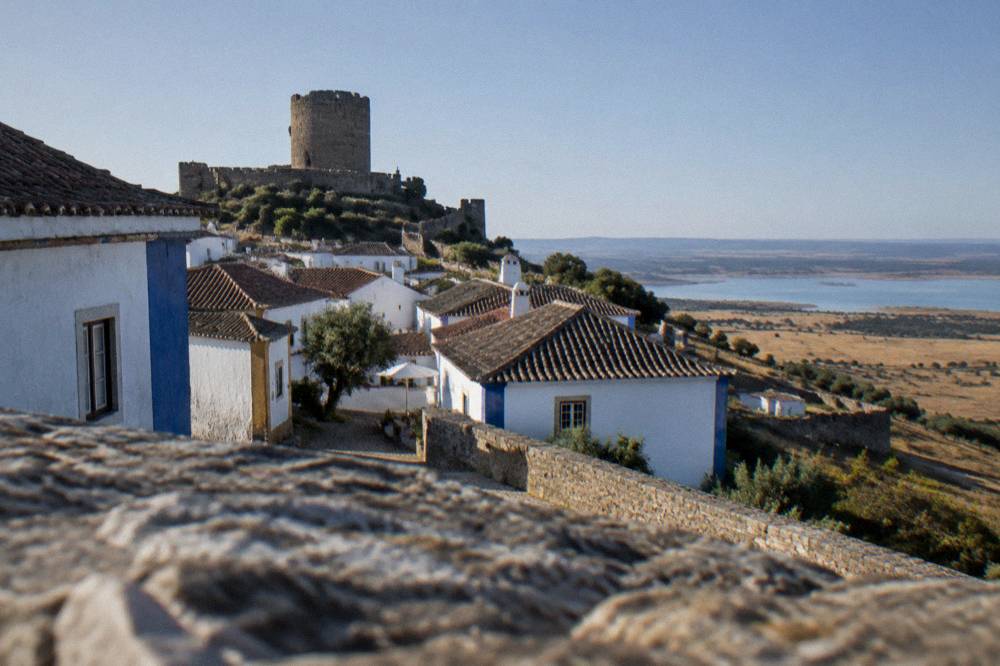
| Monsaraz | about 40-45 km | Tiny intact walled village above the Alqueva lake plain | Half day, best paired with wine or the lake shore |
| Vila Viçosa | about 60 km | Ducal seat with a palace, convent and marble quarries | Full day, softer and more aristocratic |
| Elvas | about 80 km | Great frontier fortress city, walls, forts and aqueduct | Full day, the biggest military architecture in the region |
| Marvão | about 120 km | Eagle's-nest walled village on a high ridge | Full day, best combined with Castelo de Vide |
Note what this table deliberately does not contain: opening hours, entry prices or drive times for any of these places. None of those figures was verified on an official page for this guide, and a castle in a small Portuguese town can and does close for lunch, for weather, for restoration. Check the municipal notice for each town before committing a day to it.
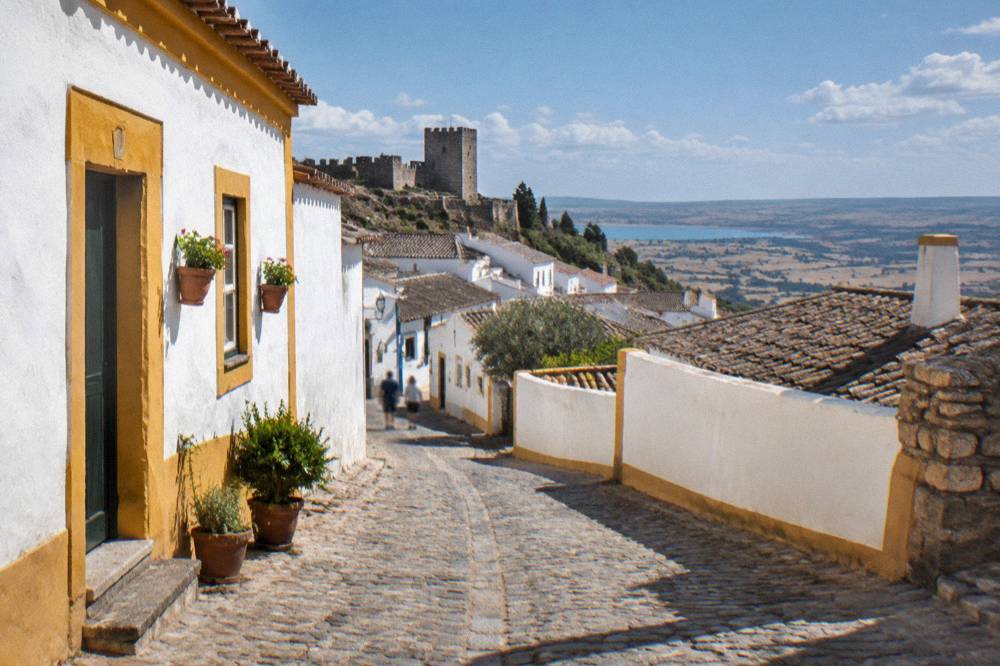
Two of these towns reward a guided approach. A private guide changes what you get out of the small places, where the story is in the stones and not on a plaque.
For travellers basing themselves in Lisbon rather than Évora, the same castle country is reachable on organised day trips that visit Évora itself; the Alentejo tour from Lisbon page covers those, and the Lisbon to Évora guide covers the transfer logistics.
What Makes Marvão And Elvas Different Kinds Of Castle Day?
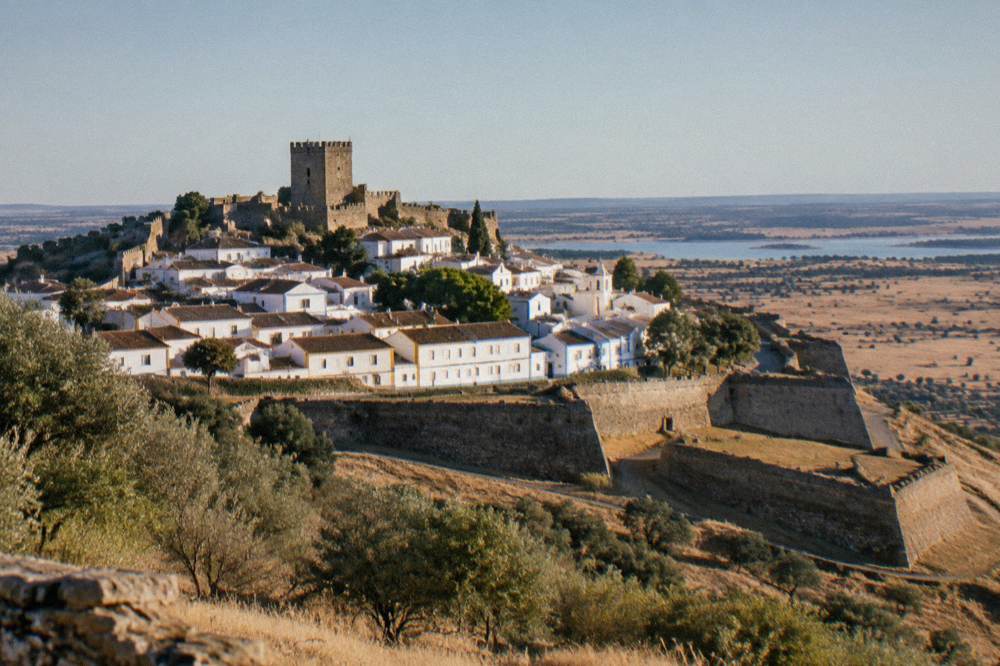
Marvão and Elvas answer two different questions: Marvão is a single spectacular walled village perched on a narrow ridge, a place you visit for the silhouette, the view and the quiet streets, while Elvas is a full fortress city, a vast system of walls, bastions, outlying forts and an aqueduct, built to hold a border against a besieging army, and it needs the better part of a day on its own.
Marvão, about 120 km from Évora, is the dramatic one. The village sits on a high ridge near the Spanish border, its houses strung along the crest inside walls that follow the rock. The approach road alone is half the experience. It is the kind of place where the sensible plan is a slow morning, a walk of the walls while the light is still low, and lunch before the afternoon heat builds on the bare stone. Nearby Castelo de Vide makes a natural pairing, a spa town of steep lanes and a medieval Jewish quarter, and the two together fill a day comfortably.
Elvas, about 80 km, is the opposite temperament. This is military engineering at city scale: trace the walls, count the bastions, find the outlying hilltop forts that made the city effectively impregnable, and walk the arcaded aqueduct that supplied it through sieges. The historic centre inside the walls is lived-in, a working Portuguese town rather than a museum piece, and the garrison-town character still shapes its streets. The fortification history of Elvas is well known to anyone who has read about the border wars, but no specific inscription or heritage-listing detail belongs on this page, because none of it was verified for this guide: the stones speak for themselves.
A practical comparison of the two days out:
| Marvão | Elvas | |
|---|---|---|
| Setting | High ridge, near the Spanish border | Fortified plain city on the eastern border belt |
| The draw | The village itself, the walls, the long views | The fortress system, walls, forts and aqueduct |
| Pace | Slow, contemplative, walkable in a morning | Structured, needs most of a day |
| Pairs well with | Castelo de Vide, the northern Alentejo | Vila Viçosa or Estremoz on the same eastern loop |
| Best for | Photographers, walkers, quiet seekers | Military-history readers, anyone who likes scale |
Both sit on the eastern side of the region, so they combine naturally with each other only if you are staying out that way or driving a full loop; from Évora as a base, Elvas plus Vila Viçosa is the tighter pairing, and Marvão usually earns its own day.
Before any eastern loop, it is worth being sure of Évora itself. The private walking tour with cathedral and Chapel of Bones, rated 5 from 256 reviews and from $113.53 per person, covers the city's own walled core with a guide and monument tickets included, and it is the natural first day of any castle itinerary: Check availability. You can also read about it on its own tour page.
Which Walled Villages Are Closest To Évora?
The closest walled villages to Évora are Arraiolos, about 20 km away, a hilltop settlement with a rare round medieval keep and a national reputation for hand-stitched carpets, and Évoramonte, a small walled town with a heavy stone keep, both of them easy half-day visits that fit around a morning or an afternoon in Évora itself.
Arraiolos is the one most visitors end up loving precisely because it asks so little. The village climbs a low hill crowned by its unusual round castle, and the streets below are full of the workshops and outlets of the Arraiolos carpet tradition, needlework carpets stitched for centuries in the town and sold across Portugal. The castle lawn is a fine picnic spot, and the whole place can be seen in a relaxed half day. The carpet tradition is the town's identity, but no workshop detail, visit or demonstration was verified for this page: treat the shops as browsing, not a scheduled tour.
Évoramonte lies in the direction of Estremoz, and its keep, a squat, powerful tower with corner turrets, is one of the more photographed structures in the region. The village inside the walls is tiny, a handful of streets, so it works best as a stop on a loop that continues to Estremoz or Vila Viçosa rather than as a destination on its own.
For the closest castle experience of all, stay inside Évora. The city's own walls, gates and towers are the subject of the Roman and medieval walls guide, and the historic centre inside them is a UNESCO-listed whole. The monuments that anchor a day in the city, with their verified official prices, are these:
| Monument | Verified Ticket | Hours (Official) | Closed |
|---|---|---|---|
| Sé de Évora, complete visit: cathedral, cloister, roof terrace, museum | 5.00 EUR, children to 12 free | 9:00-17:00 | 24 Dec afternoon, 25 Dec, 1 Jan |
| Igreja de São Francisco and Capela dos Ossos, all museum areas | 7.00 EUR adult, 5.00 EUR youth to 25 and senior over 65, 15.00 EUR family | Summer 9:00-18:30, winter 9:00-17:00 | 1 Jan, Easter Sunday, 24 Dec afternoon, 25 Dec |
| Museu de Évora | 8 EUR adult, 50% off for youth 13-24, seniors and families | Tue-Sun 9:30-13:00, 14:00-17:30 | Mondays, 1 Jan, Easter Sunday, 1 May, 29 June, 25 Dec |
| Évora Ticket multi-site pass | 8 EUR one day, 10 EUR two days, 12 EUR three days, free to 12 | Varies by site | Does not include the Sé, the Capela dos Ossos or the Museu de Évora |
The Évora Ticket's exclusion list matters: it covers the Cidade-Museu network's sites, not the three biggest paid monuments, so a first-time visitor usually buys it for the smaller churches and convents and pays the Sé and the Capela dos Ossos separately. The Convento dos Lóios, one of the pass's most interesting buildings, currently shows its price as temporarily unavailable on the municipal page, so plan for that one to be checked on arrival.
A different way to see the city's medieval core is from the saddle of a sidecar: the Medieval Tour of Évora on a Sidecar with wine tasting, from $61.90 per person and rated 4.9 from 16 reviews, loops the walls and lanes with a local driver.
How Do You Plan A Castle Route Across The Alentejo?
The classic Alentejo castle route from Évora runs east in a loop: Arraiolos or Évoramonte first, then Estremoz, Vila Viçosa and Elvas as the core of a full day, or west and south to Monsaraz and the Alqueva shore for a softer day of walls, water and wine, with three days the comfortable minimum for the region's castles and a week the unhurried version.
The single most useful planning decision is east versus south. The eastern loop, Estremoz, Vila Viçosa, Elvas, and Marvão if you add a day, is the military spine of the region: marble, fortresses, border history. The southern day, Monsaraz and the Alqueva lake country, is the scenic one, a walled village above a vast man-made lake with wineries along the shore. Mixing both into one frantic day is the mistake; the distances are honest Alentejo distances and the point of the region is not to rush it. The full index of guides sits on Évora Travel Guide.
| Loop | Towns | Realistic Length | Character |
|---|---|---|---|
| Close half-days | Arraiolos, Évoramonte | Half day each | Village walls, carpets, keeps |
| Eastern fortress day | Estremoz, Vila Viçosa, Elvas | One full day | Marble, ducal palace, fortress city |
| Northern ridge day | Marvão, Castelo de Vide | One full day | High walls, long views, spa town lanes |
| Southern lake day | Monsaraz, Reguengos wine country | One full day | Walled village, lake plain, cellar doors |
For a worked version of a multi-day route, the three days in Évora and Alentejo itinerary and the Alentejo road trip guide lay out full sequences with overnight stops. The best month to visit Alentejo question matters more here than in most of Portugal, and the next section is why.
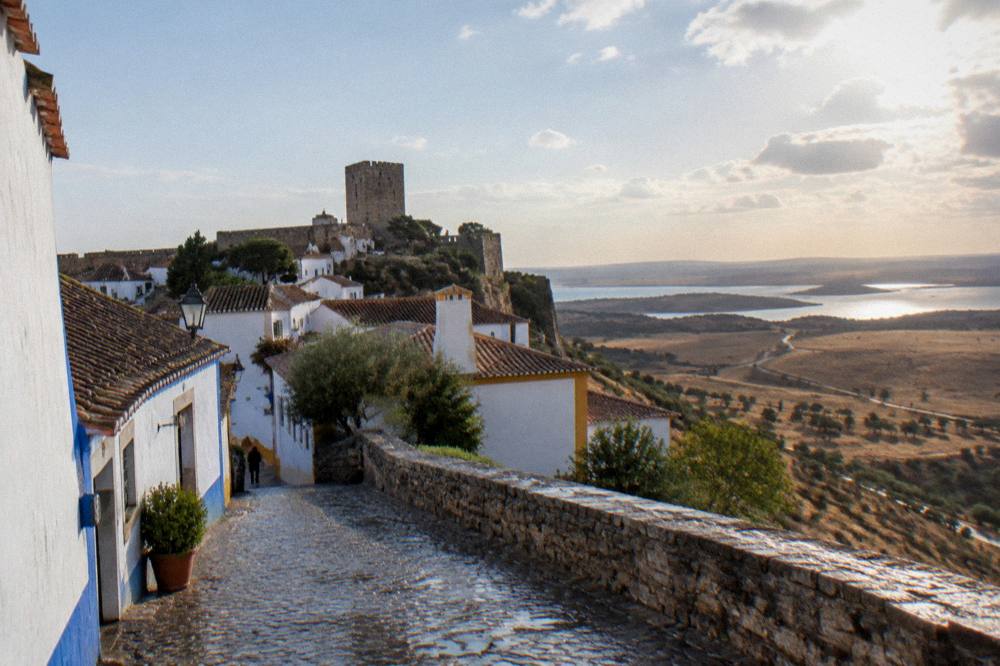
Wine belongs on any castle route, because the region's best cellars sit on the same roads as its walls. The Alentejo wine guide explains what the region's wines are like, and the Monsaraz and Wine guided tour from Évora, from $78.78 per person and rated 4.6 from 51 reviews, is the single tour that combines a walled village with a tasting.
When Is The Best Season For Alentejo Castle Towns?
The best seasons for Alentejo castle towns are April, May, late September and October, when IPMA's 1991-2020 normals for the Évora station show mean maxima of 20.7 to 25.0 C in spring and 24.1 to 29.5 C in those autumn months, against 33.3 C in July and 33.5 C in August, and the plain's rain concentrates from October to December, so summer is for early mornings and winter for short, mild days.
The numbers deserve respect. The same normals, measured at the Évora station, count 31.9 days a year with a maximum of 35 C or more, and 86.5 days at 30 C or more, almost all of them June through September. The record maximum stands at 45.4 C, set on 4 August 2018. Climbing a castle keep at two in the afternoon in July is not a plan, it is an ordeal; the walls hold the heat, and the villages have almost no shade. If summer is when you are coming, walk the walls at opening, lunch long, and move the afternoon indoors to a museum, a cellar or a cloister.
| Month | Mean Max (C), 1991-2020 | Mean Min (C) | Rain Days (1 mm+) | Castle-Town Verdict |
|---|---|---|---|---|
| March | 18.7 | 6.9 | 7.5 | Green plain, mild walking |
| April | 20.7 | 8.5 | 8.0 | Excellent, flowers on the walls |
| May | 25.0 | 10.9 | 6.0 | Excellent, warming |
| June | 30.2 | 13.8 | 1.7 | Early starts only |
| July | 33.3 | 15.6 | 0.6 | Very hot, dawn and dusk |
| August | 33.5 | 16.0 | 0.7 | Very hot, dawn and dusk |
| September | 29.5 | 14.6 | 3.6 | Good, harvest season |
| October | 24.1 | 12.3 | 7.7 | Very good, first rains |
| November | 17.6 | 7.9 | 8.8 | Quiet, soft light, some rain |
Winter is not the write-off it is further north. The mean January maximum is 14.1 C, which is perfectly walkable, and the mean minimum 4.5 C, so pack layers rather than assume Mediterranean warmth. What the table also shows is the rain distribution: July sees 2.7 mm across the whole month, while November carries 86.0 mm. The wet months are still fine for castle towns, because a walled village in soft rain, with the stone dark and the streets empty, is one of the region's better moods, but the long views from a Marvão or Monsaraz wall need the clearer months.
What Should You Not Miss Inside Évora'S Own Walls?
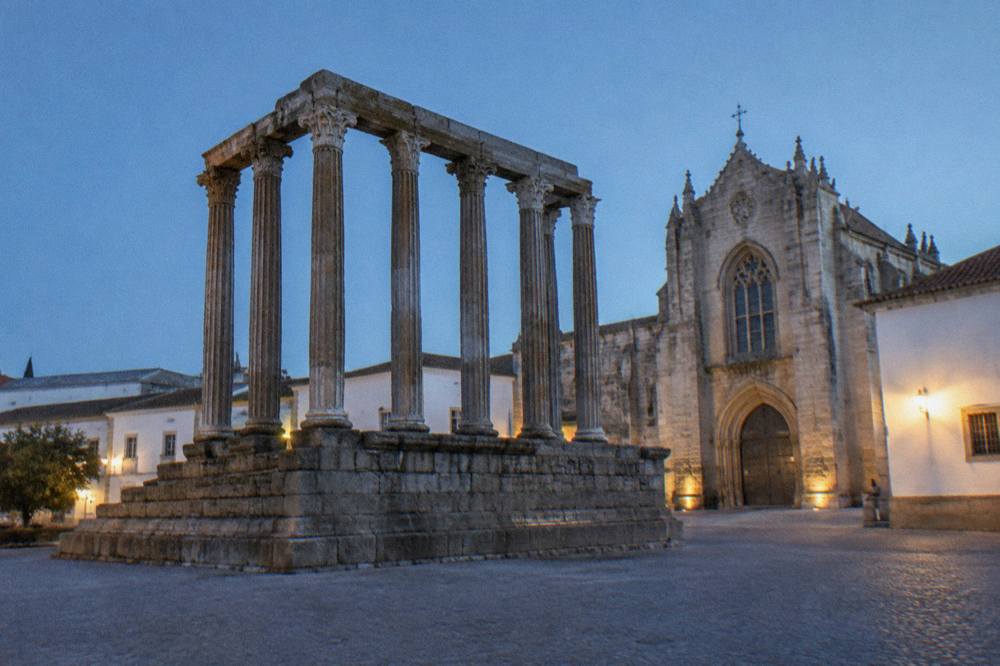
Inside Évora's walls the essentials are the Templo Romano, the 25 x 15 m Roman temple the municipal page says was probably dedicated to the imperial cult rather than to Diana, the Sé de Évora with its roof-terrace view at 5.00 EUR, the Capela dos Ossos at 7.00 EUR, the Praça do Giraldo, and the Água de Prata aqueduct marching out of the city, all of them walkable in a day that needs no car at all.
The Templo Romano is the city's signature silhouette, and its real story is better than the guidebook name. The municipal page records that the temple was probably dedicated to the imperial cult, that the Diana name only took hold in the 17th century, that its columns were later enclosed in a butcher's shop, and that its walls were freed in 1870. It is an open-air monument in a public square: no ticket, no queue, no hours to check, just granite columns that have stood since the city was Roman Ebora.
The Sé, the Capela dos Ossos and the Museu de Évora, with their verified prices and hours in the table above, are the paid core, and the skip-line tour that bundles the university, the cathedral and the Bones Chapel with a wine tasting, from $91.39 per person and rated 5 from 48 reviews, is the efficient way to take all three in one guided sweep.
Beyond the walls, the aqueduct is the walk most visitors miss. The Água de Prata carried water into Renaissance Évora, and houses were built into and under its arches as the city grew around them, so following it out of the centre is a walk through living architecture. No hours or access details were verified for the aqueduct, so treat it as a free, self-guided wander rather than a scheduled sight.
For a deeper cut of the same city, the guides to the Chapel of Bones, the Évora cathedral and the Évora UNESCO historic centre each take one monument in full.
How Do The Alentejo Castles Compare With The Rest Of Portugal?
The Alentejo's castles compare with the rest of Portugal as the quiet alternative: where the centre and north hold the great royal palaces and the Algarve holds the tourist castles, the Alentejo holds dozens of small, intact walled towns and frontier fortresses with almost no crowds, and Évora, inscribed by UNESCO in 1986, is the cultural anchor that none of the castle villages can match.
The comparison is one of kind, not rank. Sintra has palaces; Óbidos has one beautiful walled village; the Algarve has coastal forts. The Alentejo's distinction is density and quiet: a chain of fortified places, each a short drive from the next, none of them famous enough to fill, and all of them set in a landscape that is itself the attraction, an ocean of cork oak, olive, wheat and vineyard. For the head-to-head on Évora versus the better-known day trips, see which is better, Sintra or Évora.
| Region | Castle Character | Crowd Level | Best Base |
|---|---|---|---|
| Alentejo, Évora base | Hill villages, frontier fortresses, marble towns | Low | Évora |
| Lisbon area and Sintra | Royal palaces, one walled town | Very high | Lisbon |
| Algarve | Coastal forts, cliff castles | High in summer | Faro or Lagos |
| Central Portugal | University city, old fortresses | Moderate | Coimbra |
One more reason the Alentejo's stock is rising: Évora and the Alentejo are European Capital of Culture in 2027, promoted by an executive board led by the municipality, and 2026 is already a preparation year built on the concept of "Vagar", a word that means, roughly, taking one's time. The full 2027 programme is not yet published. A castle region preparing a culture year is a region worth seeing before the itineraries write themselves.
Common Questions About Alentejo Castles And Villages
How many castles are there in the Alentejo?
No verified count of the Alentejo's castles exists on an official page, and this guide prints no invented figure. What is verifiable is the character of the region: a chain of fortified towns and villages, including Évora, Arraiolos, Évoramonte, Estremoz, Vila Viçosa, Elvas, Marvão, Monsaraz and Castelo de Vide, spread across the plain from the centre to the Spanish border.
Which Alentejo castle is closest to Évora?
Arraiolos, about 20 km from Évora, is the closest of the classic walled hill villages, with its round medieval keep and its carpet-making tradition. Évoramonte, in the direction of Estremoz, is another close option, and Évora's own city walls and gates are the closest fortification of all, walkable from any hotel in the centre.
Is Elvas worth visiting from Évora?
Yes, for anyone interested in military architecture. Elvas, about 80 km from Évora, is a full fortress city: walls, bastions, outlying forts and a long aqueduct, with a lived-in historic centre. It is a full-day destination rather than a quick stop, and it pairs naturally with Vila Viçosa or Estremoz on the same eastern loop.
Can you visit Marvão and Monsaraz on the same day?
It is possible but it is not the comfortable plan. Marvão lies about 120 km north-east of Évora and Monsaraz about 40-45 km south-east, in opposite directions, so combining them means a long day of driving between two places that each deserve slow time. Better to give Marvão a day with Castelo de Vide, and Monsaraz a day with the wine country around Reguengos de Monsaraz.
Do you need a car for the Alentejo castles?
For the castle villages, yes in practice: the towns are small, the distances between them are real, and no verified bus or train timetable connects them usefully for a day of hopping. The exception is Évora itself, which is walkable and also reachable by train from Lisbon, with six through Intercidades trains listed in CP's timetable valid since 6 September 2026. Guided tours from Évora also cover Monsaraz, the megaliths and the wine country without a car.
Are Alentejo castles free to enter?
The walled villages themselves, Arraiolos, Monsaraz, Marvão's streets, are public places with no entry fee, and Évora's Templo Romano stands free in an open square. Castle keeps and museums inside the towns may charge, and no verified price list exists for them in this guide, so check the municipal notice in each town. Inside Évora, the verified paid monuments are the Sé at 5.00 EUR, the Capela dos Ossos at 7.00 EUR and the Museu de Évora at 8 EUR.
The Alentejo's castles and villages are the region's quiet answer to Portugal's better-known sights, and Évora, walled, UNESCO-listed and central, is the base from which all of them unfold.