Which Month Is Best To Visit Alentejo?
The best month to visit Alentejo, judged from the IPMA 1991-2020 climate normals for the Évora station: month-by-month temperatures, rain days and heat, plus the festivals that shape the timing.
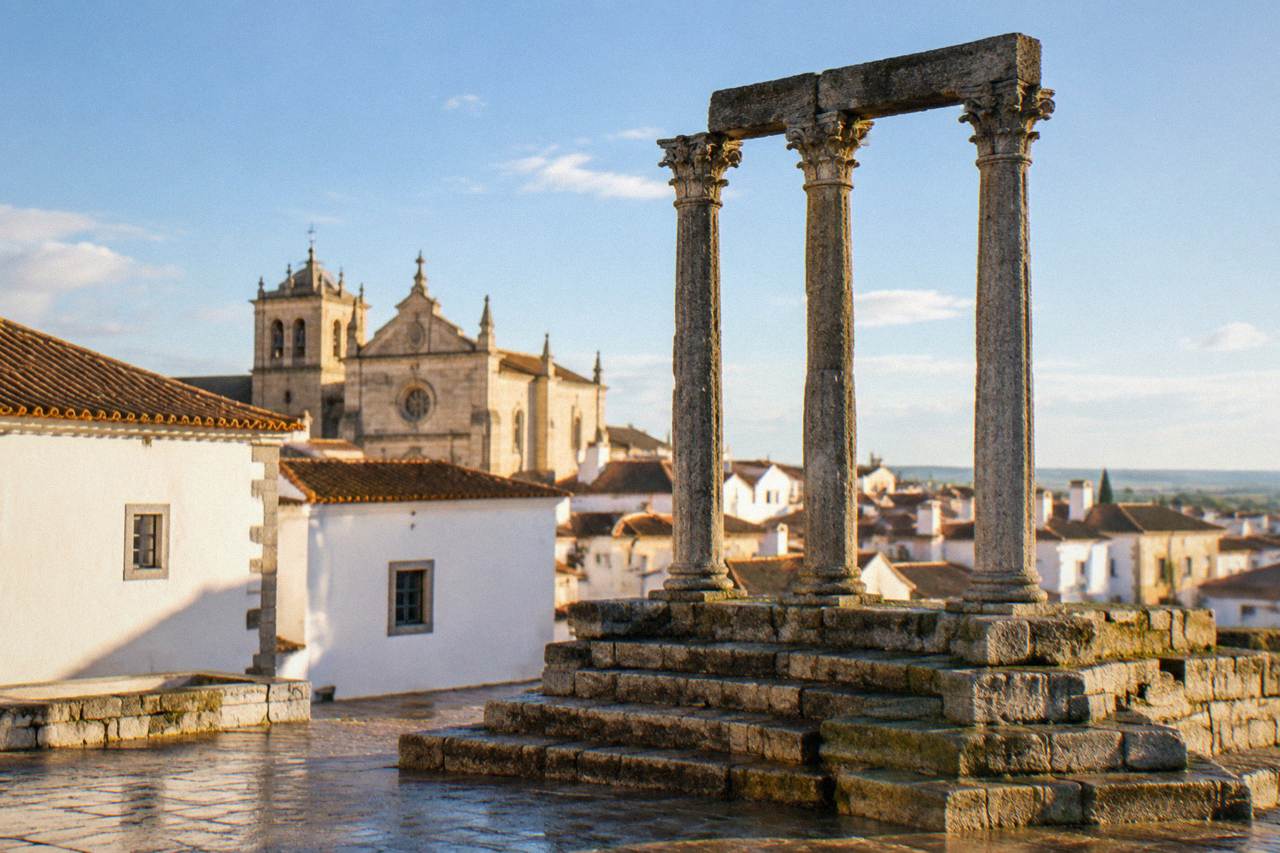
Alentejo is Portugal's great inland region of plains, cork oaks, marble towns and fortified hill villages, and its regional capital, Évora, sits at its geographic heart about 130 km from Lisbon. The question of which month to visit is really a question of heat and rain, because this is one of the hottest and driest corners of the country: the Atlantic is roughly 90 km away, and nothing about the climate is softened by a sea breeze. The answer below is built on the IPMA 1991-2020 climate normals for the Évora station (number 558, altitude 247.6 m), which give a full monthly picture of temperature, rain and extreme-heat days for the city at the centre of the region.
Which Month Is Best To Visit Alentejo?
May is the single best month to visit Alentejo, with late September a very close second. The IPMA 1991-2020 normals for the Évora station put May's average daytime high at 25.0 C against just 6.0 days of measurable rain in the whole month, and only 5.5 days reaching 30 C. September averages a 29.5 C high with 3.6 rain days, and by late September the 35 C days of August, 10.9 of them in an average year, have dropped to almost none.
The reasoning is simple. Alentejo's climate is defined by a long, hot, almost rainless summer and a mild, wetter winter, with two short shoulders between them. June is already hot: the normals give it a 30.2 C average high and 15.1 days at 30 C or more. July and August are hotter still, at 33.3 C and 33.5 C average highs, and the station's record maximum, 45.4 C, was set on 4 August 2018. May and September sit on either side of that furnace with most of the warmth and almost none of the risk.
Spring also carries the region at its greenest. After the winter rains, 68.6 mm in January and 86.0 mm in November on the 1991-2020 averages, the plains carry colour that has burned to gold by July. For readers weighing the region as a whole rather than the city alone, the question of is Alentejo worth visiting has a fuller answer elsewhere on this site, but the short version is that the region rewards slow travel, and slow travel is miserable at 35 C.
What The Évora Climate Normals Show Month By Month
The 1991-2020 normals for the Évora station show a year that averages 16.6 C overall, with mean highs running from 14.1 C in January to 33.5 C in August, total rainfall of 596.1 mm concentrated from October to March, and 31.9 days a year reaching 35 C or more. Rain days peak in November at 8.8, while July averages 0.6. The coldest reading on record is -4.2 C, set on 4 December 1998 and again on 23 January 2000.
Those are the official numbers, and they carry the whole argument of this page. The table below reproduces the monthly figures so the pattern is visible at a glance. Every figure is a 1991-2020 average for the Évora station, and none of it should be read as a forecast for any particular week.
| Month | Mean temp (C) | Mean max / min (C) | Rain (mm) | Rain days (1 mm+) | Days at 30 C+ | Days at 35 C+ |
|---|---|---|---|---|---|---|
| Jan | 9.3 | 14.1 / 4.5 | 68.6 | 8.6 | 0.0 | 0.0 |
| Feb | 10.3 | 15.7 / 5.0 | 52.3 | 7.0 | 0.0 | 0.0 |
| Mar | 12.7 | 18.7 / 6.9 | 60.8 | 7.5 | 0.0 | 0.0 |
| Apr | 14.6 | 20.7 / 8.5 | 62.1 | 8.0 | 0.3 | 0.0 |
| May | 18.0 | 25.0 / 10.9 | 46.6 | 6.0 | 5.5 | 0.7 |
| Jun | 22.0 | 30.2 / 13.8 | 10.6 | 1.7 | 15.1 | 5.6 |
| Jul | 24.5 | 33.3 / 15.6 | 2.7 | 0.6 | 23.7 | 11.5 |
| Aug | 24.7 | 33.5 / 16.0 | 6.0 | 0.7 | 25.0 | 10.9 |
| Sep | 22.1 | 29.5 / 14.6 | 33.9 | 3.6 | 13.9 | 3.1 |
| Oct | 18.2 | 24.1 / 12.3 | 81.5 | 7.7 | 2.9 | 0.1 |
| Nov | 12.8 | 17.6 / 7.9 | 86.0 | 8.8 | 0.0 | 0.0 |
| Dec | 10.0 | 14.6 / 5.3 | 85.1 | 8.7 | 0.0 | 0.0 |
Two things jump out. First, the rain is not evenly spread: the four months from June to September together contribute only a small fraction of the annual total, while October through December carries the great majority of it. Second, the heat is not a rumour: 86.5 days a year reach 30 C or more, and more than half of the 35 C days fall in July and August alone. A fuller breakdown of what these numbers mean for planning is in the Évora weather guide.
For visitors whose trip is anchored on the city itself, a private guided walk is the most heat-tolerant way to see it, because the pace and the shade stops can be arranged around the day. The private walking tour with cathedral and Chapel of Bones, from $111.42 per person and rated 5 from 106 reviews, covers the historic centre, the Sé and the Capela dos Ossos in about 2.5 hours, with monument tickets handled by the guide. Check availability
Spring In Alentejo: March To May
Spring runs from a 12.7 C March average to an 18.0 C May average on the 1991-2020 normals, with May's mean high at 25.0 C and only 6.0 rain days in the month. March and April are cooler and wetter, 7.5 and 8.0 rain days respectively, but the heat rows stay at or near zero until late May, when 5.5 days reach 30 C.
March is the month for readers who want the region green and quiet and do not mind a shower. The average high of 18.7 C is walking weather by any standard, and the megalithic sites around Évora, the Cromeleque dos Almendres chief among them, are best appreciated before the ground bakes. The Almendres Interpretation Centre in Guadalupe keeps summer hours of 10:00-18:00 from 1 May to 31 October and winter hours of 10:00-17:00 from 1 November to 30 April, so the shoulder months cost an hour of visiting time at most.
April splits the difference: a 20.7 C mean high, 62.1 mm of rain and essentially no 30 C days. It is also the month when the cork oaks are in active growth and the plains carry the year's best wildflower cover. May is the pick of the three, because the rain has fallen to 46.6 mm, the days stretch toward the summer solstice, and the 35 C days that define July, 11.5 in an average month, are still almost entirely absent.
Spring visitors should still book the indoor anchors with the calendar in mind. The Museu de Évora is closed Mondays, as well as 1 January, Easter Sunday, 1 May, 29 June and 25 December, so a May trip that lands on the first of the month loses the museum. The Sé de Évora keeps 9:00-17:00 hours and closes only on the afternoon of 24 December, 25 December and 1 January.
Summer In Alentejo: June To August
Summer is hot and dry: June averages a 30.2 C high with 10.6 mm of rain, July 33.3 C with 2.7 mm, and August 33.5 C with 6.0 mm, on the 1991-2020 normals. The heat rows are the real story, with 23.7 days at 30 C or more in July, 25.0 in August, and 11.5 and 10.9 days respectively at 35 C or more. The all-time station record, 45.4 C, was set on 4 August 2018.
None of that makes summer impossible, but it makes summer a scheduling exercise. The monuments help: the Capela dos Ossos and the Igreja de São Francisco keep summer hours of 9:00-18:30, open every day except 1 January, Easter Sunday, the afternoon of 24 December and 25 December, so a 9:00 start gives a full morning before the worst of the afternoon. The Sé opens at 9:00 year-round. The strategy is to walk early, eat late, and treat the afternoon as museum, cloister or nap territory. Everything else covered here is indexed on Évora Travel Guide.
The one thing summer is not is crowded in the coastal-resort sense. Évora is a city of about 53,000 people in a municipality that had 53,577 residents at the 2021 census, and the Alentejo's tourist pressure is nothing like Lisbon's or the Algarve's. What summer visitors trade away is comfort: a 35 C afternoon on an unshaded praça is a different activity from the same praça at 25 C.
June carries the Feira de São João, which ran from 23 June to 5 July 2026 on the Rossio de São Brás under the theme "Évora: Capital Europeia ao Sul". The 2027 dates had not been published when this page was written, so check the Câmara Municipal's notice before planning around it. A June visit built around the fair gets the festival and the 30 C afternoons together.
The same logic applies to the small-group options: the skip-line monuments tour with wine tasting and the tales-and-legends walk both run about three hours, which slots neatly into a 9:00 start and an indoor afternoon.
Autumn In Alentejo: September To November
Autumn opens with September, whose 29.5 C mean high and 3.6 rain days make late September a near match for May, and closes with a November that averages 12.8 C and 86.0 mm of rain, the wettest month of the year on the 1991-2020 normals. October is the pivot: an 18.2 C mean, 81.5 mm of rain and 7.7 rain days, with the 30 C days down to 2.9.
September is the month for readers who want the harvest. The grape and cork seasons are at their tail end, the plains still hold summer's gold, and the heat has retreated without the rains having properly arrived. The first three days of the month still average 3.1 days at 35 C, so early September is closer to August than to October, but the second half of the month belongs to spring's rival.
October brings the first literary event of the Évora 2027 programme: the GUADIANA Festival of Afro-Ibero-American Literatures, whose first edition ran 9 to 11 October 2026 with 28 authors from nine countries. The city is a European Capital of Culture in 2027, with 2026 running as a preparation year built on the concept of "Vagar", so autumn visitors in the run-up are seeing a city visibly rehearsing something.
November is the region at its quietest and wettest. The 8.8 rain days are the year's maximum, and the 17.6 C mean high is still perfectly walkable, but this is a month for indoor anchors, long lunches and the Museu de Évora, which is free to residents of Portugal on Sundays and holidays and free to everyone up to age 12. The wine angle is covered in the Alentejo wine guide, and the food that goes with it in the Alentejo food guide.
Winter In Alentejo: December To February
Winter is mild by northern European standards and wet by Alentejo ones: December averages 10.0 C with 85.1 mm of rain and 8.7 rain days, January 9.3 C with 68.6 mm, and February 10.3 C with 52.3 mm, on the 1991-2020 normals. The mean highs stay between 14.1 C and 15.7 C, no month records a single 30 C day, and the record low is -4.2 C, set on 4 December 1998 and 23 January 2000.
The pitch for winter is honest: it is the cheapest and emptiest season, and the mean highs are higher than a bad English June. The catch is the rain and the short days, which compress sightseeing into a window that closes by late afternoon. The sun hours are not in the climate-normal source, so no figure is given here, but the rain-day rows say enough: roughly nine days a month with measurable rain from November through January.
Winter visitors should also know that the Capela dos Ossos switches to winter hours, 9:00-17:00, and that the tourist office on Praça do Giraldo 73 keeps winter hours of 9:00-18:00 on weekdays and 10:00-14:00 and 15:00-18:00 at weekends from 1 November to 31 March, though that page dates from 2023 and should be treated as indicative. The Évora Ticket, the multi-site pass for the Cidade-Museu network, costs 8 EUR for one day, 10 EUR for two and 12 EUR for three, and is free to age 12, though it does not include the Sé, the Capela dos Ossos or the Museu de Évora.
Festivals And Events That Shape The Timing
The fixed points that matter are the Feira de São João, which ran 23 June to 5 July 2026 at the Rossio de São Brás, the GUADIANA literature festival of 9 to 11 October 2026, and the Évora 2027 European Capital of Culture year itself, whose full programme had not been published when this page was written. The 2026 calendar is a preparation year built on the concept of "Vagar".
The fair and the festival bracket the two best visiting windows. A late-June trip catches the Feira de São João, the annual Feira de São João, at the cost of peak-adjacent heat: the normals give June 15.1 days at 30 C or more. An early-October trip catches GUADIANA and the first of the autumn cool. Both dates come from the official pages, and the 2027 editions had not been announced, so check the Câmara Municipal and Évora 2027 notices before booking around either.
| Event | When | Where |
|---|---|---|
| Feira de São João 2026 | 23 June to 5 July 2026 | Rossio de São Brás, Évora |
| GUADIANA literature festival, first edition | 9 to 11 October 2026 | Évora, part of the Évora 2027 programme |
| Évora 2027, European Capital of Culture | 2027, full programme not yet published | Évora and the Alentejo |
| Feira de São João 2027 | Late June into early July, if the 2026 pattern holds | Rossio de São Brás, Évora |
The 2027 Capital of Culture year is the wildcard in every timing question. A city of about 53,000 people hosting a European Capital of Culture will draw visitors it does not normally see, and the open calls and community projects already listed on the official programme page suggest a calendar that fills through the year. Readers planning around 2027 should watch the official programme rather than assume, and anyone weighing the region more broadly can start with the Alentejo travel guide.
Common Questions About Visiting Alentejo
Which month is best to visit Alentejo?
May, with late September a close second. The IPMA 1991-2020 normals for the Évora station give May a 25.0 C average high, 6.0 rain days and only 5.5 days at 30 C, while late September drops the August heat without yet reaching October's 7.7 rain days.
Is Alentejo too hot in summer?
July and August average highs of 33.3 C and 33.5 C, with 11.5 and 10.9 days respectively at 35 C or more, and the station record is 45.4 C set on 4 August 2018. It is manageable with early starts, since the Capela dos Ossos keeps 9:00-18:30 summer hours and the Sé opens at 9:00, but it is genuinely hot.
Does it rain a lot in Alentejo?
The Évora station averages 596.1 mm a year on the 1991-2020 normals, concentrated from October to March. November is the wettest month at 86.0 mm over 8.8 rain days, while July averages just 2.7 mm.
Is Alentejo good in winter?
Mean highs run from 14.1 C in January to 15.7 C in February, which is mild, but the months average 8.6 and 7.0 rain days respectively, and the record low is -4.2 C. It is the quietest season, best for museums, long lunches and the indoor anchors.
When is the Feira de São João in Évora?
The 2026 edition ran 23 June to 5 July at the Rossio de São Brás, under the theme "Évora: Capital Europeia ao Sul". The 2027 dates had not been published when this page was written, so check the Câmara Municipal's notice before planning around the fair.
Does the Évora 2027 Capital of Culture change the timing?
Évora and the Alentejo are European Capital of Culture in 2027, with 2026 running as a preparation year on the concept of "Vagar". The full 2027 programme had not been published when this page was written, so anyone planning around specific events should follow the official programme page.