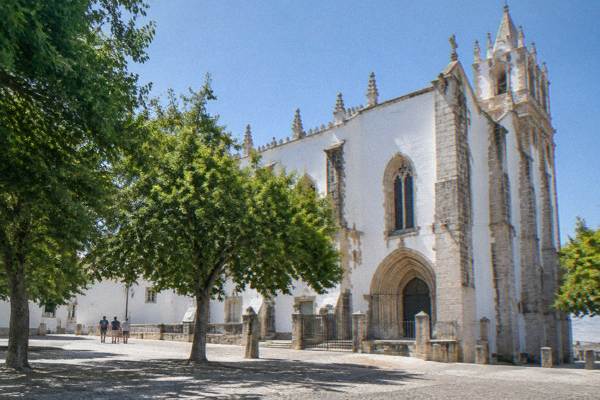
Évora City Walls: Walking The Roman And Medieval Fortifications
Évora, the capital of the Alentejo, keeps the outline of two defensive systems: a Roman wall absorbed into later buildings, and a medieval circuit that still frames the UNESCO-listed historic centre. This guide covers what survives, what is verified, and how to walk it.
Short answer
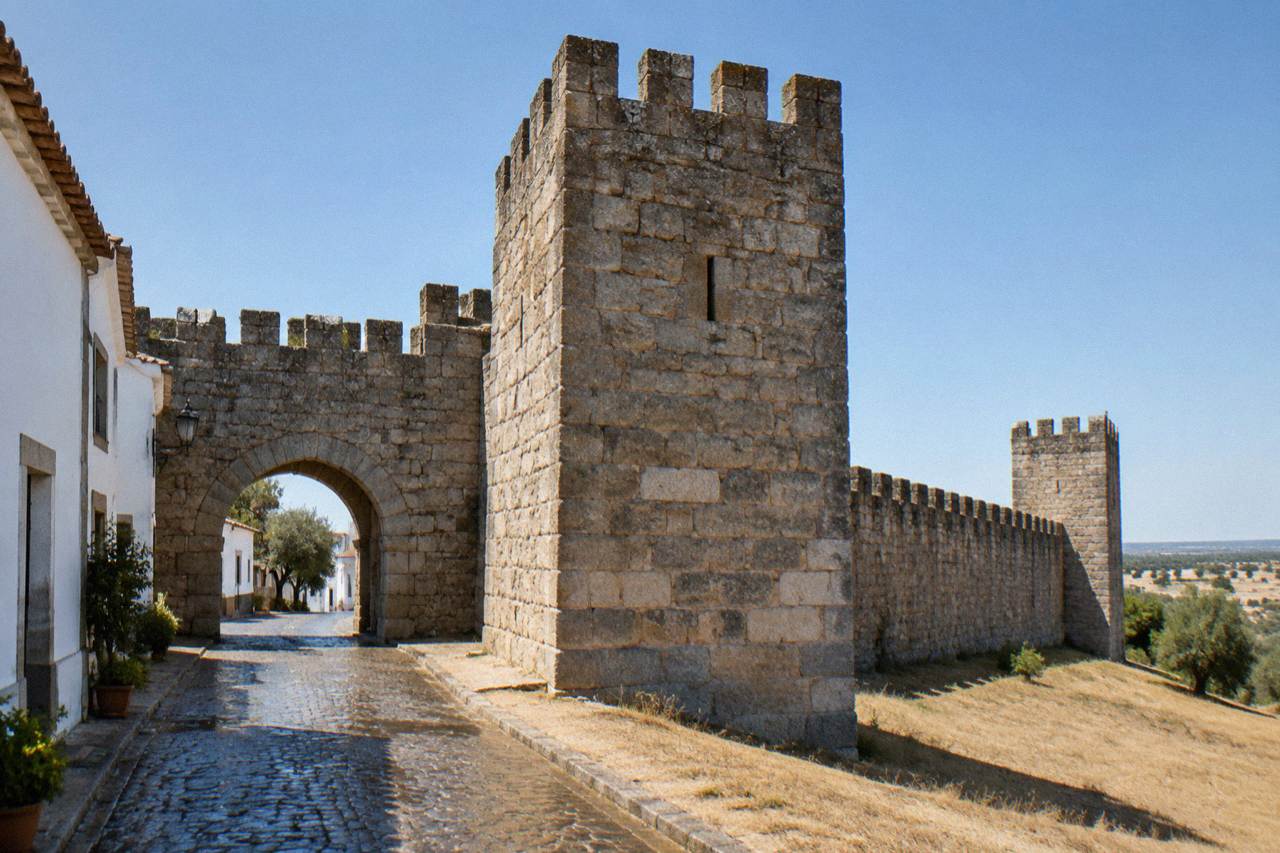
The Évora walls are two fortifications in one city: a Roman circuit whose stones were reused in later buildings, and a medieval wall that still encloses the historic centre inscribed by UNESCO in 1986. No length, height or construction date for either wall is verified on an official page, so this guide sticks to what the municipal and UNESCO records do confirm.
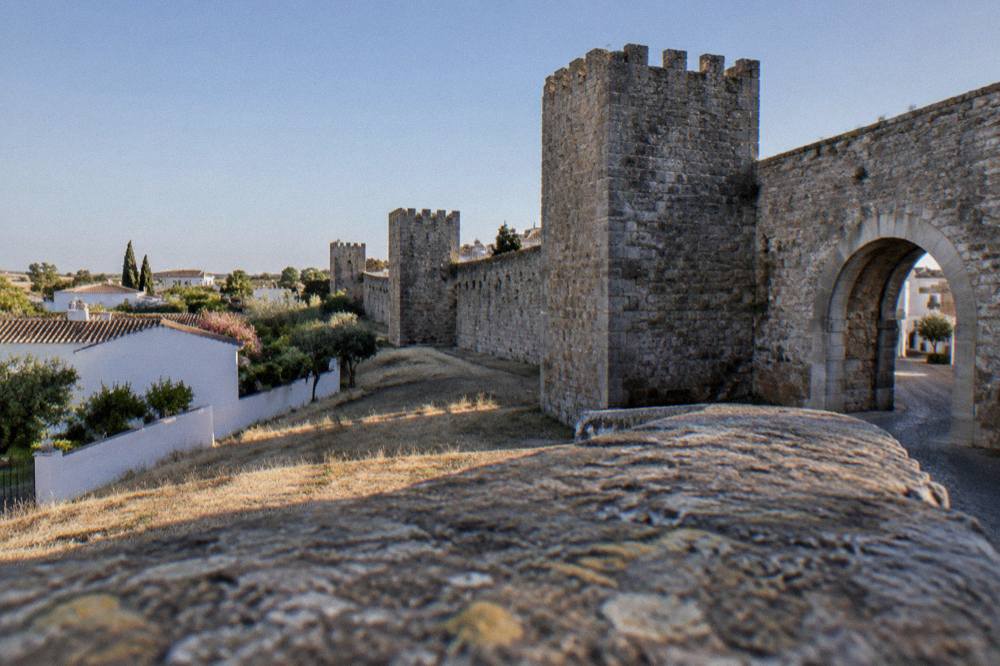
Évora, the capital of the Alentejo region of Portugal, is a city whose shape was decided by its walls. Two defensive systems lie layered inside it: a Roman circuit that once enclosed the city of Ebora, and a medieval wall that still rings the historic centre UNESCO inscribed on the World Heritage List in 1986. The Roman stones did not vanish when the empire did. They were quarried, reused and built into the houses, towers and gateways that followed, which is why a walk through Évora keeps producing fragments of ancient masonry in the least expected places, a rounded block in a kitchen wall, a straight seam of ashlar under a balcony.
The municipal record is careful about what it claims, and this guide follows that example. No length, height or construction date for either the Roman wall or the medieval wall of Évora is verified on an official page, so none appears here. What the sources do confirm is rich enough: the UNESCO inscription, the fate of the Templo Romano, the closing days and ticket prices of the monuments inside the circuit, and the climate data that decides when a wall walk is pleasant. For the full picture of the city inside the stones, start with things to do in Évora and work inward.
What Are The Évora Walls?
The Évora walls are two fortifications layered on one another: a Roman circuit around the ancient city of Ebora, largely dismantled and reused in later buildings, and a medieval wall that still encloses the historic centre. UNESCO inscribed the Historic Centre of Évora in 1986 under criteria (ii) and (iv), and its criterion (iv) text calls Évora the finest example of a city of the golden age of Portugal after the 1755 Lisbon earthquake, a quake Évora was largely spared.
That last point matters more than it first appears. The 1755 earthquake destroyed so much of Lisbon and other Portuguese cities that intact golden-age urban fabric became rare. Évora kept its, inside its walls, which is the core reason the World Heritage listing exists. The UNESCO record adds two dated facts about the city's layered past: Moorish rule ended in 1165, and the Jesuit University of the Holy Spirit dates from 1553, with the Jesuits expelled in 1759. Between those dates sits the whole story of the medieval wall: a frontier town, reconquered and walled and towered, then a royal seat wealthy enough to fill the enclosure with convents, palaces and the Jesuit university.
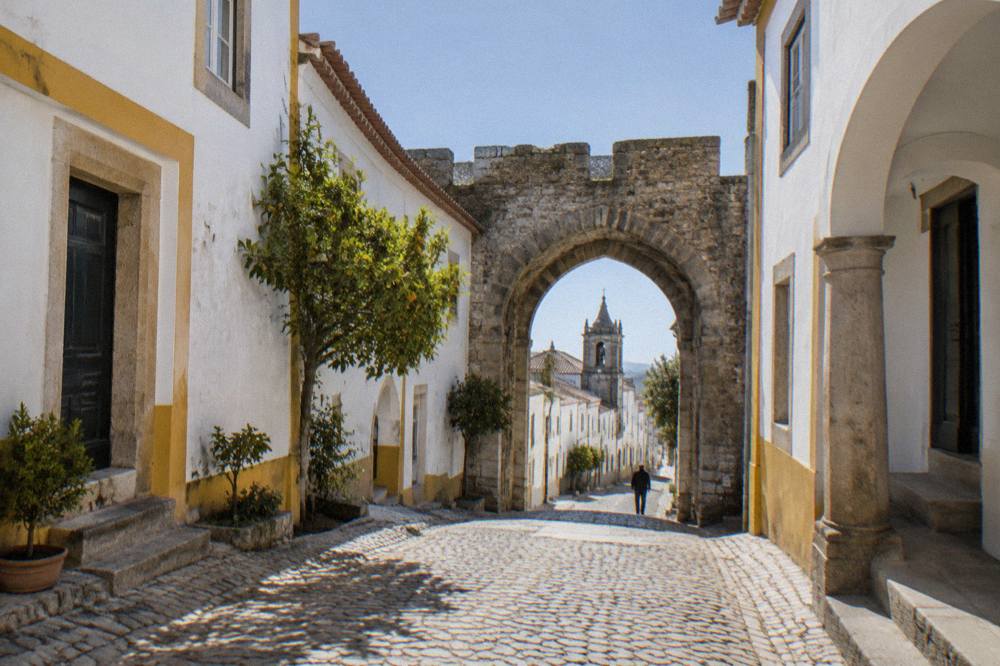
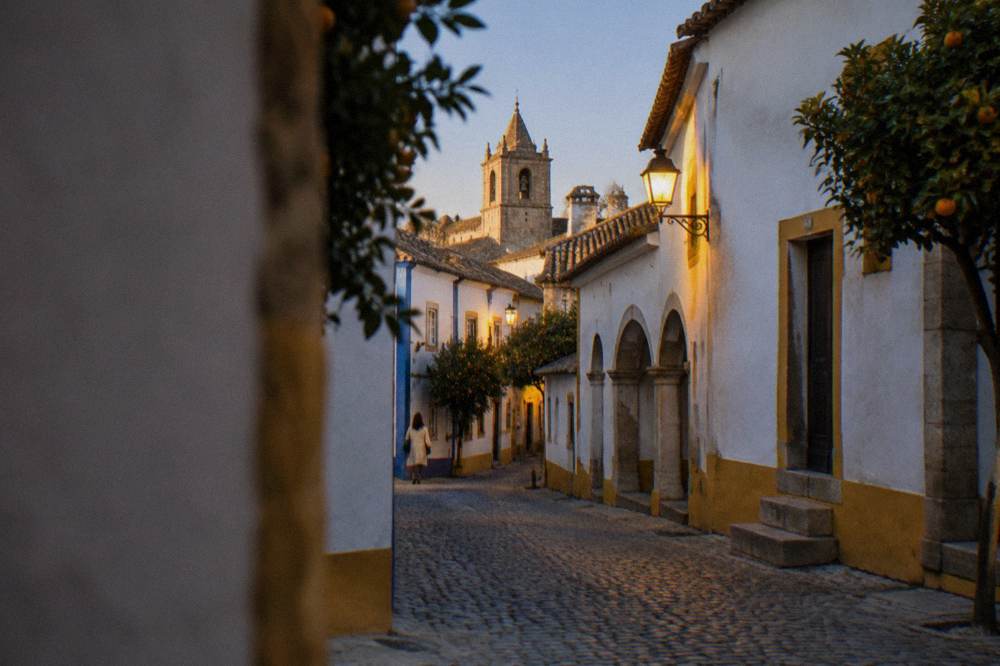
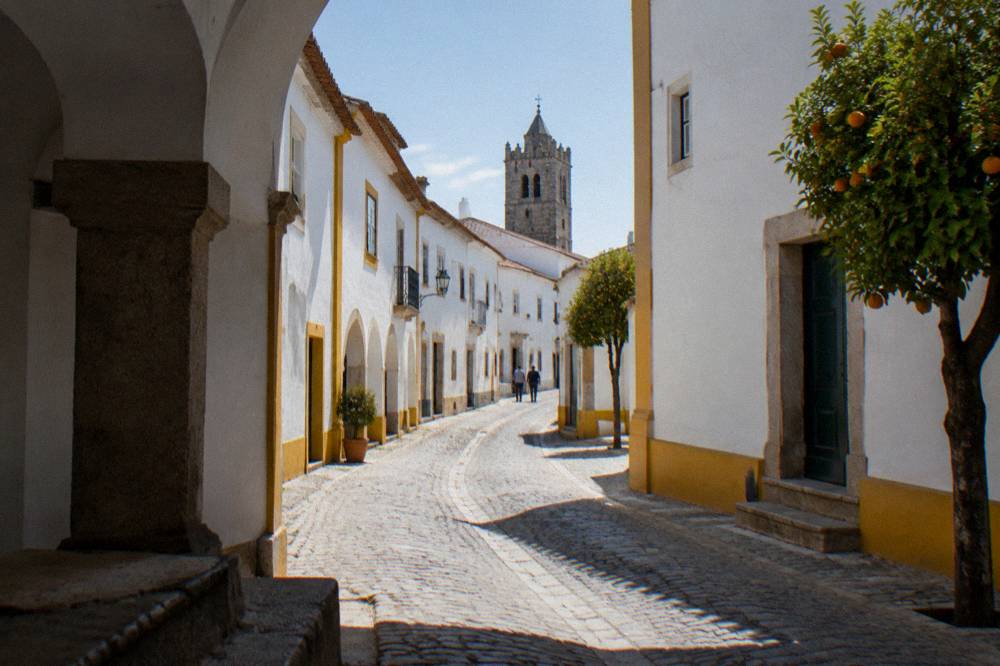
A visitor does not need to know which stone is Roman and which is medieval to enjoy the circuit. The walls work on the visitor as a whole: streets that bend because they once followed a rampart, sudden openings where a gate stood, houses that lean on medieval masonry because it was cheaper than building fresh. The Évora UNESCO historic centre is the wider story; this page stays with the stones themselves.
Where Can You Still See Roman Évora Today?
The clearest Roman survivor inside the walls is the Templo Romano, popularly the Temple of Diana, which the municipal page says was probably dedicated to the imperial cult, not to the goddess Diana, a name only in use since the 17th century. It measures 25 x 15 m, was later reused as a municipal butcher's, and had its walls freed in 1870 under Cinatti. It is an open-air monument with no ticket and no listed hours.
The temple is the headline, but the Roman wall is the quieter presence. Because no official page verifies a length, a height or a construction date for the Roman wall of Évora, this guide states none. What can be said is what any walker notices: the reuse. Roman Évora was a walled city, and cities like it were, for a thousand years afterwards, the nearest quarry. The medieval builders took what was level and squared; householders took what was left. The Água de Prata aqueduct is the other great structure of the period visible today, and the Roman baths of Évora and the wider set of Roman and ancient sites complete the picture of a city that was important long before it was Portuguese.
The municipal Museu de Évora, founded officially in 1915 and housed in the former Archbishop's Palace, is where the material record of Roman Évora is kept and displayed. The museum page gives the hours and prices that a wall walker needs before planning an indoor stretch of the day.
How Do The Medieval Walls Shape Évora Now?
The medieval wall still defines the historic centre: it sets the boundary of the UNESCO inscribed area, funnels traffic through the old gateways, and separates the dense walled town from the greener spaces beyond the circuit. The area outside the walls, including the Jardim Público and the Rossio de São Brás, where the Feira de São João ran from 23 June to 5 July in 2026, is a distinct zone with its own character and sights.
The site's guide to outside the walls covers that zone in full, from the public garden to the fairground spaces and the streets that grew up once the enclosure stopped being a military necessity.
Inside the circuit, the wall's influence is felt rather than seen. Streets run crooked because ramparts and ditches once dictated their line. Squares open where gate complexes were demolished or simplified. The Praça do Giraldo, a public square with no hours and no price, sits on the main axis that medieval traffic used, and the Porta de Moura square keeps the name of a gate in its title. When a place name in Évora contains "porta", a gate stood there.
The wall also decides the rhythm of a visit. The enclosed centre is compact, which is why so many monuments sit within a short stroll of one another: the Sé de Évora, the Capela dos Ossos, the Igreja de São Francisco, the Convento dos Lóios and the University of Évora all sit inside or hard against the line. A guided walk makes sense of that density quickly; the small-group cultural walking tour that includes the Chapel of Bones is a strong fit for the walls-and-monuments theme, and its own listing carries the current price and availability.
Which Monuments Inside The Walls Need A Ticket?
Three monument tickets are verified on official pages: the Sé de Évora complete visit at 5.00 EUR covering cathedral, cloister, roof terrace and museum, with children up to 12 free; the Capela dos Ossos museum ticket at 7.00 EUR adult, 5.00 EUR for youth up to 25 and seniors over 65, and 15.00 EUR for a family; and the Museu de Évora at 8 EUR adult, with 50% off for youth 13-24, seniors and the family ticket, and free entry to age 12.
The Évora Ticket, a multi-site pass for the Cidade-Museu network, costs 8 EUR for one day, 10 EUR for two days and 12 EUR for three days, and is free to age 12. One caution from the official pages: the pass does not include the Sé, the Capela dos Ossos or the Museu de Évora, so it complements rather than replaces the three tickets above. The Convento dos Lóios shows its price as temporarily unavailable on the official page, so no figure is stated here.
| Monument | Adult ticket | Concessions and notes |
|---|---|---|
| Sé de Évora, complete visit | 5.00 EUR | Children up to 12 free with a parent or guardian |
| Capela dos Ossos, museum ticket | 7.00 EUR | Youth to 25 and seniors over 65 5.00 EUR; family 15.00 EUR |
| Museu de Évora | 8 EUR | 50% off for youth 13-24, seniors over 65 and family; free to age 12 |
| Évora Ticket, 1 day | 8 EUR | Free to age 12; does not include the Sé, Capela dos Ossos or Museu de Évora |
| Évora Ticket, 2 days | 10 EUR | Same conditions |
| Évora Ticket, 3 days | 12 EUR | Same conditions |
| Convento dos Lóios | No verified price | Official page lists the price as temporarily unavailable |
| Templo Romano | None listed | Open-air monument, no ticket or hours listed |
The church of the Capela dos Ossos notes on its own page that it is a private religious entity and does not apply State Museum discounts, which is worth knowing if a visitor holds a Portuguese museum pass. The church is open daily except 1 January, Easter Sunday, the afternoon of 24 December and 25 December.
What Are The Opening Hours Inside The Circuit?
The Sé de Évora is open 9:00-17:00, with the museum's last admission 30 minutes before closing; the Capela dos Ossos keeps summer hours of 9:00-18:30 and winter hours of 9:00-17:00; and the Museu de Évora runs Tuesday to Sunday, 9:30-13:00 and 14:00-17:30, closed on Mondays. The walls themselves, as public streets and open spaces, keep no hours at all.
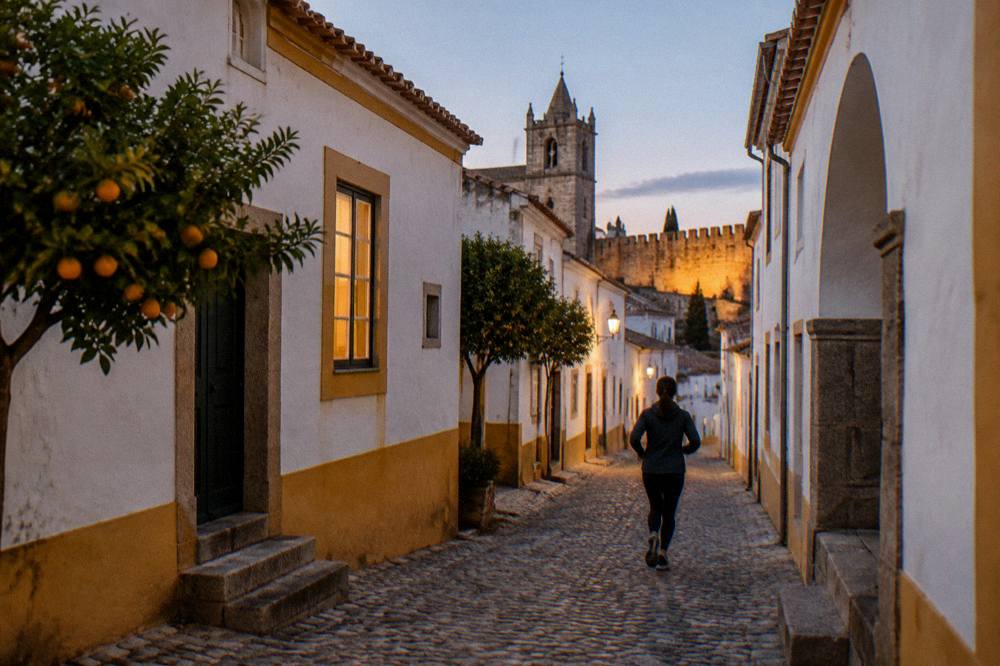
That last line is the quiet advantage of a wall walk. The monuments inside the circuit have timetables; the circuit does not. An early evening loop of the rampart line, when the light goes low and gold across the Alentejo plain, costs nothing and closes never.
| Monument | Hours | Closed |
|---|---|---|
| Sé de Évora | 9:00-17:00 | 24 Dec afternoon, 25 Dec, 1 Jan |
| Capela dos Ossos | Summer 9:00-18:30, winter 9:00-17:00 | 1 Jan, Easter Sunday, 24 Dec afternoon, 25 Dec |
| Museu de Évora | Tue-Sun 9:30-13:00, 14:00-17:30 | Mondays, 1 Jan, Easter Sunday, 1 May, 29 Jun, 25 Dec |
| Tourist office, Praça do Giraldo 73 | Winter weekdays 9:00-18:00, Sat-Sun 10:00-14:00 and 15:00-18:00 | Hours listed as indicative on the municipal page |
The tourist office sits on the main square inside the walls, at Praça do Giraldo 73, and its winter hours are as above; the municipal page carries summer hours too but flags its own listing as indicative, so treat the posted times as the authority on the day.
Which Sights Cluster Along The Wall Line?
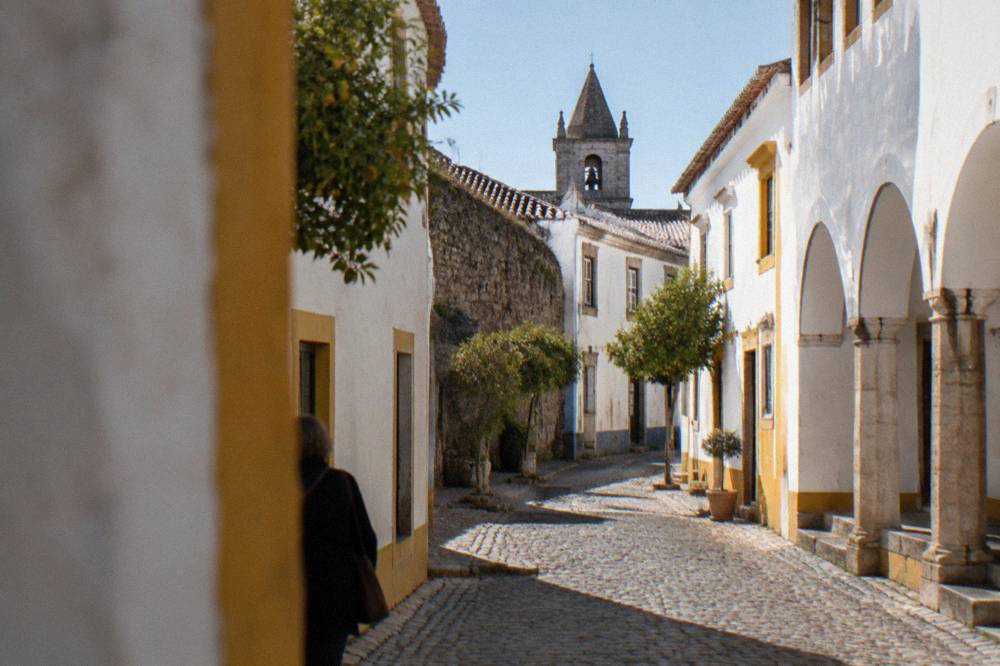
The wall line links nearly every major monument in Évora: the Templo Romano beside the Sé, the Igreja de São Francisco holding the Capela dos Ossos, the Convento dos Lóios, the University of Évora, the Museu de Évora in the former Archbishop's Palace, and the Cartuxa monastery beyond the centre, all sit inside or close to the circuit. Each has a page on this site with its own verified detail.
The table below gathers what is verified for the wall-adjacent sights. Where a cell says no verified hours or price, that is the finding, not an omission: the official pages for the aqueduct, the university, the Palácio de Dom Manuel, the Jardim Público and the Igreja de São Brás list none.
| Sight | Position relative to the walls | Verified detail |
|---|---|---|
| Templo Romano | Inside, on the high ground | Probably dedicated to the imperial cult; 25 x 15 m; walls freed in 1870 |
| Sé de Évora | Inside, at the highest point | Complete-visit ticket 5.00 EUR; closed 24 Dec afternoon, 25 Dec, 1 Jan |
| Igreja de São Francisco and Capela dos Ossos | Inside, near the centre | Museum ticket 7.00 EUR adult; open daily except four listed days |
| Convento dos Lóios | Inside, beside the temple | Price temporarily unavailable on the official page |
| University of Évora | Inside the circuit | Jesuit University of the Holy Spirit dates from 1553; Jesuits expelled 1759 |
| Museu de Évora | Inside, near the Sé | Founded 1915; adult 8 EUR; closed Mondays |
| Água de Prata aqueduct | Runs toward the walls | No verified hours or price |
| Jardim Público | Outside the walls | No verified hours or price |
The Cartuxa monastery and winery sit beyond the tight medieval core, and the Cartuxa monastery page covers them in detail. For the roof-level view of how the walls enclose the town, the rooftop views of Évora page names the terraces that look down over the circuit, including the Sé's own roof terrace, which is included in the 5.00 EUR complete-visit ticket.
A general walking tour is one way to cover the line; a themed one is another. The medieval sidecar tour, which runs three hours and includes a wine tasting, takes the walls as its backdrop from an unusual seat, and its listing carries the current price. For a self-guided day, the one day in Évora itinerary sequences the wall-adjacent monuments in a workable order.
When Is The Best Time To Walk The Évora Walls?
The best months for walking the Évora walls are April, May, September and October, according to IPMA's 1991-2020 climate normals for the Évora station: those months combine mean maxima of 20.7 C, 25.0 C, 29.5 C and 24.1 C with far fewer hot days than midsummer, while July and August average 33.3 C and 33.5 C mean maximum and together account for most of the year's 31.9 days at 35 C or more.
The same normals put the record maximum at 45.4 C, set on 4 August 2018, which is why the summer advice on this site is consistent: walk the circuit early, spend the midday indoors at the Museu de Évora or the Sé, and come out again in the evening. Rain is the winter variable. The normals count 68.9 days a year with 1 mm of rain or more, and 8.8 of them fall in November and 8.7 in December, against 0.6 in July.
| Month | Mean maximum (C), 1991-2020 | Days with 1 mm+ rain | Days at 35 C or more |
|---|---|---|---|
| April | 20.7 | 8.0 | 0.0 |
| May | 25.0 | 6.0 | 0.7 |
| June | 30.2 | 1.7 | 5.6 |
| July | 33.3 | 0.6 | 11.5 |
| August | 33.5 | 0.7 | 10.9 |
| September | 29.5 | 3.6 | 3.1 |
| October | 24.1 | 7.7 | 0.1 |
Every figure above is a 1991-2020 average from the IPMA normals for the Évora station, and it should be labelled that way in any conversation about Évora weather. The Évora weather page carries the full monthly table, and the seasonal guides cover summer, winter, spring and autumn in depth.
How Does A Wall Walk Fit Into A Day Trip From Lisbon?
Six through Intercidades trains link Lisboa Oriente and Évora on the timetable valid since 6 September 2026, departing at 07:02, 09:02, 09:58, 13:35, 17:02 and 19:02 and arriving about 1 hour 40 to 1 hour 45 later, at a fare of 13.90 EUR second class or 18.50 EUR first class. That makes a wall walk with two or three monuments inside the circuit entirely workable in a single day.
The morning arrivals land at 08:47, 10:45 and 11:40, which gives a day visitor the full afternoon inside the walls and an evening train home at 17:02 or 19:02. The CP timetable PDF carries weekday remarks on individual services, so check the current PDF before locking a plan rather than assuming every train runs every day.
| Lisboa Oriente departure | Évora arrival | Notes |
|---|---|---|
| 07:02 | 08:47 | Full day inside the walls |
| 09:02 | 10:45 | Late-morning start |
| 09:58 | 11:40 | Late-morning start |
| 13:35 | 15:13 | Afternoon arrival |
| 17:02 | 18:41 | Evening arrival |
| 19:02 | 20:46 | Evening arrival |
The Lisbon to Évora by train page covers the rail options in full, and the Évora day trip from Lisbon itinerary builds a wall-centred day around the same trains. For visitors who prefer a guided transfer of the whole experience, several tours that start in Lisbon and visit Évora are described on the Alentejo tour from Lisbon page, and they should be understood as Lisbon-start products rather than Évora walks.
What Lies Beyond The Walls?
The most rewarding destinations beyond the Évora walls are the Alentejo towns and landscapes that circle the city: Arraiolos at about 20 km, Monsaraz at about 40-45 km, Estremoz at about 45 km, Vila Viçosa at about 60 km, Elvas at about 80 km and Marvão at about 120 km, all reachable as day trips, with the megalithic sites of the Almendres area reached by taking the national road toward Lisbon and following the signposted turn-off after about 8 km.
The Almendres Interpretation Centre in the village of Guadalupe keeps summer hours of 10:00-18:00 from 1 May to 31 October and winter hours of 10:00-17:00 from 1 November to 30 April, and its page gives GPS coordinates for the site. The Almendres cromlech page carries the detail, and the megalithic sites near Évora guide widens the set. The cromlech stones themselves stand in the open, and the best day trips from Évora page sequences the towns by theme.
Back inside the walls, the Jewish quarter of Évora preserves a different layer of the walled town's history, and the Évora Museum holds the material record of every layer, Roman through golden age.
What Should A Wall Walker Know Before Going?
A wall walker in Évora needs three practical facts: the monuments inside the circuit close on specific listed days, above all the Museu de Évora on Mondays and the Sé and Capela dos Ossos on 25 December and 1 January; a municipal tourist tax applies to stays, so check the hotel; and Évora is an inland city on the Alentejo plain, roughly 90 km from the Atlantic, so no sea breeze will rescue a hot afternoon walk. Plan water and shade accordingly.
The 2027 European Capital of Culture year is the forward-looking reason to visit sooner rather than later. Évora and the Alentejo hold the title in 2027, promoted by an executive board led by the Municipality of Évora, with 2026 running as a preparation programme built on the concept of "Vagar". The GUADIANA festival of Afro-Ibero-American literatures, a first edition with 28 authors from nine countries, runs 9 to 11 October 2026 as part of that programme, and the Feira de São João filled the Rossio de São Brás outside the walls from 23 June to 5 July 2026 under the theme "Évora: Capital Europeia ao Sul". The full 2027 programme is not yet published.
For readers who want the whole story of the city rather than its stones alone, the Évora history page carries the timeline from Roman Ebora onward, and what Évora is known for answers the broader question. The Évora Travel Guide homepage collects the practical pages: transport, hotels, budgets and the full set of monument guides.
The small-group cultural walking tour that includes the Chapel of Bones is the natural companion to a wall walk: it covers the walled centre's monuments in two hours with a guide who explains which layer is which, and the operator's live listing carries the current price and availability. Booking a walk for the first morning and spending the afternoon on the circuit alone is a pattern that works well.
Common Questions About The Évora Walls
Can you walk around the Évora walls?
Yes, the line of the old fortifications can be followed on public streets inside and outside the medieval circuit, and it costs nothing. No official page verifies a length or a circuit time for the walls, so no figure is given here. The walk links most of the major monuments, including the Sé, the Templo Romano and the Igreja de São Francisco.
How old are the Évora walls?
Two systems are involved: a Roman wall around the ancient city of Ebora and a medieval wall around the historic centre. No construction date for either wall is verified on an official page, so none is stated. The wider record is firm: Moorish rule in Évora ended in 1165, and UNESCO inscribed the Historic Centre of Évora in 1986 under criteria (ii) and (iv).
Is the Templo Romano part of the walls?
No, the Templo Romano is a temple, not a wall, but it is the clearest Roman structure inside the circuit. The municipal page says it was probably dedicated to the imperial cult rather than to Diana, a name in use only since the 17th century, that it measures 25 x 15 m, was reused as a municipal butcher's, and had its walls freed in 1870. It is an open-air monument with no ticket.
Do you need a ticket for the Évora walls?
No. The walls are public streets and spaces with no ticket and no hours. The monuments inside the circuit do need tickets: the Sé complete visit at 5.00 EUR, the Capela dos Ossos museum ticket at 7.00 EUR adult, and the Museu de Évora at 8 EUR adult, all verified on official pages.
What is outside the Évora walls?
The Jardim Público, the Rossio de São Brás and the wider modern city lie outside the medieval circuit, and the Alentejo towns beyond: Arraiolos at about 20 km, Monsaraz at about 40-45 km, Estremoz at about 45 km and Vila Viçosa at about 60 km. The Feira de São João filled the Rossio de São Brás from 23 June to 5 July in 2026.
When is the best time of day to walk the walls?
Early morning or evening. IPMA's 1991-2020 normals for the Évora station put the July mean maximum at 33.3 C and the August mean maximum at 33.5 C, with 31.9 days a year reaching 35 C or more and a record of 45.4 C on 4 August 2018. Midday in summer belongs indoors, at the museum or the cathedral.
The Évora walls reward exactly the kind of attention this site recommends for the whole city: slow, source-checked and unhurried, in the spirit of the 2026 programme's own word, "Vagar". Walk the circuit once for the outline, then again for the details, and let the stones, Roman, medieval and everything after, say what the official pages let them say and nothing more.