Which Is Better, Sintra Or Evora?
A plain comparison of Sintra and Évora, Portugal: travel time, tickets, pace and what each town rewards, with verified Évora figures and honest general character for Sintra.
Sintra and Évora, Portugal, are the two most-asked-about day trips from Lisbon, and they reward completely different travellers. Sintra is a green hill town of romantic palaces and gardens close to the capital; Évora is an inland Alentejo city, the capital of its district, ringed by medieval walls, built around a Roman temple and a bone-lined chapel, sitting on a hot plain with no sea anywhere near it. Neither is better as a fact. The honest answer is that Sintra suits a first-time visitor who wants fairytale architecture in a single packed day, while Évora suits anyone who wants space, food, wine country and a city that slows down rather than speeds up. The comparison below uses verified Évora figures for everything on the Évora side and describes Sintra only in general terms, so the choice stays yours.
Which Is Better, Sintra Or Evora?
Neither town is better as an objective fact, because they answer different questions: Sintra is a compact hill town of palaces and gardens a short hop from Lisbon, best for one intense sightseeing day, while Évora is an inland Alentejo city of Roman remains, a bone chapel, cathedral rooftops and surrounding wine and megalith country, best for a slower overnight stay. Choose Sintra for architecture and convenience, Évora for depth, food and calm.
The comparison usually gets framed the wrong way, as a contest with a winner. It is closer to choosing between two different holidays. Sintra's draw is a cluster of romantic palaces set on a wooded hill; the experience is dense, vertical and famous. Évora's draw is a whole UNESCO-inscribed historic centre, listed in 1986 under criteria (ii) and (iv), where criterion (iv) calls it the finest example of a city of the golden age of Portugal after the 1755 Lisbon earthquake, which the city was largely spared. That is the structural difference: Sintra concentrates its wonder into a handful of monuments, while Évora spreads it across an entire walkable core.
The deeper comparison, with both sides laid out honestly, is in the guide to Évora versus Sintra. This page focuses on the decision itself.
Is Évora Harder To Reach Than Sintra?
Évora takes longer to reach, and the train is the one place a hard number exists: CP's Intercidades timetable valid since 6 September 2026 lists six through trains a day from Lisboa Oriente to Évora, taking about 1 hour 40 to 1 hour 45, with a second-class fare of 13.90 EUR and first class at 18.50 EUR. Sintra sits much closer to Lisbon as a suburban rail destination, but no verified Sintra timetable or fare is stated here.
Those six departures leave Lisboa Oriente at 07:02, 09:02, 09:58, 13:35, 17:02 and 19:02, arriving in Évora at 08:47, 10:45, 11:40, 15:13, 18:41 and 20:46, calling at Entrecampos, Sete Rios, Pragal, Pinhal Novo, Vendas Novas and Casa Branca. The morning trains make a day trip genuinely workable: an 09:02 departure lands before 11:00, and the 19:02 return leaves after a full afternoon. Whether every listed service runs every weekday is a question the CP timetable's own remarks answer, so check the operator's page before locking a plan.
The practical consequence is that Sintra is the easier impulse trip and Évora is the better planned one. The direct train question is settled: yes, no change needed on those six services. What the extra distance buys is the change of region. Évora is the capital of the Central Alentejo, roughly 130 km from Lisbon, and once you are there the whole Alentejo plain, its wineries, marble towns and megalithic sites, sits around you. A longer door-to-door journey for a bigger destination is a fair trade for many travellers; for others, the shorter hop wins outright. Whether a day trip even makes sense is covered in is Évora worth a day trip from Lisbon.
What Does Each Town Feel Like On The Ground?
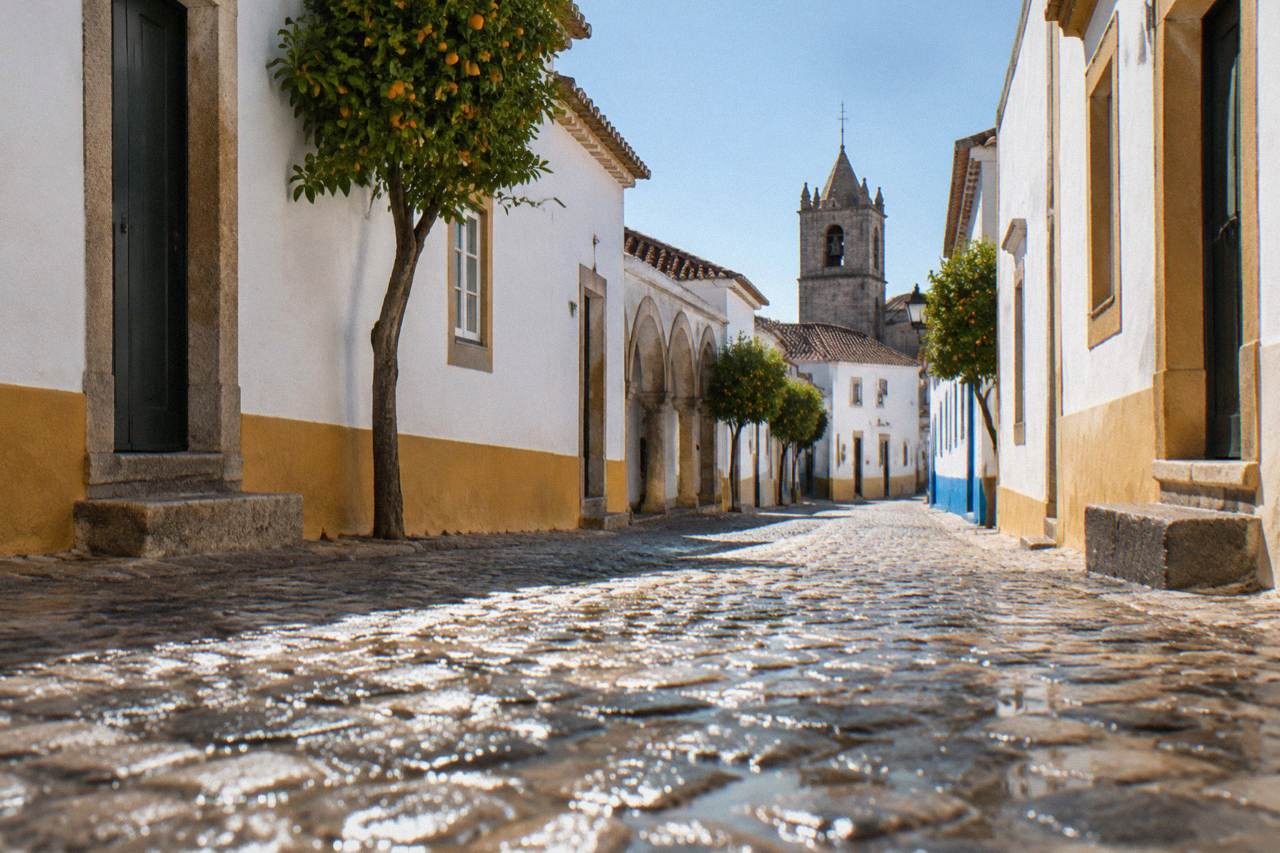
Évora feels like a small, slow, walled city where the main square, the Praça do Giraldo, the Roman temple and the cathedral all sit within a short walk of each other, with whitewashed houses, cork and wine country at the edge of town; Sintra feels like a steep, green palace hill where the day is spent moving between monuments rather than dwelling in one place. One rewards lingering, the other rewards momentum.
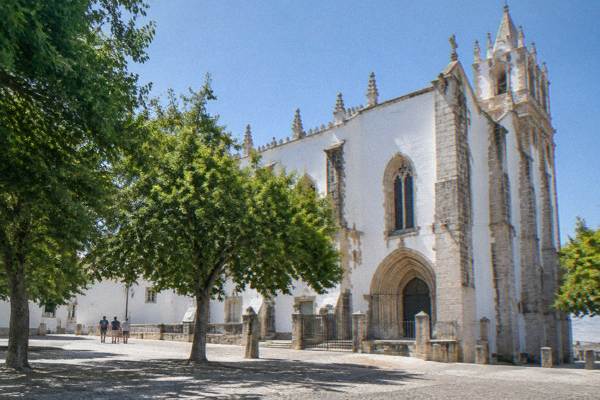
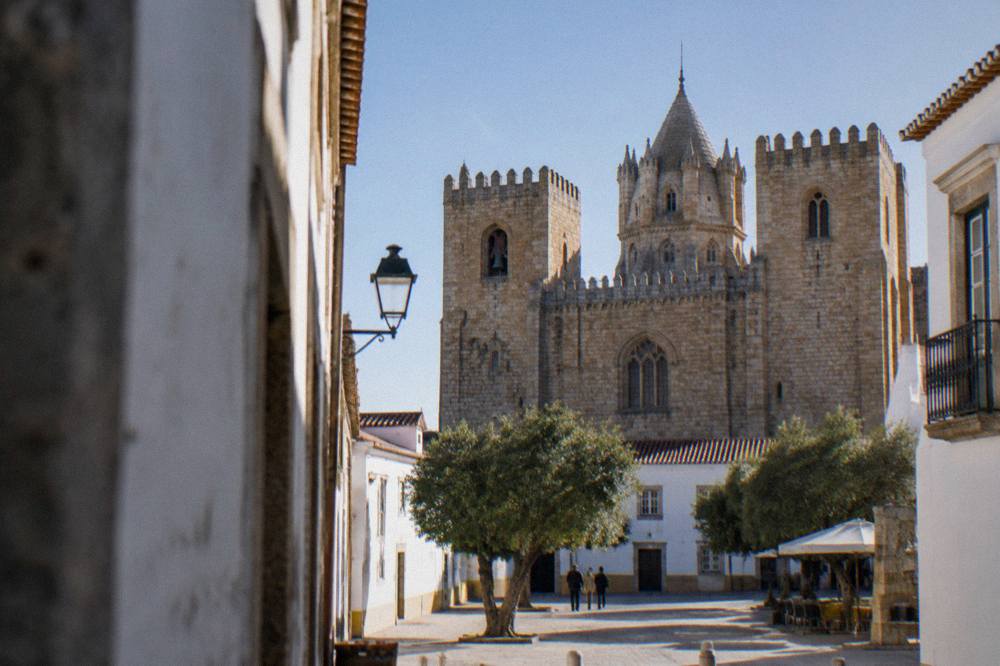
In Évora the sights sit close together. The Templo Romano, popularly called the Temple of Diana, stands in the open air in the centre; the municipal page says it was probably dedicated to the imperial cult rather than to the goddess, measures 25 x 15 m, was once reused as a municipal butcher's, and had its walls freed in 1870. It needs no ticket and no queue discipline. The Sé de Évora is a few streets away, the Praça do Giraldo a few more, and the Capela dos Ossos beside the Igreja de São Francisco beyond that. The whole core is flat enough to wander without a plan, and the must-see attractions can be covered on foot at a stroll.
Sintra's character is the opposite shape: palaces set on and around a wooded hill, reached by narrow lanes and shuttle roads, and the experience is famously busy in peak season. No crowd level for Sintra is stated here as a figure, but the general pattern, famous hillside monuments served by limited access roads, is well known, and it is the reason many travellers describe a Sintra day as rewarding but tiring. Évora's pressure points are fewer and smaller. The bone chapel has a ticketed door, the cathedral has a ticketed door, and beyond those the city is mostly open streets.
The Évora Travel Guide editorial desk's honest framing: Sintra is a place you see, Évora is a place you stay in. The difference shows up at dinner, when Évora's taverns and the Alentejo kitchen, bread soup, pork, cheese, red wine, become the evening's main event rather than an afterthought.
What Do The Main Évora Tickets Cost?
The verified Évora entry prices are: the Sé de Évora complete visit at 5.00 EUR including cathedral, cloister, roof terrace and museum, with children up to 12 free; the Capela dos Ossos museum ticket at 7.00 EUR adult, 5.00 EUR for youth up to 25 and seniors over 65, 15.00 EUR family; the Museu de Évora at 8 EUR for adults; and the multi-site Évora Ticket at 8 EUR for one day, 10 EUR for two, 12 EUR for three, free to age 12.
Two details matter for planning. First, the Évora Ticket does not include the Sé, the Capela dos Ossos or the Museu de Évora; it covers the Cidade-Museu network's other sites, so the three headline monuments are paid separately whatever pass you hold. Second, the hours differ enough to shape a day: the Sé runs 9:00-17:00, the Capela dos Ossos runs 9:00-18:30 in summer legal time and 9:00-17:00 in winter, and the Museu de Évora opens Tuesday to Sunday, 9:30-13:00 and 14:00-17:30, closed Mondays. A Monday arrival therefore loses the museum but keeps the other two. More of these guides are collected on Évora Travel Guide.
| Évora monument | Adult ticket | Concessions | Hours | Closed |
|---|---|---|---|---|
| Sé de Évora, complete visit | 5.00 EUR | Children up to 12 free | 9:00-17:00 | 24 Dec afternoon, 25 Dec, 1 Jan |
| Capela dos Ossos, Igreja de São Francisco | 7.00 EUR | Youth to 25 and seniors over 65 at 5.00 EUR, family 15.00 EUR | Summer 9:00-18:30, winter 9:00-17:00 | 1 Jan, Easter Sunday, 24 Dec afternoon, 25 Dec |
| Museu de Évora | 8 EUR | Youth 13-24, seniors over 65 and family 50% off, free to age 12 | Tue-Sun 9:30-13:00, 14:00-17:30 | Mondays, 1 Jan, Easter Sunday, 1 May, 29 June, 25 Dec |
| Évora Ticket, multi-site | 8 EUR one day, 10 EUR two days, 12 EUR three days | Free to age 12 | Network sites vary | Does not include the Sé, the Capela dos Ossos or the Museu de Évora |
No Sintra price is printed here, because none was verified for this build. Sintra's palaces are ticketed individually by their own operators, and the honest instruction is to check each palace's official page before going, especially in high season when timed entry can sell out. What can be said generally is that a packed Sintra day involves several separate monument tickets, while Évora's headline sights cost the three figures above and nothing else.
How Much Time Do You Need In Évora?
One long day covers Évora's core: the Praça do Giraldo, the Templo Romano, the Sé with its roof terrace, the Capela dos Ossos and a proper Alentejo lunch, which is exactly what the 09:02 train and the 19:02 return allow. Two days is the better fit, because the second day opens the Cromeleque dos Almendres, the wineries of the Alentejo, and towns like Arraiolos about 20 km or Estremoz about 45 km away.
The one-day version is real and popular; the full case for it is laid out in what to do in Évora for a day. But the single-day visitor sees a city and misses a region. The Almendres Interpretation Centre in the village of Guadalupe, the municipality's partner site for the cromlech, keeps summer hours of 10:00-18:00 from 1 May to 31 October and winter hours of 10:00-17:00, and the stones themselves stand in open country about 8 km off the national road toward Lisbon. That is not a lunch-break excursion; it is a half day.
Sintra can also fill more than a day, and many travellers give it two. The difference is what the extra time buys. In Sintra, a second day means more palaces and gardens on the same hill. In Évora, a second day means a different landscape entirely: cork forests, marble quarries at Vila Viçosa about 60 km away, a walled village at Monsaraz about 40-45 km away, or a glass of Alentejo red at a winery outside town. The how much time you need in Évora question therefore has a different answer depending on whether the Alentejo itself is part of the plan.
When Is The Best Time To Make This Trip?
For Évora, the verified climate data is unambiguous: IPMA's 1991-2020 normals for the Évora station show a July mean maximum of 33.3 C and an August mean maximum of 33.5 C, with 31.9 days a year reaching 35 C or more, so spring and autumn are the comfortable seasons; the record maximum of 45.4 C was set on 4 August 2018. Sintra, being a green hill near the Atlantic, does not share this inland heat pattern, but no Sintra figure is stated here.
The Alentejo plain is the deciding climate fact. The same normals show October with a mean maximum of 24.1 C and 7.7 days of 1 mm or more rain, and May with 25.0 C and 6.0 such days, which makes late spring and early autumn the sweet spot for walking Évora's streets and standing in open megalithic fields. July and August, by contrast, average 23.7 and 25.0 days at 30 C or more respectively. A summer Sintra trip is a hill-and-garden experience; a summer Évora trip is a heat-plan experience, with sightseeing shifted to morning and evening and the middle of the day given to shade. The seasonal detail is in which month is best to visit the Alentejo.
There is also a cultural reason 2027 is on the calendar: Évora and the Alentejo are a European Capital of Culture in 2027, with 2026 running a preparatory programme built on the concept of "Vagar", a word that means taking one's time. That is the city's own stated spirit, and it happens to be the correct advice for visiting it.
A guided walk is the most efficient way to spend the first hours in Évora, and the small-group cultural walking tour that includes the Chapel of Bones, from $77.66 per person and rated 4.9 from 141 reviews, is the strongest fit for the one-day visitor: it covers the historic core and the bone chapel in two hours, leaving the afternoon free for the Sé's roof terrace and a long lunch. Check availability.
Common Questions About Sintra Or Évora
Which is better, Sintra or Evora?
Neither is better as fact. Sintra suits travellers who want romantic palaces and gardens close to Lisbon in one packed day; Évora suits travellers who want a walled Alentejo city, Roman remains, a bone chapel, strong food and wine, and a slower pace, ideally with an overnight stay.
Can I see Évora as a day trip from Lisbon?
Yes. The 09:02 Intercidades from Lisboa Oriente arrives in Évora at 10:45, and the 19:02 return departs after a full day, with a second-class fare of 13.90 EUR each way per the CP price table valid for 2026.
Is Évora too hot in summer?
The 1991-2020 IPMA normals for the Évora station show a July mean maximum of 33.3 C and an August mean maximum of 33.5 C, with 31.9 days a year at 35 C or more. Summer visits work best with morning sightseeing, a long shaded lunch and evening walks.
Does the Évora Ticket cover the main monuments?
No. The Évora Ticket costs 8 EUR for one day, 10 EUR for two and 12 EUR for three, but it does not include the Sé de Évora, the Capela dos Ossos or the Museu de Évora; those three are ticketed separately at 5.00 EUR, 7.00 EUR and 8 EUR for adults.
Which town is better for food and wine?
Évora sits in the Alentejo, Portugal's wine, cork and slow-cooking region, and its taverns, cheese, bread and red wine are a central reason to stay the night. Sintra is primarily a monument destination; its food scene is not part of this comparison because no verified detail is stated for it.
The choice, in the end, is between a hill of palaces and a city of plains. Sintra delivers spectacle at speed; Évora delivers a whole region at walking pace, with the 1986 UNESCO inscription, the Roman temple, the bone chapel and the Alentejo table all inside one small walled centre, and the train from Lisbon now runs six times a day to prove it.