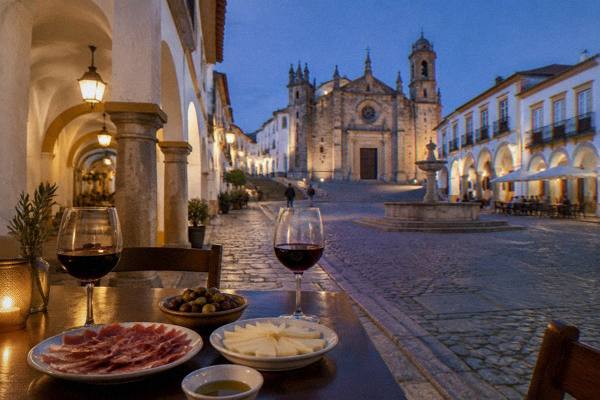
Alentejo Dishes To Try In Évora
Évora, the inland capital of Portugal's Alentejo, eats from one of the most distinctive regional kitchens in the country: bread soups, pork with clams, sheep's cheese and monastery sweets. This guide sets out the dishes to look for and how to taste them.
Short answer
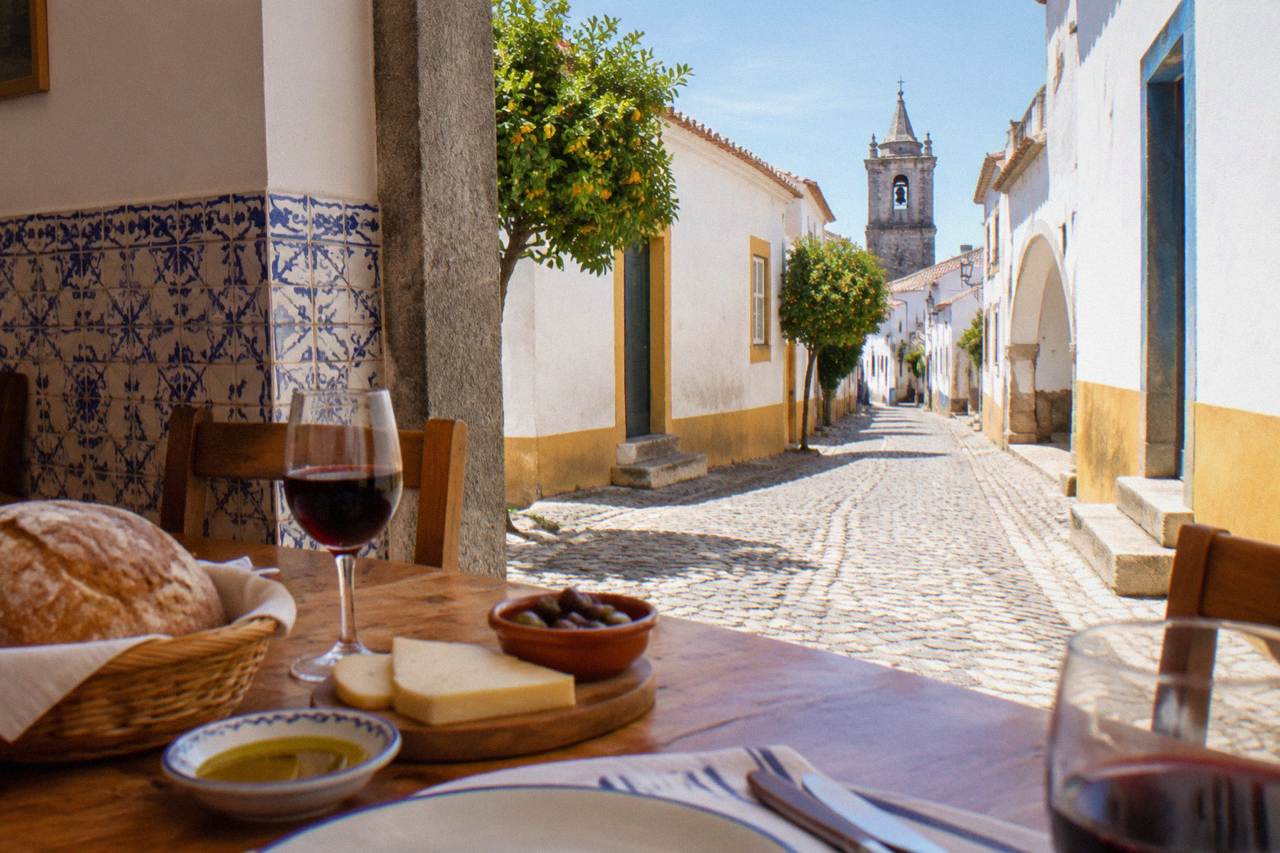
The one dish most visitors come for is carne de porco a alentejana, pork fried with clams in a wine and paprika sauce. Around it sit açorda, migas, gaspacho alentejano, grilled black pork, sheep's cheese and the egg-yolk sweets of the Alentejo convents. A food crawl or cooking class in Évora is the easiest way to meet several of them in one evening.
Évora, the inland capital of Portugal's Alentejo region, sits on a hot, dry plain where the cooking was built around bread, pork, olive oil, garlic and coriander rather than the fish of the coast. The Atlantic is roughly 90 km away, and the kitchen shows it: this is a peasant tradition of shepherds and cereal farmers, thickened into one of the most recognisable regional cuisines in Portugal. The dish most visitors arrive asking for is carne de porco a alentejana, and it is a good place to start, but it is only one plate on a long list.
This guide walks through the dishes in the order a visitor usually meets them: the famous pork and clams, the bread soups and mashes that anchor everyday eating, the cheeses and cured meats, the sweets, and the wines that go alongside. Nothing here recommends a specific restaurant, because the honest position is that no individual venue in Évora has been verified by this desk; what the guide can do is tell you exactly what each dish is, so you recognise it on any menu in the city. For tasting the spread in one evening, the Évora evening food and wine crawl exists precisely for that job, moving between kitchens with a local host. For the wider regional context, start with the guide to Alentejo food and the answers to what Alentejo is famous for.
What Is Carne De Porco A Alentejana?
Carne de porco a alentejana is the Alentejo's signature plate: cubes of pork, marinated in white wine, garlic and paprika, then fried and served with clams, in a sauce that finishes with coriander. The clams are the surprise for most first-time visitors, because the Alentejo is inland and clams come from the coast, but the combination is old and standard across the region. Fried potato cubes usually sit underneath, and the dish is eaten with bread for the sauce.
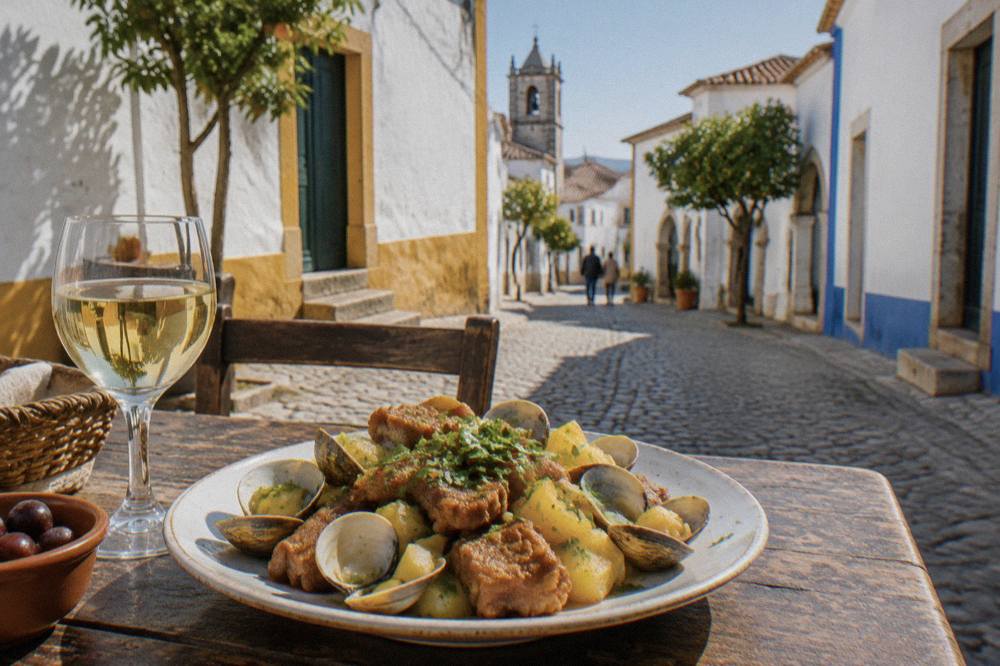
The pork itself matters. The Alentejo raises a black Iberian pig, the same animal behind the region's cured hams and sausages, and its fresh meat carries more fat and flavour than a standard white pig. A well-made version of the dish tastes of wine, garlic, paprika and sea salt at once, with the clams lifting the richness. The paprika, the wine and the coriander are the three notes to look for; if none of them arrives, the kitchen is cooking a generic pork-and-clams rather than the regional plate.
Order it with a regional red. The Alentejo makes full, warm reds that stand up to the dish, and the guide to Alentejo wine covers what to expect from them in detail. If you want a first evening in Évora that puts the plate in context, the guided options below include a crawl built around exactly this kind of eating.
Which Alentejo Dishes Should You Try First In Évora?
Beyond the pork and clams, the five dishes that define the Alentejo plate are açorda alentejana, migas, gaspacho alentejano, ensopado de borrego and grilled black Iberian pork with presunto and queijo. Açorda is a bread soup: day-old bread, garlic, coriander, olive oil and often a poached egg, mixed into a warm, soft bowl. Migas are bread fried with garlic and pork fat into a golden mash, served beside meat.
Gaspacho alentejano is not the Spanish drink but a thick soup of soaked bread, tomato, cucumber, onion and olive oil. Ensopado de borrego is lamb stewed with bread until the bread dissolves into the sauce. The grilled pork platter, with cured ham and sheep's cheese on the side, closes the list.
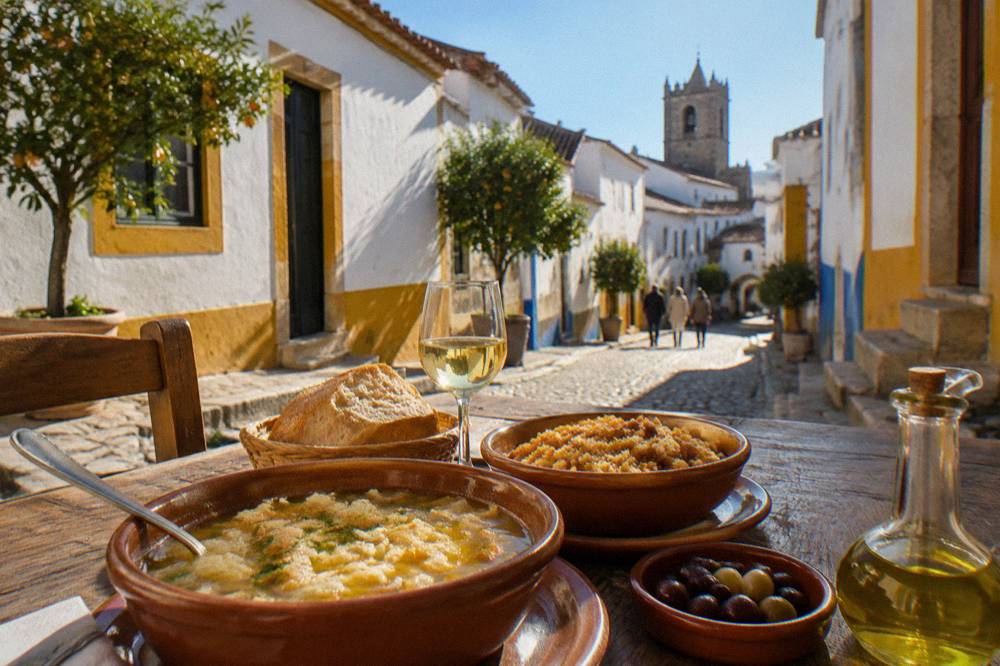
Bread is the thread through all of them. The Alentejo was historically Portugal's cereal belt, and the kitchen treats stale bread as an ingredient rather than a leftover, which is why so many dishes are essentially bread in different costumes. Olive oil is the second thread, and the guide to Alentejo olive oil explains why the region's oils run strong and peppery. Together they explain the shape of the table: filling, cheap, built to feed people doing physical work in heat.
| Dish | What it is | What to expect on the plate |
|---|---|---|
| Carne de porco a alentejana | Marinated fried pork with clams | Wine, garlic, paprika, coriander, fried potato |
| Açorda alentejana | Bread soup with garlic and coriander | Soft soaked bread, olive oil, often a poached egg |
| Migas | Fried bread mash | Golden, dense, served beside pork or fish |
| Gaspacho alentejano | Cold thick bread and tomato soup | Soaked bread, cucumber, onion, olive oil |
| Ensopado de borrego | Lamb stewed with bread | Fall-apart lamb in a bread-thickened sauce |
| Grilled black Iberian pork | Fresh cuts of the black pig | Simple grill seasoning, served with migas or potatoes |
None of these dishes needs translation help in Évora: they appear by their Portuguese names on menus everywhere from the simplest tasca to hotel dining rooms. A visitor who orders one bread dish and one meat dish per meal will cover the repertoire inside a couple of days. The three-day Évora and Alentejo itinerary leaves room for exactly that pace.
What Are The Bread, Cheese And Cured Meat Staples Of The Alentejo?
The staples that surround every Alentejo meal are sheep's cheese, cured pork from the black Iberian pig, and coarse country bread with olive oil. Sheep's cheese is the region's great dairy product, made in the south of the Alentejo in styles that run from buttery and mild when young to hard, sharp and crumbly when aged, and it is served at the start or the end of a meal with bread and, often, a glass of red.
The cured meats come from the same black pig as the fresh pork: presunto, air-dried hams, and coarse sausages such as farinheira, which is padded with flour, and morcela, a blood sausage with rice. Bread arrives without being asked for and is treated as part of the cover.
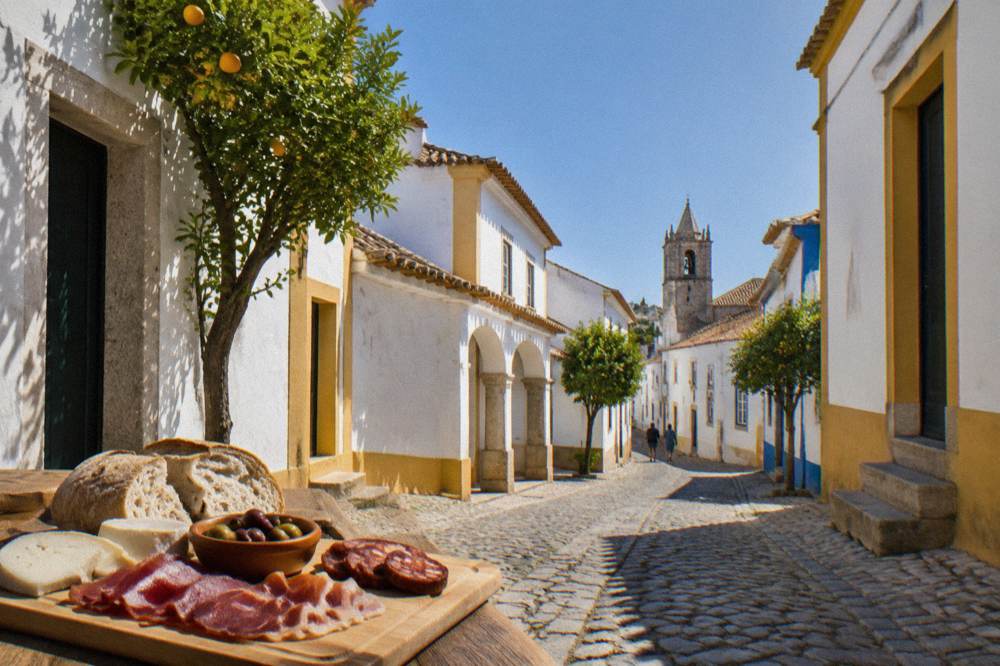
Two habits are worth knowing before you sit down. First, the cheese course is not a dessert here: it comes whenever it suits the meal, and a board of cheese and cured meat is a legitimate light dinner on its own. Second, the couvert, the bread, olives and cheese set down at the start, is usually charged per item in Portugal; if you do not want it, move it aside rather than eating it. This is standard across the country, not an Évora quirk, but it surprises visitors who assume the basket is free.
The best way to meet several of these staples in one sitting is a tasting that strings them together. The evening crawl run in Évora builds its route around exactly these boards, moving between stops so each kitchen's version of the cheese-and-ham plate can be compared against the next.
| Staple | Made from | How it is served |
|---|---|---|
| Sheep's cheese, young | Ewe's milk | Soft, buttery, with bread at the start of a meal |
| Sheep's cheese, aged | Ewe's milk | Hard and sharp, at the end of a meal with red wine |
| Presunto | Cured black Iberian pig leg | Sliced thin, on its own or with cheese |
| Farinheira | Pork and flour, smoked | Cooked or sliced, mild and filling |
| Morcela | Blood sausage with rice | Grilled or in stews |
| Country bread | Wheat, coarse | At every meal, with olive oil for dipping |
For the full regional picture, the Alentejo travel guide covers where these products come from and how the region's agriculture shaped its table.
What Sweets And Pastries Is The Alentejo Known For?
The Alentejo's sweets are convent sweets: egg-yolk desserts thickened with sugar and often cinnamon, of which the ones to look for in Évora are bolo rançoso, sericaia, encharcada and queijinhos do céu. Sericaia is a baked egg custard, gently spiced with cinnamon, traditionally served with stewed plums. Encharcada is a dessert of egg yolks cooked in hot syrup, glossy and very sweet.
Bolo rançoso is a simple almond and egg cake from the northern Alentejo, and queijinhos do céu, little "cheeses of heaven", are small almond cakes made without cheese at all. The shared logic is eggs, sugar and almonds, the legacy of convent kitchens across Portugal, and the Alentejo kept a large share of the repertoire. More of these guides are collected on Évora Travel Guide.
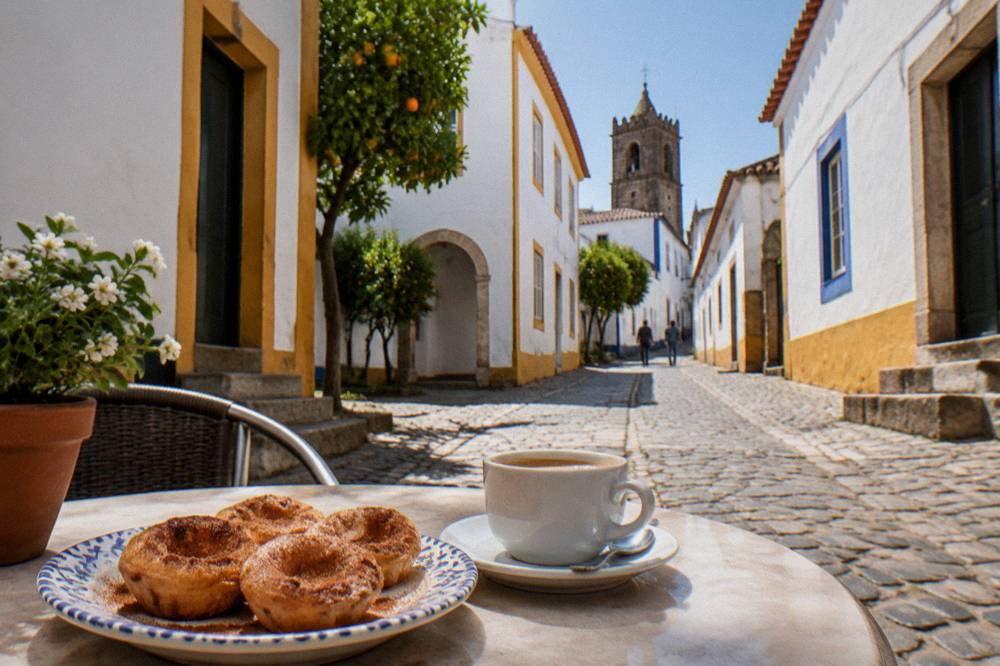
Order them the local way, after the meal with a coffee, and expect sweetness levels that are higher than most northern European palates expect. A bica, the Portuguese espresso, is the standard partner and cuts through the sugar. Bakeries and pastry counters across Évora carry a rotating selection through the day, and the convention of eating sweets in the mid-morning or mid-afternoon, rather than only at dessert, means a pastry stop is a normal part of the daily rhythm rather than an indulgence.
The guide to Évora cheese, bread and pastries goes deeper on the city's baking tradition. For an evening that ends somewhere sweet, the food crawl finishes in exactly this register, with dessert and a glass of something at the last stop.
What Should You Drink With Alentejo Food?
The default drink with Alentejo food is a regional red wine, full-bodied and warm, and the other two to know are a chilled white from the same region and água-pé or a licor bebida regional, the local after-dinner drinks. The Alentejo's reds are the reason the region's wine has travelled: generous, ripe, soft in tannin, and made to sit beside bread soups and grilled pork. Whites have grown in standing and suit the sheep's cheese and the gaspacho in summer. Beyond wine, the Alentejo makes brandy-based liqueurs flavoured with local things such as honey and pennyroyal, and they appear at the end of meals in the traditional taverns.
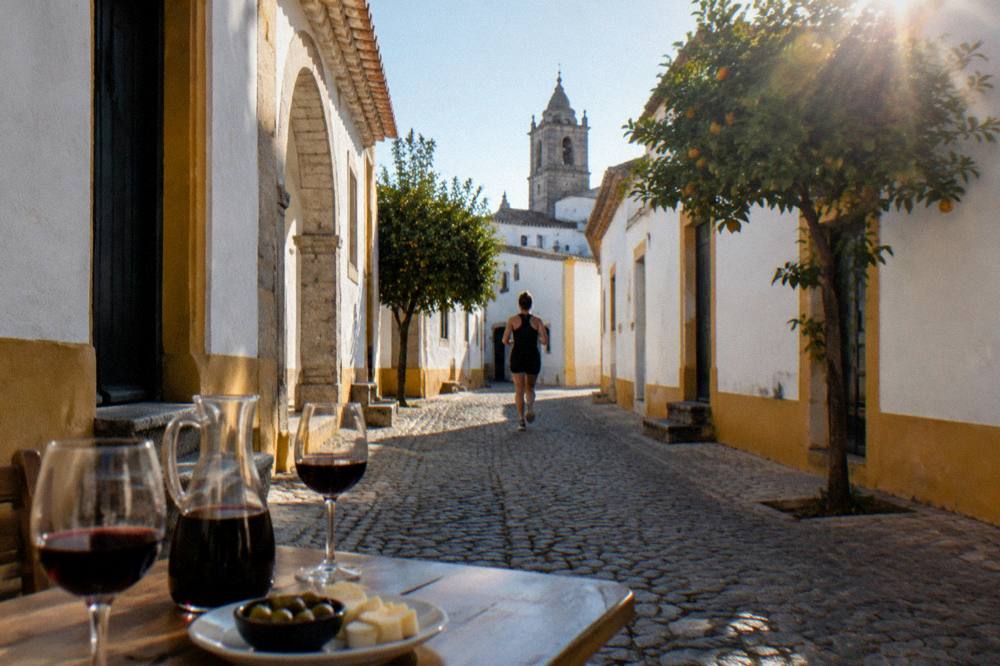
A caution from this desk: no wine style comparison, no count of grape varieties and no producer detail can be stated here as verified fact, and none is. What can be said is practical: ask for a house red in a tasca and you will usually be served something regional, cheap and correct; ask in a wine bar and you can taste your way across the region by the glass. The answers on what Alentejo wine is like and what it is similar to cover the style question honestly, and the wine tasting guide for Évora lists the bookable options, including vineyard visits in the surrounding countryside.
| Drink | Style | Best food match |
|---|---|---|
| Alentejo red | Full, ripe, soft tannin | Carne de porco a alentejana, grilled black pork |
| Alentejo white | Dry, often fresh and citric | Sheep's cheese, gaspacho, fish dishes |
| House red in a tasca | Simple regional pour | Migas and everyday plates |
| Regional liqueur | Brandy-based, honey or herb | After dessert, with coffee |
For visitors staying several days, the Reguengos de Monsaraz wine route day trip combines the region's cellars with its hilltop scenery, and it pairs naturally with a food-first stay in Évora.
Where Do You Actually Eat These Dishes In Évora?
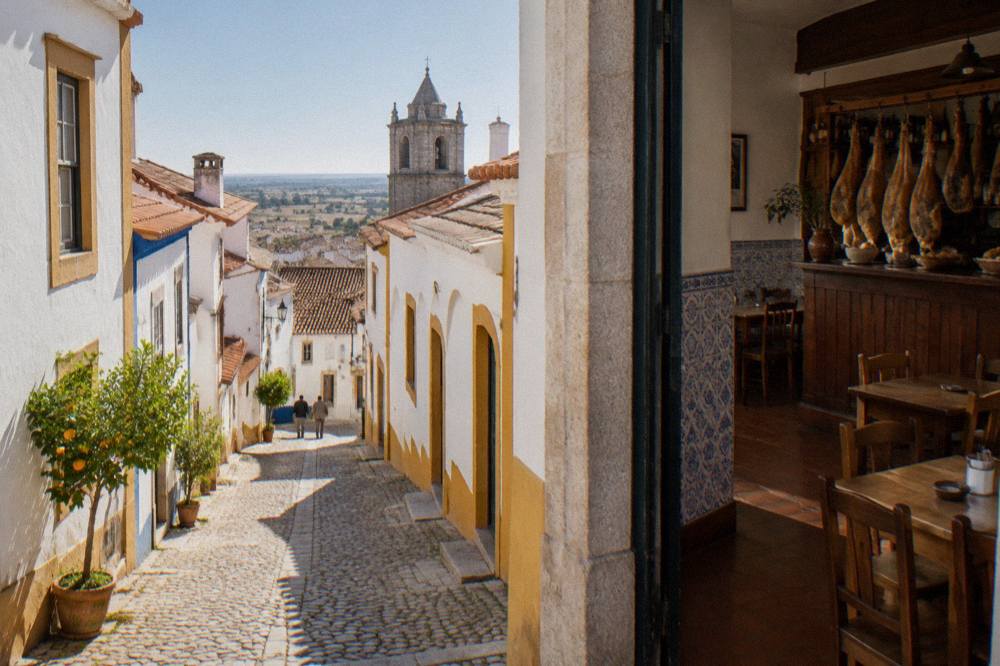
The honest answer is that no individual restaurant in Évora can be recommended from verified knowledge, so the reliable routes are the everyday categories: the tasca, the regional restaurant, the market and the guided food crawl. A tasca is a small, simple tavern serving a short list of regional dishes at low prices, and it is where açorda and migas are most at home. A restaurant de cozinha tradicional, a traditional-kitchen restaurant, will run the full repertoire including the pork and clams.
The municipal market sells the raw materials: sheep's cheese, cured sausages, bread and, in season, the herbs the soups depend on. Each category is dependable in a way no single name can be.
This desk publishes no venue names, addresses, prices or rankings for any restaurant, tavern, café, pastry shop or market stall in Évora, because none has been verified. What can be offered instead is the structured route: a guided crawl that moves between several kitchens in one evening, tasting the staples with a host who can explain each plate as it lands. The Évora evening food and wine crawl runs from $83.28 per person, is rated 4.6 from 19 reviews and lasts about 3 hours, according to the operator's live listing, and it is the most efficient answer to the question of where to eat on a first night. Check availability
| Way to eat | What you get | Guided option from the listings |
|---|---|---|
| Evening food and wine crawl | Several kitchens, local host, about 3 hours | From $83.28 per person, rated 4.6 from 19 reviews |
| Cooking class | Cook the dishes yourself, then sit down to them | Learn the Art of Alentejo Cuisine, from $166.29 per person |
| Walking tour with wine | The city's history, ending in a tasting | Golden Era walk and wine tasting, from $23.92 per person |
| Self-guided tasca crawl | Your own route, pay as you go | Free to plan, prices vary by venue |
For visitors who prefer to wander alone, the advice is simple: read the menu posted at the door, look for the dishes named in this guide, and trust a short menu over a long one. A kitchen cooking six things well will beat a kitchen cooking thirty.
Can You Learn To Cook Alentejo Dishes Yourself?
Yes, and in Évora the way to do it is a cooking class that takes you through the market and then into the kitchen, of which the bookable option on this page is Learn the Art of Alentejo Cuisine, a hands-on class from $166.29 per person. The class format in the Alentejo typically follows the logic of the cuisine itself: shop for bread, olive oil, pork and herbs, then cook a small number of dishes properly rather than many quickly, and finish by eating what you made. The listing for this class carries a 3 rating from 3 reviews, a thin base worth knowing about before booking, and the operator's live listing carries the current schedule and inclusions.
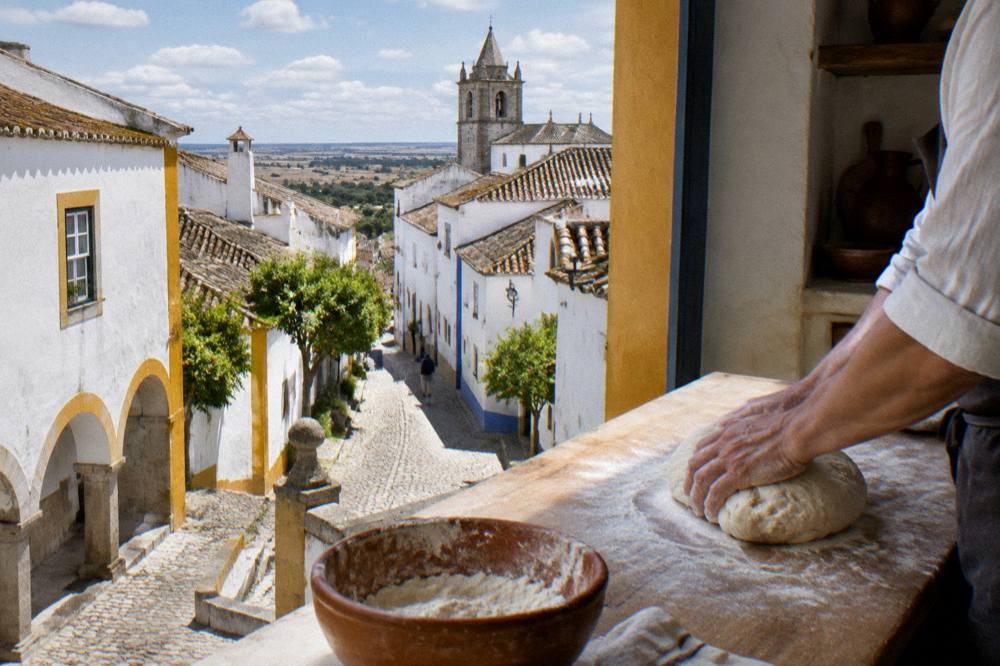
A class suits a particular kind of traveller: someone staying two or more days, who has already eaten the dishes once and wants to understand why they taste the way they do. The logic of açorda, for instance, is obvious once you have soaked the bread yourself, and the paprika marinade for the pork makes sense when you smell it raw. For shorter stays, the crawl is the better fit, because it covers more ground in one evening. The answers on how much time you need in Évora can help you decide which pattern fits your trip.
When Is The Best Time To Eat Your Way Through Évora?
The most comfortable months for eating your way through Évora are late autumn and spring, because IPMA's 1991 to 2020 normals for the Évora station put the July mean maximum at 33.3 C and the August mean maximum at 33.5 C, with 31.9 days a year reaching 35 C or more. Summer eating in the Alentejo shifts to the cold dishes by necessity: gaspacho, cheese boards and long evening meals after the heat breaks. Spring and autumn sit in the middle of the range, warm enough for outdoor tables, cool enough to enjoy the stews. Winter is low season, cold at night, and the kitchen is at its most convincing, because the bread soups and the ensopado are cold-weather food by origin.
The numbers behind that answer come from IPMA's 1991 to 2020 climate normals for the Évora station, and they deserve a table, because they change what you order:
| Month | Mean maximum (C), 1991-2020 | Days at 35 C or more, 1991-2020 | What it means for eating |
|---|---|---|---|
| April | 20.7 | 0.0 | Outdoor tables, full menu |
| May | 25.0 | 0.7 | Warm, still comfortable |
| July | 33.3 | 11.5 | Cold dishes, late dinners |
| August | 33.5 | 10.9 | Peak heat, eat indoors at midday |
| October | 24.1 | 0.1 | Ideal again, chestnut season |
| December | 14.6 | 0.0 | Stew weather, low crowds |
The record maximum for the Évora station is 45.4 C, set on 4 August 2018, which is the honest ceiling behind every summer warning in this region. The guide to the best time to visit Évora and the answers on which month is best for the Alentejo cover the planning question from every angle.
Common Questions About Alentejo Dishes
What is carne de porco a alentejana?
It is the Alentejo's signature dish: pork marinated in white wine, garlic and paprika, fried and served with clams, finished with coriander, usually over fried potatoes. The clams come from the coast, but the dish belongs to the inland Alentejo.
Why does inland Alentejo cooking use clams?
Coastal products have always travelled inland to the Alentejo's markets, and the pork-and-clams pairing is a long-established part of the regional repertoire rather than a modern fusion. The sea is roughly 90 km from Évora.
What is açorda?
A bread soup made by soaking day-old bread with garlic, coriander and olive oil, often with a poached egg on top. It is the clearest example of the Alentejo's habit of treating bread as an ingredient.
What cheese should you try in Évora?
Sheep's cheese from the Alentejo, served at both the young, buttery stage and the aged, sharp stage. This desk names no producer or venue, but the category appears on virtually every menu in the city.
Are Alentejo sweets very sweet?
Yes. The convent tradition builds desserts from egg yolks and sugar, and sericaia, encharcada and queijinhos do céu all sit at the sweet end of the scale. Coffee alongside is the local solution.
Can you taste several Alentejo dishes in one evening?
Yes. A guided food and wine crawl in Évora moves between kitchens and covers the staples in about 3 hours; the self-guided alternative is a tasca crawl planned around the dishes named in this guide.
The Alentejo table in Évora is a small repertoire cooked with conviction: bread, pork, sheep's cheese, olive oil, eggs and wine, arranged into dishes that have barely needed to change. Learn the names in this guide, order one bread dish and one meat dish at a time, and the region's kitchen will introduce itself.