What Is Alentejo Famous For?
What the Alentejo is famous for, from Évora's UNESCO-listed old town to cork forests, marble towns, cante and megaliths, with the numbers that matter.
The Alentejo is the great inland region of southern Portugal, and Évora, its best-known city, is the capital of both the district and the Central Alentejo sub-region that carry its name. The name itself is usually explained as "beyond the Tagus", the river that marks the region's northern edge, and everything the Alentejo is famous for follows from that geography: an endless, gently rolling plain with no coast, hot dry summers, and a rhythm of life built around what the land gives. Wheat, cork oak, olives, vines and marble have shaped its towns, and the region's cultural weight sits in a handful of places, above all Évora, whose historic centre was inscribed by UNESCO in 1986 under criteria (ii) and (iv).
What Is Alentejo Famous For?
The Alentejo is famous for five things above all: the golden plains and white-washed towns that define its landscape, cork harvested from its oak forests, full-bodied red wines, marble cut from towns such as Vila Viçosa and Estremoz, and a remarkable concentration of prehistoric megalithic monuments, including the Cromeleque dos Almendres near Évora. Around them sits a UNESCO-listed capital, Évora, inscribed in 1986, and a food tradition of bread, pork, cheese and slow-cooked stews.
That is the short answer. The longer one is that the Alentejo is famous less for any single sight than for a whole register of experience: silence, heat, big skies and towns the colour of chalk. Évora, with about 53,000 residents in its municipality at the 2021 Census, is the region's cultural anchor, and most first visits to the Alentejo start or end there. The city's own fame, the Chapel of Bones and the Roman temple, is really the Alentejo's fame in compressed form.
Why Is The Landscape Itself So Famous?
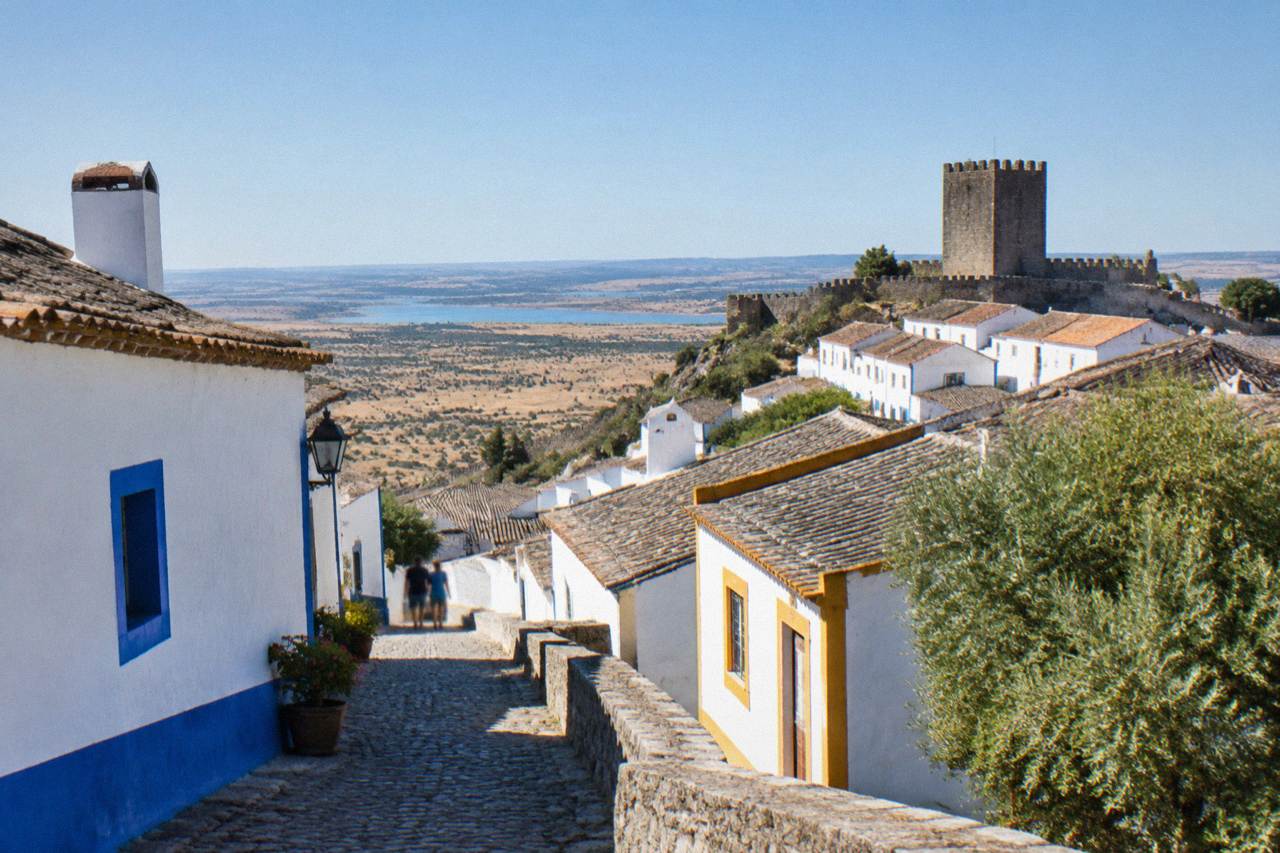
The Alentejo landscape is famous for its flat-to-rolling golden plain, dotted with cork oaks, holm oaks, olive groves and vineyards, stretching from the Tagus to the Algarve hills with no coastline anywhere in between. The Atlantic is roughly 90 km from Évora, and the region's interior position gives it the hottest summers in mainland Portugal, with a July mean maximum of 33.3 C and August 33.5 C at the Évora station in the 1991-2020 normals.
The plain is what visitors remember, and it is what the region's identity is built on. Wheat was the historic crop, and the golden colour of the fields in early summer is the image on every Alentejo postcard. The cork oak is the other signature tree: its bark is stripped in cycles and turned into the cork stoppers Portugal is known for, and the montado, the open oak woodland the harvest creates, is the region's defining working landscape. The Évora Travel Guide editorial desk's own day-trip pages keep returning to that same picture: a road through oaks, a white town on a low hill, and nothing else to the horizon.
IPMA's 1991-2020 normals for the Évora station, number 558, show what that inland position means in numbers. The table below is the climate of the region's capital and is representative of the Central Alentejo.
| Jan | Apr | Jul | Oct | Year | |
|---|---|---|---|---|---|
| Mean max (C) | 14.1 | 20.7 | 33.3 | 24.1 | 23.1 |
| Mean min (C) | 4.5 | 8.5 | 15.6 | 12.3 | 10.1 |
| Precipitation (mm) | 68.6 | 62.1 | 2.7 | 81.5 | 596.1 |
| Days with 1 mm+ rain | 8.6 | 8.0 | 0.6 | 7.7 | 68.9 |
Thirty-one point nine days a year reach 35 C or more, and the station record is 45.4 C, set on 4 August 2018. Spring and autumn are the seasons most guides point to, and the best month question has a data-backed answer in those rows.
What Are The Alentejo'S Famous Foods And Wines?
Alentejo food is famous for its bread, its pork, its sheep's cheese and slow-cooked dishes such as açorda and migas, built around the region's own olive oil rather than seafood. Alentejo wine is famous for full, warm reds from native grapes grown on the plain and around Évora, Reguengos de Monsaraz, Borba, Redondo and Portel, and the region is one of the names Portuguese wine drinkers reach for first.
The cooking is a cuisine of scarcity turned into identity. Bread appears in soups and stews as a substance, not a side; pork, including the black Iberian pig finished on acorns in the montado, is the region's signature meat; and lamb, game and river fish fill the gaps. The full food guide covers the dishes, and the shortlist of things to try is the practical version for a first trip.
Wine is the other pillar. The Alentejo's reds are typically generous, ripe and soft, and the region's wines are widely available across Portugal; the guide to what Alentejo wine is like and the comparison with other styles cover the character in detail. Around Évora itself, the Cartuxa winery and the Reguengos route are the best-known addresses, and a wine and food day from Évora is the classic way to taste them. Olive oil, the quiet third sibling of bread and wine, has its own guide.
What Are The Famous Towns And Monuments Of The Alentejo?
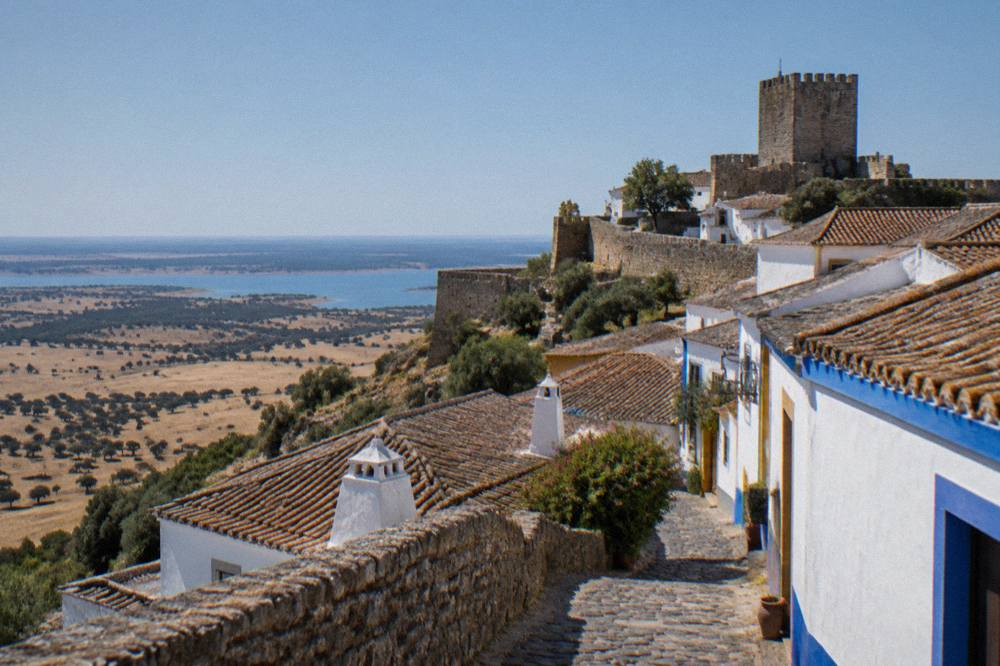
The famous towns are Évora, the UNESCO-listed capital; Monsaraz, a walled medieval village above the Alqueva lake; Estremoz and Vila Viçosa, the marble towns; Elvas with its vast bastioned fortifications; and Marvão, a castle village on a high ridge. The famous monuments range from Évora's Roman temple and Capela dos Ossos to the Cromeleque dos Almendres, one of the great stone circles of prehistoric Europe.
Évora carries the region's World Heritage listing. The Templo Romano, popularly called the Temple of Diana, is a 25 x 15 m Roman temple that the municipal page says was probably dedicated to the imperial cult, not to Diana at all; it was later reused as a municipal butcher's shop and its walls were freed in 1870. The Capela dos Ossos, why it is famous is answered in full elsewhere, is the region's single most-discussed interior. The city's golden-age architecture is what UNESCO's criterion (iv) points at: Évora was largely spared by the 1755 earthquake that destroyed Lisbon, so the fabric of its golden age, the era of the Jesuit University of the Holy Spirit founded in 1553, survived intact.
Beyond Évora the distances are honest Alentejo ones, always worth knowing before planning a circuit:
| Town | Distance From Évora | Known For |
|---|---|---|
| Arraiolos | about 20 km | Handmade embroidered carpets |
| Monsaraz | about 40-45 km | Walled village above the Alqueva lake |
| Estremoz | about 45 km | Marble and a hilltop castle |
| Vila Viçosa | about 60 km | Marble quarries and the ducal palace |
| Elvas | about 80 km | Bastioned fortifications |
| Marvão | about 120 km | Castle village on a high ridge |
The castles and villages guide and the Alentejo road trip string these together, and the three-day Évora and Alentejo itinerary is the short version.
Why Is The Alentejo Famous For Megaliths?
The Alentejo is famous for one of the densest concentrations of prehistoric megalithic monuments in Europe, above all the Cromeleque dos Almendres near Évora, a stone circle of menhirs set on a low hill among cork oaks, together with standing stones, dolmens and settlement sites scattered across the Évora plain. The Almendres Interpretation Centre in the village of Guadalupe, open 10:00-18:00 in summer and 10:00-17:00 in winter, anchors visits to the stones.
The Almendres cromlech sits about 8 km from Évora along the national road toward Lisbon, then a turn-off, as the interpretation centre's own page describes. The stones stand in the open, free to walk to, and the site is usually paired with the Great Dolmen of Zambujeiro on guided half-days. For the wider picture, the megalithic sites near Évora page covers the circuit, and the question of whether Portugal has its own Stonehenge is answered on the Stonehenge-in-Portugal page.
This is the Alentejo's deepest layer of fame. Évora was a Roman city, Ebora, before that a settlement of older roots, and the plain around it was a ritual landscape thousands of years before the Romans arrived. A guided visit with an archaeologist, such as the half-day cromlech tours from Évora, is the way most visitors make sense of the stones; the three-hour Almendres and Zambujeiro option is the shortest good introduction.
Is The Alentejo Famous For Cork And Marble?
Yes. Cork is the Alentejo's most famous raw material: the region's montado oak forests supply the bark that becomes wine stoppers, and the cork harvest, stripping bark by hand in cycles, is the traditional summer work of the plain. Marble is the second stone of fame, quarried around Estremoz, Vila Viçosa and Borba, a white-gold stone that paves and dresses the region's towns and was cut for royal building projects.
Cork and the cork oak have their own full guide, and around Évora the practical experiences are a cork factory visit, a walk in a cork forest, or the combined megaliths-and-cork half-day that does both in one outing. The marble country sits east of Évora: Vila Viçosa, about 60 km away, is the ducal seat of the Braganças and a town built visibly out of its own quarries, and the two-hour marble tours there are among the best-value guided visits in the region. Estremoz, about 45 km, is the other marble name, and why Estremoz is famous is answered on its own page.
The pattern to notice is that everything famous in the Alentejo comes from the land: wheat, bark, stone, vine, olive and clay. Even the region's pottery villages, such as São Pedro do Corval near Monsaraz, work the plain's clay into the unglazed black ware that sits in every Alentejo kitchen.
Common Questions About The Alentejo
What is Alentejo famous for?
Golden plains, white-walled towns, cork, wine, marble, megalithic monuments and the UNESCO-listed city of Évora, together with a bread-and-pork food tradition and a famously slow pace of life.
Is the Alentejo worth visiting?
Yes, and the case is made in detail on the is Alentejo worth visiting page. In short: Évora alone justifies the trip, and the surrounding towns, wineries and prehistoric sites turn a weekend into a full itinerary.
Where is the Alentejo located in Portugal?
Southern Portugal, inland, south of the Tagus and north of the Algarve. Évora, its best-known city, is about 130 km from Lisbon. The location page has the full geography.
What does Alentejo mean in Portuguese?
The name is usually explained as "beyond the Tagus", the river forming the region's northern boundary. The meaning page covers the etymology.
How much time do you need in Évora and the Alentejo?
One full day covers Évora's historic centre; two to three days allow the cromlech, a winery and one or two hill towns. The time-needed page breaks it down by itinerary length.
Which Alentejo experiences are the most famous?
The Capela dos Ossos and the Roman temple in Évora, the Almendres cromlech, a winery visit, a cork-oak walk, and the drive to Monsaraz above the Alqueva lake are the region's signature experiences.
The Alentejo's fame, in the end, is a fame of substance rather than spectacle: a UNESCO-listed golden-age city, a working landscape of oaks and vines, its prehistoric stone circles, and a table set with the plain's own bread, pork, cheese and wine. Start in Évora, and the rest of the region explains itself.