Best Time To Visit Évora
Spring and early autumn give Évora its kindest weather, and the official climate record for the city says so plainly. Here is what the IPMA 1991-2020 normals show, month by month, plus the events that shape the calendar.
Short answer
The best time to visit Évora is April, May, late September and October, when the IPMA 1991-2020 normals for the Évora station show mean maximums of 20.7 C to 25.0 C in spring and 24.1 C to 29.5 C in early autumn, with few hot days and moderate rain.
Évora, the inland capital of Portugal's Alentejo region, rewards almost every month of the year, but the official climate record for the city is unambiguous about which ones are kindest. The IPMA 1991-2020 climate normals for the Évora station, number 558, sitting at 38.5365 N, 7.8880 W and 247.6 m of altitude, give a full thirty-year picture: a yearly mean of 16.6 C, 596.1 mm of rain, and 31.9 days a year at 35 C or more. That last figure is the one that should shape your planning more than any other, because Évora is an inland city with no sea breeze to rescue a July afternoon. This guide from the Évora Travel Guide editorial desk walks through the record month by month, then matches it to the events calendar and to the kind of trip you are planning.
What Is The Best Time To Visit Évora?
The best time to visit Évora is April, May, late September and October, when the IPMA 1991-2020 normals for the Évora station show mean maximum temperatures of 20.7 C to 25.0 C in spring and 24.1 C to 29.5 C in early autumn, with rain on only 3.6 to 8.0 days a month and almost no days at 30 C or above.
July and August average 33.3 C and 33.5 C at peak, which makes sightseeing on foot a morning activity in high summer.
Those four sweet-spot months are not a matter of taste, they are arithmetic. April brings a 20.7 C mean maximum against 62.1 mm of rain spread over 8.0 days, and May improves to 25.0 C with just 0.7 days at 35 C or more across the whole month on average. October cools to a 24.1 C mean maximum, and while it is the wetter shoulder month at 81.5 mm, the rain still averages only 7.7 days. September sits between the two worlds: a 29.5 C mean maximum, 13.9 days at 30 C or more, but only 3.6 days with measurable rain.
The trade-offs are real and worth naming. Winter is genuinely quiet and mild by northern European standards, with January mean maximums of 14.1 C, but it is also the wettest stretch of the year alongside November and December. Summer is dry almost to the point of absurdity, 2.7 mm in July, but the heat is structural rather than exceptional. The sections below take each season in turn, and the month-by-month tables let you check any specific date you are holding.
What Do The Évora Climate Normals Show Month By Month?
Across a full year the Évora station averages 16.6 C overall, with a mean maximum of 23.1 C and a mean minimum of 10.1 C, 596.1 mm of rain falling on 68.9 days, 86.5 days reaching 30 C or more and 31.9 days reaching 35 C or more. The record high is 45.4 C, set on 4 August 2018, and the record low is -4.2 C, recorded on 4 December 1998 and again on 23 January 2000.
Every figure in this table is the 1991-2020 average for the Évora station, so a specific year will wander around these numbers, but the shape of the year holds. The rain concentrates from October to December, with November the wettest month at 86.0 mm, and nearly vanishes from June to August, when July manages 2.7 mm across the whole month.
| Month | Mean Temp (C) | Mean Max (C) | Mean Min (C) | Rain (mm) |
|---|---|---|---|---|
| Jan | 9.3 | 14.1 | 4.5 | 68.6 |
| Feb | 10.3 | 15.7 | 5.0 | 52.3 |
| Mar | 12.7 | 18.7 | 6.9 | 60.8 |
| Apr | 14.6 | 20.7 | 8.5 | 62.1 |
| May | 18.0 | 25.0 | 10.9 | 46.6 |
| Jun | 22.0 | 30.2 | 13.8 | 10.6 |
| Jul | 24.5 | 33.3 | 15.6 | 2.7 |
| Aug | 24.7 | 33.5 | 16.0 | 6.0 |
| Sep | 22.1 | 29.5 | 14.6 | 33.9 |
| Oct | 18.2 | 24.1 | 12.3 | 81.5 |
| Nov | 12.8 | 17.6 | 7.9 | 86.0 |
| Dec | 10.0 | 14.6 | 5.3 | 85.1 |
| Year | 16.6 | 23.1 | 10.1 | 596.1 |
The heat columns tell the sharper story. August averages 25.0 days at 30 C or more, which is most of the month, and July averages 11.5 days at 35 C or more on top of its 23.7 days at 30 C. By contrast, from November to March the 30 C count is zero in every month, and even May only manages 5.5 such days on average.
| Month | Days With 1 mm+ Rain | Days At 30 C Or More | Days At 35 C Or More |
|---|---|---|---|
| Jan | 8.6 | 0.0 | 0.0 |
| Feb | 7.0 | 0.0 | 0.0 |
| Mar | 7.5 | 0.0 | 0.0 |
| Apr | 8.0 | 0.3 | 0.0 |
| May | 6.0 | 5.5 | 0.7 |
| Jun | 1.7 | 15.1 | 5.6 |
| Jul | 0.6 | 23.7 | 11.5 |
| Aug | 0.7 | 25.0 | 10.9 |
| Sep | 3.6 | 13.9 | 3.1 |
| Oct | 7.7 | 2.9 | 0.1 |
| Nov | 8.8 | 0.0 | 0.0 |
| Dec | 8.7 | 0.0 | 0.0 |
| Year | 68.9 | 86.5 | 31.9 |
Read alongside the events calendar further down, these numbers make the planning decision for you. A fuller treatment of the city's climate lives in the Évora weather guide, and the question of how many days to give the city is covered in how much time you need in Évora.
Is Spring The Best Season For Évora?
Spring is the strongest single season for Évora. March averages a 12.7 C mean temperature with no 30 C days at all, April moves to 14.6 C with a 20.7 C mean maximum, and May reaches 18.0 C with 25.0 C mean maximums, while rain falls on just 6.0 to 8.0 days a month across the three. The Alentejo plain turns green between March and May, which it is not for most of the year.
March is the month for anyone who likes a city to themselves and does not mind a jacket, with mean minimums of 6.9 C meaning cold evenings. April is close to ideal: warm afternoons, cool nights at 8.5 C mean minimum, and flowers in the Jardim Público. May is the last month before the heat arrives in force, though its 5.5 average days at 30 C are a warning of what June brings.
The green window matters for day trips too. The Cromeleque dos Almendres and the cork forests around Évora look completely different in April than they do in the brown of August, and the Almendres Interpretation Centre in Guadalupe runs summer hours of 10:00 to 18:00 from 1 May, winter hours of 10:00 to 17:00 before that. A guided walk is the easiest way to read the historic centre in one pass, and the Évora Walking Tour, from $53.90 per person and rated 4.8 from 37 reviews, runs a street-stories route of about the whole walled town, with Check availability options across the seasons.
For travellers who want a small-group introduction to the monuments rather than a private guide, the small-group cultural walking tour that includes the Capela dos Ossos is a two-hour format rated 4.9 from 141 reviews, from $77.66 per person.
One spring caveat: Easter moves. The Igreja de São Francisco, which houses the Capela dos Ossos, closes on Easter Sunday itself, one of only four closing days in its year, so a March or April visit that lands on that weekend loses a headline sight for a day. The Sé de Évora keeps normal hours then, and its complete-visit ticket at 5.00 EUR covers the cathedral, cloister, roof terrace and museum.
How Hot Is Summer In Évora?
Summer in Évora is hot and almost rainless: July averages a 33.3 C mean maximum with 2.7 mm of rain in the whole month, and August averages 33.5 C with 25.0 days at 30 C or more and 10.9 days at 35 C or more. The city's all-time record, 45.4 C, was set on 4 August 2018, and nights offer limited relief, with July and August mean minimums of 15.6 C and 16.0 C.
This is dry continental heat, not beach heat, because there is no beach: Évora sits inland on the Alentejo plain, roughly 90 km from the Atlantic. The practical consequence is that the day has a shape. Monuments open early, the Capela dos Ossos runs summer hours of 9:00 to 18:30, the Sé from 9:00, and the middle of the day belongs to shade, a long lunch and a cold glass of Alentejo white. Early evening is when the Praça do Giraldo fills again.
If July or August is your only window, do not abandon the trip, plan around the heat. Book the first entry slot of the morning for the Capela dos Ossos and the Sé's roof terrace, keep the megalithic sites, which have no shade at all, to before 11:00, and treat the Museu de Évora, open Tuesday to Sunday from 9:30 to 13:00 and 14:00 to 17:30 with an 8 EUR adult ticket, as your midday refuge. A private walking tour with skip-the-line monument entry is the summer-proof option, since a guide will sequence the route around the sun.
June is the transitional month and, for many, the sweet spot of summer: a 30.2 C mean maximum is hot but not August, and the Feira de São João fills the Rossio de São Brás from late June. In 2026 it ran 23 June to 5 July under the theme "Évora: Capital Europeia ao Sul". The fair is an annual event, and it is a genuine reason to choose the last week of June over any other week of summer.
Is Autumn A Good Time To Visit Évora?
Autumn is the second-best season after spring. September still averages a 29.5 C mean maximum with 13.9 days at 30 C or more, but by October the mean maximum drops to 24.1 C with just 2.9 such days, and rain returns only gradually, on 3.6 days in September and 7.7 in October. Early October is arguably the single best-weather fortnight of the Évora year.
September behaves like a gentler June. The light is strong, the vineyards around Évora are heavy with harvest, and the wine route through Reguengos de Monsaraz and the Cartuxa winery is at its most atmospheric. The heat statistics are averages, so a hot September week is possible, but the 35 C days fall to 3.1 a month on average, from 10.9 in August.
October adds culture to the weather. The GUADIANA festival of Afro-Ibero-American literatures, an Évora 2027 project, holds its first edition on 9 to 11 October 2026 with 28 authors from nine countries, and the run-up to the European Capital of Culture year means the autumn calendar is thicker than it was a few seasons ago. Rain becomes something to plan around rather than fear: 81.5 mm across the month, but concentrated into 7.7 days, which leaves most days dry.
For a low-cost way to see the centre whatever the weather, the flexible historic-centre walking tour runs about three hours, from $13.51 per person and rated 4.8 from 105 reviews, and it departs daily.
November is the month the tables turn. At 86.0 mm it is the wettest of the year, with rain on 8.8 days, and the mean maximum slides to 17.6 C. It is a month for long lunches, the Évora food guide and Alentejo food rather than long walks, though the museums keep their full hours and the tourist office on Praça do Giraldo 73 stays open through winter weekdays from 9:00 to 18:00.
What Is Winter Like In Évora?
Winter in Évora is mild by day and cold by night, with January mean maximums of 14.1 C against mean minimums of 4.5 C, and it is the wettest quarter, with December at 85.1 mm and 8.7 rain days and January at 68.6 mm and 8.6 days. Frost is possible, the record low being -4.2 C, but 30 C days are zero from November through March and the winter sun is often strong.
The rhythm of a winter visit is indoor-forward. The Sé de Évora, the Capela dos Ossos and the Museu de Évora all keep winter hours, with the Capela dos Ossos open 9:00 to 17:00 and daily except 1 January, Easter Sunday, 24 December afternoon and 25 December. The Évora Ticket multi-site pass costs 8 EUR for one day, 10 EUR for two and 12 EUR for three, though it does not include the Sé, the Capela dos Ossos or the Museu de Évora, so price it against the individual tickets before buying.
Winter is also the season with the clearest gap in the published calendar. Évora's 2027 European Capital of Culture year will bring the biggest programme the city has ever staged, but the full calendar is not yet published, so a winter 2027 visit is a bet on a programme still being announced. For dates that are fixed, the CP Intercidades timetable valid since 6 September 2026 lists six through trains a day each way between Lisboa Oriente and Évora, taking about 1 hour 40 to 1 hour 45, at 13.90 EUR second class and 18.50 EUR first, which makes a winter city break from Lisbon straightforward: see the Lisbon to Évora by train guide for the full picture.
December deserves a better reputation than it gets. The mean maximum of 14.6 C is warmer than a good share of northern Europe's summer, and the 85.1 mm of rain is spread across 8.7 days, meaning three dry weeks out of four on average. Pack layers for evenings that drop to a 5.3 C mean minimum and the month works well.
Which Events Shape The Évora Calendar?
Three events matter most for timing a visit: the Feira de São João, which ran 23 June to 5 July 2026 at the Rossio de São Brás and follows a late June into early July pattern; the GUADIANA literature festival on 9 to 11 October 2026; and the European Capital of Culture year itself in 2027, for which the full programme is not yet published. 2026 is a preparation year built on the concept of "Vagar".
The Feira de São João is the anchor. It is the Alentejo's great fair, staged on the Rossio de São Brás, and its 2026 edition carried the theme "Évora: Capital Europeia ao Sul" as a nod to the title year coming. Anyone planning around it should check the Câmara Municipal's notice for the current year's dates before booking, since the edital is published annually.
| Event | Verified Dates | What It Is |
|---|---|---|
| Feira de São João | 23 June to 5 July 2026, Rossio de São Brás | The city's great annual fair, theme "Évora: Capital Europeia ao Sul" in 2026 |
| GUADIANA literature festival | 9 to 11 October 2026 | First edition, 28 authors from nine countries, an Évora 2027 project |
| Évora 2027, European Capital of Culture | 2027 title year | Fourth Portuguese city to hold the title; full programme not yet published |
| Preparation year "Vagar" | Throughout 2026 | Évora 2027's preparatory programme of events and open calls |
The Capital of Culture title changes the calculus for 2027 specifically. Évora and the Alentejo hold the title jointly, promoted by an executive board led by the municipality with the regional culture directorate, the University of Évora and others, and the open calls and community projects are already running through 2026. A 2027 visit will meet a city mid-celebration; what it will not yet meet is a published full calendar, so watch the official programme page rather than second-hand listings.
Which Months Suit Which Kind Of Trip To Évora?
For a first sightseeing trip, April, May, late September and October are the months the climate record favours. For a wine and harvest trip, September into October. For the fair and the liveliest streets, late June into early July. For museums, gastronomy and the lowest chance of heat, November to March, accepting 8.6 to 8.8 average rain days a month. Every one of these pairings comes straight from the normals and the event dates, not from guesswork.
The table below matches each month band to the trip it serves best, using only the climate and event figures above. It deliberately avoids crowd and price claims, which vary by year and by operator; for what things cost generally, see the Évora cost and budget guide.
| Months | Mean Max (C) | Rain Days | Best For |
|---|---|---|---|
| Mar to May | 18.7 to 25.0 | 6.0 to 8.0 | First visits, walking the walls, green countryside, megaliths |
| Jun (early) | 30.2 | 1.7 | Warm evenings, terraces, pre-fair quiet |
| Late Jun to early Jul | 33.3 | 0.6 | The Feira de São João, festival atmosphere |
| Jul to Aug | 33.3 to 33.5 | 0.6 to 0.7 | Early-morning monuments, pool-side lunch breaks, indoor middays |
| Sep | 29.5 | 3.6 | Wine harvest, vineyard visits, long light |
| Oct | 24.1 | 7.7 | Best-weather fortnight, GUADIANA festival, day trips |
| Nov to Mar | 14.1 to 17.6 | 7.0 to 8.8 | Museums, gastronomy, low heat, quiet streets |
Day trips respond to the seasons too. The marble town of Vila Viçosa, about 60 km away, Estremoz about 45 km and Monsaraz about 40 to 45 km are all reachable year round, but the drive across the plain is a different experience in a green April than in a 35 C August. The best day trips from Lisbon guide covers the Lisbon-start options, and the Alentejo travel guide frames the wider region.
A sidecar tour is the season-proof way to cover the medieval streets without walking them, combining the ride with a wine tasting, from $61.90 per person and rated 4.9 from 16 reviews over about three hours.
What Should You Pack For Évora Through The Year?
Pack for hot, dry, high-sun days from June to September, when mean maximums run 29.5 C to 33.5 C and rain is nearly absent, and for cool, changeable weather from November to March, when mean minimums sit between 4.5 C and 7.9 C and rain falls on 7.0 to 8.8 days a month. The two constants all year are a hat and water, because the inland plain has no shade and no sea wind.
Spring and autumn are layering seasons. An April day can run from 8.5 C at dawn to 20.7 C at mid-afternoon, and an October evening from a 24.1 C afternoon down to a 12.3 C night, so a light jacket over short sleeves covers almost everything. Summer packing is simple and unforgiving: loose clothing, covered shoulders for church visits, and shoes that grip, because the cobbles of the historic centre hold heat and glare.
| Season | Daytime Reality | Evening Reality | What To Bring |
|---|---|---|---|
| Spring (Mar to May) | 18.7 to 25.0 C mean max | 6.9 to 10.9 C mean min | Layers, light jacket, compact umbrella |
| Summer (Jun to Aug) | 30.2 to 33.5 C mean max | 13.8 to 16.0 C mean min | Sun hat, high-factor sun cream, refillable bottle, covered shoulders for churches |
| Autumn (Sep to Nov) | 17.6 to 29.5 C mean max | 7.9 to 14.6 C mean min | Layers, umbrella from October, comfortable walking shoes |
| Winter (Dec to Feb) | 14.1 to 15.7 C mean max | 4.5 to 5.3 C mean min | Warm coat, sweater, waterproof, gloves for evenings |
One note on timing within the day, which matters more in Évora than in coastal cities: the sun here is continental, and the 31.9 annual days at 35 C or more cluster in June to August. Whatever the season, the hours before noon and after 17:00 are the kind ones for photography, and the Évora rooftop views are best in that low light. For where to base yourself, the where to stay in Évora guide maps the neighbourhoods inside and outside the walls.
How Does Getting To Évora Change With The Seasons?
The journey to Évora is stable year round: CP's Intercidades timetable valid since 6 September 2026 lists six through trains a day from Lisboa Oriente, departing at 07:02, 09:02, 09:58, 13:35, 17:02 and 19:02 and arriving about 1 hour 40 to 1 hour 45 later, at 13.90 EUR second class and 18.50 EUR first. Road distances are about 130 km from Lisbon, and coach operators also serve the route, though no verified fare can be quoted here.
The morning trains are the day-tripper's tools: the 07:02 arrives at 08:47, in time for a 9:00 opening at the Sé or the Capela dos Ossos, and the 09:02 lands at 10:45. The last return, the 19:02 from Oriente, arrives back in Évora at 20:46, which in summer means a full evening in the city before bed. Check the operator's own timetable before travelling, since the PDF carries weekday remarks worth reading.
Winter travel needs one extra check and no more: rain can slow the A6 and the secondary roads to the megalithic sites, and the Almendres Interpretation Centre keeps winter hours of 10:00 to 17:00 from 1 November to 30 April. The Lisbon to Évora overview compares train, bus and car, and Évora parking covers the final mile if you drive.
Common Questions About The Best Time To Visit Évora
What is the best month to visit Évora?
May and October are the two best months. May averages a 25.0 C mean maximum with only 6.0 rain days and 0.7 days at 35 C or more, while October averages 24.1 C with 7.7 rain days, and early October pairs that with the GUADIANA literature festival.
Is Évora too hot in summer?
July and August average 33.3 C and 33.5 C mean maximums, with 25.0 days at 30 C or more in August, so the middle of the day is genuinely hot. It is manageable with early monument entries, a long shaded lunch and evening walks, but spring or autumn is more comfortable for a walking-heavy trip.
Does it rain a lot in Évora?
The 1991-2020 normals give Évora 596.1 mm of rain a year on 68.9 days, concentrated from October to December, when each month sees 7.7 to 8.8 days with 1 mm or more. From June to August rain is nearly absent, with July at just 2.7 mm for the whole month.
Is winter a good time to visit Évora?
Winter is mild by day, with January mean maximums of 14.1 C, and cold by night, with mean minimums of 4.5 C. It is the wettest quarter, but the museums keep full hours, the restaurants are at their best, and the historic centre is quiet. Pack warm layers for the evenings.
When is the Feira de São João in Évora?
The 2026 edition ran 23 June to 5 July at the Rossio de São Brás, under the theme "Évora: Capital Europeia ao Sul". The fair follows a late June into early July pattern, but check the Câmara Municipal's annual edital for the current year's exact dates before booking around it.
Is 2027 a good year to visit Évora?
Évora and the Alentejo are European Capital of Culture in 2027, the fourth Portuguese city to hold the title, with 2026 running as a preparation year under the concept of "Vagar". The full 2027 programme is not yet published, so expect a rich cultural calendar and check the official programme page as dates firm up.
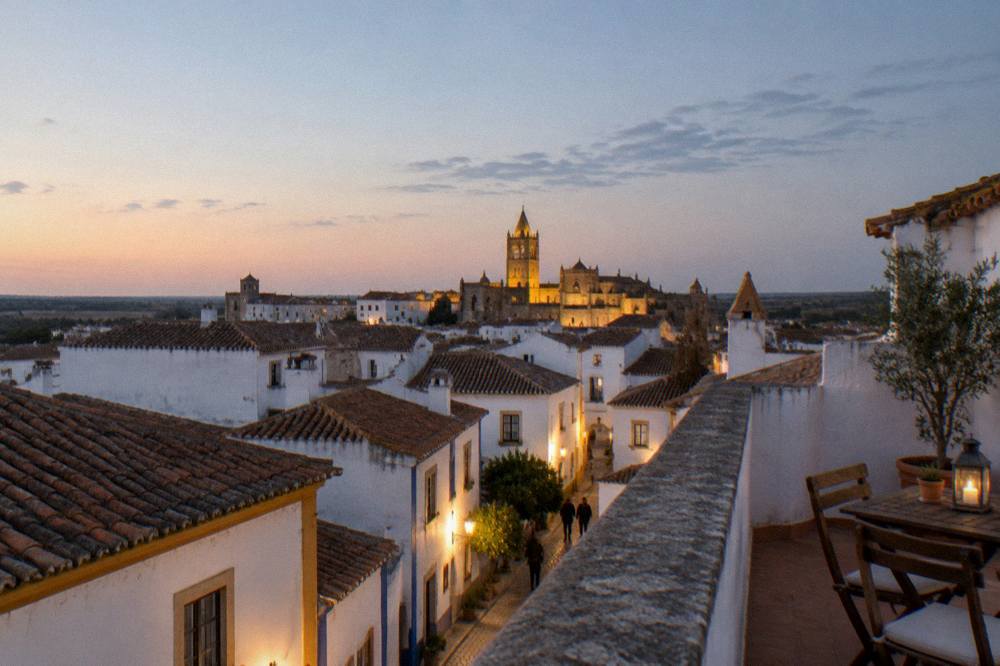
The short version of all of this: choose April, May, late September or October for the weather, late June for the fair, October 2026 for the literature festival, and 2027 for the Capital of Culture, and in every case check the operator's live listing and the official event pages before locking dates, because Évora's calendar is filling faster than it has in a generation.