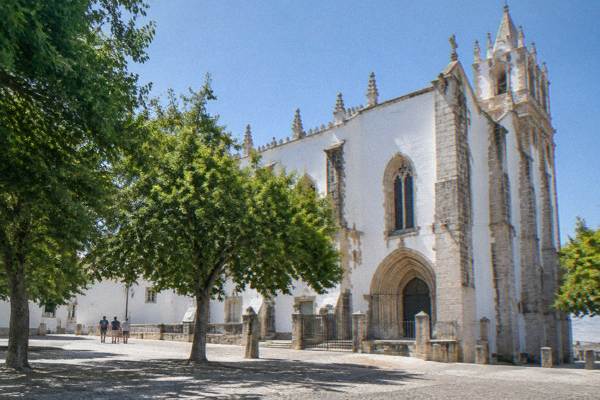
Évora Photography
Évora, the inland capital of the Alentejo, is a compact walled city of whitewashed walls, Roman stone and hard southern light. This guide lists the photo spots that matter, the light to expect, and the practical facts for planning a shoot.
Short answer
The strongest Évora photo spots cluster inside the walls: the Templo Romano, the Sé roof terrace, Praça do Giraldo, the Rua das Casas Pintadas lanes and the Água de Prata aqueduct arches. The Cromeleque dos Almendres, west of the city, is the essential half-day addition.
Évora, in Portugal's Alentejo region, is a city built for photographers without them having to chase anything. The historic centre, inscribed on the UNESCO World Heritage list in 1986 under criteria (ii) and (iv), fits inside a walkable ring of medieval walls, and its palette is fixed: whitewashed walls trimmed in yellow and blue, granite Roman stone, and tile roofs stacked against a wide inland sky. UNESCO's criterion (iv) calls it the finest example of a city of the golden age of Portugal, largely spared the 1755 earthquake that reshaped Lisbon. That survival is exactly what a camera registers here: streets that kept their golden-age bones.
This guide walks through the photo spots that earn their place, the light the Alentejo actually delivers, and the practical layer: tickets, seasons and how to get here. For a broader sightseeing frame, start with the things to do in Évora overview and the longer Alentejo travel guide.
Where Are The Best Évora Photo Spots Inside The Walls?
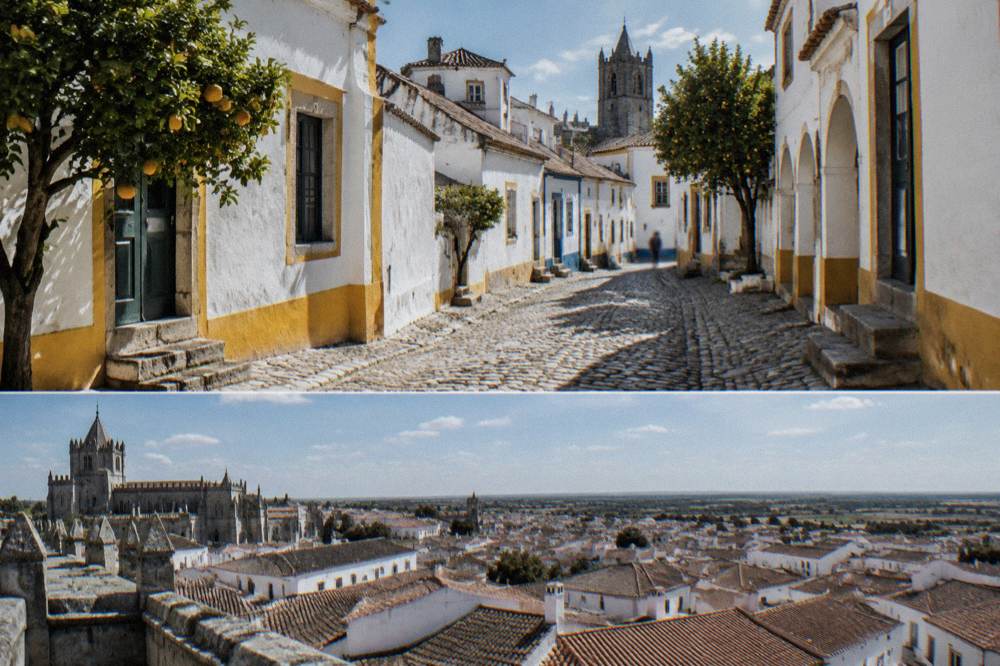
The essential five inside the walls are the Templo Romano, the Sé de Évora with its roof terrace, Praça do Giraldo, the Capela dos Ossos at the Igreja de São Francisco, and the lanes around the Rua das Casas Pintadas and the Convento dos Lóios. All five sit within a few minutes' walk of one another, which is what makes Évora unusually productive for a photographer: the whole set can be covered on foot in a single long morning or two short ones.
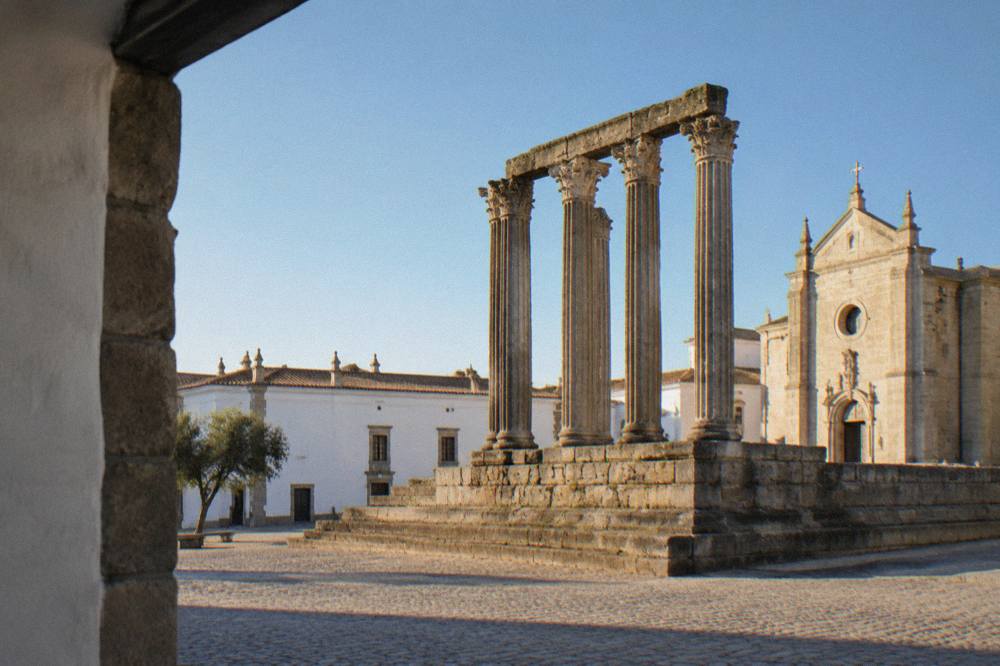
The Templo Romano, popularly called the Temple of Diana, is the city's signature stone. The municipal page for the monument says it was probably dedicated to the imperial cult rather than to the goddess Diana, a name applied only since the 17th century, and that its standing walls were freed from later buildings in 1870. It measures 25 x 15 m and stands in an open precinct with no ticket, so the only planning variable is the light: the granite columns read best in the first or last two hours of the day, when the sun rakes across the fluting. The deeper background of the site is covered in the Roman Temple of Évora guide.
Praça do Giraldo is the other classic frame: a wide public square of arcades, the chafariz fountain at one end, café tables under the arches. As a public square it has no hours and no entry fee, which makes it the most flexible subject in the city. Early morning gives empty stone and long shadows; late afternoon fills the tables and turns the whitewash warm. The square's own guide, Giraldo Square, covers its history and what surrounds it.
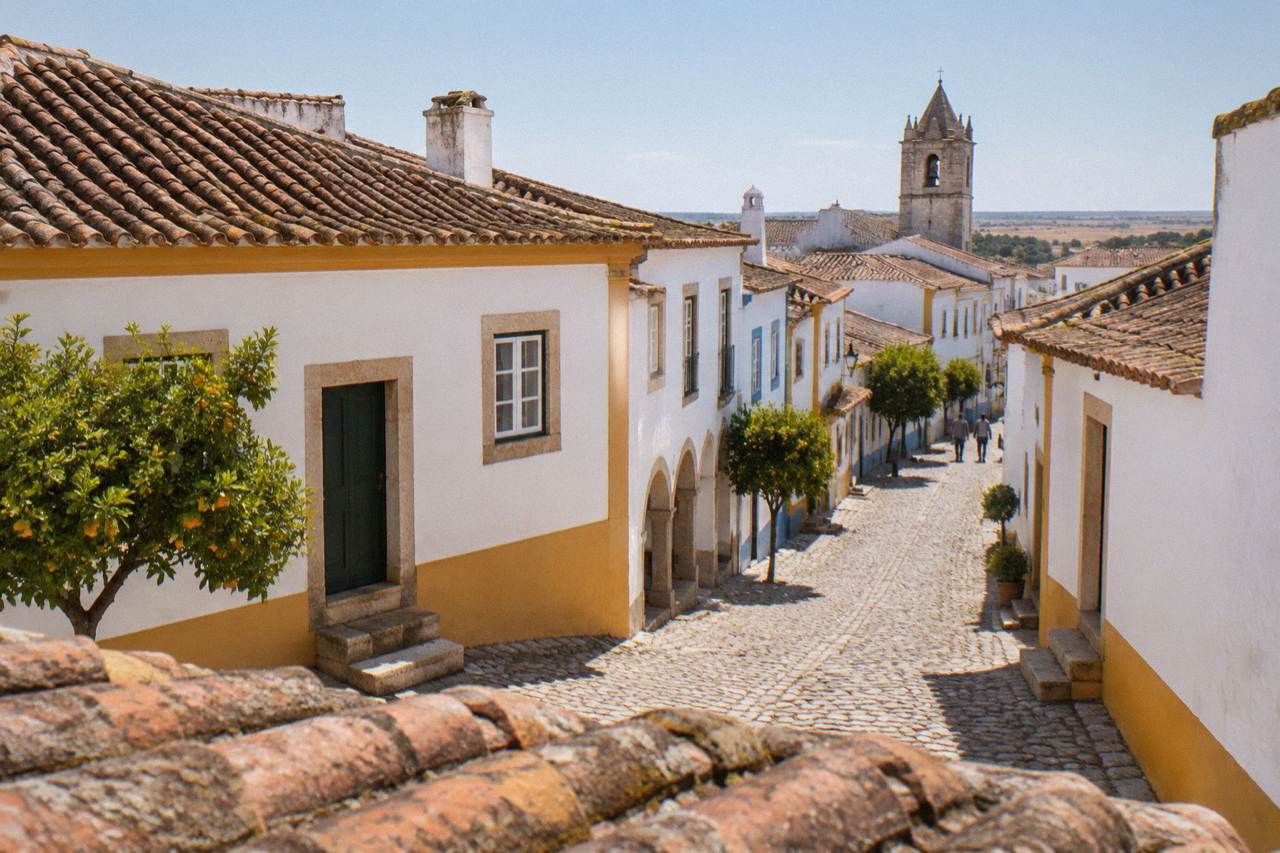
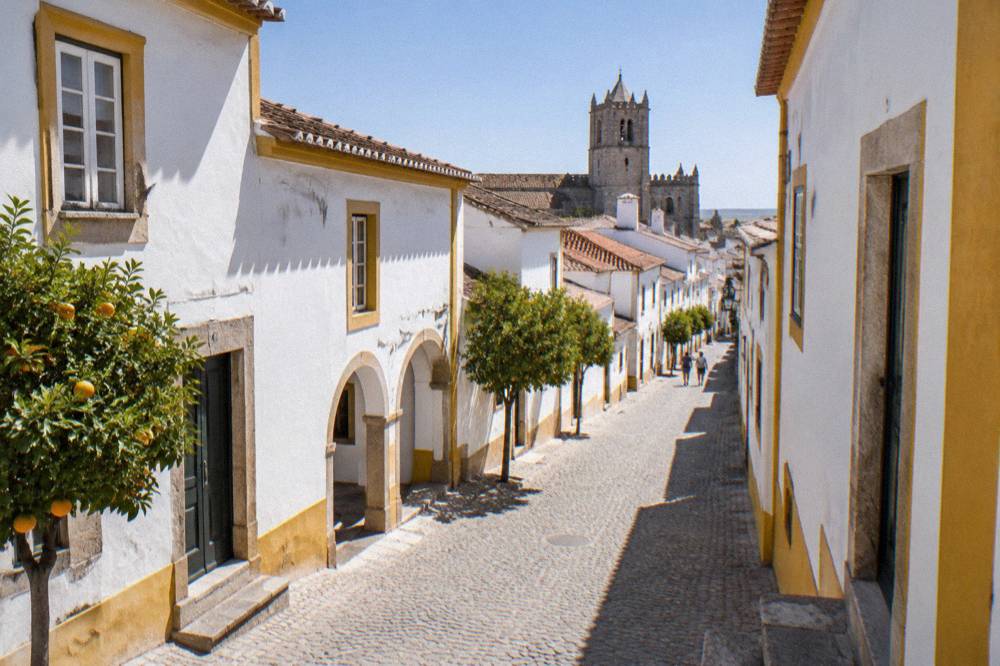
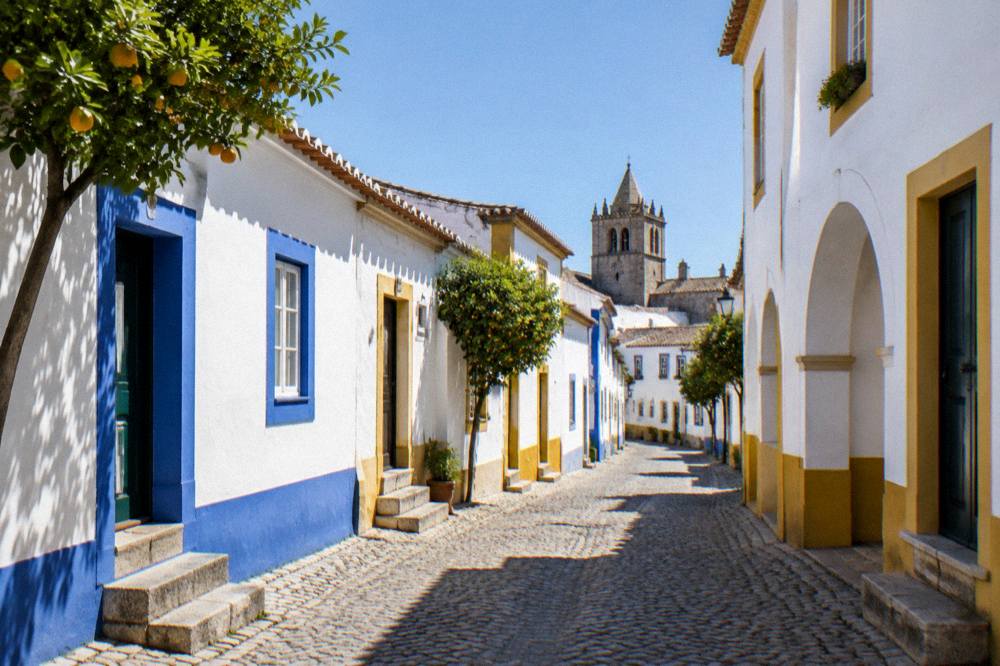
The lanes are the part most visitors under-shoot. The Rua das Casas Pintadas, the stretch toward the Porta da Moura square and the small Jewish quarter streets all deliver the same Alentejo formula: low white walls, colour-banded doorways, laundry lines, and a sky that does something dramatic in about half the year. These streets reward a slow walk with a single lens far more than a checklist of monuments does.
| Photo spot | Type of frame | Access facts that matter |
|---|---|---|
| Templo Romano | Roman columns, open precinct | No ticket; open-air monument |
| Sé de Évora roof terrace | City panorama from height | Complete-visit ticket 5.00 EUR, children to 12 free |
| Praça do Giraldo | Square, arcades, fountain | Public square, no hours or fee |
| Capela dos Ossos, Igreja de São Francisco | Interior chapel detail | Museum ticket 7.00 EUR adult |
| Rua das Casas Pintadas lanes | Street texture, doorways, whitewash | Public streets |
| Água de Prata aqueduct arches | Architecture against the wall line | Viewed from public streets outside the walls |
What Light Does The Alentejo Give A Photographer In Évora?
Évora delivers hard, high-contrast light for most of the year: IPMA's 1991 to 2020 normals for the Évora station show a July mean maximum of 33.3 C and an August mean maximum of 33.5 C, with 31.9 days a year reaching 35 C or more and a record of 45.4 C set on 4 August 2018. Rain concentrates from October onwards, with 81.5 mm in October against 2.7 mm in July, so summer means harsh midday light and strong golden hours.
The numbers deserve a second read because they shape a shooting day. The same station data shows the mean daily maximum climbing from 20.7 C in April to 30.2 C in June, and the number of days at or above 30 C jumping from 5.5 in May to 15.1 in June and 23.7 in July. A photographer working in July is planning around heat, not around light: the middle of the day is for editing, and the productive hours sit at the very edges of the day. The full breakdown is in the site's Évora weather and best time to visit Évora guides.
Winter is a different city for a camera. The mean maximum falls to 14.1 C in January and the mean minimum to 4.5 C, with the lowest temperature on record at -4.2 C, recorded on 4 December 1998 and again on 23 January 2000. Rain days run 8.6 in January and 8.8 in November, so a winter shoot is a lower-light, wetter-weather project, but the white walls hold colour beautifully in overcast conditions and the streets are quieter. There is no sea and no coast anywhere near Évora; the Atlantic is roughly 90 km away, so no marine layer ever softens this light. Everything here is inland continental light.
| Month | Mean max (C) | Mean min (C) | Rain (mm) | Days at 30 C+ |
|---|---|---|---|---|
| March | 18.7 | 6.9 | 60.8 | 0.0 |
| April | 20.7 | 8.5 | 62.1 | 0.3 |
| May | 25.0 | 10.9 | 46.6 | 5.5 |
| June | 30.2 | 13.8 | 10.6 | 15.1 |
| July | 33.3 | 15.6 | 2.7 | 23.7 |
| August | 33.5 | 16.0 | 6.0 | 25.0 |
| September | 29.5 | 14.6 | 33.9 | 13.9 |
| October | 24.1 | 12.3 | 81.5 | 2.9 |
All figures are the 1991 to 2020 averages for the Évora station, number 558.
Which Évora Monuments Photograph Best, And What Do The Tickets Cost?
The two monuments that most reward a camera are the Sé de Évora, whose single 5.00 EUR complete-visit ticket covers the cathedral, the cloister, the roof terrace and the museum with children up to 12 free, and the Capela dos Ossos at the Igreja de São Francisco, whose museum ticket is 7.00 EUR for an adult, 5.00 EUR for youth to 25 and seniors over 65, and 15.00 EUR for a family.
The Évora Ticket pass, at 8 EUR for one day, does not include either.
The Sé is the one place in the city where the frame changes completely: the roof terrace puts the tiled roofs, the Templo Romano below and the plain beyond the walls into one panorama. The cathedral's ticket page states hours of 9:00 to 17:00, with the museum's last admission 30 minutes before closing, and closure on 24 December in the afternoon, 25 December and 1 January. There is no cheaper roof-only tier on the official page, so a photographer buys the complete visit or skips the view. The Évora Cathedral guide covers the interior in detail.
The Capela dos Ossos is an interior subject, and a difficult one: low light, textured walls, and a space that rewards a fast lens and patience. The church's own page states summer hours of 9:00 to 18:30 and winter hours of 9:00 to 17:00, open every day except 1 January, Easter Sunday, 24 December in the afternoon and 25 December. Photography conditions inside should be checked against the notices at the entrance on the day, since no verified rule can be stated here. The chapel's history and context are in the Chapel of Bones Évora guide, and the question of whether the visit earns its ticket is answered in the site's piece on is the Chapel of Bones worth visiting.
A guided option exists for photographers who would rather have someone else handle the queueing. The Évora University, Cathedral & Bones Chapel skip-line tour, from $91.39 per person and rated 5 from 48 reviews on the operator's listing, moves through the university, the cathedral and the chapel with entry handled, and ends with a wine tasting. Check availability
Where Are The Best Views And Panoramas Of Évora?
The best elevated view of Évora is the roof terrace of the Sé de Évora, included in the 5.00 EUR complete-visit ticket, which looks directly down on the Templo Romano and across the whole roofline of the historic centre. The best ground-level panoramas come from outside the walls, along the stretch where the Água de Prata aqueduct arches run against the city silhouette. The Museu de Évora, at 8 EUR for an adult, adds interior museum frames rather than views.
The roof terrace is the shot that defines a photography trip to Évora. Because it looks north over the cathedral's own roofs toward the Templo Romano, the light works from late morning onward, when the sun has cleared the tower and the columns below are fully lit. The Évora rooftop views guide lists the other vantage points, including the wall-walk possibilities.
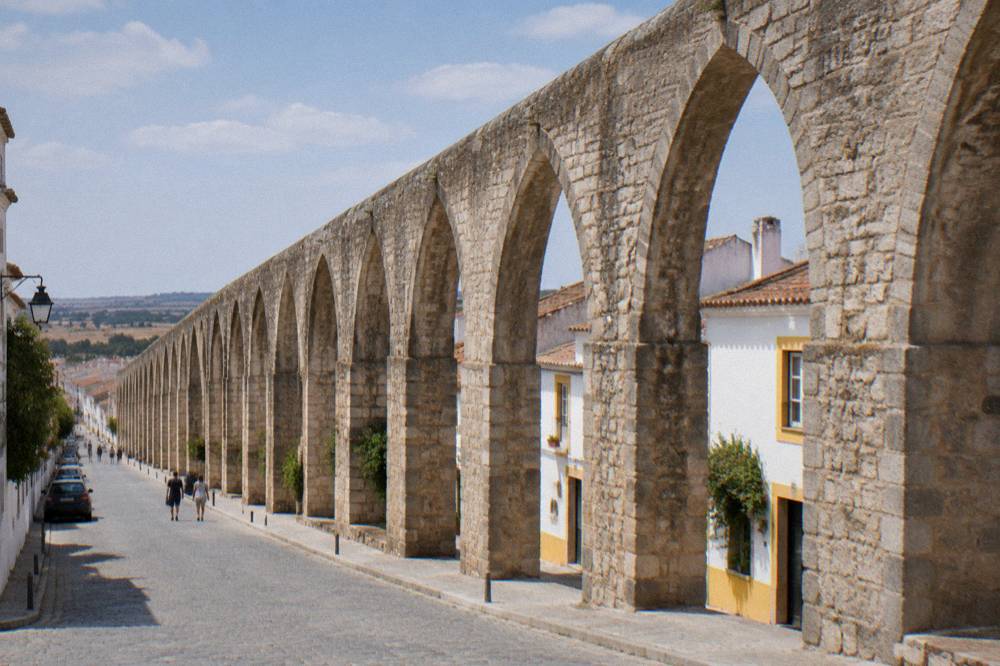
The aqueduct is the counterweight subject. The Água de Prata aqueduct's arches march into the city from the east, and houses were built into and under them in places, which produces the strange, photogenic collision of monumental engineering and domestic life. No verified hours or prices exist for the aqueduct itself, so it should be treated as a streetscape subject: walk the line where it meets the walls and work the arches against the sky. The Água de Prata aqueduct guide covers its history.
For photographers who want the city explained while shooting it, two guided formats stand out. The private walking tour with cathedral and Chapel of Bones, from $113.53 per person and rated 5 from 256 reviews on its listing, moves at its own pace through the centre with monument tickets included. The Medieval Tour of Évora on a sidecar, from $61.90 per person and rated 4.9 from 16 reviews, covers the medieval city from a vintage motorcycle sidecar with a wine tasting, which is also simply a moving camera platform with a driver who knows the lanes.
The sidecar format suits a specific kind of shooting day: one where the photographer wants coverage of the whole medieval street plan quickly, before the light gets hard, and is happy to shoot on the move rather than wait a scene out.
What Are The Best Photo Spots Outside The Walls Of Évora?
The essential outside-the-walls subject is the Cromeleque dos Almendres, reached by taking the national road from Évora toward Lisbon and, after 8 km, following the turn-off as the Almendres Interpretation Centre's page directs. The centre in the village of Guadalupe keeps summer hours of 10:00 to 18:00 from 1 May to 31 October and winter hours of 10:00 to 17:00 from 1 November to 30 April.
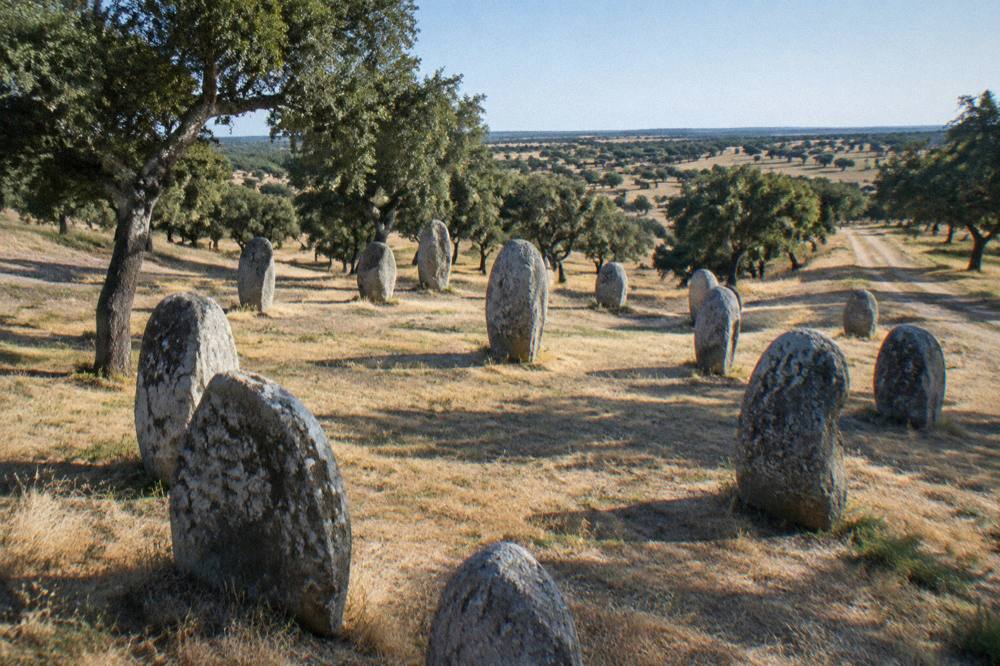
The stones stand in the open landscape, free to approach, and they are the strongest wide-frame subject in the Évora area.
The cromlech is the reason many photographers make the trip at all. A stone circle set on a low slope among cork oaks, it photographs completely differently from anything inside the walls: wide lenses, sky, weather, and the texture of the Alentejo plain. The best hours are the ends of the day, when the stones throw long shadows and the light comes low across the plain. The site's archaeology and context are in the Almendres Cromlech guide, and the wider set of surrounding sites in the megalithic sites near Évora and Évora archaeological sites guides.
Getting there independently means a car or a tour. The Cromlech of Almendres and Great Dolmen of Zambujeiro tour, from $33.76 per person and rated 5 from 54 reviews, covers the cromlech and the dolmen in a three-hour trip from Évora. The archaeologist-led half-day version, the Half Day Megaliths Cromlech Tour, from $74.54 per person and rated 5 from 77 reviews, adds interpretation a photographer can use. Both are collected with the rest in the Évora tours overview.
Beyond the megaliths, the day-trip towns each carry a distinct photographic subject, and the site's guides cover them individually: marble at Vila Viçosa, the hilltop silhouette of Monsaraz, the castle towns of Estremoz and Marvão. Other pages covering the same trip are gathered on Évora Travel Guide.
How Do You Plan A Photography Day Around Évora'S Light And Crowds?
A productive day in Évora starts at the Templo Romano and the lanes in the first two hours of morning light, moves indoors to the Sé, its cloister and the Capela dos Ossos during the harsh midday hours, returns to Praça do Giraldo in late afternoon as the tables fill, and finishes from the aqueduct side as the sun drops behind the walls.
In summer the heat forces this rhythm, with 23.7 July days and 25.0 August days at 30 C or more in the 1991 to 2020 normals.
The interior slots matter more than they seem. The Sé's hours of 9:00 to 17:00 and the Capela dos Ossos's summer hours of 9:00 to 18:30 both open early enough that the indoor block can absorb the whole middle of the day. The Museu de Évora runs Tuesday to Sunday, 9:30 to 13:00 and 14:00 to 17:30, closed Mondays, at 8 EUR for an adult, with 50 percent off for youth 13 to 24, seniors over 65 and a family ticket, and free entry to age 12. Its closure list also includes 1 January, Easter Sunday, 1 May, 29 June and 25 December.
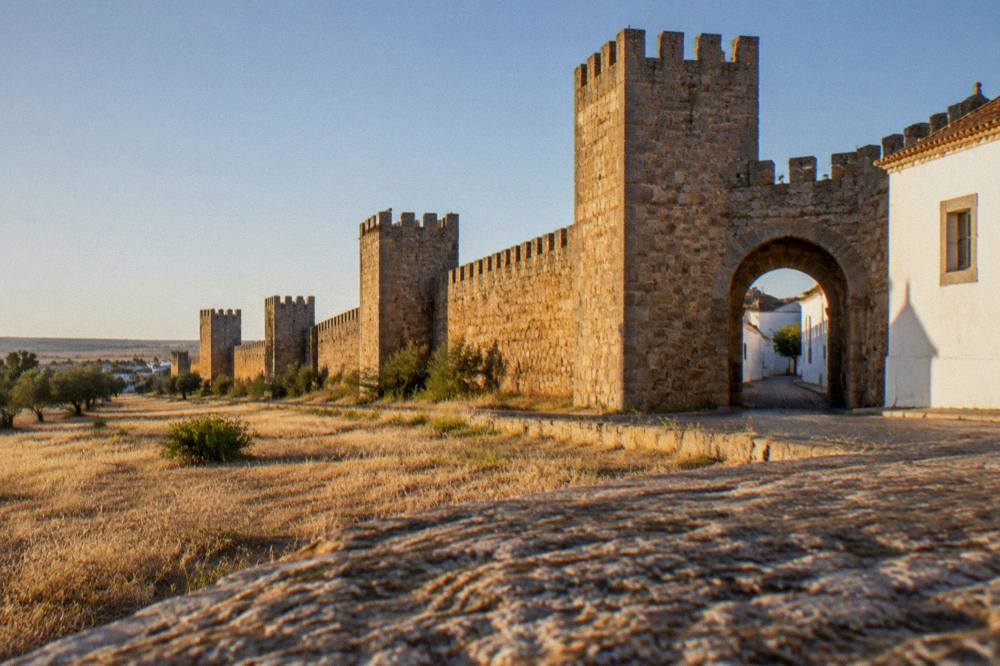
For a two-frame structure, the second day belongs outside the walls: the aqueduct line in the morning, the drive to Almendres for late afternoon, and the wall silhouette at sunset. The site's one day in Évora and two days in Évora itineraries carry the non-photographic version of the same plan, and the outside the walls guide covers the ground beyond the ramparts.
| Time block | Subject | Why it works then |
|---|---|---|
| First two hours of light | Templo Romano, painted lanes | Raking light on stone, empty streets |
| Mid-morning | Praça do Giraldo, arcades | Soft side light before the overhead hours |
| Midday | Sé interior and cloister, Capela dos Ossos | Indoor subjects during the harshest light |
| Late afternoon | Giraldo tables, Rua das Casas Pintadas | Warm colour on whitewash, street life |
| Last hour | Aqueduct arches, wall silhouette | Backlight and silhouette conditions |
What Gear And Practical Details Matter For Photographing Évora?
The kit that suits Évora is light and wide: a standard zoom for the lanes, a wide lens for the Templo Romano and the cromlech, and a fast prime for the dark interiors of the Sé and the Capela dos Ossos, where a tripod may not be welcome and higher ISO work is the realistic answer.
A hat and water matter more than any lens in summer, because the same station data that gives a 33.3 C July mean maximum also records 45.4 C as the all-time high.
Interiors are the technical challenge. The cathedral's museum and cloister and the bone chapel are all low-light spaces, and no verified photography rule for either can be stated here, so the working assumption should be hand-held and discreet, with the notices at each entrance checked on the day. The Museu de Évora's split hours, closed Mondays, mean a museum interior shoot has to be planned around a 9:30 to 13:00 or 14:00 to 17:30 window.
Practical costs are modest and mostly fixed. The Sé complete visit at 5.00 EUR, the Capela dos Ossos at 7.00 EUR and the Museu de Évora at 8 EUR together cost less than a single entry at many European cathedrals, and children up to 12 enter the Sé free. A municipal tourist tax applies to hotel stays, with no amount stated here, so the figure to check is on the booking confirmation. The budget picture, including food and lodging ranges, is laid out in the Évora cost and budget guide.
How Do You Get To Évora For A Photography Trip?
CP's Intercidades timetable, valid since 6 September 2026, lists six through trains from Lisboa Oriente to Évora, departing at 07:02, 09:02, 09:58, 13:35, 17:02 and 19:02 and arriving at 08:47, 10:45, 11:40, 15:13, 18:41 and 20:46, a journey of about 1 hour 40 to 1 hour 45 with no change needed.
The fare is 13.90 EUR in second class and 18.50 EUR in first class, and the 07:02 departure lands at 08:47, in time for first light.
That early train is the single most useful planning fact on this page. Lisbon is about 130 km away, and the through service means a photography day can start with the morning block rather than lose it to travel. The details of the route, including the stops at Entrecampos, Sete Rios, Pragal, Pinhal Novo, Vendas Novas and Casa Branca, are in the Lisbon to Évora by train guide, with the wider options in Lisbon to Évora and best day trips from Lisbon.
For photographers travelling with a car, the Évora parking guide covers where to leave one, and the Lisbon to Évora by car guide covers the drive. Returning, Évora to Lisbon and Évora to Lisbon airport close the loop.
| Depart Lisboa Oriente | Arrive Évora | Class | Fare |
|---|---|---|---|
| 07:02 | 08:47 | 2nd | 13.90 EUR |
| 09:02 | 10:45 | 2nd | 13.90 EUR |
| 09:58 | 11:40 | 1st | 18.50 EUR |
| 13:35 | 15:13 | 2nd | 13.90 EUR |
| 17:02 | 18:41 | 1st | 18.50 EUR |
| 19:02 | 20:46 | 2nd | 13.90 EUR |
Fares are the CP Intercidades prices for the Lisboa Oriente to Évora journey; both classes run on every departure, and the table shows one class per row for illustration. Check the operator's live timetable before travelling.
Should You Photograph Évora With A Guide Or On Your Own?
Évora photographs well on foot, because the core subjects are close together, cheap to enter and walkable, but a guide earns its cost when time is short or the monuments are the priority: the private skip-line tour at from $91.39 per person, rated 5 from 48 reviews, handles the university, the cathedral and the Capela dos Ossos with entry organised, while the sidecar tour at from $61.90 per person, rated 4.9 from 16 reviews, turns street work into a moving platform.
A photographer with two days needs neither.
The honest split is by subject. Street and light work in Évora is a solo discipline: the lanes reward waiting, and no guide improves a doorway at 08:30. Monument interiors are where a guide saves time, because the skip-line formats remove the ticket-and-queue friction at the two busiest sites. The Évora walking tour guide compares the guided formats in detail, and the free GuruWalk options, including the Essential Free Tour of Évora, rated 4.93 from 774 reviews, cover the same ground on a tip basis for photographers who want orientation before a solo shoot.
The private format is the one to pick when the shot list is fixed in advance: the pace follows the photographer, not a route, and the monument tickets are handled so no frame is lost standing in a queue.
Common Questions About Évora Photography
What are the best photo spots in Évora?
The Templo Romano, the Sé roof terrace, Praça do Giraldo, the Capela dos Ossos, the painted lanes around Rua das Casas Pintadas and the Água de Prata aqueduct arches are the core set, with the Cromeleque dos Almendres outside the city as the essential half-day addition.
Can you photograph inside the Capela dos Ossos?
No verified photography rule for the Capela dos Ossos can be stated here. Check the notices at the entrance on the day of the visit, and plan for low-light, hand-held work in any case.
Where is the best view over Évora's rooftops?
The roof terrace of the Sé de Évora, included in the 5.00 EUR complete-visit ticket, looks over the Templo Romano and the whole roofline of the historic centre. The aqueduct side of the walls gives the best ground-level silhouette at sunset.
What season gives the best light for photographing Évora?
The shoulder months. IPMA's 1991 to 2020 normals for the Évora station show July and August mean maximums of 33.3 C and 33.5 C with 23.7 and 25.0 days at 30 C or more, so summer light is harsh and the productive hours are early and late. Spring and autumn give milder working conditions and more usable hours.
How do you get to the Almendres cromlech for photos?
Take the national road from Évora toward Lisbon and, after 8 km, follow the turn-off, as the Almendres Interpretation Centre's page directs. The centre in Guadalupe keeps hours of 10:00 to 18:00 in summer and 10:00 to 17:00 in winter, and guided tours from Évora run to the cromlech and the Great Dolmen of Zambujeiro.
Is Évora a good photography destination without a car?
Yes for the city itself, since every core subject inside the walls is walkable and the train from Lisbon runs six through services a day. A car or a tour is only needed for the cromlech and the day-trip towns such as Monsaraz and Vila Viçosa.
Évora rewards a camera in a way few inland European cities of its size do, because everything a photographer needs sits inside a wall a short walk across, and the one great subject outside it, the Almendres cromlech, is an easy half-day away. Plan around the light the Alentejo actually gives, buy the two monument tickets that matter, and the city does the rest.