Almendres Cromlech Near Évora In Portugal: Standing Stones, Hours And Tours
The Cromeleque dos Almendres is a prehistoric standing-stone site on the Alentejo plain a short drive from Évora, Portugal. This guide covers what it is, how to reach it, opening hours for the interpretation centre and the guided tours that visit it.
Short answer
The Almendres Cromlech is a prehistoric group of standing stones near Guadalupe village, reached from Évora by the national road toward Lisbon with a turn-off after 8 km. The interpretation centre is open 10:00-18:00 in summer and 10:00-17:00 in winter, and entry to the stones themselves is reported free.
The Cromeleque dos Almendres is a prehistoric standing-stone site on the open Alentejo plain, a short drive west of Évora, Portugal, the inland capital of the district and of the Central Alentejo sub-region that gives the city its name. There is no sea here and no coast: the Atlantic lies far away, and what surrounds the stones is cork oak, olive groves and a horizon that seems to run on without end. A cromlech, by definition, is a circle or group of standing stones, and Almendres is the best known example of one in the Évora area. This guide covers what the site is, how to get there from Évora, the interpretation centre's hours, the guided tours that visit it, and what else to build into a day around it.
What Is The Almendres Cromlech Near Évora?
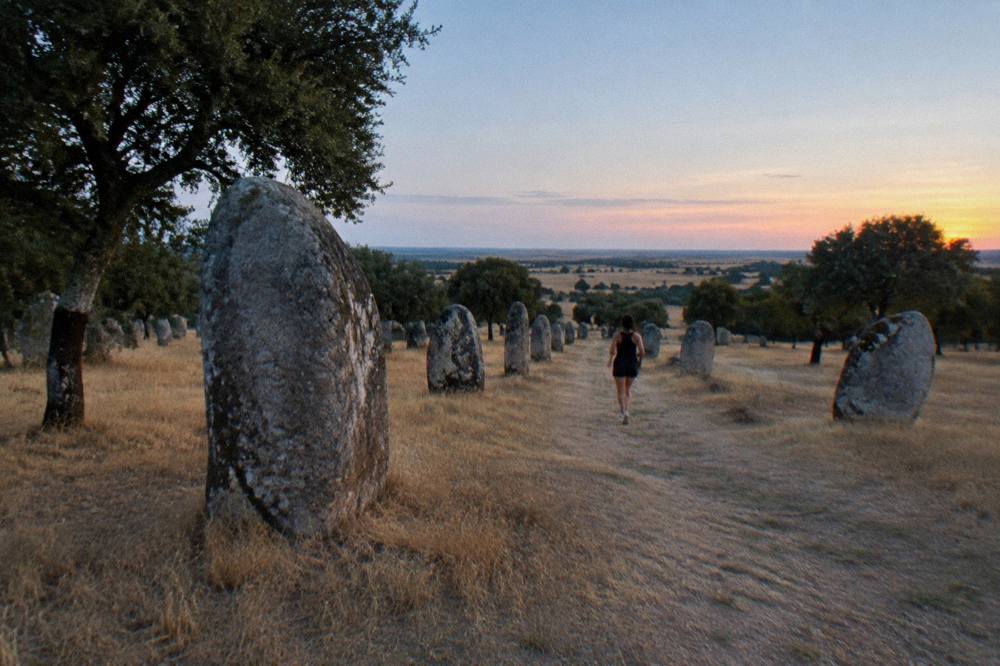
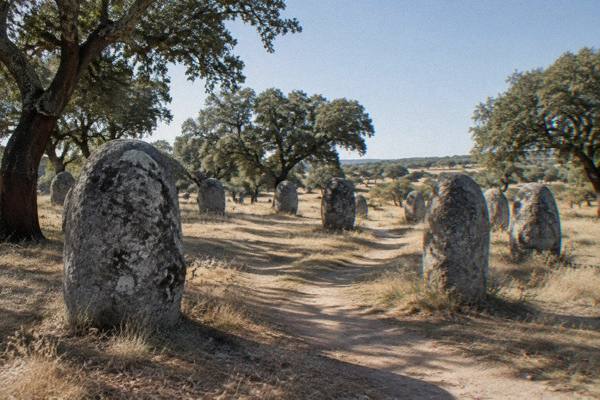
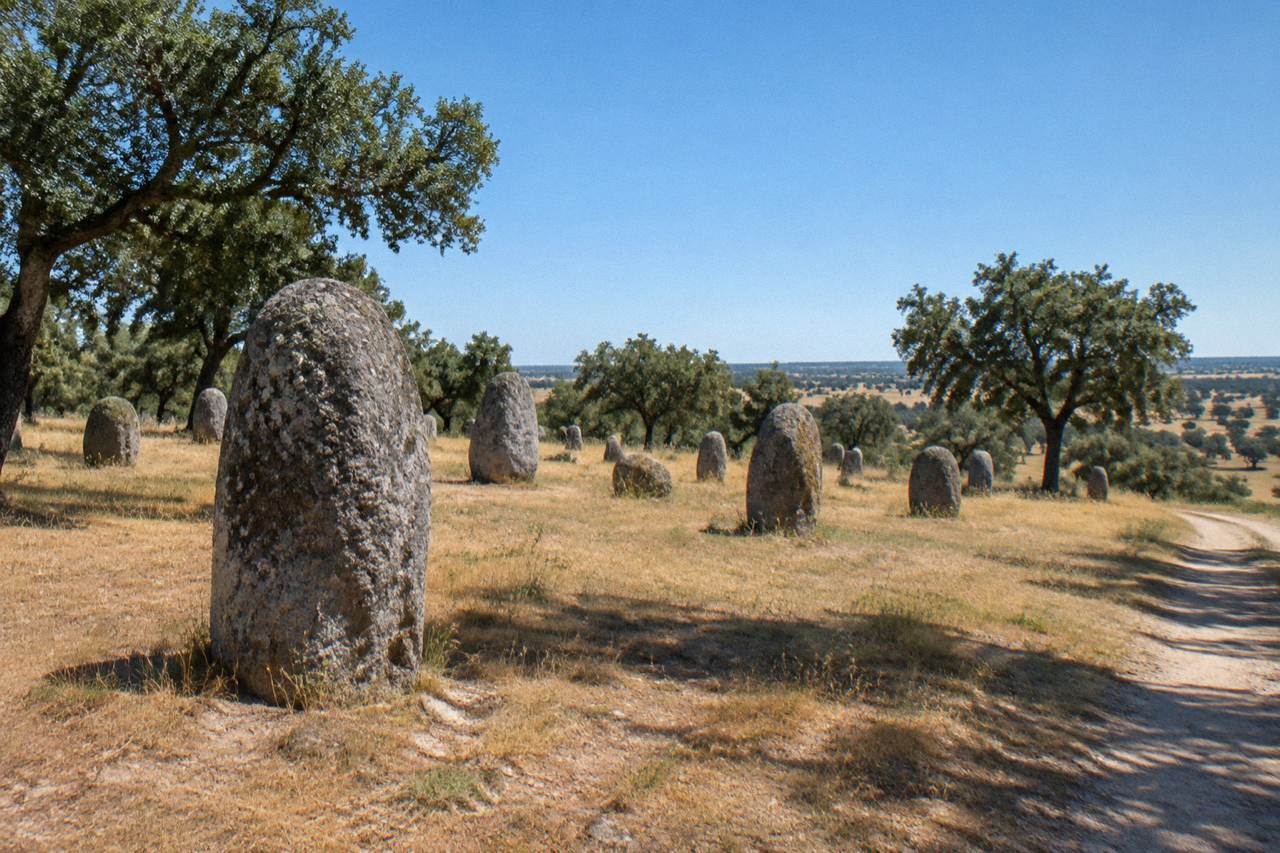
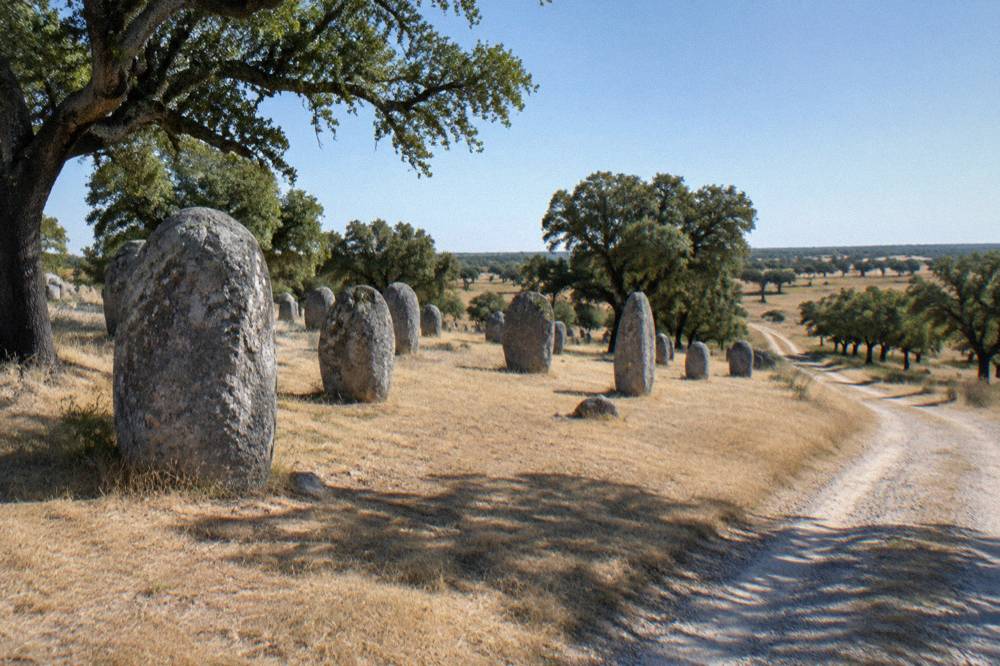
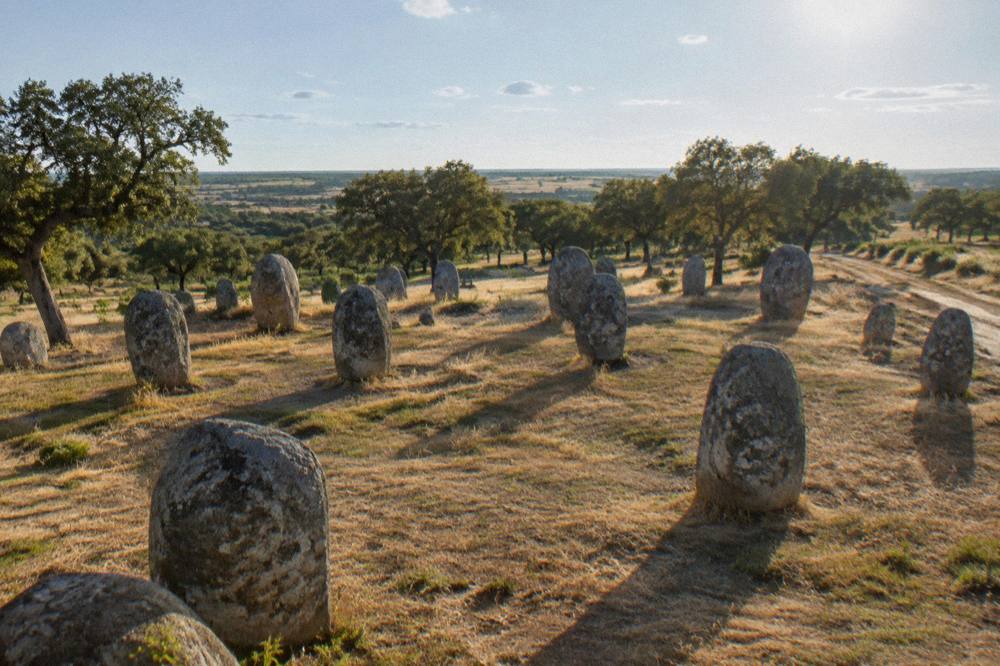
The Almendres Cromlech is a prehistoric group of standing stones arranged in patterns on a hillside near Guadalupe village, west of Évora in the Alentejo. A cromlech is a circle or group of standing stones, and Almendres is the most visited example in the Évora area. The stones stand in open countryside with no barrier or building around them, and the site is part of a wider scatter of megalithic monuments across the plain around the city.
The stones sit within a landscape that archaeologists describe as one of the densest concentrations of prehistoric monuments in the region. The plain around Évora carries menhirs, dolmens and settlement sites as well as this cromlech, and several of them can be reached on the same half-day loop if you have a car or a guide. The municipality and its partners document this network through the Almendres Interpretation Centre in Guadalupe, which is the practical base for a visit.
What strikes most visitors first is the setting rather than the stones themselves. The hillside is quiet, wide and low, and the stones rise out of grass and scrub with nothing modern in sight except the track you arrived on. Early morning and late afternoon light across the plain are the reasons photographers plan their timing around the sun rather than the clock.
The site is often compared with Stonehenge, and the comparison is fair only in the narrow sense that both are prehistoric standing-stone sites. For the difference between the two forms, see the cromlech versus Stonehenge explainer elsewhere in this guide's answers section.
How Do You Get To The Almendres Cromlech From Évora?
The site is reached from Évora by taking the national road toward Lisbon and, after 8 km, following the turn-off signposted toward the stones, as the interpretation centre's own directions describe. The Almendres Interpretation Centre sits in Guadalupe village on Rua do Cromeleque, at GPS 38.567801, -8.027456. There is no verified public bus route to the stones, so the practical options are a hire car, a taxi arranged locally, or a guided tour with transport included.
For independent drivers, the directions published by the interpretation centre are simple: national road toward Lisbon out of Évora, 8 km, then the turn-off. The final stretch is on minor rural roads, so allow more time than the bare distance suggests and drive slowly through the farmland. Parking at the site is informal; arrive early in high season if you want the stones to yourself.
Guided tours solve the transport question entirely, and several depart from Évora itself. The Cromlech of Almendres and Great Dolmen of Zambujeiro tour is the direct option, a 3-hour trip from $33.76 per person, rated 5 from 54 reviews, and it pairs the cromlech with the Great Dolmen of Zambujeiro, another of the plain's major megalithic monuments. If you would rather not drive on unfamiliar rural roads, that is the decision this tour exists for: Check availability.
| Option | How it works | What to know |
|---|---|---|
| Hire car from Évora | National road toward Lisbon, turn-off after 8 km | Minor rural roads at the end; drive slowly |
| Guided tour from Évora | Pickup in the city, transport and commentary included | From $33.76 per person for the 3-hour cromlech and dolmen tour |
| Taxi arranged locally | Book in Évora and agree a return pickup time | Agree the return time before you are dropped off |
Tours starting in Lisbon that visit Évora and the megaliths also exist, including an 8-hour private option from $90.04 per person rated 4.7 from 576 reviews, but those are Lisbon day trips and belong in a different plan. If Évora is your base, choose a tour that starts in the city.
When Is The Almendres Interpretation Centre Open, And What Does It Cost?
The Almendres Interpretation Centre in Guadalupe is open 10:00-18:00 in summer, defined as 1 May to 31 October, and 10:00-17:00 in winter, defined as 1 November to 30 April. The centre is a partner of the Évora municipality and sits on Rua do Cromeleque in Guadalupe. Entry to the stones themselves is reported free, though that is not confirmed on an official page, so check at the centre before you set out.
The centre is the place to start if you want context before standing among the stones. It covers the megalithic network of the Évora plain, explains what a cromlech is and how these sites are studied, and gives directions and conditions for the tracks out to the monuments. Its published hours are the only fixed schedule attached to a visit here, since the stones stand in open country with no gate or ticket point of their own.
| Item | Detail |
|---|---|
| Centre address | Rua do Cromeleque, Guadalupe village |
| GPS | 38.567801, -8.027456 |
| Summer hours (1 May to 31 Oct) | 10:00-18:00 |
| Winter hours (1 Nov to 30 Apr) | 10:00-17:00 |
| Entry to the stones | Reported free; confirm at the centre |
Plan around the seasons rather than the clock. In summer the plain is brutally hot by midday: IPMA's 1991-2020 normals for the Évora station show a July mean maximum of 33.3 C and an August mean maximum of 33.5 C, with 11.5 and 10.9 days a year respectively at 35 C or more. A morning visit to the stones, the centre, and then shade in Évora is the shape of a sensible summer day.
What Can You Actually See At The Cromeleque Dos Almendres?
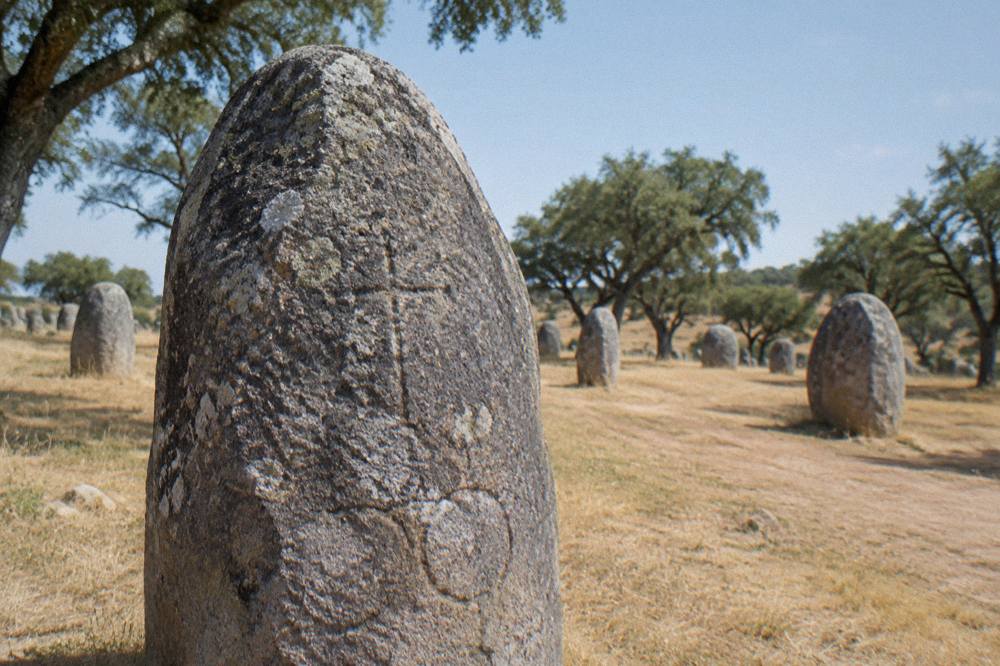
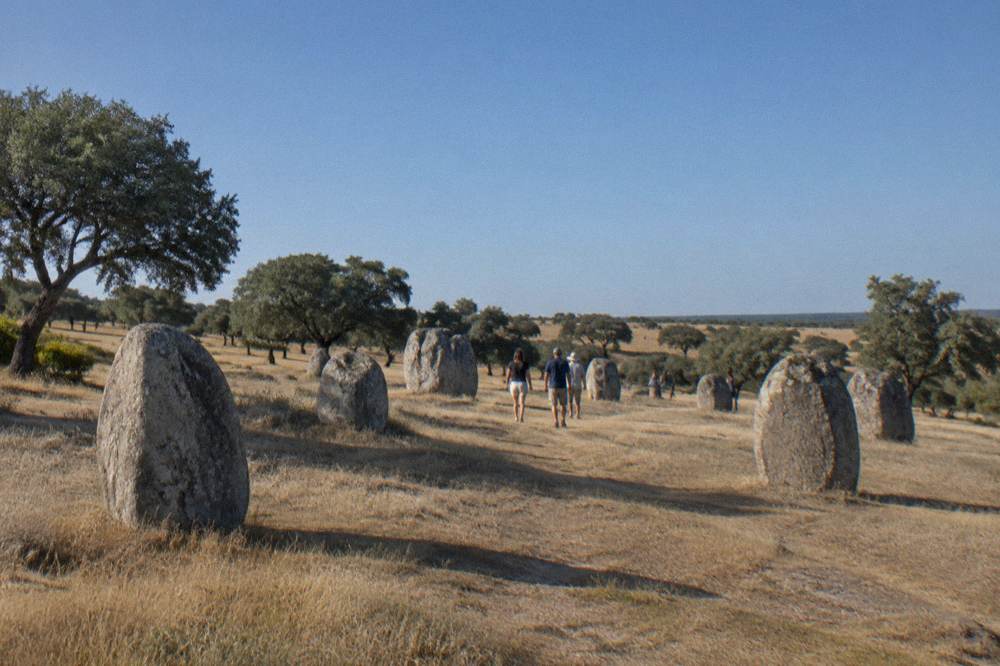
What you see at Almendres is a group of standing stones, some plain and some carved with faint markings, set in patterns across a low hillside of grass, cork oak and open sky. The stones are the whole attraction: there is no visitor building at the site itself, no fence and no interpretive panels in the field, which is why the interpretation centre in Guadalupe exists to carry that load. The walk between stones and the surrounding plain are as much the experience as the monument.
Approach the stones on foot from wherever you park, and give the field time. The arrangements are best read slowly, walking the perimeter and then cutting through the middle, and the carvings on individual stones show up better in low, raking light than at noon. Visitors who arrive in the middle of a July afternoon tend to see a hot field; those who come early see the monument.
Respect the stones plainly: do not climb on them, do not rub the carvings, and leave the tracks as you found them. The site has survived on an open plain for a very long time precisely because nothing stands between it and the visitor except the visitor's own conduct. There are no wardens in the field, so the etiquette is on you.
The plain around the cromlech holds other monuments from the same prehistoric world, including the Great Dolmen of Zambujeiro, which is one of the largest chambered tombs of its kind in the region and is included in the 3-hour guided tour from Évora. For the wider picture of the city's ancient sites, from Roman Évora to the megalithic plain, see the Évora archaeological sites overview.
Is The Almendres Cromlech Like Stonehenge?
Almendres and Stonehenge are both prehistoric standing-stone sites, and that is where the honest comparison begins and ends. A cromlech is a circle or group of standing stones, a definition that fits Almendres exactly, while Stonehenge is a single monumental circle with a different form of construction. Almendres has no visitor building at the stones, no fence and reported free access, which gives a visit a far more open, informal character than a ticketed monument.
The temptation with any famous standing-stone site is to reach for rankings, ages and counts. Resist it here. What matters for a visitor deciding whether to go is the experience on the ground: an unfenced hillside, a short walk, and stones you can stand beside at length. The Almendres stones carry faint carvings that reward slow looking, and the plain around them holds further monuments you can add to the same drive.
For the formal difference between the two monument types, in plain language, read the difference between Stonehenge and a cromlech. The short version is that a cromlech is a circle or group of standing stones, a category Almendres belongs to, and that both sites are prehistoric standing-stone monuments with nothing more claimed for either by way of age or ranking on this page.
Which Guided Tours Visit The Almendres Cromlech?
The direct option is the 3-hour Cromlech of Almendres and Great Dolmen of Zambujeiro tour from Évora, from $33.76 per person and rated 5 from 54 reviews. An archaeologist-led half-day megaliths tour from $74.54 per person, rated 5 from 77 reviews, adds expert commentary, and a 4-hour megalithic and cork forest combination from $50.65 per person, rated 4.9 from 41 reviews, pairs the stones with the Alentejo's other famous landscape. All three start in Évora.
Guides earn their fee at a site like this. The stones speak only to those who can read them, and a guide who knows the plain can point out carvings you would walk past, explain what a cromlech is and how these monuments are studied, and handle the rural driving. For visitors without a car, the tour is not a luxury but the only practical route.
| Tour from Évora | Price | Rating | Duration |
|---|---|---|---|
| Cromlech of Almendres and Great Dolmen of Zambujeiro | from $33.76 | 5 from 54 reviews | 3 hours |
| Half-Day Megaliths Cromlech Tour by Archaeologists | from $74.54 | 5 from 77 reviews | half day |
| Megalithic and Cork Forest guided tour | from $50.65 | 4.9 from 41 reviews | 4 hours |
| Évora and Megaliths Full-Day Tour (starts in Lisbon) | from $90.04 | 4.7 from 576 reviews | 8 hours |
The archaeologist-led half-day tour is the choice for visitors who want the deepest available commentary, since it is led by people who study these landscapes professionally. The megalithic and cork forest combination suits travellers who want one morning to cover both the plain's prehistory and the living landscape of the cork oak that defines the Alentejo.
If your time in the region is anchored in the capital rather than the Alentejo, Lisbon-start day trips that visit Évora and the megaliths exist, including a full-day private tour from $90.04 per person rated 4.7 from 576 reviews and a second option from $91.74 per person rated 4.7 from 165 reviews. Those are described accurately as starting in Lisbon, and they trade depth in Évora for the convenience of not changing base.
What Else Should You Combine With A Visit To The Stones?
The strongest pairing is the Almendres Cromlech with Évora's own monuments: the Sé de Évora at 5.00 EUR for the complete visit, the Capela dos Ossos at 7.00 EUR adult, and the Museu de Évora at 8 EUR. The Évora Ticket, at 8 EUR for one day, 10 EUR for two and 12 EUR for three, covers the city's Cidade-Museu network, though it does not include the Sé, the Capela dos Ossos or the Museu de Évora.
A morning at the stones and an afternoon in the city is the classic Évora day, and it works because the two halves are so different. The plain gives you silence and prehistory; the historic centre gives you the Sé's roof terrace, the Roman temple on its square, and the cool interiors that a hot afternoon demands. Start with the stones while the light is low and the heat has not built, then retreat inside the walls.
| Évora monument | Ticket | Hours and notes |
|---|---|---|
| Sé de Évora, complete visit | 5.00 EUR | 9:00-17:00, children to 12 free, closed 24 Dec afternoon, 25 Dec, 1 Jan |
| Capela dos Ossos, Igreja de São Francisco | 7.00 EUR adult | Summer 9:00-18:30, winter 9:00-17:00, open daily except 1 Jan, Easter Sunday, 24 Dec afternoon, 25 Dec |
| Museu de Évora | 8 EUR adult | Tue-Sun 9:30-13:00 and 14:00-17:30, closed Mondays |
| Évora Ticket | 8 EUR one day, 10 EUR two days, 12 EUR three days | Free to age 12; does not include the Sé, the Capela dos Ossos or the Museu de Évora |
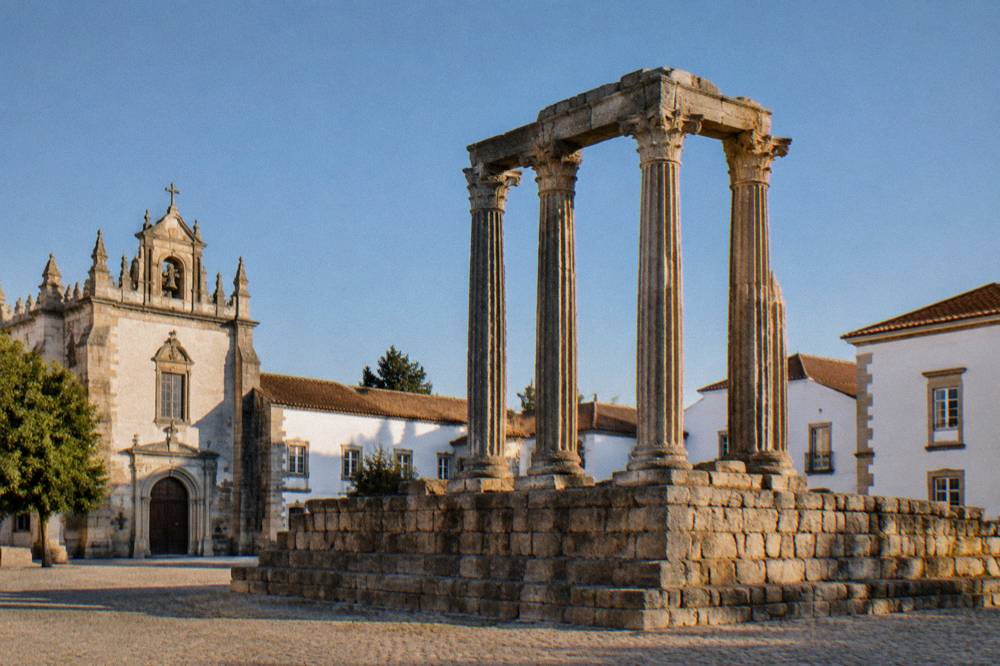
The Roman temple, popularly called the Temple of Diana, belongs on the same afternoon: the municipal page says it probably served the imperial cult rather than the goddess, measures 25 x 15 m, and once housed a butcher's shop before its walls were freed in 1870. The Roman temple guide covers it in full, and the Capela dos Ossos guide does the same for the city's most famous interior.
Back in the centre, the Évora Tales and Legends guided walking tour, from $52.90 per person and rated 4.8 from 40 reviews over 2.5 hours, walks the historic centre's stories after dark, which pairs well with a megaliths morning: . A simpler daytime alternative is the Évora walking tour, from $53.90 per person, rated 4.8 from 37 reviews.
For the full menu of the city's sights, read the things to do in Évora overview, which sequences the monuments, the plain and the food into complete days.
When Is The Best Time Of Year To Visit The Almendres Cromlech?
Spring and autumn are the best seasons for the Almendres Cromlech, because the plain is walkable and the light is good without the summer's heat. IPMA's 1991-2020 normals for the Évora station show April with a mean maximum of 20.7 C and October with 24.1 C, against July and August means of 33.3 C and 33.5 C, and the site has almost no shade. Summer visits are best made in the first hours after the interpretation centre opens at 10:00.
The numbers tell the story plainly. The same normals record 31.9 days a year at 35 C or more, with the record maximum of 45.4 C set on 4 August 2018, and 23.7 days at 30 C or more in July alone. Rain is the winter trade-off: November averages 86.0 mm and December 85.1 mm across 8.8 and 8.7 days with 1 mm or more, while July averages just 2.7 mm over 0.6 days. The stones are always reachable, but a wet December track is a different walk from a dry May one.
| Month | Mean max (C), 1991-2020 | Days max 30 C+ | Days with 1 mm+ rain |
|---|---|---|---|
| April | 20.7 | 0.3 | 8.0 |
| May | 25.0 | 5.5 | 6.0 |
| June | 30.2 | 15.1 | 1.7 |
| July | 33.3 | 23.7 | 0.6 |
| September | 29.5 | 13.9 | 3.6 |
| October | 24.1 | 2.9 | 7.7 |
Whatever the month, bring more water than feels reasonable, a hat, and shoes that can handle a dirt track. The Alentejo plain offers no shelter, no shop and no tap at the stones, and the nearest facilities are back in Guadalupe or Évora.
How Does The Almendres Cromlech Fit Into The Alentejo'S Bigger Picture?
The cromlech is one piece of a megalithic landscape that spreads across the plain around Évora and out through the Alentejo, and it sits inside a region that UNESCO recognised at its centre: the Historic Centre of Évora was inscribed in 1986 under criteria (ii) and (iv), with criterion (iv) calling it the finest example of a city of the golden age of Portugal after the 1755 Lisbon earthquake. The stones predate that city by an unimaginable stretch, and the contrast is the point.
Read together, the plain and the city give the Alentejo its depth. The megalithic monuments belong to a prehistoric world of farmers and herders; the Roman temple, the walls and the aqueduct belong to an empire; the Sé, the churches and the university belong to Portugal's golden age. A visitor who sees only the historic centre misses half of what the region is.
The Alentejo is also a living landscape of cork oak, marble towns and wine, and the same half-day drives that reach the stones reach those too. Arraiolos lies about 20 km from Évora with its carpets, Estremoz about 45 km with its marble and castle, and Monsaraz about 40 to 45 km with its hilltop views over the Alqueva. Those distances are rounded estimates, so treat them as planning figures rather than measurements.
The editorial desk behind this Évora Travel Guide site treats the cromlech as the region's opening chapter: start with the stones, then work forward through the ages inside the walls.
Common Questions About The Almendres Cromlech
Is the Almendres Cromlech free to visit?
Entry to the stones themselves is reported free, though that is not confirmed on an official page, so check at the Almendres Interpretation Centre in Guadalupe before you set out. The interpretation centre, open 10:00-18:00 in summer and 10:00-17:00 in winter, is the place to confirm current conditions.
Can you get to the Almendres Cromlech without a car?
There is no verified public bus route to the stones. The practical car-free options are a guided tour from Évora with transport included, from $33.76 per person for the 3-hour cromlech and dolmen trip, or a taxi arranged in Évora with a agreed return pickup time.
Where exactly is the Almendres Cromlech?
The stones stand on the plain near Guadalupe village, west of Évora. The Almendres Interpretation Centre is at Rua do Cromeleque in Guadalupe, GPS 38.567801, -8.027456, and the published directions from Évora are the national road toward Lisbon, then the turn-off after 8 km.
Is the Almendres Cromlech like Stonehenge?
Both are prehistoric standing-stone sites, and a cromlech is defined as a circle or group of standing stones. Beyond that shared category, the honest comparison stops: Almendres is an open, unfenced hillside with reported free access, a very different experience from a ticketed monument.
What should I combine with a visit to the stones?
The classic pairing is a morning at the cromlech and an afternoon in Évora's historic centre: the Sé de Évora complete visit at 5.00 EUR, the Capela dos Ossos at 7.00 EUR adult and the Museu de Évora at 8 EUR, with the Great Dolmen of Zambujeiro often added on the same guided trip.
When is the interpretation centre open?
The Almendres Interpretation Centre is open 10:00-18:00 from 1 May to 31 October and 10:00-17:00 from 1 November to 30 April. Those hours are the only fixed schedule attached to a visit, since the stones stand in open country with no gate of their own.
The Cromeleque dos Almendres is the Alentejo at its most elemental: stones, sky and a plain that holds the whole story of the region before the first wall of Évora was ever raised. Go early, go with water, and let the interpretation centre or a guide turn a quiet hillside into the prehistoric landscape it actually is.