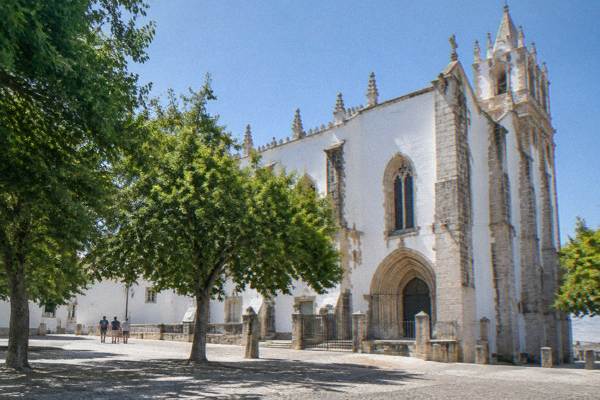
Água De Prata Aqueduct In Évora, Portugal: What To See Along The Arches
The Água de Prata aqueduct is the most photogenic way into Évora, a line of stone arches that walks straight through the city's rooftops, shops and gardens.
Short answer
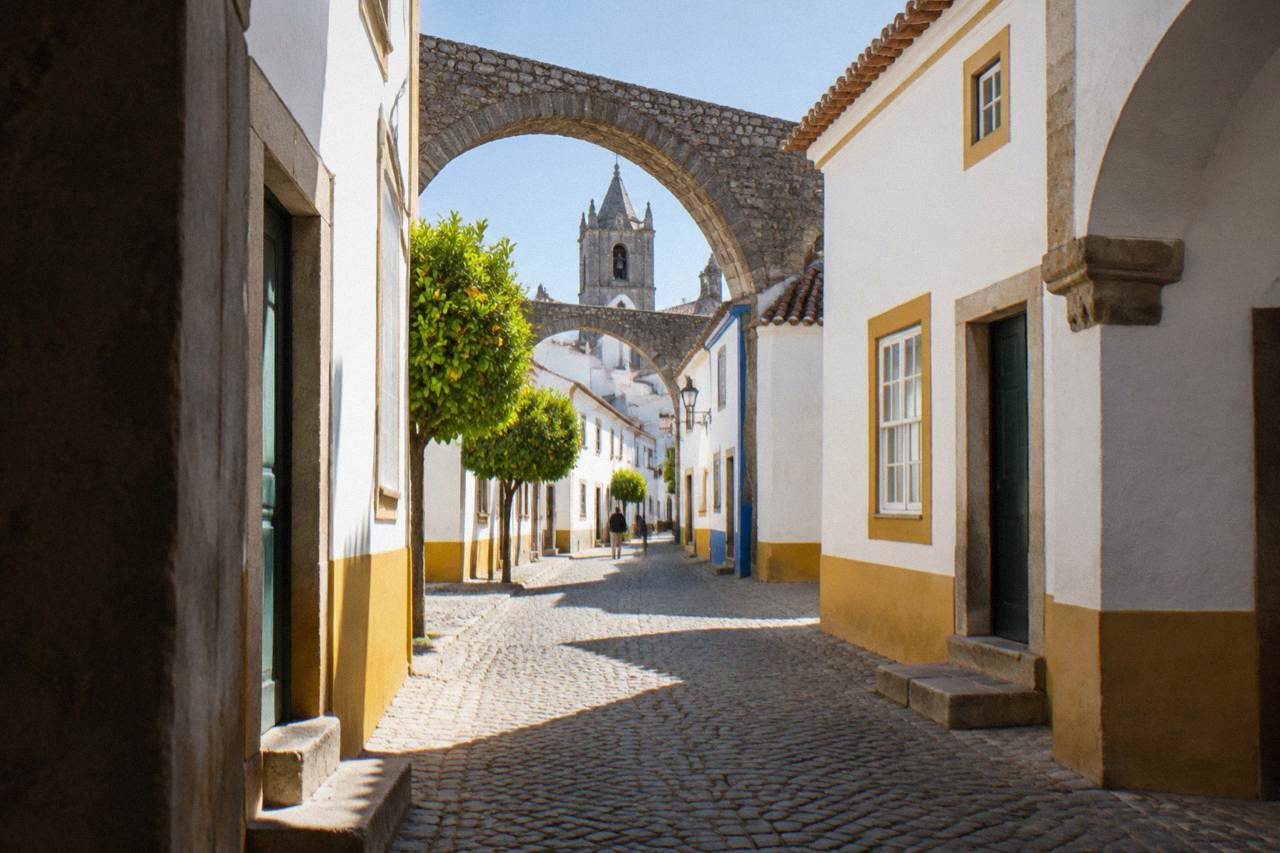
The Água de Prata aqueduct is a landmark stone structure that enters Évora from the east and carries its arches through the historic centre, with houses built into the arches on Rua da Cano and a walkable stretch from Praça do Giraldo towards the public garden. There is no ticket and no visitor entrance: it is a piece of the city you look at and walk beside.
The Água de Prata aqueduct is the one Évora landmark that refuses to stay politely outside the frame. Évora, Portugal, inland capital of the Alentejo, is a city of walls and squares, and the aqueduct cuts through all of it: a long chain of stone arches that arrives from the open plain east of the city and then threads its way between houses, some of which are built directly into the arches themselves. The name means Silver Water, and the structure is one of the reasons the historic centre of Évora was inscribed by UNESCO in 1986 under criteria (ii) and (iv), the second of which calls Évora the finest example of a city of the golden age of Portugal after the 1755 Lisbon earthquake, which Évora was largely spared.
There is no ticket office, no queue and no roped-off viewing platform. The aqueduct is simply there, running through the streets, and the way to see it is to walk it. This guide lays out what the arches look like, where the best stretches are, how the walk connects to the rest of the old town, and how a guided option such as the Évora private walking tour with cathedral and Chapel of Bones folds the aqueduct into a full day's route.
What Is The Água De Prata Aqueduct In Évora?
The Água de Prata aqueduct is a large stone water-supply structure that enters Évora from the east and carries a line of arches through the southern edge of the historic centre, ending near the Praça do Giraldo area. It is a landmark of the city rather than a ticketed monument: you see it from the streets, walk under its arches and, on one famous stretch, see houses built into the arches themselves. No opening hours or admission price applies, because it is part of the street.
It was built to bring water into a city that sits on the dry Alentejo plain, roughly 90 km from the Atlantic coast, where summer rain is almost nonexistent. IPMA's 1991 to 2020 normals for the Évora station show July with an average of just 2.7 mm of rain across the whole month and August 6.0 mm, so a reliable water supply was always the central engineering problem of a city like this. The aqueduct answered it by carrying water from springs outside the walls into the centre, and the name, Silver Water, refers to the clarity of that spring water.
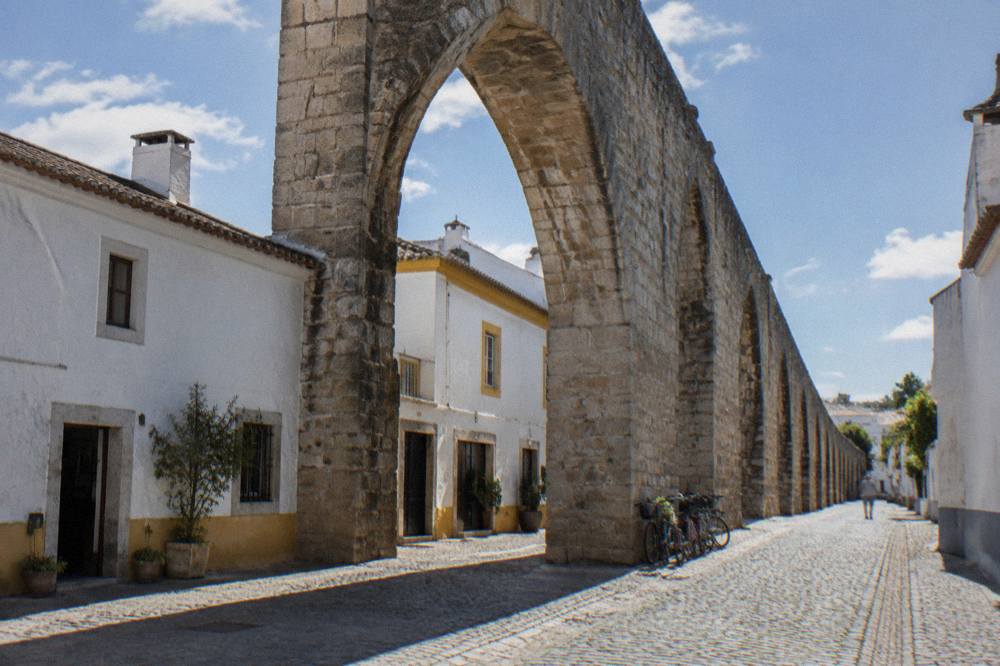
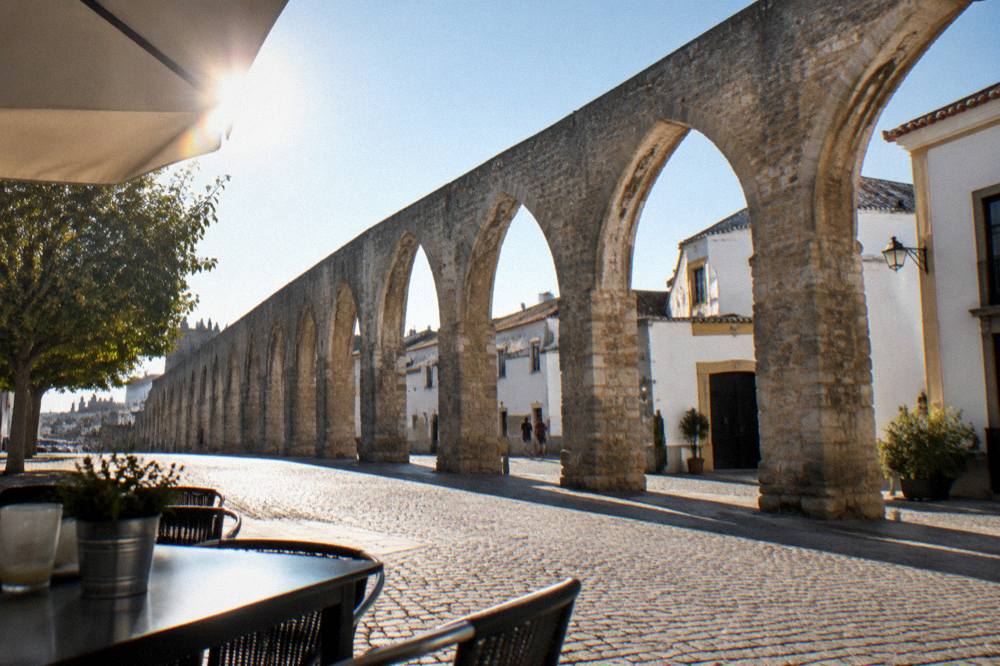
What makes it unusual among European aqueducts is the intimacy of the final stretch. In most cities an aqueduct stands apart, a ruin in a field or a viaduct over a valley. In Évora the arches arrive and the city simply absorbs them: shops sit under the arches, apartments sit above them, and on Rua da Cano the buildings are constructed into the structure itself, so that the aqueduct and the street are the same thing. That fusion of infrastructure and daily life is exactly the quality UNESCO cited when it described Évora as a city whose golden-age fabric survived intact.
Where Does The Aqueduct Run Through Évora?
The arches enter the city from the east, cross the area beyond the old walls near the railway station side, and then run through the southern part of the historic centre, with the most photographed stretch on Rua da Cano where houses are built into the arches, before the line ends in the streets around Praça do Giraldo and the public garden. The whole visible route inside the walls is walkable in a single continuous stroll.
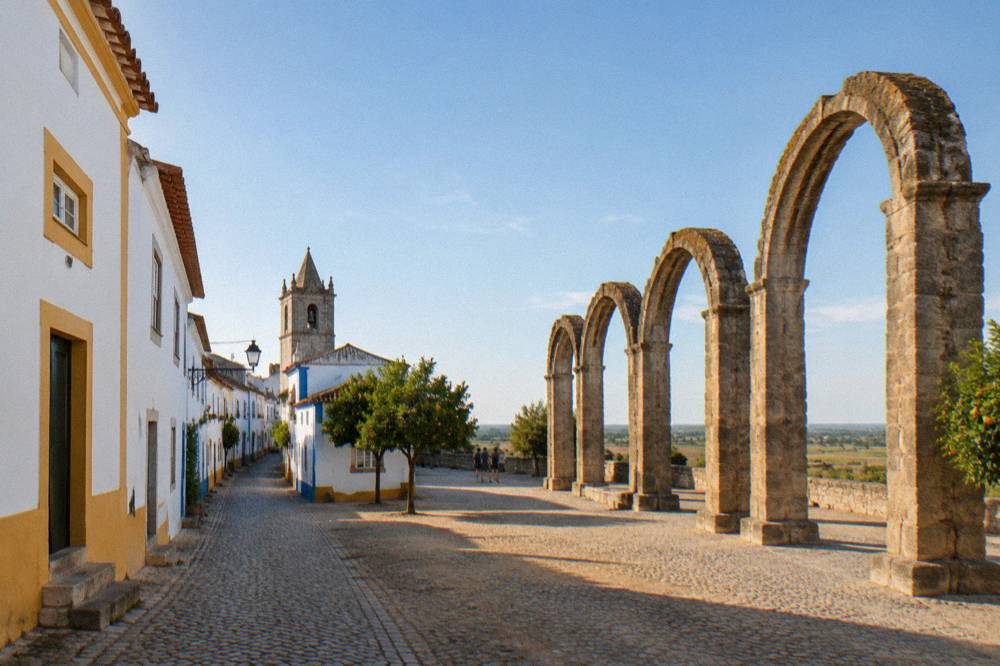
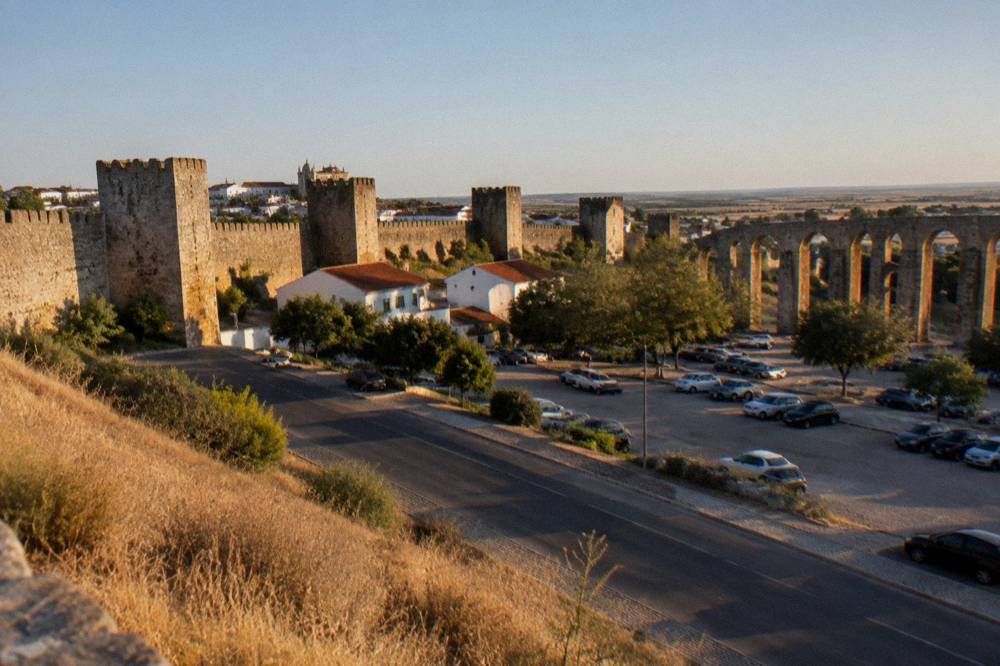
The walk is best done from east to west, following the water's old direction of travel. You start on the edge of town, where the arches stand free against the sky and you can read the structure plainly: piers, arches, and the raised channel on top that once carried the water. This is the stretch where photographers set up, because the arches march in a clean line with nothing but sky and the plain behind them.
As you move towards the centre the arches shrink into the streetscape. They pass close to the São Brás chapel and the Rossio de São Brás, the broad esplanade that hosts the Feira de São João, which ran from 23 June to 5 July in 2026 with the theme "Évora: Capital Europeia ao Sul". From there the line dips into the tight lanes of the old town, and the houses close in around it until the arches become doorways, lintels and load-bearing walls.
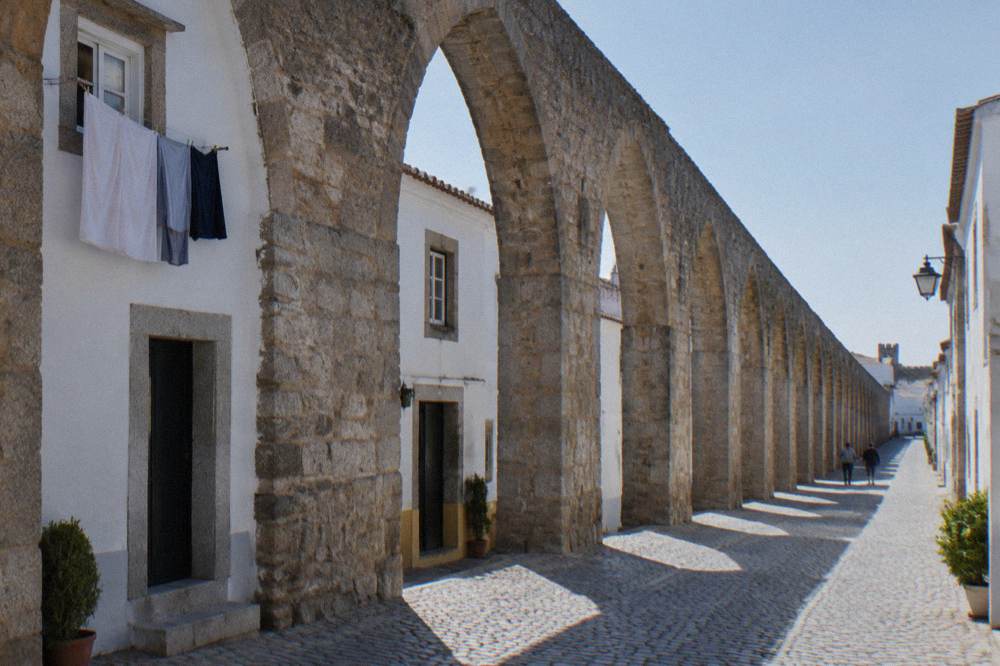
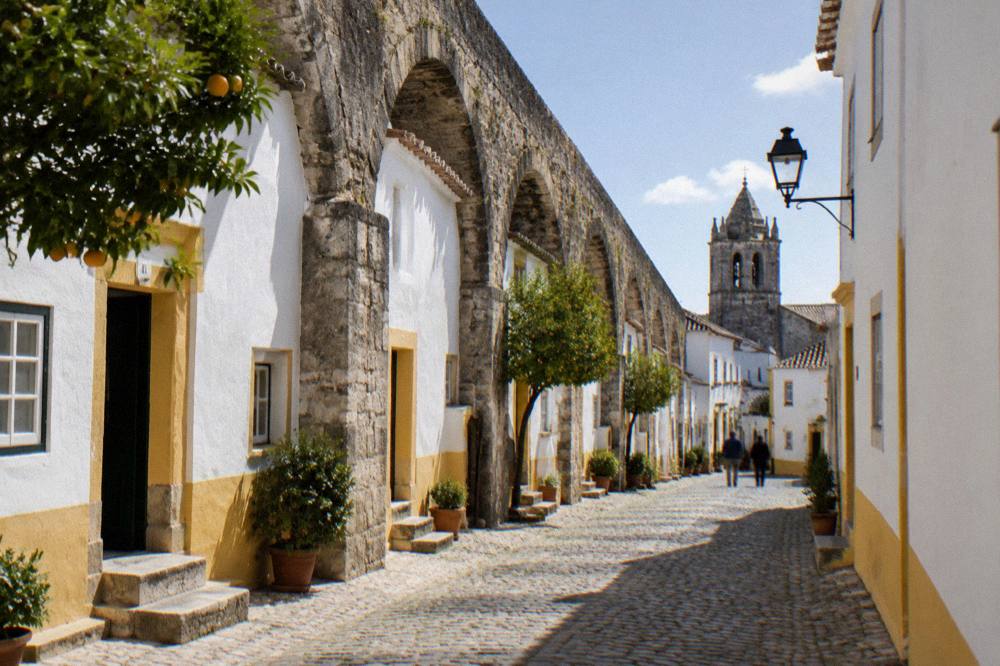
The final stretch is the famous one. Rua da Cano, the street whose name literally refers to the water pipe, is where the aqueduct stops being a monument and becomes a row of homes. First-floor windows sit where the water channel ran. The stone of the arches is the stone of the facades. It is one of the most distinctive streets in Portugal, and it costs nothing to walk.
How Long Does The Aqueduct Walk Take?
A full walk along the visible arches, from the free-standing stretch on the eastern edge of Évora through Rua da Cano to the end of the line near the public garden, is a relaxed stroll of well under an hour without stops. With photography, the detours into the lanes either side of the arches, and a coffee in Praça do Giraldo, most visitors turn it into a half-day thread through the old town, and it pairs naturally with the cathedral and the Chapel of Bones.
No official walking time is published for the route, so treat any figure as a planning estimate rather than a fact. What is certain is the character of the walk: it is flat, it is on pavements and cobbled lanes, and it can be broken anywhere, because every stretch of the aqueduct sits inside a living neighbourhood with cafés, shops and squares around it.
A sensible plan is to walk the arches in the morning before the heat builds, then use the aqueduct as your east-west spine for the rest of the day. IPMA's 1991 to 2020 normals for the Évora station put the July average maximum at 33.3 C and August at 33.5 C, with 31.9 days a year reaching 35 C or more, and the record maximum 45.4 C set on 4 August 2018. Morning walking is not a stylistic preference in this city, it is basic summer logistics.
If you would rather have the route, the context and the monument tickets handled in one go, the guided options below cover the aqueduct stretch as part of a full historic-centre circuit.
For a different angle entirely, the sidecar tour of medieval Évora passes the arches from the street rather than on foot, which suits visitors with limited mobility or anyone travelling with children who would rather ride than walk.
What Can You Actually See Along The Arches?
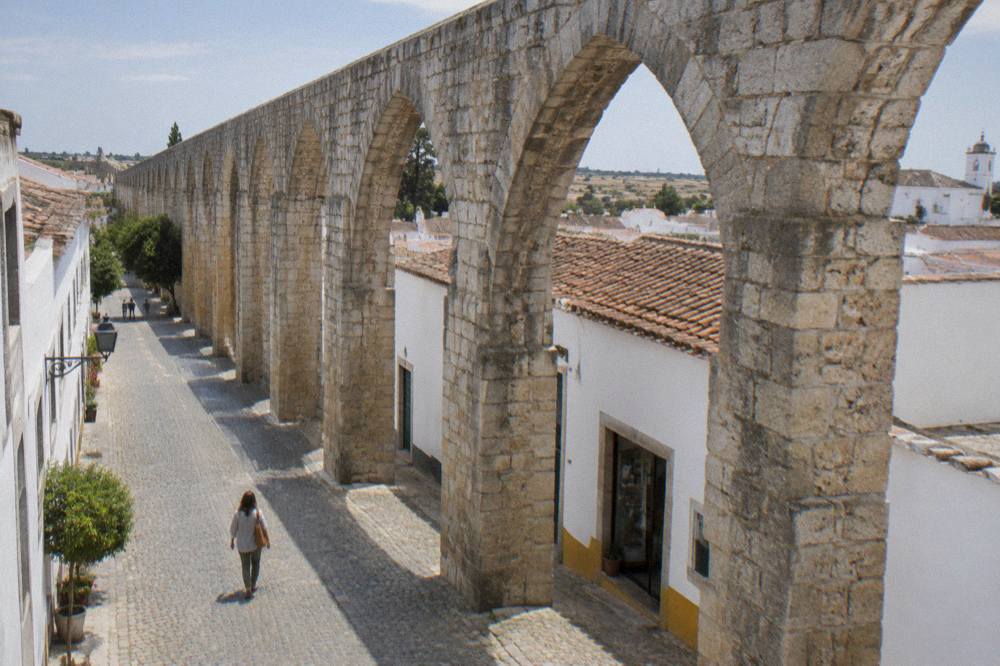
The visible highlights are the free-standing arcade on the eastern approach, the tall single arch that spans a street near the Rossio de São Brás, the stretch where arches pass between buildings with shops beneath them, and above all Rua da Cano, where two-storey houses are built into the arches so that the aqueduct forms the fronts of the buildings. There is no interior to visit, no channel walk and no museum: the arches are the attraction.
The eastern approach is where the structure reads most clearly. Standing under the arcade you can see the taper of the piers, the profile of the arches and the raised channel on the crown, all of which is hard to read once the city has grown around the stonework. It is also the quietest stretch, and the light in the late afternoon comes low across the plain and rakes the arches. The wider set of guides lives on Évora Travel Guide.
Inside the walls the interest shifts from engineering to urban texture. Look for the way later builders filled spandrels with masonry, cut doorways through piers, and set floor levels against the arch springing. On Rua da Cano the windows of the houses sit directly above the arch openings, and the whole street elevation is a cross-section of the aqueduct turned into domestic architecture. Photographers should note that the narrow street means the best shots come from the middle of the lane, and that the light is better in the morning when the sun is on the facades.
The walk also delivers you, almost accidentally, to several of Évora's other sights.
Is The Água De Prata Aqueduct Free To Visit?
Yes, there is nothing to pay and nothing to enter. The aqueduct is a piece of the city's street network: the arches stand on public ground, the stretch on Rua da Cano is an ordinary residential street, and no ticket, pass or guided access is required at any point. The only costs on the walk are the ones you choose, such as a coffee in Praça do Giraldo or a guided tour that includes the arches in a wider route.
This makes it one of the best-value sights in a city that is already generous with free public space. Praça do Giraldo is a public square with no hours and no price, the medieval walls can be walked freely, and the Templo Romano, popularly called the Temple of Diana, is an open-air monument with no ticket or hours listed, standing 25 x 15 m on its platform, probably dedicated to the imperial cult rather than to the goddess according to the municipal page, and once reused as a municipal butcher's before its walls were freed in 1870.
For visitors counting euros, the pattern in Évora is that the grand indoor monuments charge and the streets do not. The Capela dos Ossos at the Igreja de São Francisco charges 7.00 EUR for an adult museum ticket, the Museu de Évora charges 8 EUR and closes on Mondays, and the Évora Ticket costs 8 EUR for one day, 10 EUR for two and 12 EUR for three, while including none of those three. The aqueduct, the walls, the squares and the arches of Rua da Cano cost nothing at all.
How Does The Aqueduct Fit Into A Day In Évora?
The arches work best as the connective thread of a day rather than a standalone destination: walk the eastern arcade early, follow the arches through Rua da Cano into the centre, spend the middle of the day on the cathedral, the Chapel of Bones and the museums, and end in the public garden or on a food and wine crawl in the evening. A single day is enough for the aqueduct plus the major monuments; two days let you add the megaliths or a day trip to Monsaraz.
The natural shape of a one-day visit is a loop. Start east with the free-standing arches while the streets are empty, walk west with the water's old direction, and let the aqueduct deliver you into the heart of the old town. From the end of the line everything in the historic centre is a short walk: the Sé, the Templo Romano, the Loios convent, whose ticket price is currently listed as temporarily unavailable, and the Chapel of Bones.
For the loop with everything explained, the small-group cultural walking tour with Chapel of Bones entry is a two-hour format that covers the historic centre's core, and a longer private version exists for visitors who want the cathedral and the Chapel of Bones tickets folded in. Both types of tour pass the aqueduct's arches, because any honest route through the centre does.
If you have a second day, the same eastern edge of town that the aqueduct comes from is also the direction of the Alentejo's megalithic country. The Cromeleque dos Almendres sits about 8 km from the turn-off on the national road towards Lisbon, according to the Almendres Interpretation Centre's page, which lists its own hours as 10:00 to 18:00 in summer and 10:00 to 17:00 in winter. A megaliths morning and an aqueduct afternoon is a very Alentejo day.
When Is The Best Time To Walk The Arches?
Morning, in every season, is the best time to walk the Água de Prata arches: the light comes low from the east and lights the facades on Rua da Cano, the lanes are quiet, and in summer you are off the street before the 33 C-plus afternoon heat that IPMA's 1991 to 2020 normals record for July and August in Évora. Late afternoon is the best time for the free-standing eastern arcade, when the low sun rakes the arches.
The climate table for the Évora station is blunt about the summer. July averages a maximum of 33.3 C and August 33.5 C, with 23.7 and 25.0 days respectively reaching 30 C or more, and 11.5 and 10.9 days reaching 35 C or more. Rain is close to irrelevant in those months, 2.7 mm in July and 6.0 mm in August, so the planning problem is heat, not weather.
Spring and autumn are the kindest seasons for the whole walk. In April the average maximum is 20.7 C with 62.1 mm of rain across the month, and in October it is 24.1 C with 81.5 mm, with roughly eight days of measurable rain in each. Winter is perfectly walkable too, with January average maxima of 14.1 C and minima of 4.5 C, and the record low for the station is -4.2 C, recorded on 4 December 1998 and again on 23 January 2000. There is no season in which the arches are not open, because they are never closed.
What Is Near The Água De Prata Aqueduct?
Within a short walk of the arches you reach Praça do Giraldo, the Sé de Évora, the Templo Romano, the Igreja de São Francisco and Capela dos Ossos, the Museu de Évora, the public garden and the university, which is why the aqueduct makes such an effective spine for a visit: almost every major sight in the historic centre sits on or just off the line between its eastern arcade and its end near the centre.
The table below shows what clusters where, with the ticket figures that are published for each sight. Where no figure is given, none is published, and the right move is to ask at the door.
| Sight | Relation To The Aqueduct Walk | Ticket Situation |
|---|---|---|
| Praça do Giraldo | At the end of the line inside the walls | Public square, free |
| Sé de Évora | Short walk from the central stretch | 5.00 EUR complete visit, children to 12 free |
| Igreja de São Francisco and Capela dos Ossos | Short walk from the central stretch | 7.00 EUR adult museum ticket |
| Museu de Évora | Near the cathedral | 8 EUR adult, closed Mondays |
| Templo Romano | Near the cathedral and public garden | Open-air, no ticket listed |
| Convento dos Lóios | Near the central stretch | Price temporarily unavailable |
| Public garden | At the western end of the walk | No verified hours or price |
| University of Évora | Beyond the public garden | No verified hours or price |
The Sé deserves the longest stop of any ticketed sight on the loop. Its single 5.00 EUR ticket covers the cathedral itself, the cloister, the roof terrace with its panoramic view over the aqueduct's arches and the plain beyond, and the museum, with the last museum admission 30 minutes before the 17:00 closing. It is closed on the afternoon of 24 December, on 25 December and on 1 January. The Capela dos Ossos keeps longer hours, 9:00 to 18:30 in summer and 9:00 to 17:00 in winter, open every day except 1 January, Easter Sunday, the afternoon of 24 December and 25 December.
For eating, the lanes around the arches are the heart of Alentejo cooking. The regional dishes to look for are covered in the guide to Alentejo dishes, and the Reguengos de Monsaraz wine route makes a strong follow-up day for anyone who falls for the local reds.
How Does The Aqueduct Compare With Évora'S Other Landmarks?
The Água de Prata arches are Évora's most atmospheric landmark and its least demanding one: unlike the Sé, the Chapel of Bones or the museums, they ask for no ticket, no time slot and no queue, and unlike the Templo Romano they run for a long continuous stretch you can walk rather than stand at. They are weaker on interior spectacle, because there is no interior, and they are best treated as the free, open-air counterweight to the city's ticketed monuments.
A useful way to budget a day is to pair one paid interior with one free exterior in each half. The morning could be the aqueduct walk followed by the Sé's complete visit at 5.00 EUR; the afternoon could be the Templo Romano and the walls, followed by the Capela dos Ossos at 7.00 EUR. A visitor doing all four ticketed headline sights, the Sé, the Capela dos Ossos, the Museu de Évora at 8 EUR and the Évora Ticket at 8 EUR for one day, spends under 30 EUR on monuments, and the aqueduct stitches them together for nothing.
| Sight | Type | Adult Ticket | Hours Basis |
|---|---|---|---|
| Água de Prata arches | Open-air street walk | Free | Always accessible |
| Sé de Évora | Cathedral, cloister, roof, museum | 5.00 EUR | 9:00-17:00 |
| Capela dos Ossos | Museum and chapel | 7.00 EUR | 9:00-18:30 summer, 9:00-17:00 winter |
| Museu de Évora | National museum | 8 EUR | Tue-Sun, closed Mondays |
| Évora Ticket | Multi-site pass | 8 EUR one day | Varies by site |
| Templo Romano | Open-air monument | No ticket listed | Always accessible |
Two cautions on the table. The Évora Ticket does not include the Sé, the Capela dos Ossos or the Museu de Évora, so it complements rather than replaces those tickets. And the Convento dos Lóios appears in no table here because its official page lists its price as temporarily unavailable; check the door or the municipal page before planning a visit around it.
What Should Photographers Know About The Arches?
The two essential shots are the free-standing eastern arcade in late afternoon light, when the low sun rakes the piers and the arches stand against open sky, and the Rua da Cano stretch in the morning, when the sun is on the facades of the houses built into the arches and the lane is still quiet. A tall single arch spanning a street makes a strong third frame, and the roof terrace of the Sé gives the only elevated view of the arches threading through the rooftops.
The elevated view is the one that costs money, and it is worth it. The Sé's 5.00 EUR complete-visit ticket includes the roof terrace, and from there the line of arches reads as a single gesture across the city, cutting through the roofscape towards the plain. No other publicly accessible viewpoint in Évora shows the aqueduct in that way.
| Shot | Best Light | Access |
|---|---|---|
| Eastern arcade, full arches | Late afternoon, low sun | Free, street level |
| Rua da Cano houses in the arches | Morning, sun on facades | Free, residential lane |
| Single arch spanning a street | Midday, arch backlit | Free, street level |
| Arches through the rooftops | Any daylight hours | Sé roof terrace, 5.00 EUR |
| Arches with the plain behind | Golden hour | Free, eastern edge |
Be a good guest on Rua da Cano. The houses in the arches are people's homes, and the lane is narrow, so keep volumes low, let residents pass, and take the portrait-of-a-street shots without pressing lenses into windows. The stretch is beautiful precisely because it is lived in.
Common Questions About The Água De Prata Aqueduct
Is the Água de Prata aqueduct free to visit?
Yes. The arches stand on public streets and there is no ticket, gate or opening time anywhere along the visible route, including the famous stretch on Rua da Cano.
Can you walk along the Água de Prata aqueduct in Évora?
Yes, the walkable route runs from the free-standing arches on the eastern edge of the city through the historic centre to the streets near Praça do Giraldo, and it is a flat stroll on pavements and cobbled lanes.
Where are the houses built into the aqueduct?
On Rua da Cano, inside the historic centre, where two-storey houses are constructed into the arches so that the aqueduct forms the street frontage, with windows sitting above the arch openings.
How long does the aqueduct walk take?
No official time is published, but the visible stretch inside and just outside the walls is a relaxed walk of well under an hour without stops; most visitors spend half a day once they fold in photographs, cafés and the monuments along the way.
Is the Água de Prata aqueduct part of the UNESCO site?
The historic centre of Évora was inscribed by UNESCO in 1986 under criteria (ii) and (iv), and the aqueduct's arches run through that inscribed centre, threading between the golden-age buildings the citation describes.
What is the best time of day to photograph the arches?
Late afternoon for the free-standing eastern arcade, when low sun rakes the piers, and morning for Rua da Cano, when the light is on the facades; the Sé's roof terrace, included in the 5.00 EUR complete-visit ticket, gives the only elevated view of the arches across the rooftops.
The arches of the Água de Prata are the quietest bargain in Évora: a landmark of national weight that charges nothing, closes never, and delivers you, street by street, into the heart of a UNESCO-listed city.