Megalithic Sites Near Évora
Évora, the inland capital of Portugal's Alentejo region, sits in the middle of one of the richest clusters of prehistoric standing stones and burial monuments in Iberia. This guide covers the Cromeleque dos Almendres, the Almendres Interpretation Centre, the dolmens reachable on guided tours, and how to plan the visit.
Short answer
The main megalithic sites near Évora are the Cromeleque dos Almendres stone circle and the Great Dolmen of Zambujeiro, both in the countryside about a short drive from the city. The Almendres Interpretation Centre in the village of Guadalupe is open 10:00-18:00 in summer and 10:00-17:00 in winter, and entry to the stones themselves is reported free. Guided tours from Évora run from about $33.76 per person.
Évora, the inland capital of the Alentejo region of southern Portugal, is best known for its Roman temple and its bone-decorated chapel, but the countryside around the city holds something far older. Long before the Romans, before Moorish rule ended in 1165, before the Jesuit University of the Holy Spirit was founded in 1553, the people of this plain raised standing stones in circles and built chambered tombs from enormous slabs. The Cromeleque dos Almendres, the Almendres menhir and the Great Dolmen of Zambujeiro all sit within easy reach of the city walls, and the municipality supports visits through an interpretation centre in the village of Guadalupe. This guide lays out what the sites are, how to reach them, what a guided visit costs, and how to fit them into a wider Alentejo itinerary.
Why Is Évora A Good Base For Megalithic Sites?
Évora works as a base because the main megalithic monuments of the Central Alentejo sit in open country just west of the city, close enough for a half-day trip, while the city supplies the hotels and transport links of a regional capital. The Cromeleque dos Almendres lies off the national road from Évora toward Lisbon, with the turn-off about 8 km out, and guided tours from Évora reach the cromlech and the Great Dolmen of Zambujeiro in a three-hour loop.
The interpretation centre in Guadalupe anchors the visit.
The geography matters here. Évora is an inland city on the Alentejo plain, roughly 90 km from the Atlantic, and the land around it is a gently rolling plateau of cork oak, olive groves and pasture. That open landscape is precisely why the prehistoric monuments survive in clusters: the stone was on the surface, the ground was clear, and later building did not swallow everything. The municipality had about 53,000 residents at the 2021 Census, small enough that the megalithic zone begins within minutes of leaving the historic centre.
The city also gives you a full day of monuments to balance the prehistoric half-day. The things to do in Évora range from the Sé de Évora, whose complete-visit ticket costs 5.00 EUR, to the Museu de Évora at 8 EUR for adults, closed Mondays. For background on the Roman and earlier layers of the city itself, the guide to Évora's ancient and Roman sites and the overview of archaeological sites in Évora cover the in-town remains, including the Templo Romano, a 25 x 15 m structure the municipal page says was probably dedicated to the imperial cult rather than to Diana.
What Is The Cromeleque Dos Almendres?
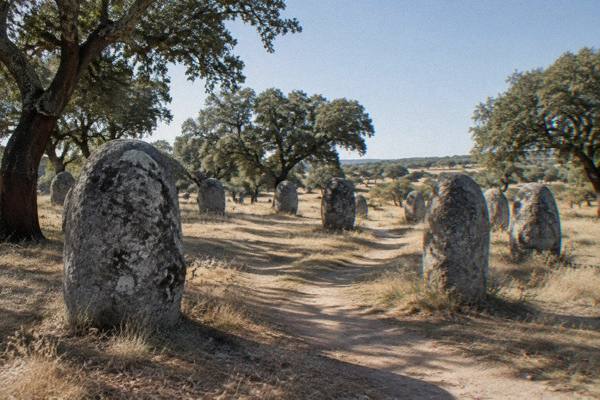
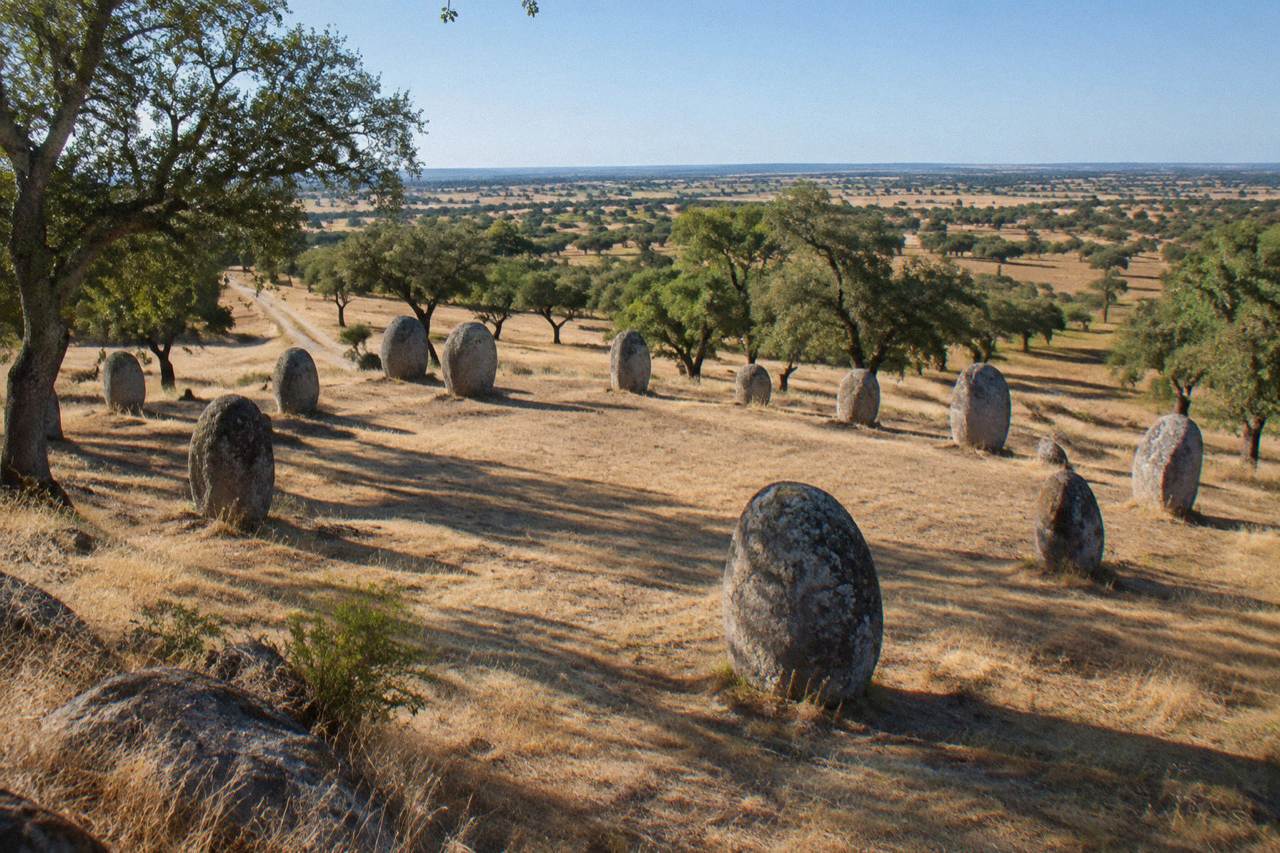
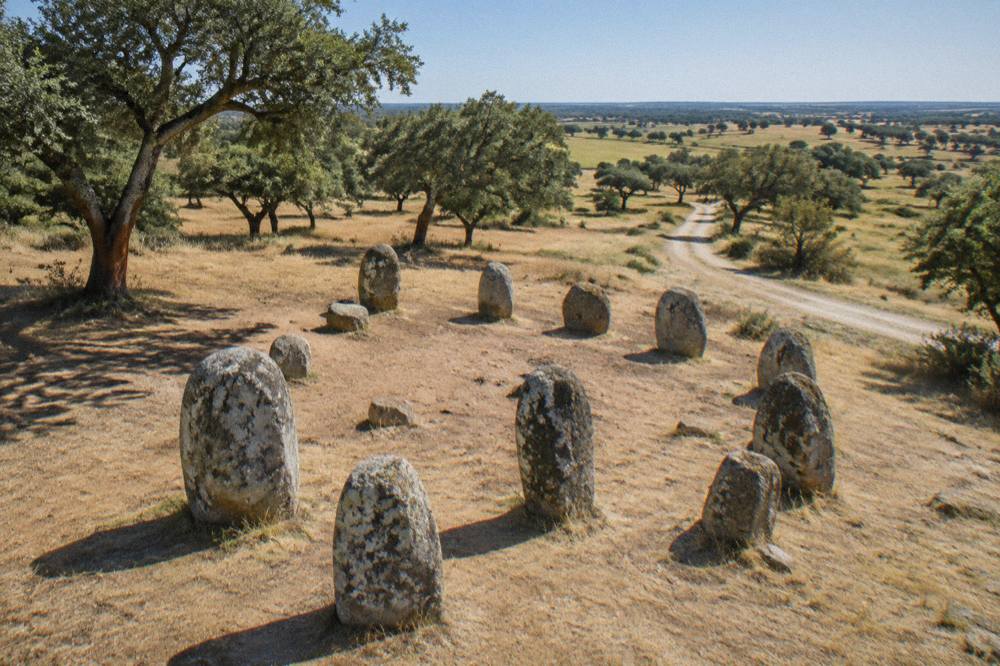
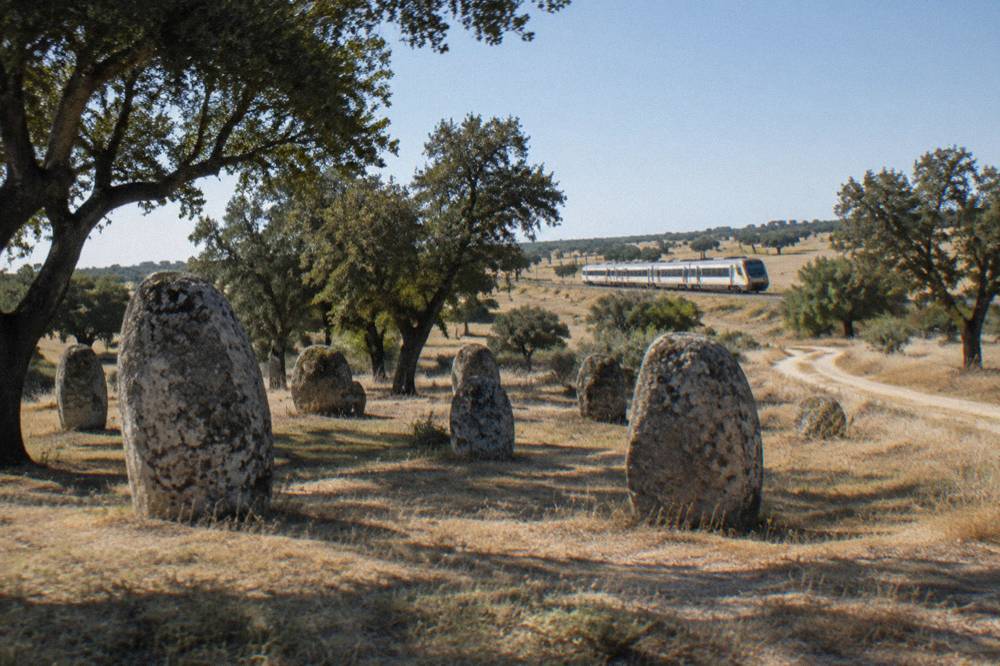
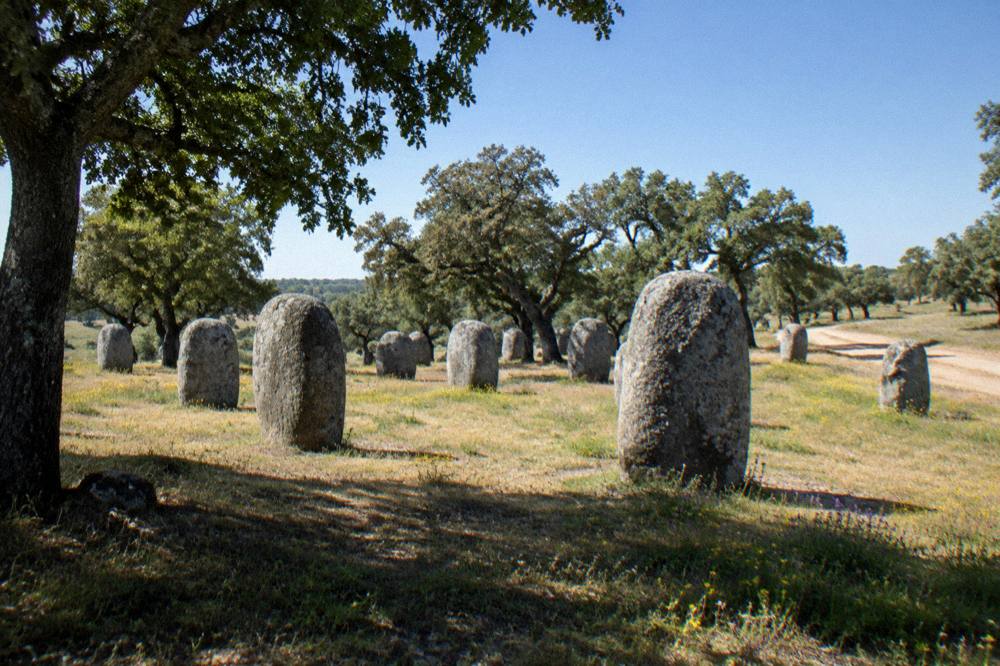
The Cromeleque dos Almendres is a prehistoric cromlech, meaning a circle or group of standing stones, set on a hillside west of Évora in the Central Alentejo. It is the largest known cromlech on the Iberian Peninsula, and it stands in an open landscape of cork oak and cleared ground reached by a track from the national road between Évora and Lisbon. The stones themselves are reported free to visit, and the municipality's partner interpretation centre in Guadalupe village explains the site.
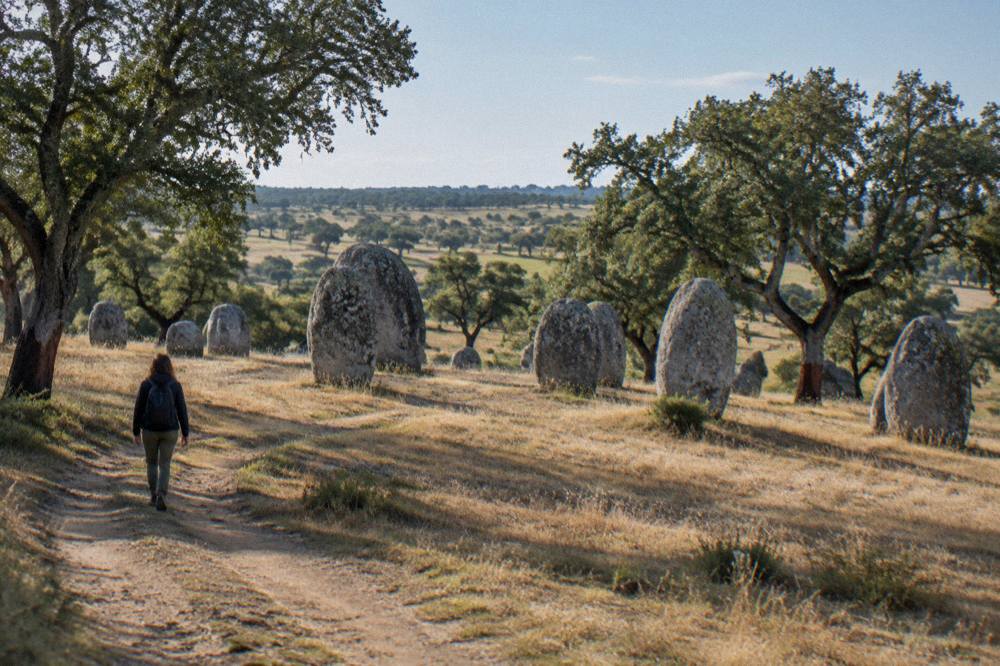
A cromlech, in the plain definition, is an arrangement of standing stones, usually a circle or an oval, raised in prehistory. The Almendres stones stand in that formation on a slope, and the setting is the draw as much as the archaeology: the site looks out over the plain, and at sunrise and sunset the low light gives the stones their long shadows. Visitors should not expect interpretation panels at the stones themselves, ropes, or any facilities beyond the track and the field; this is an open monument in working farmland.
What the site is not is equally worth knowing. It is not Stonehenge, and any comparison should stop at the shared category: both are prehistoric standing-stone sites. No age, size or ranking is printed here, because the figures that circulate about Almendres vary widely and the municipal and interpretation-centre pages do not state them. For the wider question of which structure in Europe holds the "oldest" title, the site's own page on the oldest megalithic structure in Europe works through what can and cannot be claimed.
The Almendres Interpretation Centre is the practical anchor for the visit. It sits in the village of Guadalupe on the Rua do Cromeleque, GPS 38.567801, -8.027456, and it is a partner of the Évora municipality. Its hours are fixed and published: 10:00 to 18:00 in summer, meaning 1 May to 31 October, and 10:00 to 17:00 in winter, meaning 1 November to 30 April.
| What | Detail |
|---|---|
| Site type | Prehistoric cromlech, a circle or group of standing stones |
| Location | Hillside off the national road from Évora toward Lisbon, turn-off about 8 km from the city |
| Entry to the stones | Reported free, not confirmed on a page |
| Interpretation centre | Almendres Interpretation Centre, Guadalupe village, Rua do Cromeleque |
| Centre GPS | 38.567801, -8.027456 |
| Centre hours, 1 May to 31 October | 10:00-18:00 |
| Centre hours, 1 November to 30 April | 10:00-17:00 |
How Do You Get To The Almendres Cromlech From Évora?
By car, the route given by the interpretation centre's own page is simple: take the national road from Évora toward Lisbon, and after about 8 km follow the turn-off toward the site, which then leads onto local tracks to the stones and to the Guadalupe interpretation centre. There is no verified public bus route to the cromlech, and no verified taxi fare, so a rental car or a guided tour with transport included are the realistic options. Guided tours from Évora start from about $33.76 per person.
The directions above are the only route detail printed here, because they are the ones the interpretation centre publishes. The last stretch is unsurfaced, and in wet weather the tracks can be rough; after rain, check conditions locally before setting out. Parking at the site is informal, at the edge of the field, and there are no facilities at the stones, so water, sun protection and closed shoes belong in the car.
For visitors without a car, the guided option is genuinely the efficient one. The three-hour Almendres cromlech and Great Dolmen of Zambujeiro tour from Évora costs from $33.76 per person, is rated 5 from 54 reviews, and handles the driving as well as the interpretation. At a genuine decision moment, you can also Check availability on the operator's live listing.
What Other Megalithic Monuments Sit Near Évora?
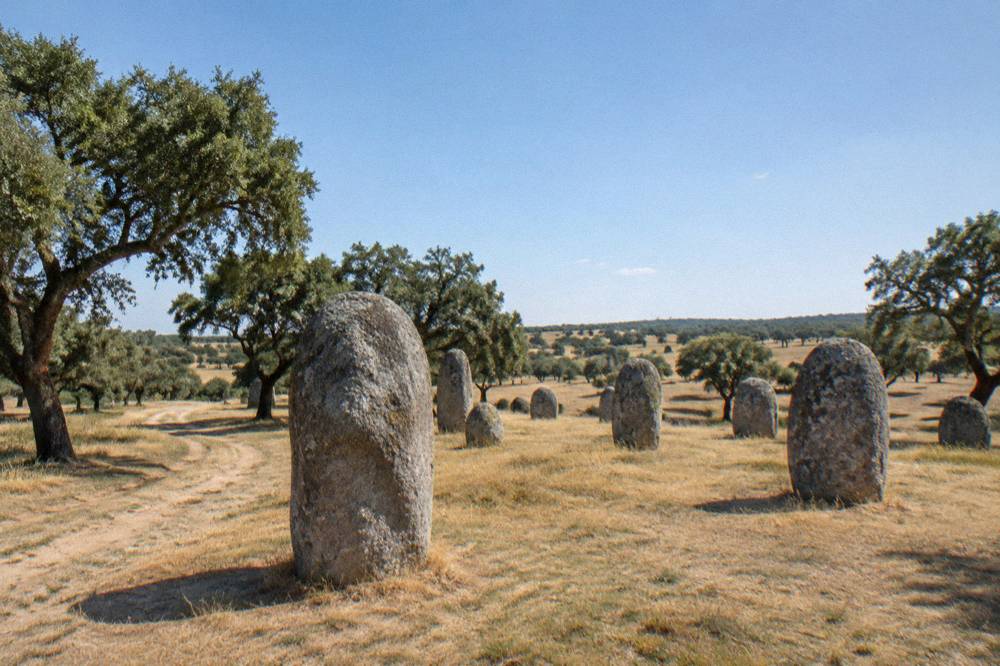
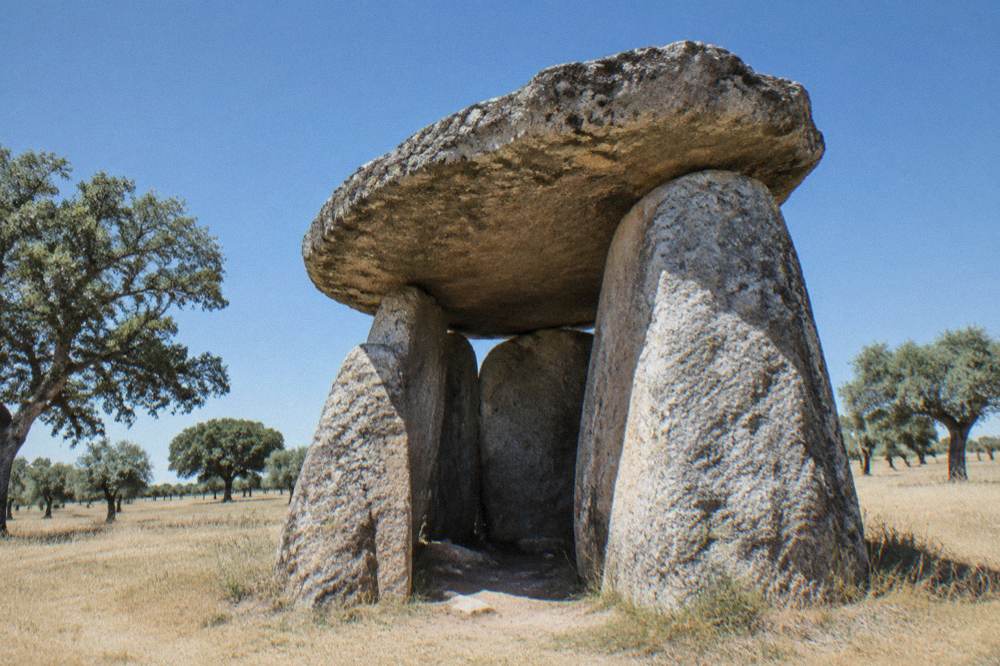
The other headline megalithic monument near Évora is the Great Dolmen of Zambujeiro, a large chambered tomb built from massive stone slabs, which guided tours from the city visit together with the Almendres cromlech in a single three-hour loop. The same guided routes take in the Almendres menhir, a single standing stone of the kind prehistoric communities raised across this part of the Alentejo. All of these sites stand in open farmland, with no facilities on site, and all are reached by road west of Évora.
A dolmen is a chambered tomb: upright slabs carrying a capstone, originally covered by an earth mound, of which little or nothing remains at most Alentejo sites. The Zambujeiro dolmen is the one that appears by name on the guided itineraries from Évora, and its slabs are the visual opposite of the cromlech's field of uprights. A menhir, in turn, is a single standing stone, sometimes shaped, sometimes a raw block, and the Almendres menhir is the local example that tours point out.
Because none of these sites has on-site interpretation to the level of a museum, the guided tours carry real weight for the general visitor. Beyond the three-hour cromlech and dolmen tour, a longer option exists: the archaeologist-led half-day megaliths tour from Évora, from $74.54 per person and rated 5 from 77 reviews, which spends more time on the wider cluster of monuments.
There is also a combined route for visitors who want prehistory plus the Alentejo landscape that produced it: the megalithic and cork forest guided tour from Évora, from $50.65 per person, rated 4.9 from 41 reviews, which pairs the standing stones with a walk through the cork oak woodland that dominates the same hills. Cork is the living industry of this countryside, and the Alentejo cork and cork oak guide covers it in depth.
| Monument | What it is | How it is usually visited |
|---|---|---|
| Cromeleque dos Almendres | Prehistoric cromlech, a circle or group of standing stones | Self-drive, or the 3-hour guided tour from Évora |
| Great Dolmen of Zambujeiro | Chambered tomb of massive upright slabs and capstone | Guided tour from Évora, paired with the cromlech |
| Almendres menhir | A single standing stone near the cromlech | Pointed out on guided itineraries |
| Almendres Interpretation Centre | Municipal partner centre in Guadalupe village | Stop before or after the stones, fixed hours |
Which Guided Tours Cover The Megalithic Sites From Évora?
Three guided products cover the megalithic sites from Évora: the three-hour cromlech and Great Dolmen of Zambujeiro tour from $33.76 per person, the archaeologist-led half-day megaliths tour from $74.54 per person, and the megalithic and cork forest combination from $50.65 per person. All three start in Évora, include transport on rural tracks, and remove the need for a rental car. The full range of options, including walking and food tours in the city, is covered in the guide to tours in Évora.
The choice between them comes down to depth and width. The three-hour tour is the efficient one: cromlech, dolmen, back in the city with half a day to spare for the Sé or the Capela dos Ossos, whose museum ticket is 7.00 EUR for an adult. The archaeologist-led half-day spends longer at the stones and goes further into the cluster of monuments, which suits visitors who want the archaeology rather than the photo. The cork combination suits visitors whose interest is the Alentejo landscape as a whole, stones and woodland together. More of these guides are collected on Évora Travel Guide.
| Tour from Évora | Duration | From (per person) | Rating |
|---|---|---|---|
| Cromlech of Almendres and Great Dolmen of Zambujeiro | 3 hours | $33.76 | 5 from 54 reviews |
| Half-Day Megaliths Cromlech Tour by Archaeologists | Half day | $74.54 | 5 from 77 reviews |
| Megalithic and Cork Forest Guided Tour | 4 hours | $50.65 | 4.9 from 41 reviews |
Prices on the cards are in US dollars, and a tour's live listing is the place to confirm the current figure before booking. For visitors building a wider plan, the Évora tours guide sorts the city's guided options by type, and the best time to visit Évora page handles the seasonal question for the whole region.
Can You Visit The Megalithic Sites On A Day Trip From Lisbon?
Yes, in two ways. The first is to take the train to Évora and join a megaliths tour from the city: CP's Intercidades timetable, valid since 6 September 2026, lists six through trains from Lisboa Oriente to Évora taking about 1 hour 40 to 1 hour 45, at 13.90 EUR second class. The second is a Lisbon-start day tour visiting Évora and the megaliths in one outing, from about $90.04 per person, trading a city base for one booked day.
The train option deserves the detail. CP's PDF timetable, valid since 6 September 2026, lists departures from Lisboa Oriente at 07:02, 09:02, 09:58, 13:35, 17:02 and 19:02, arriving in Évora at 08:47, 10:45, 11:40, 15:13, 18:41 and 20:46, with no change needed on these through trains. The fare is 13.90 EUR second class and 18.50 EUR first class. That makes a morning arrival entirely realistic, a megaliths tour in the early afternoon, and an evening train back. The practicalities of the route, station and connections are covered in the Lisbon to Évora by train guide, and the wider options in the Lisbon to Évora guide.
| Lisboa Oriente departure | Évora arrival | Journey |
|---|---|---|
| 07:02 | 08:47 | About 1 h 40 to 1 h 45 |
| 09:02 | 10:45 | About 1 h 40 to 1 h 45 |
| 09:58 | 11:40 | About 1 h 40 to 1 h 45 |
| 13:35 | 15:13 | About 1 h 40 to 1 h 45 |
| 17:02 | 18:41 | About 1 h 40 to 1 h 45 |
| 19:02 | 20:46 | About 1 h 40 to 1 h 45 |
The coach alternative is covered in the Lisbon to Évora by bus guide, though no fare or journey time is printed here, because none was confirmed on an operator page. For the one-day, one-booking route, the Évora and Megaliths Full-Day Tour from Lisbon, from $90.04 per person and rated 4.7 from 576 reviews, visits the city and the stones with a private guide, and belongs on the best day trips from Lisbon shortlist alongside the From Lisbon to Alentejo megaliths tour at $91.74.
When Is The Best Time Of Year To Visit The Megaliths?
Spring and autumn are the best times to visit the megalithic sites near Évora, because the sites are unshaded open fields and the Alentejo summer is hot: IPMA's 1991-2020 normals for the Évora station show a July mean maximum of 33.3 C and an August mean maximum of 33.5 C, with 31.9 days a year reaching 35 C or more.
May and October still average 25.0 C and 24.1 C mean maximums, and the station's record high is 45.4 C, set on 4 August 2018.
The sites are unshaded. That is the whole planning problem. The stones stand in cleared fields, the tracks to them are exposed, and the interpretation centre in Guadalupe is a short drive away rather than a place to wait out the midday heat. In July and August, the morning departures and late afternoons are the workable windows, and a guided tour with a vehicle is safer than a long self-drive walk in the middle of the day.
| Month (1991-2020 normals, Évora station) | Mean maximum (C) | Mean minimum (C) | Rain (mm) |
|---|---|---|---|
| March | 18.7 | 6.9 | 60.8 |
| April | 20.7 | 8.5 | 62.1 |
| May | 25.0 | 10.9 | 46.6 |
| June | 30.2 | 13.8 | 10.6 |
| July | 33.3 | 15.6 | 2.7 |
| August | 33.5 | 16.0 | 6.0 |
| September | 29.5 | 14.6 | 33.9 |
| October | 24.1 | 12.3 | 81.5 |
The winter side of the year is quieter and greener, with January and February mean maximums of 14.1 C and 15.7 C, and the interpretation centre keeps its 10:00-17:00 winter hours from 1 November to 30 April. The trade-off is rain: November averages 86.0 mm and December 85.1 mm, against 2.7 mm in July, and wet tracks to the stones are the practical risk. The full monthly picture, including the days above 30 C, is in the Évora weather guide.
How Do The Alentejo Megaliths Compare With Stonehenge?
Both the Cromeleque dos Almendres and Stonehenge are prehistoric standing-stone sites, and that is where the honest comparison begins and ends. A cromlech is a circle or group of standing stones, the same broad category as Stonehenge, but no age, size, stone count or ranking is printed here for Almendres, because the figures in circulation differ and the municipal and interpretation-centre pages do not state them. Instead, Almendres is free of turnstiles, walk-up close, and set in working farmland rather than behind a visitor cordon.
That difference is the real one for a visitor. The Alentejo sites have no visitor centre at the stones, no timed entry, no crowd management, and no fee reported at the stones themselves. What they also do not have is the interpretive infrastructure a site like Stonehenge has built, which is exactly the gap the Guadalupe interpretation centre and the guided tours fill. A visitor who wants to understand what they are looking at should either stop at the centre or go with a guide.
The comparison question is common enough that this site answers it directly elsewhere: the difference between Stonehenge and a cromlech is covered as its own question, and whether there is a Stonehenge in Portugal is the search phrase most people arrive with. Both answers hold to the same line: category yes, figures no.
What Should You Bring To A Megalithic Site Visit?
Bring more water and sun protection than feels necessary, closed shoes for the unsurfaced tracks, and nothing that cannot be carried, because the sites are open fields with no facilities, no shade and no water point. The stones stand in working farmland reached by gravel and dirt tracks, the interpretation centre is a drive away in Guadalupe, and in summer the Alentejo heat is the main risk, with IPMA's 1991-2020 normals showing 25.0 days a year at 30 C or more in August alone.
The practical list is short. Water, a hat, sunscreen, shoes that can handle dust and stones, and a phone or camera with charge left, because the light at the open sites, especially early and late, is the reason many visitors go. In winter, add a layer: the January mean minimum at the Évora station is 4.5 C, and the station's record low is -4.2 C, set on 4 December 1998 and again on 23 January 2000.
| Season | Ground and light | What to carry |
|---|---|---|
| Spring, March to May | Green fields, wildflowers, soft light | Water, light layers, closed shoes |
| Summer, June to August | Dry, hard ground, harsh midday light | Extra water, hat, sunscreen, morning visit |
| Autumn, September to November | Golden ground, low warm light | Water, layer for evening, shoes for dust |
| Winter, December to February | Wet tracks possible, low grey light | Waterproof layer, boots, check tracks after rain |
One more thing belongs on the list: a plan for the rest of the day. The megaliths half-day pairs naturally with an afternoon in the historic centre, and the one day in Évora itinerary sequences the city's monuments, from the Sé's 5.00 EUR complete-visit ticket to the Capela dos Ossos museum ticket at 7.00 EUR, into a workable order.
Which Other Alentejo Towns Pair Well With The Megaliths?
The towns that pair best with a megalithic day are Monsaraz, about 40-45 km from Évora, a walled hilltop village above the Alqueva lake, and Estremoz and Vila Viçosa, about 45 km and about 60 km out, both marble and castle towns of the eastern Alentejo. Arraiolos, about 20 km away, is the shortest detour, known for its hand-stitched carpets. All are reachable by car in a loop from Évora, and none needs more than a half-day each.
The reason to pair them is that the megalithic sites sit west of Évora while the classic towns sit east and south, so a two-day plan splits cleanly: stones and cork country one day, marble towns or Monsaraz the next. The best day trips from Évora guide covers the full list, and the three days in Évora and the Alentejo itinerary sequences exactly this combination.
Guided products cover the pairing too. The Monsaraz and Wine tour from Évora, from $80.28 per person and rated 4.9 from 31 reviews, is the small-group morning option to the hilltop village, and the marble tours in Vila Viçosa, from $28.14 per person, are the shortest bookable town tour in the region.
| Alentejo town | Distance from Évora | Known for |
|---|---|---|
| Arraiolos | About 20 km | Hand-stitched carpets, hilltop church |
| Monsaraz | About 40-45 km | Walled hilltop village above the Alqueva lake |
| Estremoz | About 45 km | Marble, castle, market town |
| Vila Viçosa | About 60 km | Marble, ducal palace |
| Elvas | About 80 km | Fortified border city, aqueduct |
| Marvão | About 120 km | Mountain-top walled village |
Distances are rounded road estimates and should be treated as such. No drive times are printed here, because none were confirmed on a primary page for these routes.
Common Questions About Megalithic Sites Near Évora
Is there a Stonehenge in Portugal?
The Cromeleque dos Almendres near Évora is the site most often given that label, because it is a prehistoric cromlech, a circle or group of standing stones, and the largest known on the Iberian Peninsula. It shares the broad category with Stonehenge and nothing more that can be stated with confidence: no age, size or ranking is printed here.
How do I get to the Almendres cromlech?
By car, take the national road from Évora toward Lisbon and after about 8 km follow the turn-off, as the interpretation centre's page directs, then continue on local tracks to the stones. There is no verified public bus route and no verified taxi fare, so the alternatives are a rental car or a guided tour from Évora with transport included.
How much does it cost to visit the Almendres cromlech?
Entry to the stones themselves is reported free, though this is not confirmed on an official page. The Almendres Interpretation Centre in Guadalupe is the municipal partner facility; check its published hours before you go. Guided tours from Évora that include the cromlech and the Great Dolmen of Zambujeiro start from $33.76 per person.
What is the difference between a cromlech and a dolmen?
A cromlech is a circle or group of standing stones; a dolmen is a chambered tomb built from upright slabs carrying a capstone, originally covered by a mound. Near Évora the Cromeleque dos Almendres is the cromlech and the Great Dolmen of Zambujeiro is the dolmen, and guided tours visit both in one loop.
Can you visit the megalithic sites from Lisbon in one day?
Yes. CP's Intercidades timetable valid since 6 September 2026 lists six through trains from Lisboa Oriente to Évora taking about 1 hour 40 to 1 hour 45 at 13.90 EUR second class, which allows a morning arrival, a megaliths tour, and an evening return. Lisbon-start day tours visiting Évora and the megaliths run from about $90.04 per person.
When is the best time of day to see the stones?
Early morning or late afternoon. The sites are open, unshaded fields, and IPMA's 1991-2020 normals for the Évora station show July and August mean maximums of 33.3 C and 33.5 C, so midday visits in summer are best avoided. The low light at either end of the day is also when the stones photograph best.
The megalithic landscape west of Évora is one of the few places where a regional capital, a UNESCO-listed historic centre and a prehistoric stone circle sit within a quarter hour of each other. Whether you drive out on the Lisbon road and turn off after about 8 km, or let a guide from $33.76 per person handle the tracks, the stones are the oldest reason to spend a night in Évora rather than a day.