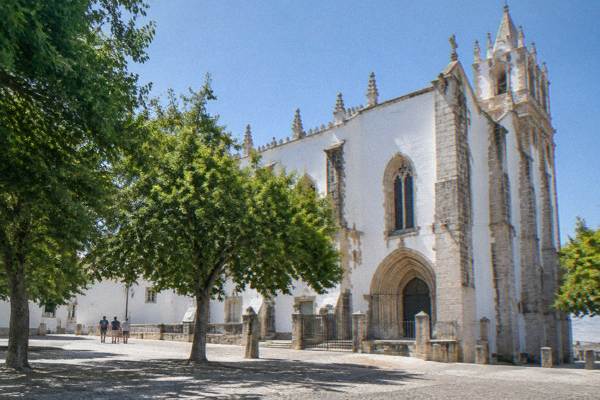
Roman Temple Of Évora (Temple Of Diana)
The Templo Romano stands at the highest point of Évora's walled centre, fourteen granite columns that have watched the city change hands for two millennia. The municipal page says it was probably dedicated to the imperial cult, not to Diana at all.
Short answer
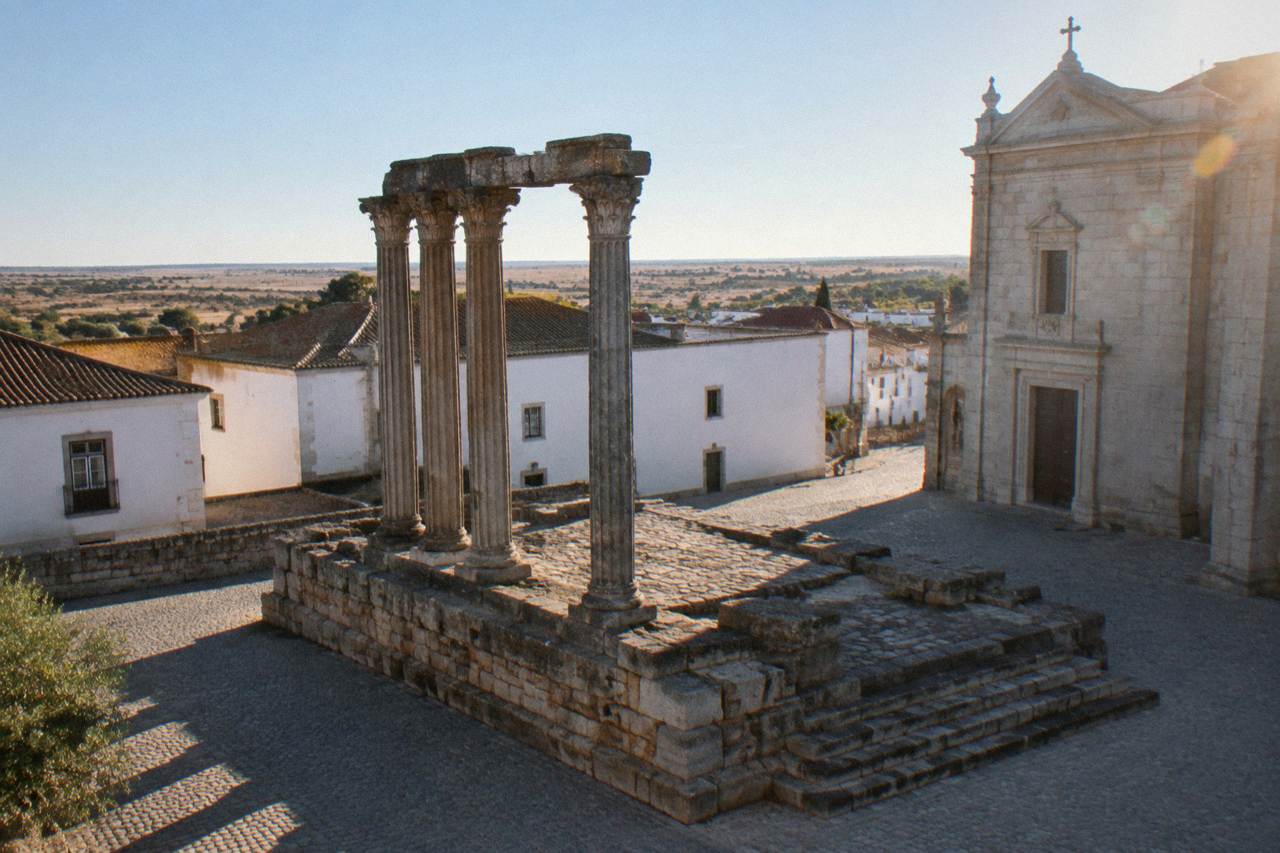
The Roman Temple of Évora is an open-air monument with no ticket, no listed hours and no roof, standing beside the Sé at the top of the historic centre. It measures 25 x 15 m, was reused as a butcher's shop for centuries and had its walls freed in 1870. The name Temple of Diana dates only from the 17th century.
The Roman Temple of Évora, known across the world as the Temple of Diana, is the single most recognisable structure in this inland Alentejo city. Fourteen Corinthian columns of granite and marble rise from a platform beside the cathedral, at the highest point inside the medieval walls, and they have appeared on more postcards of Évora than everything else in the city combined. Yet almost everything a casual visitor believes about the temple is either unproven or flatly contradicted by the municipal page that documents it: the Diana name is a 17th-century invention, the temple was probably dedicated to the imperial cult instead, and for a large stretch of its life the building served the town as a municipal butcher's shop.
The short version: it costs nothing, it never closes, and it takes ten minutes to see unless you choose to linger, which many people do because the setting is one of the finest in southern Portugal.
What Is The Roman Temple Of Évora?
The Roman Temple of Évora is a raised rectangular podium with fourteen standing columns, measuring 25 x 15 m, at the top of the historic centre beside the Sé. It is an open-air monument with no ticket and no listed opening hours, so it can be seen at any time of day or night. The municipal page records that the building was reused as a municipal butcher's and that its encasing walls were freed in 1870 under Cinatti.
Those few sentences contain nearly everything that is firmly documented. The temple belongs to the small group of Roman monuments in Iberia that were never fully dismantled, and the reason is almost comic: the building was swallowed by later construction and put to mundane use, which protected its stones from the quarrymen who took most Roman Évora apart. The structure stood incorporated into other buildings for centuries, functioning at one stage as the town's butcher's shop, and it only re-emerged as a recognisable ancient temple when the walls around it were taken down in 1870.
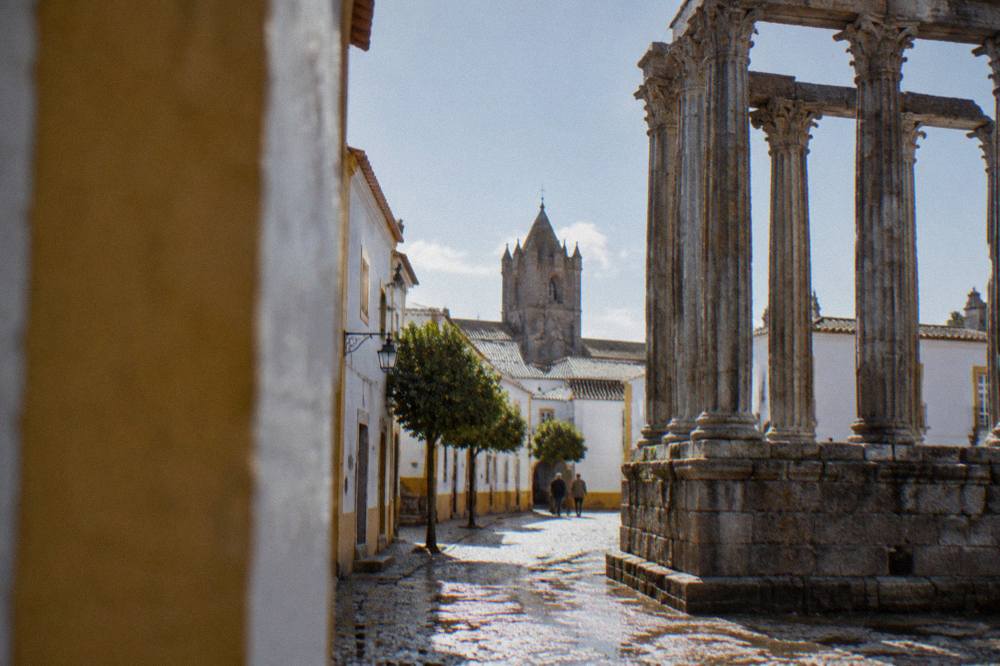
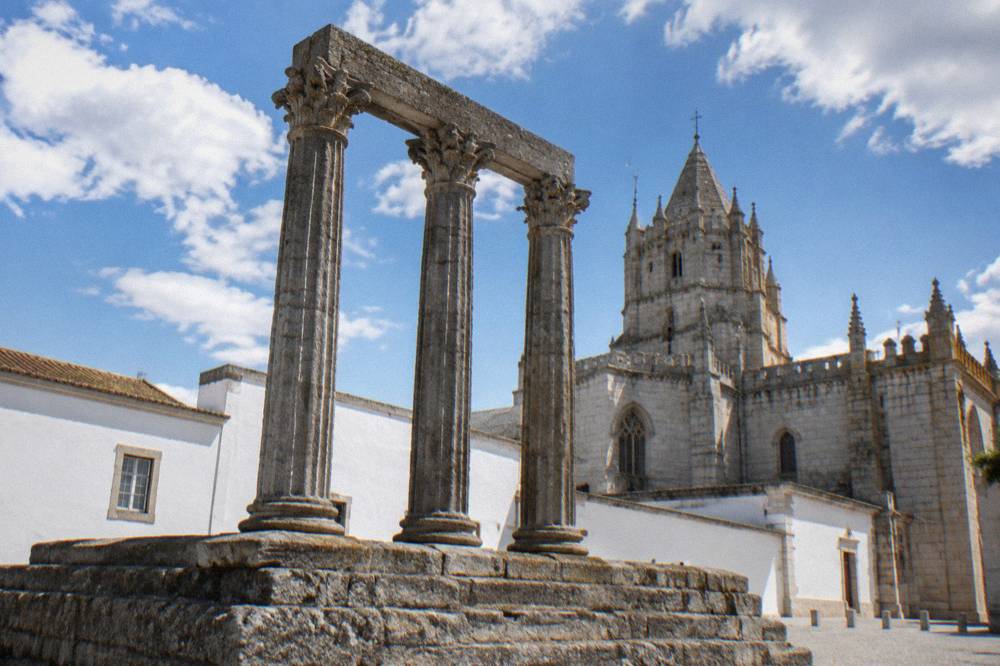
What a visitor sees today is the temple's east-facing flank, a row of columns carrying a section of entablature, set on the platform at the edge of a small square. The position is not an accident of Roman town planning alone. Roman Évora, then called Ebora, had its forum and its acropolis on this high ground, and the temple sat at the ceremonial heart of it. The site later became the Romanesque and Gothic cathedral quarter, so the temple now stands in the shadow of the Sé's massive towers, a collision of two millennia of building that is the reason photographers keep coming back.
A summary of the documented record:
| Fact | What the municipal page says |
|---|---|
| Common name | Temple of Diana, in use since the 17th century |
| Probable dedication | The imperial cult, not the goddess Diana |
| Footprint | 25 x 15 m |
| Later use | Reused as a municipal butcher's |
| Modern restoration | Walls freed in 1870, under Cinatti |
| Access | Open-air monument, no ticket, no listed hours |
Why Is It Called The Temple Of Diana If It Was Not Dedicated To Her?
The name Temple of Diana is a label that caught on in the 17th century and has stuck ever since, even though the municipal page for the monument says the temple was probably dedicated to the imperial cult rather than to the goddess. No inscription naming Diana has ever been attached to the building. The misnomer survives because it is romantic, short and easy to print on a postcard.
The habit of naming unnamed Roman temples after famous deities was common practice across Europe long before archaeology became a disciplined science. Locals and early antiquarians looked at the elegant columns, reached for the most familiar figure of Roman religion, and the name took hold during the 17th century. The municipal page, which is the primary source for the monument's history, is careful with its wording: probably dedicated to the imperial cult. That phrase matters. Temples to the imperial cult, honouring the emperor and his family as divine, were a standard feature of provincial Roman cities, and a prominent temple on a forum platform in Lusitanian Ebora fits that pattern well.
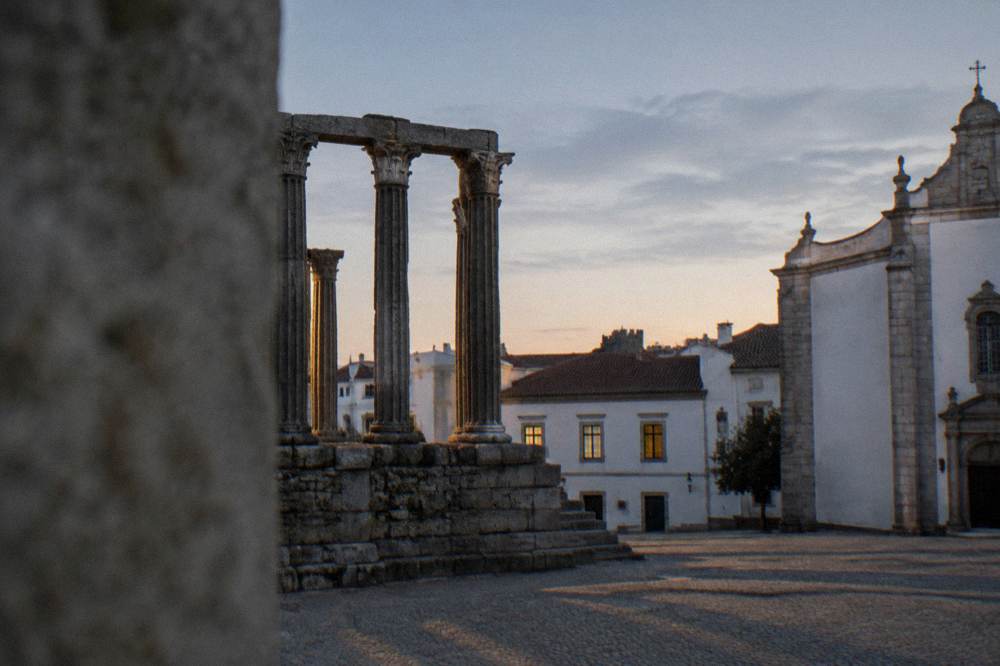
Nothing in the verified record states a construction date, and this page will not invent one. Guides and older websites frequently print a specific century, sometimes two different ones in the same paragraph, but none of those dates comes from the municipal documentation. What can be said is structural: the temple is a Corinthian podium temple of the kind the Romans built across their provinces, using the local granite for the shafts with marble details where they showed. For everything beyond that, the honest answer is that the dedication and the date remain scholarly questions rather than settled facts.
The practical consequence for a visitor is small but real. If a guide or an app tells you confidently that this is a temple of Diana from a specific year, treat the sentence as colour rather than record. The monument rewards a different kind of attention: it is one of very few Roman temples anywhere on the Iberian Peninsula whose columns still stand to their full height in the middle of a living city, whatever name you give it.
How Much Does It Cost To Visit The Templo Romano?
Nothing. The Templo Romano is an open-air monument in a public square, with no ticket, no turnstile and no listed opening hours, so it can be visited free of charge at any hour. This makes it one of the few headline sights of Évora that costs nothing at all, in a city where the major ticketed monuments sit within a two-minute walk of it.
That free access shapes how most people experience it. There is no queue and no crowd control, only a small square that fills and empties with the rhythm of the day. Early in the morning it is often near-empty, with the low sun raking across the column shafts; in the middle of a July afternoon the same square can feel like an oven, because Évora is inland and the Atlantic is roughly 90 km away, so no sea breeze rescues the midday heat. IPMA's 1991 to 2020 normals for the Évora station show a July mean maximum of 33.3 C and an August mean maximum of 33.5 C, with 31.9 days a year reaching 35 C or more, so the smart move in summer is to treat the temple as a morning or evening stop.
The surrounding monuments are not free, and the contrast is worth planning around. The temple sits directly beside the Sé, whose complete-visit ticket covers the cathedral, the cloister, the roof terrace and the museum for 5.00 EUR, with children up to 12 free. A few minutes downhill, the Capela dos Ossos museum ticket is 7.00 EUR for an adult. The Museu de Évora charges adults 8 EUR. The Évora Ticket, a multi-site pass for the Cidade-Museu network, runs 8 EUR for one day, 10 EUR for two days and 12 EUR for three days, free to age 12, and it does not include the Sé, the Capela dos Ossos or the Museu de Évora, so check what it does cover before buying.
| Monument | Adult price | Hours in the verified record |
|---|---|---|
| Templo Romano | Free, no ticket | Open-air, no listed hours |
| Sé de Évora (complete visit) | 5.00 EUR | 9:00-17:00, closed 24 Dec afternoon, 25 Dec, 1 Jan |
| Capela dos Ossos / Igreja de São Francisco | 7.00 EUR | Summer 9:00-18:30, winter 9:00-17:00, daily except 1 Jan, Easter Sunday, 24 Dec afternoon, 25 Dec |
| Museu de Évora | 8 EUR | Tue-Sun 9:30-13:00 and 14:00-17:30, closed Mondays |
| Évora Ticket | 8 EUR one day, 10 EUR two days, 12 EUR three days | Valid at the Cidade-Museu network sites |
A guided walk is the way many visitors tie the free temple to the ticketed monuments around it, and the private option below is the one that pairs it with the cathedral and the Chapel of Bones, with monument tickets included in the listing.
Where Is The Templo Romano And What Stands Around It?
The Templo Romano stands on the high ground of Évora's historic centre, immediately beside the Sé cathedral and above the Largo do Conde de Vila Flor, inside the UNESCO-listed walled city. Everything of note in the old centre is within a short walk of it: the Praça do Giraldo, the Igreja de São Francisco, the Convento dos Lóios and the Museu de Évora all sit within a few minutes on foot.
The location is the temple's greatest asset. It occupies what was the religious and civic high point of Roman Ebora, and every era of the city since has built around it rather than over it. Step out of the square and the whole catalogue of Évora's monuments unfolds in a compact loop: the Sé with its roof terrace, the Roman baths of Évora buried in the town hall's courtyard, the Água de Prata aqueduct marching into the eastern streets, the Renaissance University of Évora a few blocks south. The Chapel of Bones and the church of São Francisco that holds it are downhill toward the Praça do Giraldo, and the Museu de Évora sits just off the square in the former Archbishop's Palace.
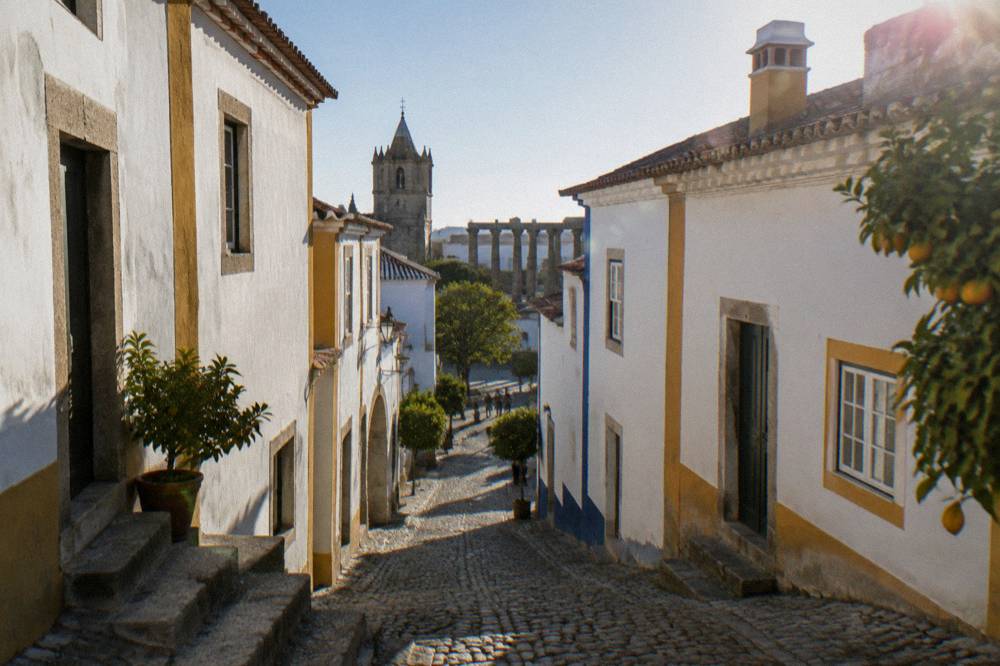
A sensible loop, using only the monuments whose details are in the record:
| Stop | What it is | Practical note |
|---|---|---|
| Templo Romano | Roman podium temple, 25 x 15 m | Free, open-air, no hours |
| Sé de Évora | Gothic cathedral with cloister and roof terrace | 5.00 EUR complete visit, 9:00-17:00 |
| Loios Convent and church | Former convent beside the temple square | Ticket price temporarily unavailable, check at the door |
| Museu de Évora | National museum in the Archbishop's Palace | 8 EUR, closed Mondays |
| Praça do Giraldo | Main public square with the fountain and arcades | Public square, no hours or price |
| Igreja de São Francisco and Capela dos Ossos | Church and ossuary chapel | 7.00 EUR museum ticket, open daily except listed holidays |
For the wider Roman picture, the ancient and Roman sites of Évora pull together the baths, the walls, the aqueduct and the temple in one itinerary, and the question of Roman aqueducts in Portugal has its own answer page. Anyone with a spare half day should also consider the Cromeleque dos Almendres west of the city, a stone circle far older than Rome itself, reachable on the megalith tours that leave from Évora.
When Is The Best Time To See The Temple?
The best light and the coolest conditions come in the early morning and the late afternoon, and in spring and autumn rather than high summer. IPMA's 1991 to 2020 normals for the Évora station show July and August mean maxima of 33.3 C and 33.5 C, with June through August producing almost all of the year's 31.9 days at 35 C or more. October and April sit far closer to comfortable, with mean maxima of 24.1 C and 20.7 C.
Because the temple faces east and stands in an open square, sunrise light hits the columns head-on and is the photographer's hour, while the late afternoon gives the warmer, lower light that suits the cathedral behind it. Midday in July is the hour to be somewhere with a ceiling and a glass of something cold. The same normals show how dry the summer is: July averages 2.7 mm of rain across the month and August 6.0 mm, so a summer visit rarely needs a rain plan, while November averages 86.0 mm, December 85.1 mm and January 68.6 mm, each with eight to nine days of a millimetre or more.
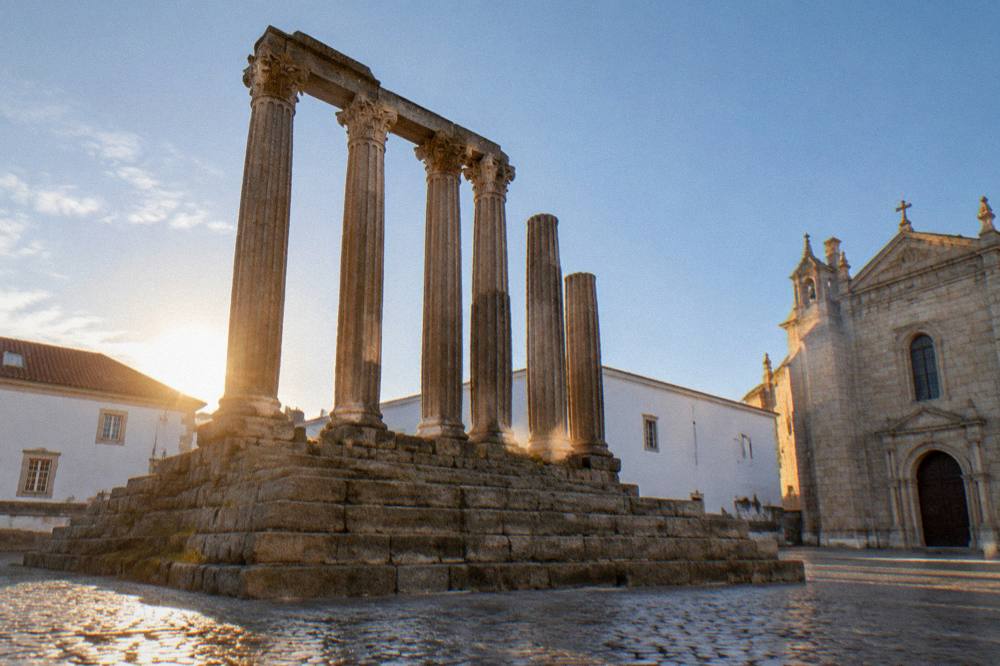
The monthly picture, from the IPMA 1991-2020 normals for station Évora:
| Month | Mean max (C) | Mean min (C) | Rain days (1 mm or more) |
|---|---|---|---|
| January | 14.1 | 4.5 | 8.6 |
| April | 20.7 | 8.5 | 8.0 |
| July | 33.3 | 15.6 | 0.6 |
| August | 33.5 | 16.0 | 0.7 |
| October | 24.1 | 12.3 | 7.7 |
| December | 14.6 | 5.3 | 8.7 |
The record maximum for the station is 45.4 C, set on 4 August 2018, which is the kind of number that turns a midday temple visit into a two-minute dash between patches of shade. Winter is mild by northern European standards but genuinely cold at night, with a record minimum of -4.2 C recorded on 4 December 1998 and again on 23 January 2000. The temple itself is equally visible in every season, since it has no interior, no roof and no gate; only your comfort changes.
Which Tours In Évora Include The Templo Romano?
Most guided walks of Évora's historic centre pass the Templo Romano, because it sits on the standard monument loop beside the cathedral. The private walking tour that pairs the cathedral and the Chapel of Bones covers it, the flexible historic-centre walk covers it at a lower price, and the sidecar tour passes it as part of a wider medieval circuit. Prices run from about $13.51 per person for the flexible group walk to $113.53 for the private best-of tour.
The choice between them is really a choice of depth and style. The private tour, rated 5 from 256 reviews, is the one that suits a visitor who wants the monuments explained in depth and the tickets handled, moving at their own pace through the temple square, the Sé and the ossuary chapel. The flexible historic-centre walk, from $13.51 and rated 4.8 from 105 reviews, is the budget option that still takes in the temple and the main squares over three hours. The sidecar tour, from $61.90 and rated 4.9 from 16 reviews, covers the same ground in an open vintage sidecar with a wine tasting attached, which is a very Alentejo way to see a Roman monument.
For orientation on a first day, the free walks deserve a mention. The Essential Free Tour of Évora on GuruWalk, rated 4.93 from 774 reviews over two hours, passes the temple as part of its standard route, and Évora through history and how it shaped the city, also on GuruWalk and rated 4.88 from 74 reviews, uses the temple as one of its anchor stops. These are tip-based walks led by local gurus, and they cost nothing to join beyond what you choose to tip. The trade-off is simple: a free walk gives you the outline, a private guide gives you the depth and the skip-line access to the monuments around the temple.
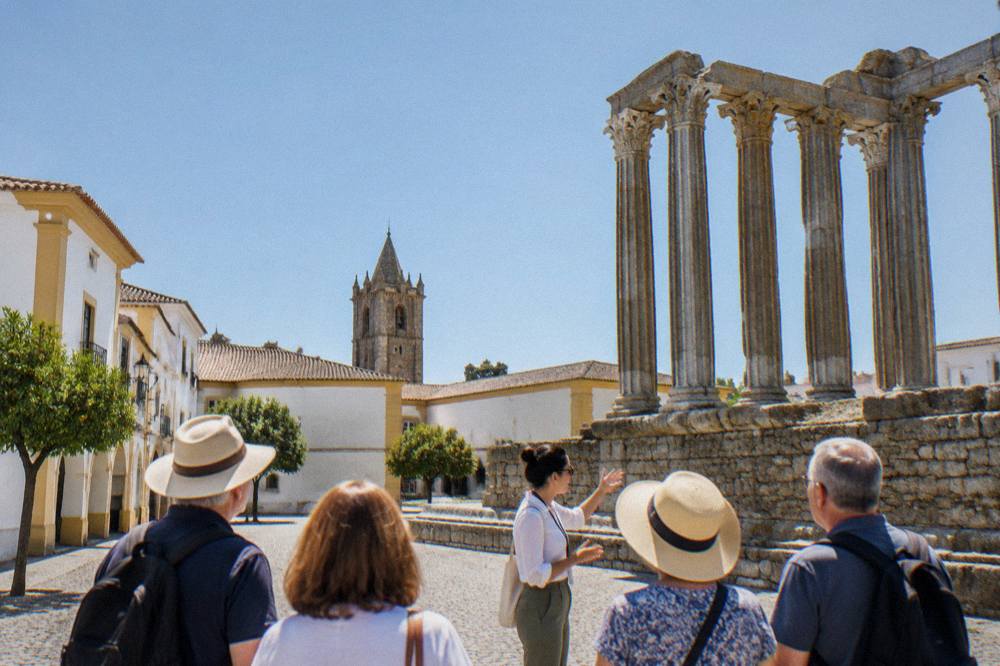
The sidecar option suits travellers who want the historic centre without the walking, or who want to combine the temple with viewpoints the standard loop misses:
| Tour | Style | From (per person) | Rating | Length |
|---|---|---|---|---|
| Private walking tour, cathedral and Chapel of Bones | Private walk, monument tickets | $113.53 | 5 from 256 reviews | 2.5 hours |
| Personal and flexible historic-centre walk | Small-group walk | $13.51 | 4.8 from 105 reviews | 3 hours |
| Medieval sidecar tour with wine tasting | Sidecar ride, tasting | $61.90 | 4.9 from 16 reviews | 3 hours |
| The Essential Free Tour of Évora | Free tip-based walk on GuruWalk | Free, tip based | 4.93 from 774 reviews | 2 hours |
For visitors basing themselves in Lisbon rather than in Évora, the day trips from the capital that include the city also pass the temple, though those tours start in Lisbon and should be planned as full-day outings rather than quick stops.
How Does The Templo Romano Fit Into A Day In Évora?
The temple works best as the hinge of a day rather than a destination in itself: see it at sunrise or in the early morning, spend the middle of the day inside the cathedral, the museum and the Chapel of Bones, and return to the square in the late afternoon for the second round of light. Because it is free and always visible, it costs a day nothing and can absorb whatever time the weather and the crowds leave over.
A one-day plan built around the temple square might run like this. Morning: the temple in low light, then the Sé's complete visit, whose 5.00 EUR ticket includes the cloister, the roof terrace and the museum, with the roof giving a view back down over the columns. Midday: lunch in the lanes around the Praça do Giraldo, then the Museu de Évora in the Archbishop's Palace, remembering it closes on Mondays and splits its day into two sessions, 9:30-13:00 and 14:00-17:30. Afternoon: the walk down to the Igreja de São Francisco and the Capela dos Ossos, open daily except 1 January, Easter Sunday, the afternoon of 24 December and 25 December. Evening: back up the hill for the temple at dusk, when the columns go dark against the sky and the square empties.
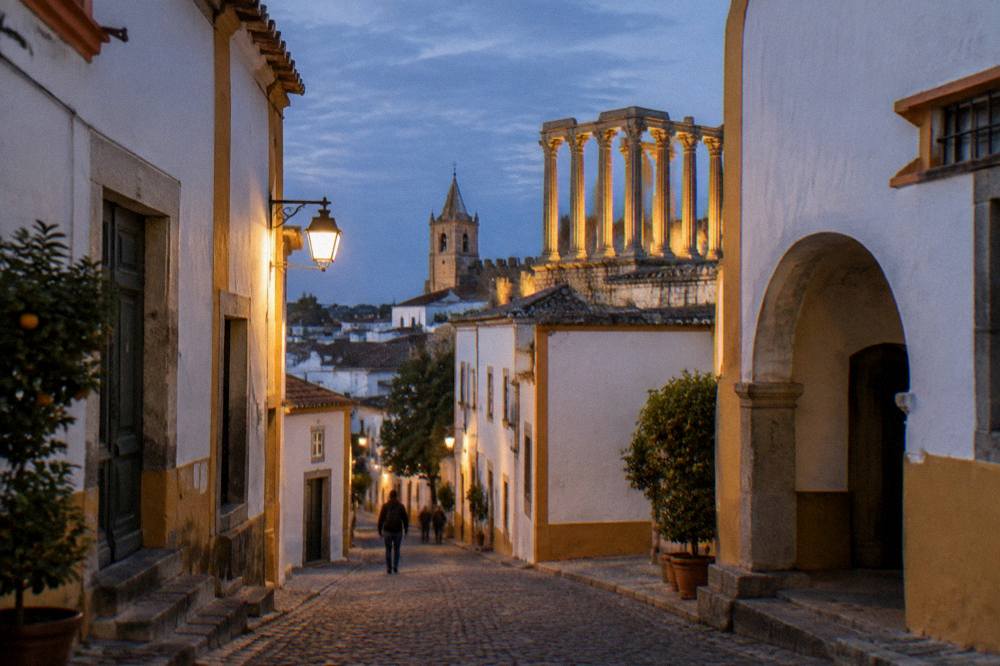
Visitors with more than a day can push outward. The full things to do in Évora catalogue covers the city itself, while the second day is better spent outside the walls: the Almendres stone circle, the marble town of Vila Viçosa about 60 km away, or Monsaraz about 40 to 45 km away above the Alqueva reservoir. The temple is also one of the city's best spots for the rooftop views of Évora, since the platform's height means the eye travels from the columns straight over the sea of white walls and terracotta to the plain beyond.
One last practical note that the Évora Travel Guide editorial desk hears often: the temple square is a working public space, and the small cafés and the pousada around it are part of the view. The tables nearest the columns fill first in the evening, and the square hosts passers-by at every hour, because there is nothing to close. That permanence is the point. The columns were a butcher's, a wall, a ruin and a postcard, and they are still standing at the top of the city, free to see, an hour after the last cathedral ticket has been sold and long before the first one of the next day.
Common Questions About The Roman Temple Of Évora
Is the Roman Temple of Évora free to visit?
Yes. The Templo Romano is an open-air monument in a public square with no ticket, no turnstile and no listed opening hours. It can be seen at any time of day or night without charge.
Why is it called the Temple of Diana?
The name has been in use since the 17th century, but the municipal page for the monument says the temple was probably dedicated to the imperial cult rather than to the goddess Diana. No inscription naming Diana is attached to the building.
How big is the Templo Romano?
The temple measures 25 x 15 m, standing on a raised platform beside the cathedral. Fourteen Corinthian columns survive to full height along its flank.
What was the temple used for after Roman times?
The building was reused as a municipal butcher's, and it stood encased in later construction for centuries. Its walls were freed in 1870 under Cinatti, which is when the temple re-emerged as a recognisable ancient monument.
When was the Roman Temple of Évora built?
No construction date is stated in the municipal documentation for the monument, and this page does not print one. It is a Corinthian podium temple of the standard provincial Roman type, and its exact date remains a scholarly question.
What else is near the Templo Romano?
The Sé de Évora stands directly beside it, with the Convento dos Lóios and the Museu de Évora within a few minutes' walk. The Praça do Giraldo and the Igreja de São Francisco with the Capela dos Ossos are a short walk downhill.