Alentejo Cork And Cork Oak: The Landscape Around Évora, Portugal
The cork oak is the tree that shapes the Alentejo, and Évora sits in the middle of it. This guide explains the landscape, the harvest, the tours that take you into the cork forests, and what cork to bring home.
Short answer
The Alentejo around Évora is cork country: a landscape of low cork oaks spaced across grassland, harvested by hand for their bark in cycles. Guided tours from Évora visit working cork farms and forests, from about $50 per person, and the city's shops sell cork products from wallets to handbags.
The plain that surrounds Évora, the inland capital of Portugal's Alentejo region, is covered in low, gnarled trees with bark the colour of rust. These are cork oaks, and the landscape they make, open grassland dotted with trees rather than dense forest, is the single most characteristic sight of central Alentejo. The region's name is usually explained as "beyond the Tagus", and everything beyond that river, Évora included, shares this scattered tree cover. Cork is not a footnote to the Alentejo: it is the reason the countryside looks the way it does, and a day spent understanding it changes how the whole region reads.
What Is The Cork Oak And Why Does It Define The Landscape Around Évora?
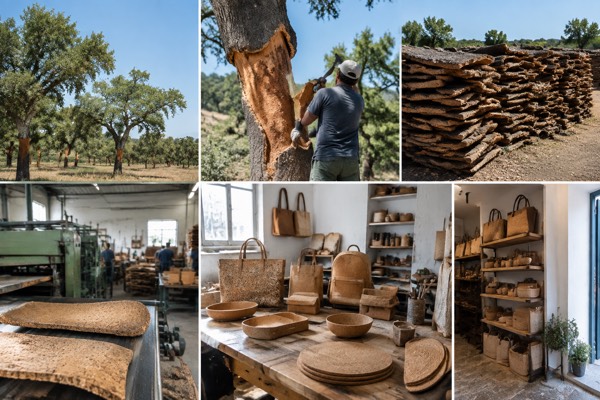
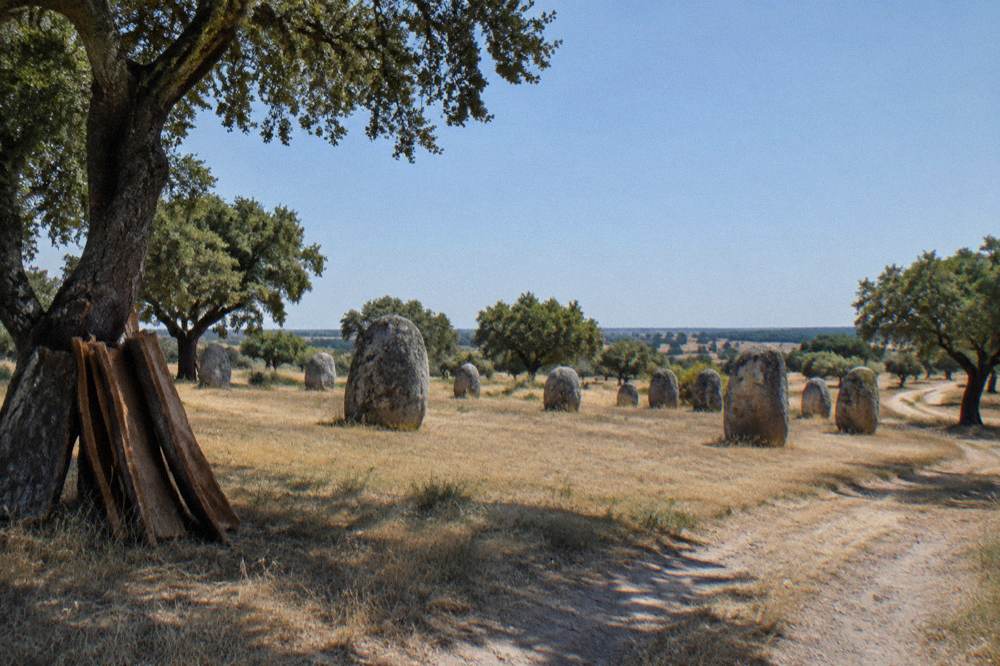
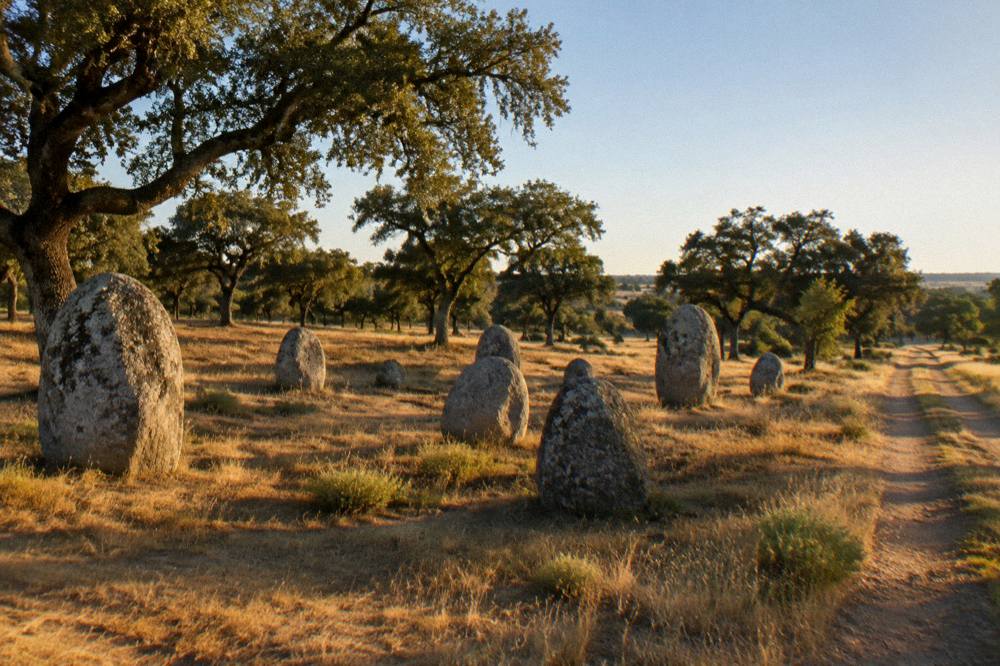
The cork oak is an evergreen tree whose thick outer bark is stripped and sold as cork, and around Évora it grows not in dense woods but as widely spaced individual trees across grazing land, a landscape the Portuguese call the montado. The trees give shade to sheep and pigs, their acorns feed the animals, and the bark pays the farmer, so the same hectare produces cork, meat and olive oil at once. That mixed use is why the countryside looks open and park-like rather than forested.
The montado is a working landscape, not a wilderness. Each tree belongs to someone, each strip of bark has a value, and the grass between the trees is pasture. A visitor driving out of Évora in any direction will pass through it within minutes: the road to Arraiolos, about 20 km away, and the road toward Lisbon both run through continuous cork cover. The trees are short, rarely forming a closed canopy, and their stripped trunks, pale orange where the bark has been taken and grey where it has regrown, are visible from a distance.
The tree itself is adapted to exactly the conditions the Alentejo provides. IPMA's 1991 to 2020 normals for the Évora station show a July mean maximum of 33.3 C and an August mean of 33.5 C, with 31.9 days a year reaching 35 C or more and a record of 45.4 C on 4 August 2018. A thick, insulating bark and deep roots are what let a tree survive that. Annual rainfall across the same 1991 to 2020 window averages 596.1 mm, most of it between October and March, so the tree spends its summer drawing on stored water.
Where Can You See Cork Oaks And Cork Forests Near Évora?
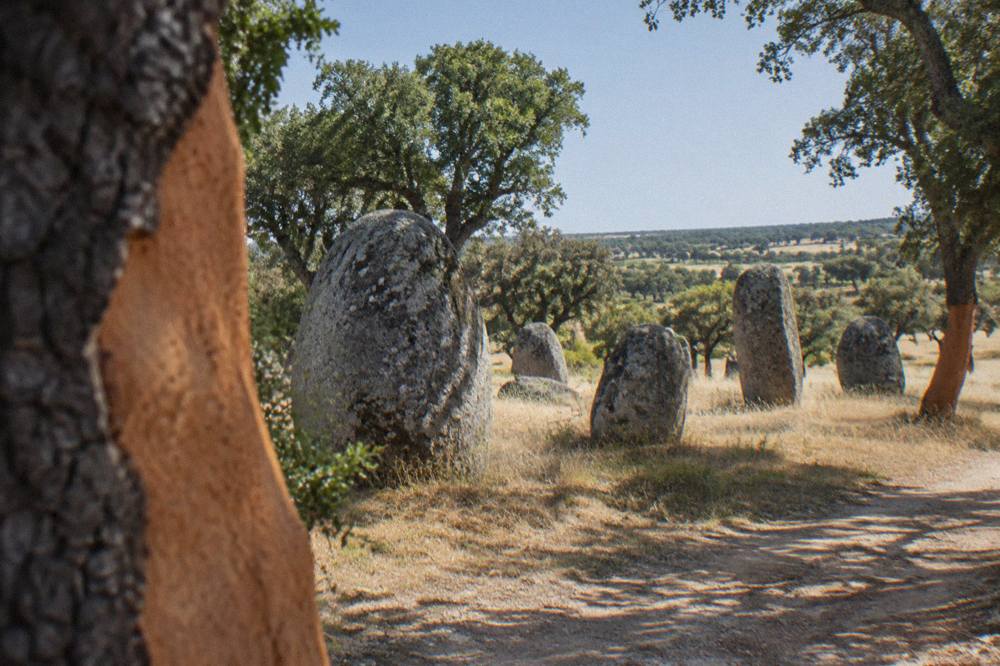
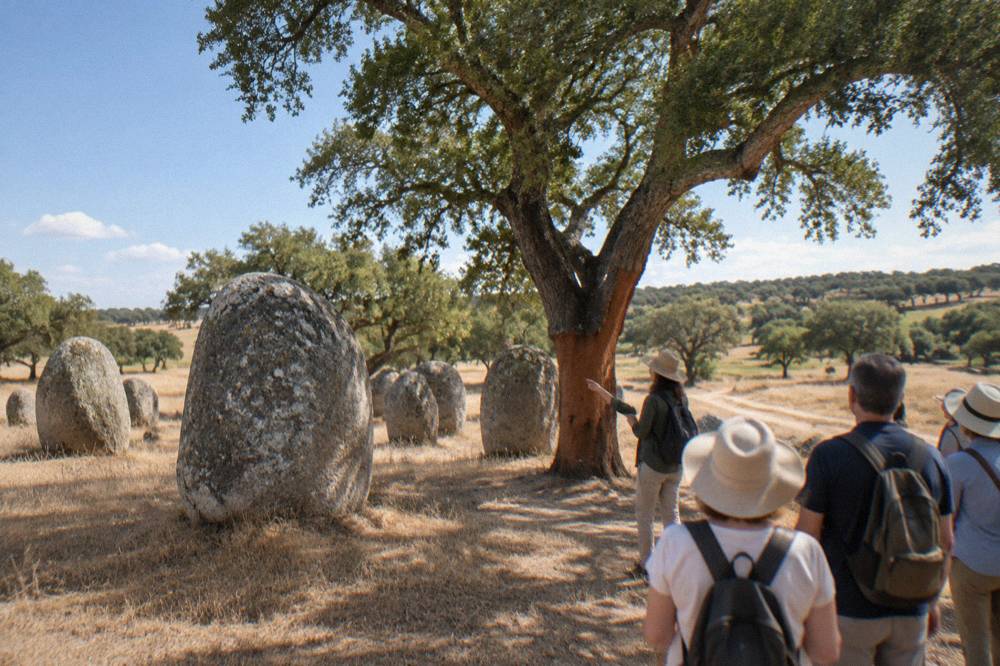
Cork oaks begin at the edge of town: any road leaving Évora passes through the montado within minutes, and the deeper stands lie in the countryside toward Arraiolos, about 20 km away, and across the hills south and west of the city. For a structured visit, guided tours from Évora take small groups into working cork forests and farms, from about $50.65 per person for a four-hour megalithic and cork forest walk to $112.55 for a full day with lunch included.
The difference between looking at the landscape and understanding it is a guide who knows the trees. Several operators run cork-focused trips out of the city, and the range is wide enough to fit most budgets and schedules. The table below sets out the cork tours that start in Évora itself, with prices in US dollars exactly as the operators list them.
| Tour | Duration | From price (USD) | Rating |
|---|---|---|---|
| Megalithic and Cork Forest guided tour from Évora | 4 hours | $50.65 | 4.9 from 41 reviews |
| 2hr Walk in a Cork Forest | 2 hours | $71.10 | 4.7 from 43 reviews |
| Alentejo Wine and Cork from Évora | 4 hours | $78.78 | 4.7 from 24 reviews |
| 2hr Cork Safari in a Classical Land Rover | 2 hours | $102.07 | 4.8 from 33 reviews |
| Évora: Cork Factory and Cork Farm Lunch included | 8 hours | $112.55 | 4.8 from 26 reviews |
The four-hour options suit a morning or an afternoon slot in a longer Évora itinerary, and the eight-hour factory and farm day is effectively a full countryside excursion with lunch built in. For travellers who want the landscape paired with prehistoric stone, the megalithic and cork forest combination visits the Cromeleque dos Almendres area and the cork stands in a single trip; the Almendres Interpretation Centre in the village of Guadalupe keeps summer hours of 10:00 to 18:00 from 1 May to 31 October and winter hours of 10:00 to 17:00 from 1 November to 30 April.
Beyond the guided options, the city itself holds cork. The cork museum and cork shops of Évora cover where to see the material worked and where to buy it, and a walk through the historic centre passes several shopfronts selling cork handbags, hats and wallets. For the broader picture of the region, the Alentejo travel guide and the answer to what Alentejo is famous for set cork alongside the wine, marble and hilltop villages.
What Happens On A Cork Tour From Évora?
A cork tour from Évora typically pairs a walk through standing cork oaks with a visit to a place where the bark is processed or turned into products, and the better ones add a wine tasting, since cork and wine country are the same country here. The Alentejo Wine and Cork from Évora tour runs four hours from $78.78 per person, rated 4.7 from 24 reviews, and combines the forest with a tasting stop. Others focus purely on the trees and the land.
What you actually see depends on the season. The stripping of bark happens in early summer, when the tree is growing actively and the bark lifts away cleanly; outside that window, tours show the forest, the farms and the workshops instead, and the stripped trunks from earlier harvests remain visible year round. A guide also reads the landscape for you: which trees have been cut, which are resting, and how the pasture, the pigs and the olive trees share the same ground.
For visitors building a full countryside day, the strongest pairing is cork with wine. The Alentejo's wineries sit inside the same montado, and a combined tour moves from tree to tasting room without a long transfer. The Alentejo wine guide covers the wine side in depth, and the Évora wine tasting guide lists where to taste in the city itself. Nothing about individual wineries, their hours or their tasting fees can be stated as fact here: check each operator's notice before you go, or let a tour handle the arrangements.
The factory and farm option deserves a separate word. At $112.55 per person for eight hours with lunch included, it is the most complete version of the day: standing trees in the morning, the processing side at midday, and a farm lunch in the middle of it. It is rated 4.8 from 26 reviews. For travellers on a shorter stay, the two-hour options, the cork forest walk at $71.10 and the Land Rover cork safari at $102.07, fit inside a half-day in the city.
How Does Cork Harvesting Work In The Alentejo?
Harvesters cut the outer bark of the cork oak by hand with axes, lifting it away in curved panels and leaving the living inner bark intact, and the tree then regrows its protective layer over a number of years before it is stripped again. The first strip from a young tree is rougher and less valuable than later harvests, and a single tree is productive across a very long working life. No figures for Portugal's or the Alentejo's cork output are published on this page.
The skill is in the cut. An experienced stripper makes a vertical cut, a horizontal cut at the top and bottom, and lifts the panel free without scoring the thin layer underneath, because a wound to that layer exposes the tree to fire, drought and disease. The stripped trunk is left pale and orange, and it darkens as the bark returns. The panels are stacked at the roadside and taken away for boiling, grading and processing into stoppers, flooring, insulation and the consumer goods sold in Évora's shops.
Fire is the standing threat to all of this. The Alentejo's hot, dry summers, with the IPMA 1991 to 2020 normals showing July and August mean maxima above 33 C, make the montado vulnerable, and the landscape's open spacing is partly a fire adaptation: scattered trees with grazed grass beneath burn less fiercely than a closed canopy. The same grazing that feeds the region's pigs and sheep also keeps the fuel load down.
What Cork Products Can You Buy In Évora?
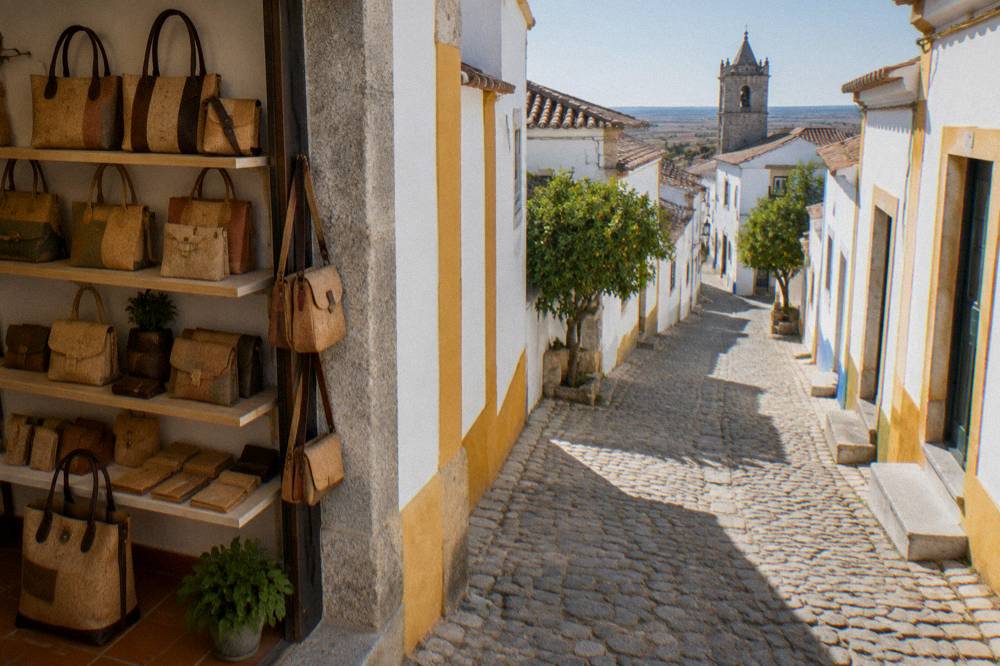
Évora's shops sell cork worked into almost everything leather used to do: handbags, wallets, belts, hats, shoes and notebooks, alongside the traditional stoppers and the newer cork fabrics, and because the material is harvested rather than felled, it is widely presented as a renewable alternative to leather. The cork museum and the specialist shops in the historic centre are the places to compare quality, and prices vary widely, so check each shop's range in person.
The useful test when buying is feel and finish. Well-worked cork fabric is smooth, dense and stitched like leather, and it ages similarly; the cheaper end can be stiffer and thinner. Évora's position as the region's market town means the selection here is broader than in the smaller Alentejo villages, and a purchase made in the city supports the same countryside the tours drive through. The wider set of guides lives on Évora Travel Guide.
For a sense of the wider regional shopping, the Alentejo food guide and the guide to Alentejo dishes to try cover the edible side of what the region sells, and the answer to whether Alentejo is worth visiting weighs the whole trip. The olive-oil story runs in parallel with cork: the Alentejo olive oil guide explains the third product of the same montado landscape.
How Does Cork Fit A Wine, Food And Countryside Day Around Évora?
Cork sits naturally at the centre of a countryside day built from Évora, because the wineries, the cork forests and the food of the Alentejo all occupy the same land, and several tours bundle two or three of them into a single booking. The Alentejo Wine and Cork from Évora tour, four hours from $78.78, is the direct pairing; the megalithic and cork forest tour at $50.65 adds prehistoric stones; the cork factory and farm day at $112.55 adds lunch and a full eight hours.
The logic of combining is simple: the distances involved are short by the standards of rural Portugal, and the drives between stops run through the montado itself, so the scenery is part of the itinerary. A three-day plan that mixes the city, the cork country and one hilltop village is sketched in the three days in Évora and Alentejo itinerary, and drivers will find the Alentejo road trip guide covers the cork roads in detail.
| Day Shape | Cork Component | Best Paired With | Tour That Does Both |
|---|---|---|---|
| Half day, city based | 2-hour cork forest walk, $71.10 | Historic-centre walking tour | 2hr Walk in a Cork Forest |
| Half day, countryside | Cork safari by Land Rover, $102.07 | Megalithic sites | 2hr Cork Safari in a Classical Land Rover |
| Full day, small group | Cork forest plus wine tasting, $78.78 | Alentejo winery stop | Alentejo Wine and Cork from Évora |
| Full day, deep dive | Cork factory plus farm lunch, $112.55 | Working farm visit | Cork Factory and Cork Farm Lunch |
| Full day, mixed | Cork forest plus megaliths, $50.65 | Cromeleque dos Almendres | Megalithic and Cork Forest guided tour |
Travellers arriving from Lisbon rather than staying in Évora can also reach this landscape, though those tours start in the capital and should be read as Lisbon day trips. The Lisbon to Évora guide and the train option cover the transfer, and the Alentejo tour from Lisbon page lists the combined options.
When Is The Best Time To Visit The Cork Landscapes Around Évora?
Spring and autumn are the comfortable seasons for the cork country: the IPMA 1991 to 2020 normals for the Évora station show May at a mean maximum of 25.0 C and October at 24.1 C, against July and August means of 33.3 C and 33.5 C, and those summer months average 23.7 and 25.0 days at 30 C or more. The stripping season falls in early summer, so a July visit is the hottest but the most likely to show the harvest in progress.
The trade-off is real and worth planning around. A summer visit buys the spectacle of the harvest and the fully dry, golden plain, but it also buys heat: 31.9 days a year reach 35 C or more on the 1991 to 2020 average, and the record stands at 45.4 C on 4 August 2018. A spring visit buys green grass, wildflowers between the trees and walking weather, and October brings the first rain, 81.5 mm on average across the 1991 to 2020 window, which settles the dust and darkens the colours.
| Month | Mean maximum (C), 1991-2020 | Days at 30 C or more | Rainfall (mm) |
|---|---|---|---|
| May | 25.0 | 5.5 | 46.6 |
| June | 30.2 | 15.1 | 10.6 |
| July | 33.3 | 23.7 | 2.7 |
| August | 33.5 | 25.0 | 6.0 |
| September | 29.5 | 13.9 | 33.9 |
| October | 24.1 | 2.9 | 81.5 |
The fuller month-by-month picture, including winter, is in the best time to visit Évora guide, and the question of which month is best for the Alentejo is answered directly on its own page. Whatever the month, carry water on any countryside walk: these are open landscapes with little shade outside the trees themselves.
How Do You Get To Évora And Out Into The Cork Country?
CP's Intercidades timetable, valid since 6 September 2026, lists six through trains a day from Lisboa Oriente to Évora, taking about 1 hour 40 to 1 hour 45, with a second-class fare of 13.90 EUR and first class at 18.50 EUR; departures run at 07:02, 09:02, 09:58, 13:35, 17:02 and 19:02. Once in Évora, the cork country begins on the town's edge, and the guided tours collect visitors in the city rather than requiring a car.
The train is the simplest route in from the capital, Lisbon being about 130 km away by road. Travellers already staying in Évora do not need a vehicle for the cork experience specifically, because the tours depart from the city; a car only becomes necessary for independent exploration of the smaller villages, and the Évora parking and Évora car rental guides cover that side. The Évora train station page has the arrival detail.
| Lisboa Oriente departure | Évora arrival | Second-class fare | First-class fare |
|---|---|---|---|
| 07:02 | 08:47 | 13.90 EUR | 18.50 EUR |
| 09:02 | 10:45 | 13.90 EUR | 18.50 EUR |
| 09:58 | 11:40 | 13.90 EUR | 18.50 EUR |
| 13:35 | 15:13 | 13.90 EUR | 18.50 EUR |
| 17:02 | 18:41 | 13.90 EUR | 18.50 EUR |
| 19:02 | 20:46 | 13.90 EUR | 18.50 EUR |
For orientation once you are in the region, the rounded distances from Évora are: Arraiolos about 20 km, Monsaraz about 40 to 45 km, Estremoz about 45 km, Vila Viçosa about 60 km, Elvas about 80 km and Marvão about 120 km. The where is Alentejo located page places the whole region on the map, and what Alentejo means in Portuguese explains the name.
What Else Should You Know Before Visiting The Cork Country?
Bring sun protection and closed shoes, expect almost no shade between the trees, and book the harvest-season tours early if you want to see stripping in progress, because the small-group options fill first. The Alentejo is working farmland, so stay with your guide on private land, and treat the cork oaks with the same respect the landowners do: a damaged tree can be lost for good. A municipal tourist tax applies to stays in Évora, so check your hotel's final bill.
Évora's own sights fill the rest of a visit, and the entry prices are fixed and public: the Sé de Évora complete-visit ticket, covering the cathedral, cloister, roof terrace and museum, is 5.00 EUR with children up to 12 free; the Capela dos Ossos museum ticket at the Igreja de São Francisco is 7.00 EUR adult, 5.00 EUR for youth to 25 and seniors over 65, and 15.00 EUR for a family; the Museu de Évora is 8 EUR for adults. The Évora Ticket, a multi-site pass, costs 8 EUR for one day, 10 EUR for two and 12 EUR for three, though it does not include those three headline monuments.
| Site | Ticket | Adult price | Notes |
|---|---|---|---|
| Sé de Évora | Complete visit, cathedral, cloister, roof, museum | 5.00 EUR | Children up to 12 free |
| Igreja de São Francisco / Capela dos Ossos | Museum ticket | 7.00 EUR | Youth to 25 and seniors over 65 5.00 EUR, family 15.00 EUR |
| Museu de Évora | Admission | 8 EUR | Closed Mondays |
| Évora Ticket | Multi-site pass | 8 EUR one day, 10 EUR two days, 12 EUR three days | Free to age 12, excludes the three sites above |
The full monument picture, including hours and closures, is in the Évora tickets and passes guide, and the things to do in Évora page rounds up the city itself. For the free introduction to the historic centre, GuruWalk lists a tip-based Essential Free Tour of Évora, rated 4.93 from 774 reviews over two hours, which pairs well with a paid cork excursion on the following day.
Common Questions About Alentejo Cork And Cork Oak
Can you visit a cork forest from Évora without a car?
Yes. Guided tours depart from Évora and handle the transport, from the two-hour cork forest walk at $71.10 per person to the full-day cork factory and farm visit at $112.55 with lunch included. Booking in advance is wise for the small-group options.
When is cork harvested in the Alentejo?
Stripping happens in early summer, when the bark lifts cleanly from the trunk. Outside that window the forests, farms and workshops are still visited year round, and the pale stripped trunks from earlier harvests stay visible in every season.
Is cork harvesting harmful to the tree?
No, when done correctly. Only the outer bark is removed and the living layer beneath is left intact, after which the bark regrows over a number of years. The harvest is done by hand with axes precisely because a careless cut can injure the tree.
What is the montado?
The montado is the Alentejo's characteristic landscape of cork oaks, and sometimes holm oaks, spaced across grazed grassland. It produces cork, pasture for sheep and pigs, and often olives from the same ground, which is why the countryside looks open and park-like rather than forested.
Where can you buy cork products in Évora?
Specialist shops in the historic centre sell cork handbags, wallets, hats, shoes and notebooks, and the cork museum covers the material's history and processing. Compare finish and stitching in person before buying, as quality varies widely.
Are the cork tours suitable for children?
The short forest walks generally suit families, and several monuments in Évora admit children up to 12 free, including the Sé and the Évora Ticket network. Check each tour's listing for its own age policy before booking.
The cork oak rewards the small amount of attention it asks for. Once you can read a stripped trunk, a resting one and the grassland between them, every road out of Évora becomes a working landscape rather than scenery, and the region's wine, its food and its famous golden plain all turn out to be parts of the same story, told one tree at a time.