Cork Shops In Évora: A Practical Guide To Alentejo Cork
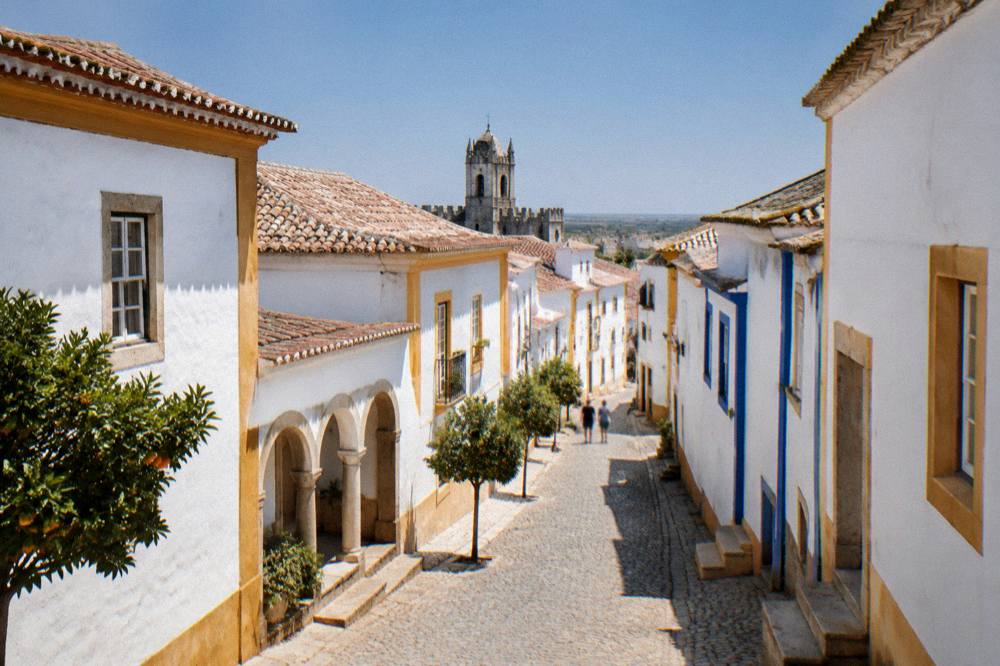
Évora, the inland capital of Portugal's Alentejo, sits in the middle of the montado, the cork oak landscape that supplies much of the world's cork, and its historic centre is where that harvest turns into bags, wallets and umbrellas you can carry home.
Short answer
Évora is one of the best places in Portugal to buy cork because the city sits inside the Alentejo montado, the cork oak woodland that makes the region the heart of world cork supply. Shops inside the UNESCO-listed historic centre sell cork bags, footwear, accessories and souvenirs, and guided tours from Évora visit the cork forests and workshops where the bark is worked.
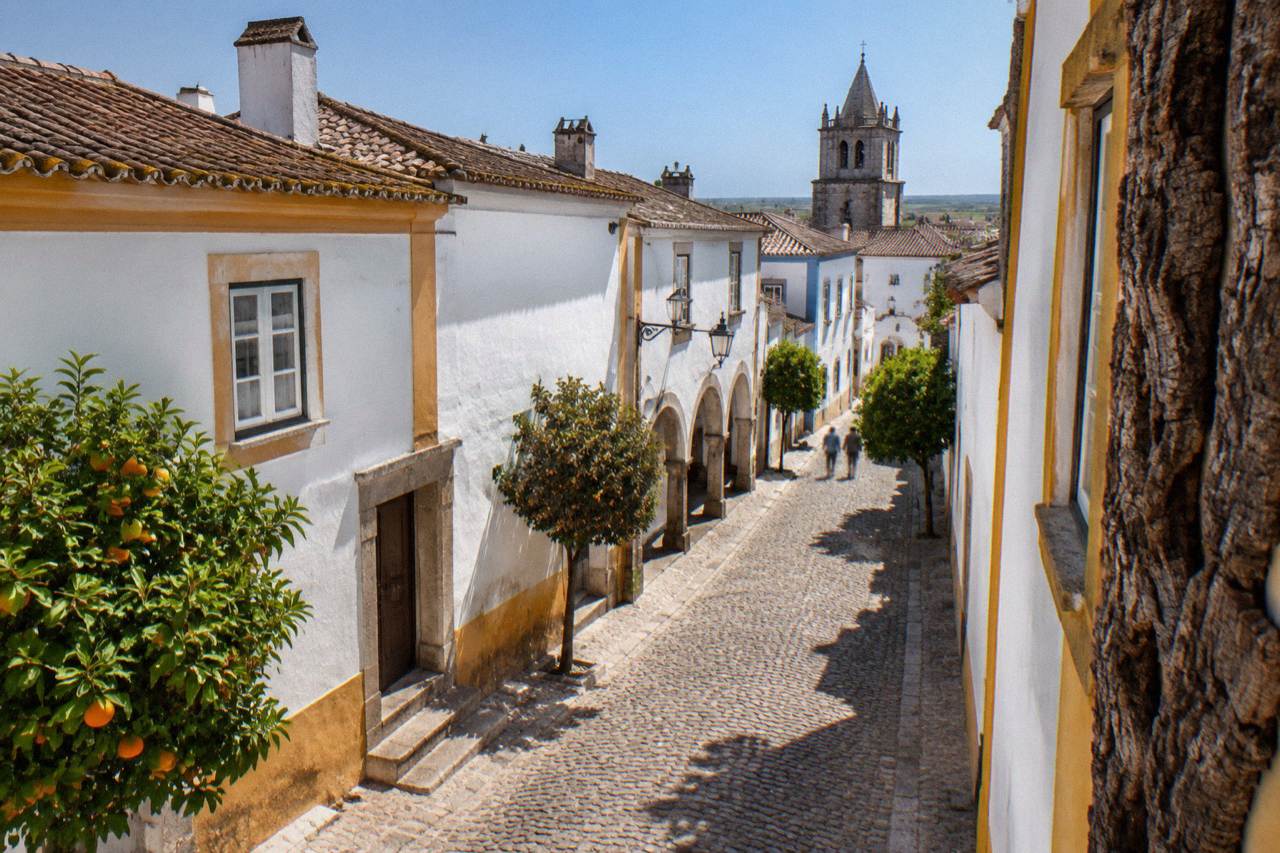
Évora, in the Alentejo region of Portugal, is a walled city of white houses and Roman stones that happens to sit in the middle of the world's great cork country. The montado, the open cork oak woodland that covers much of the surrounding plain, is the reason this modest inland city became a place where travellers buy handbags made from tree bark. The historic centre, inscribed by UNESCO in 1986 under criteria (ii) and (iv) as the finest example of a city of the golden age of Portugal after the 1755 Lisbon earthquake, is small enough that the cork shops sit a few minutes' walk from the Roman temple, the Sé and the Praça do Giraldo. This page explains what cork actually is, how it travels from tree to shop counter, what to look for when you buy, and which guided experiences let you see the landscape behind the product. For the wider story of the tree itself, the companion page on Alentejo cork and the cork oak goes deeper into the montado as a landscape.
Why Is Évora Known For Cork?
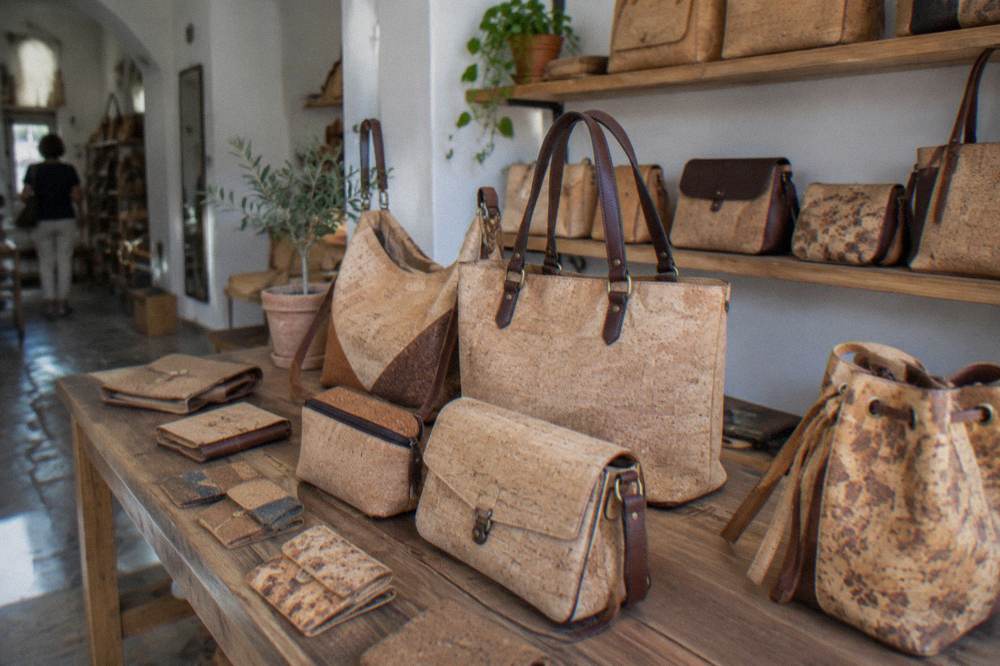
Évora is known for cork because it is the capital of the Alentejo, the Portuguese region whose cork oak woodland, the montado, supplies a large share of the world's cork, and the city's historic centre has long been the commercial heart where that material is cut, stitched and sold. Travellers encounter cork here as a finished product: bags, hats, footwear, coasters and accessories in shops a short walk from the Roman temple, the cathedral and the Praça do Giraldo, all inside the UNESCO-listed centre.
The connection is geographic before it is commercial. Évora stands on an inland plateau, roughly 130 km from Lisbon, surrounded by the rolling plain of Central Alentejo. Cork oaks grow in that plain in open parkland, their bark stripped in cycles and left to regrow. The city grew as the administrative and market centre of that landscape, and the cork trade followed the same road the Romans built on.
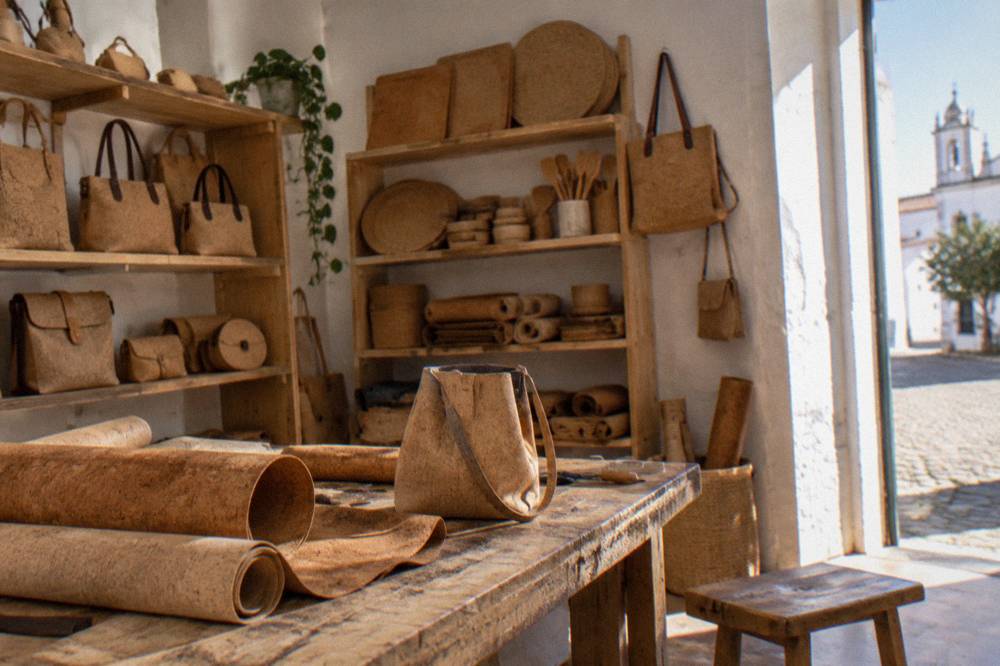
What surprises many first-time visitors is how ordinary cork feels once you handle it. The material is light, waterproof, soft to the touch and remarkably durable, and modern workshops have turned it into fashion items that look nothing like a wine stopper. A cork handbag from Évora is, quite literally, bark from a tree an hour's drive away, compressed and finished by hand.
The city's other attractions make the shopping easy to combine with sightseeing. The Capela dos Ossos, the Sé de Évora and the Giraldo Square are all inside the same compact walled area, so an afternoon of looking at cork shops costs no extra travel time. The full sightseeing picture is on the things to do in Évora page.
What Is The Montado, The Landscape Behind Évora Cork?
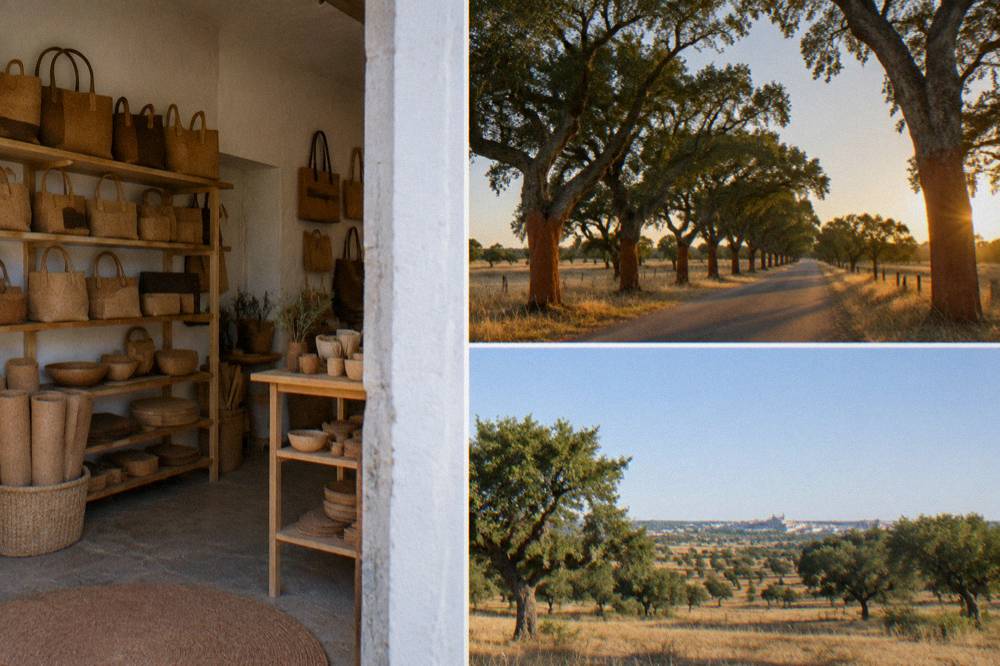
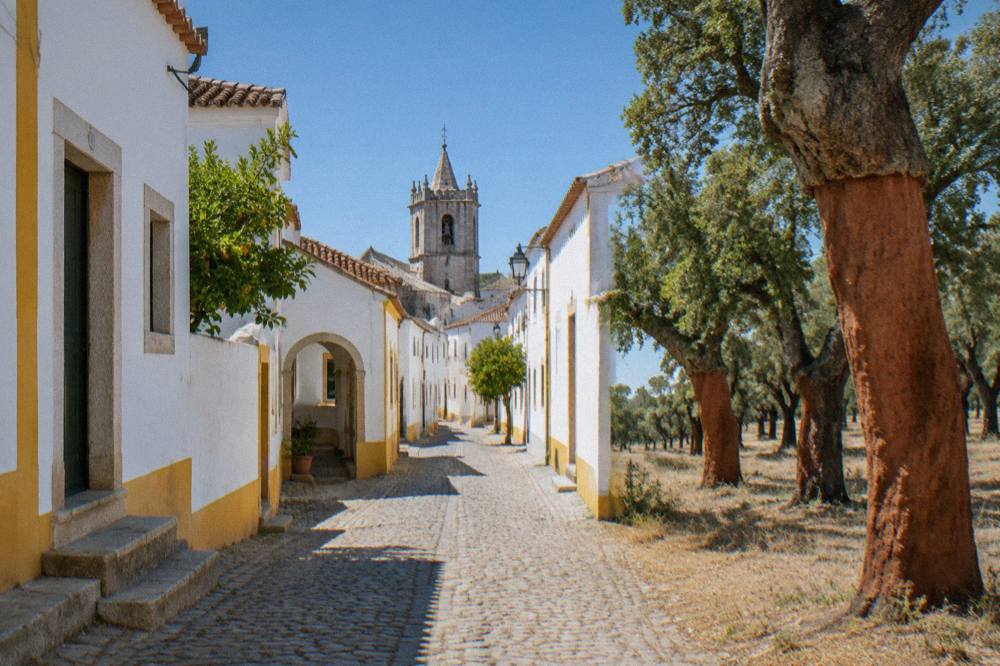
The montado is the open cork oak woodland of the Alentejo and southern Portugal, a managed landscape where cork oaks grow scattered across grassland used at the same time for grazing and cereal cultivation. It is an agro-silvo-pastoral system: the same hectare produces cork, supports livestock in its shade and stabilises thin soils. For a visitor based in Évora, the montado is the countryside you pass on almost any drive out of the city.
The cork oak is a slow evergreen adapted to hot, dry summers, and the Alentejo climate explains why it thrives here. IPMA's 1991 to 2020 normals for the Évora station (number 558) show what the tree copes with: a July mean maximum of 33.3 C and an August mean maximum of 33.5 C, with 31.9 days a year reaching 35 C or more across the full record. The same normals record just 2.7 mm of rain in an average July and 6.0 mm in August, against 86.0 mm in November. A tree that survives that, and still produces a thick insulating bark, is exactly the tree this plain favours.
| Month (1991-2020 normals, Évora station 558) | Mean max (C) | Mean min (C) | Rain (mm) |
|---|---|---|---|
| April | 20.7 | 8.5 | 62.1 |
| June | 30.2 | 13.8 | 10.6 |
| July | 33.3 | 15.6 | 2.7 |
| August | 33.5 | 16.0 | 6.0 |
| October | 24.1 | 12.3 | 81.5 |
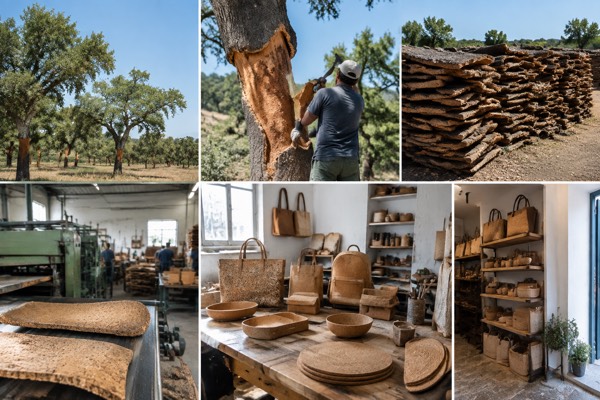
The harvest itself is done by hand. Strippers cut the outer bark away with axes in curved panels, leaving the reddish inner layer exposed, and the tree regrows its armour over the following years. Nothing about the process is mechanised in the traditional montado, which is part of why the landscape looks the way it does: widely spaced trees, no rows, grass and rock underneath, and the occasional white village on a hill.
For travellers who want to see this rather than read about it, guided options leave from Évora itself. The Megalithic and Cork Forest guided tour from Évora pairs the cork woodland with the region's standing stones in a four-hour loop, and the two-hour Cork Safari in a Classical Land Rover covers the forest alone.
How Does Cork Get From The Tree To The Shop?
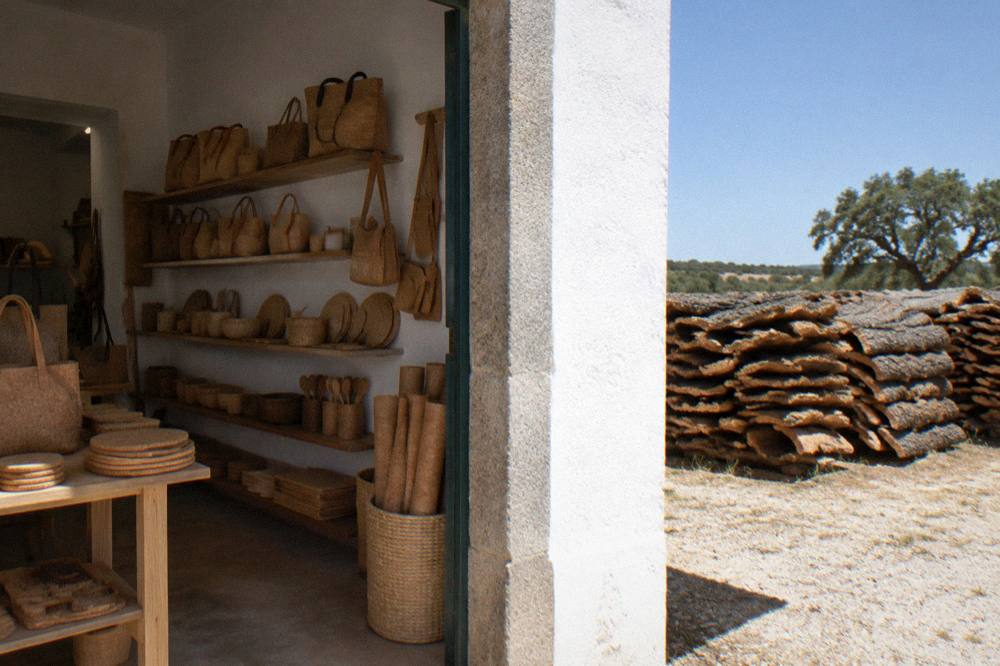
Cork reaches Évora's shops through a long chain: the bark is stripped by hand in the montado, stacked and seasoned in the open air, boiled to clean and soften it, graded by thickness and quality, and only then cut, laminated or stitched into finished goods in workshops, several of which sit in and around Évora. The shops in the historic centre are the last link in that chain, and several also run visits where you can watch the working.
The seasoning stage matters more than most visitors realise. Freshly stripped cork is not worked immediately; it rests in stacks so weather and time stabilise the material. Boiling then expands and cleans the planks, and grading decides what each piece becomes: the best material goes to wine stoppers, and the remainder, along with granulated cork, becomes the fabric-like sheets used for bags, shoes and accessories.
It is the granulated and laminated forms that made cork a fashion material rather than just a bottle closure. Cork fabric, sometimes called cork leather, is cork granule bonded to a backing and finished with a natural coating, and it is this material that appears in most of the products sold in Évora. It is light, wipes clean, tolerates rain and does not crack the way thin leather can.
A guided visit to a cork factory shows the middle of the chain. The Cork Factory and Cork Farm tour from Évora runs a full day with lunch included and takes in both the working landscape and the processing side, while the Alentejo Wine and Cork tour from Évora combines the forest with a winery stop. Both are bookable through the operator's live listing, and prices shown on the cards are in US dollars.
What Should You Look For When Buying Cork In Évora?
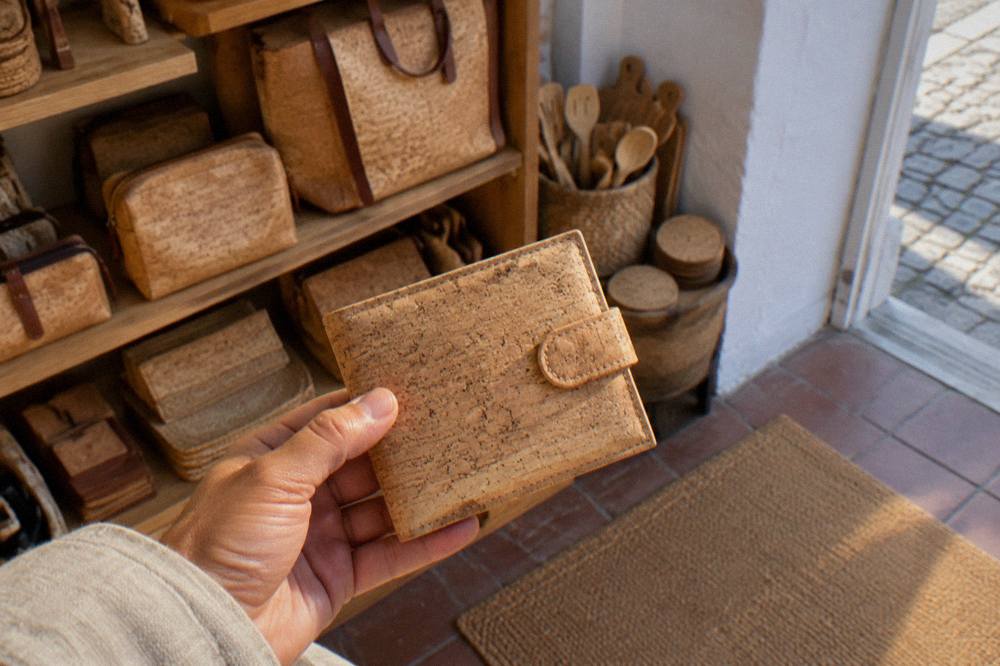
When buying cork in Évora, look for products made from natural cork fabric rather than printed imitations, check the backing and stitching the way you would on leather, ask where the cork was grown and worked, and expect to pay craft prices for hand-finished goods. Good cork fabric feels dense and slightly textured, not plasticky, and the grain of the bark should still be visible in the surface.
A few practical checks help. Run a thumb across the surface: natural cork fabric has a faint give and a matte grain, while imitation versions often feel slick and uniform. Look at the seams and lining, since a cork bag lives or dies by its stitching. Ask about care: most cork fabric simply wipes clean with a damp cloth, which is one of its real advantages over leather in a city where summer rain can arrive as a short heavy shower even in the hot months.
Be honest with yourself about what you need. Small items like coasters, wallets and keyrings are the classic souvenir purchase and travel well. Larger bags, footwear and hats cost more but use more material and more handwork, and they are the items most worth examining closely before you pay. Umbrellas with cork fabric canopies are a popular Évora purchase, and they make sense in a city whose average October still records 81.5 mm of rain on the 1991 to 2020 normals.
One thing worth knowing: shop hours and specific shop names change often enough that no printed list stays useful for long, so treat any shop you hear about as a starting point and check its current opening times on the spot or at the tourist office on the Praça do Giraldo. The tourist office itself, at Praça do Giraldo 73, is the reliable place to ask which workshops are receiving visitors at the time of your trip.
The guided experiences below are the most dependable way to see the material at its source, with prices as shown on the tour cards in US dollars.
| Guided experience from Évora | Duration | From (USD per person) | Rating |
|---|---|---|---|
| Megalithic and Cork Forest guided tour | 4 hours | $50.65 | 4.9 from 41 reviews |
| 2hr Walk in a Cork Forest | 2 hours | $71.10 | 4.7 from 43 reviews |
| 2hr Cork Safari in a Classical Land Rover | 2 hours | $102.07 | 4.8 from 33 reviews |
| Cork Factory and Cork Farm, lunch included | 8 hours | $112.55 | 4.8 from 26 reviews |
| Alentejo Wine and Cork from Évora | 4 hours | $78.78 | 4.7 from 24 reviews |
Which Cork And Wine Tours Leave From Évora?
The strongest all-day option from Évora is the 1 Day Wine Tour Around Évora, a full-day private tour from $321.11 per person rated 5 from 11 reviews on its listing, which includes lunch and transport through the wine country where the cork oaks grow. Shorter options include the four-hour Megalithic and Cork Forest tour at $50.65 and the four-hour Alentejo Wine and Cork tour at $78.78, both rated above 4.7 from their reviews.
The full-day tour is the one that connects everything this page is about. The Alentejo's vineyards and its montado are not separate landscapes; they interleave, and a day driving between wineries passes cork oaks constantly. A tour that stops at both a winery and a cork estate, with lunch and transport arranged, is the simplest way to understand why Évora's shops sell what they sell. The listing carries the current price, and the button below goes to the operator's live page.
For a shorter afternoon, the Evening Food and Wine Crawl from Évora runs about three hours from $83.28 per person, rated 4.6 from 19 reviews, and shifts the focus from landscape to table: Alentejo bread, cheese, wine and the pork dishes the region is known for, eaten across a series of stops in the historic centre. It is not a cork tour, but it is the tasting half of the same story, and it ends within walking distance of the shops.
If you are staying in Lisbon rather than Évora, note which products start where. The From Lisbon: Évora and Monsaraz with Regional Wine Tasting day trip, from $64.09 per person and rated 4.7 from 360 reviews, brings you into the city from the capital with a wine tasting included, and it is described accurately on its listing as a Lisbon start. The Évora-based tours above are the ones to book if you are sleeping inside the walls.
How Do You Tell Real Cork From An Imitation?
Real cork fabric shows the natural grain of bark, has a faint texture and a matte surface, is slightly warm to the touch and often carries small natural variations that no print reproduces exactly, while imitations tend to be glossy, perfectly uniform and light in a hollow way. In Évora the practical test is simple: reputable shops will tell you plainly where the cork was grown, and a seller who cannot answer a question about the material is a reason to walk on.
The variations are the giveaway. Natural cork has tiny fissures, colour shifts from pale to russet and an irregular cell pattern, because it grew as bark. Printed imitation, usually a synthetic sheet with a cork-look coating, repeats a pattern and feels like plastic under the thumb. Price is a secondary signal, not a primary one: cheap cork exists, and expensive imitations exist too, so judge the material first and the tag second.
There is also a middle category worth understanding: composite cork, where granules are bonded together. This is a legitimate material, not a fake, and much of the fabric used in bags and footwear is exactly this. Ask the shop what you are holding, and treat the question as a test of the shop as much as of the product. A workshop that makes its own goods will answer in detail, and several in Évora do.
What Else Should You Combine With Cork Shopping In Évora?
Combine cork shopping with the monuments that share its streets: the Capela dos Ossos at 7.00 EUR for an adult museum ticket, the Sé de Évora complete visit at 5.00 EUR including the cloister and roof terrace, and the Museu de Évora at 8 EUR, all inside or a few minutes from the walls. The Évora Ticket pass covers other municipal sites at 8 EUR for one day, but it does not include the Sé, the Capela dos Ossos or the Museu de Évora.
That last point is the one visitors most often get wrong. The Évora Ticket and the individual monument tickets are separate systems, and assuming the pass covers everything leads to an unplanned queue. The pass runs 8 EUR for one day, 10 EUR for two and 12 EUR for three, free to age 12. The standing facts: the Capela dos Ossos, part of the Igreja de São Francisco complex, charges 7.00 EUR adult with youth and senior reductions and a 15.00 EUR family ticket, open daily in summer from 9:00 to 18:30 except 1 January, Easter Sunday, 24 December afternoon and 25 December. The Sé's single 5.00 EUR ticket covers cathedral, cloister, roof terrace and museum, with children up to 12 free. The Museu de Évora, closed Mondays, runs Tuesday to Sunday 9:30 to 13:00 and 14:00 to 17:30 at 8 EUR for an adult.
| Ticket | Adult price | What it covers | Closed |
|---|---|---|---|
| Sé de Évora complete visit | 5.00 EUR | Cathedral, cloister, roof terrace, museum | 24 Dec afternoon, 25 Dec, 1 Jan |
| Capela dos Ossos museum ticket | 7.00 EUR | All museum areas of the Igreja de São Francisco complex | 1 Jan, Easter Sunday, 24 Dec afternoon, 25 Dec |
| Museu de Évora | 8 EUR | Former Archbishop's Palace collections | Mondays, 1 Jan, Easter Sunday, 1 May, 29 June, 25 Dec |
| Évora Ticket, one day | 8 EUR | Municipal Cidade-Museu network sites, not the three above | See the pass page |
Beyond the walls, the cork country continues into towns that make good half-day targets, each about the distances the regional figures give: Arraiolos about 20 km away, Estremoz about 45 km, Vila Viçosa about 60 km and Monsaraz about 40 to 45 km. Estremoz and Vila Viçosa are marble country, a different stone in the same landscape, and both are covered on their own pages. The Almendres Cromlech standing stones sit out in the montado itself, which is why so many cork tours include them.
| Day trip from Évora | Rough distance |
|---|---|
| Arraiolos | about 20 km |
| Monsaraz | about 40-45 km |
| Estremoz | about 45 km |
| Vila Viçosa | about 60 km |
| Elvas | about 80 km |
Timing matters more than most guides admit. The hot months are genuinely hot: IPMA's 1991 to 2020 normals for the Évora station record a July mean maximum of 33.3 C, an August mean maximum of 33.5 C and a record maximum of 45.4 C set on 4 August 2018. Shopping inside the walled centre is a good hot-weather activity because the streets are narrow and shaded, but a cork forest walk is a morning activity in summer, and the tours that run them schedule accordingly.
| Month (1991-2020 normals, Évora station 558) | Days max 30 C or more | Days max 35 C or more |
|---|---|---|
| May | 5.5 | 0.7 |
| June | 15.1 | 5.6 |
| July | 23.7 | 11.5 |
| August | 25.0 | 10.9 |
| September | 13.9 | 3.1 |
When Is The Best Time Of Year For Cork In Évora?
The best time to engage with cork in Évora is spring or autumn: April's 1991 to 2020 normals show a mean maximum of 20.7 C with 62.1 mm of rain, and October shows 24.1 C with 81.5 mm, both comfortable for walking both the historic centre and the forest. Summer suits shopping and indoor visits, since July and August average 33.3 C and 33.5 C at the maximum, and winter is quiet but mild, with a January mean maximum of 14.1 C.
Spring has a second advantage: the montado is green then, and the wildflowers between the oaks make the landscape photographs look nothing like the dry plain of August. Autumn brings the harvest season atmosphere and the first cool evenings, and it is the season when the region's festivals overlap with the tourist calendar. The Feira de São João, the great annual fair held on the Rossio de São Brás, ran 23 June to 5 July in 2026 under the theme "Évora: Capital Europeia ao Sul", a late June into early July pattern that repeats each year even though the following year's dates are only published when the municipal edital appears.
The city's cultural calendar is also building toward something larger. Évora and the Alentejo are a European Capital of Culture in 2027, with 2026 running as a preparation year built on the concept of "Vagar", and the first edition of the GUADIANA festival of Afro-Ibero-American literatures ran 9 to 11 October 2026 with 28 authors from nine countries. What that means practically for a shopper is that Évora is lively now and likely livelier still, with the full 2027 programme not yet published.
Is Cork A Sustainable Souvenir?
Cork is widely considered one of the more sustainable materials a traveller can buy, because the bark is harvested without felling the tree, the tree regrows its bark and continues to live and store carbon for generations, and the montado it comes from supports grazing, biodiversity and soil stability on land that would struggle under intensive agriculture. The honest caveat is that not every product is equal, and the transport footprint of a flight home is the same whatever the bag is made of.
The case rests on the tree's biology. A stripped cork oak is not a wounded tree in the way a felled pine is a dead one; the harvest removes only the outer bark, the tree continues to grow, and the same tree is harvested again across a long working life. The montado as a whole is a landscape that produces a renewable material, shade for livestock, acorns for pigs and habitat for birds, all on thin soils that would yield little under plough.
Buying in Évora shortens the chain. A bag sold a few streets from where its material was grown and worked has a shorter story behind it than one shipped across a continent, and asking a shop about the origin of its cork is both a sustainability question and a quality question. The shops that answer it well are the ones worth returning to.
Common Questions About Cork In Évora
Where can I buy cork in Évora?
Cork shops are concentrated inside the UNESCO-listed historic centre, within a short walk of the Praça do Giraldo, the Roman temple and the Sé. Names and hours change, so ask at the tourist office on the Praça do Giraldo for the workshops currently receiving visitors, or check the shop's own notice before you go.
Is cork from Évora good quality?
Évora sits in the middle of the Alentejo montado, the source of a large share of the world's cork, so the material sold in the city is local and the workshops work it by hand. Judge each item on its own stitching, backing and surface grain, as you would with leather.
Can you visit a cork forest from Évora?
Yes. Guided tours from Évora visit the cork forests and estates of the surrounding plain, from a two-hour forest walk to a full-day cork factory and farm visit with lunch included. Prices on the tour cards are in US dollars.
What is cork fabric made of?
Cork fabric, sometimes called cork leather, is natural cork, often in granulated or laminated form, bonded to a fabric backing and finished so it can be cut and stitched like leather. It keeps the grain and lightness of the bark while becoming flexible enough for bags and footwear.
How do I care for cork products?
Wipe cork fabric with a damp cloth and let it dry naturally. It tolerates rain and sun better than thin leather, but sharp edges and heavy abrasion will mark it as they would any natural material.
Can I combine cork shopping with wine tasting?
Yes, and several guided tours do exactly that. The Alentejo Wine and Cork tour from Évora pairs the two in four hours, and the 1 Day Wine Tour Around Évora spends a full day among vineyards set in the same landscape as the cork oaks.
What Should You Remember About Cork In Évora?
The essentials are these: Évora's cork shops are the retail end of the montado, the cork oak landscape that defines the Alentejo; real cork fabric shows its bark grain and answers questions about origin; the best way to understand the material is a guided visit to the forest or factory; and the whole experience fits easily alongside the city's monuments, all inside the same walled centre. Book the tours that interest you through the operator's live listings, and check shop hours locally rather than relying on any printed list.
Cork is the Alentejo in a portable form. The tree that grew your handbag stood in the same sun that ripens the wine in your glass, on the same plain that Évora has traded from since the Romans built their temple by what is now the Praça do Giraldo. Few souvenirs anywhere carry that direct a line from landscape to counter, and the Évora Travel Guide covers the rest of what the city and its plain have to offer.