Comporta And Alentejo Coast From Évora
Évora is an inland city, but the Atlantic coast of the Alentejo is a feasible day trip west. This guide explains what Comporta is, what the route looks like, and how to fit the coast into an Alentejo itinerary.
Short answer
Comporta is a small Atlantic beach village on Portugal's coast west and slightly south of Évora. No drive time, distance or timetable for the run was verified for this page, so plan it as a full day: the Alentejo plain, cork oak and rice country sit between the city and the sea, and Évora itself has no coast of its own.
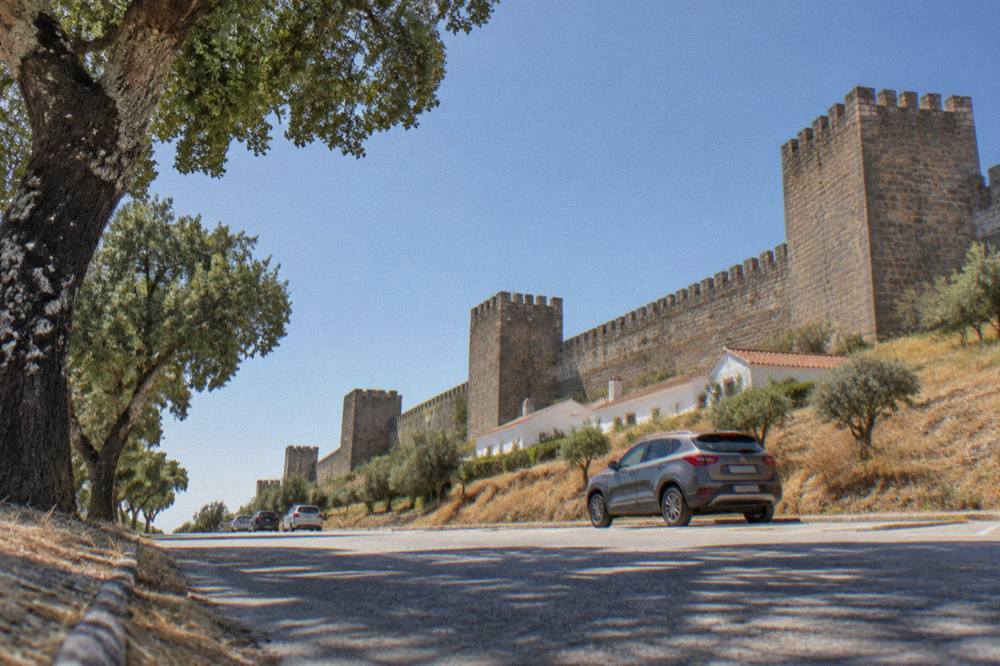
Évora, the inland capital of Portugal's Alentejo region, stands on a hot, dry plain where the Atlantic lies roughly 90 km to the west. The city itself has no sea, no beach and no coastal view: its monuments are the Roman Templo Romano, the Sé and the Capela dos Ossos, all inside UNESCO's Historic Centre of Évora, inscribed in 1986. What the city does have is a position at the heart of a region that stretches all the way to the ocean, and the Comporta and Alentejo coast is the day trip that answers the question every summer visitor eventually asks: where is the nearest water? The answer is a string of low-key Atlantic villages where the Alentejo's rice fields, cork oak and pine forest meet the sea, and it makes a very different day from the marble towns and megaliths inland.
Where Is Comporta Relative To Évora?
Comporta is a small coastal village on Portugal's Atlantic shore, lying west of Évora across the Alentejo plain, and no verified drive time, distance or timetable exists for the run between them, so the trip must be planned as a full day rather than a quick hop. Évora is the capital of the Évora district and of the Central Alentejo sub-region, a city of about 53,000 residents at the 2021 Census, and the Atlantic is roughly 90 km away from it. Comporta itself sits at the northern end of a long sandy stretch of coast, and the day out there crosses the same cork oak and holm oak country that surrounds the city before the land flattens into rice paddies and dunes.
The usual explanation of the name Alentejo is "beyond the Tagus", and that geography is the whole point of this trip. The region begins south of the great river and runs to the sea, so a coast day is not a departure from the Alentejo but a completion of it. The Alentejo travel guide covers the region as a whole, and where Alentejo sits in Portugal explains the frame; this page is about the western edge.
One planning note matters more than any number. Nothing about the Comporta run was verified as a timetable or a distance for this page, so treat any drive time you see elsewhere as an estimate to check against your own route. What is certain is the character of the journey: inland plain first, then coastal forest and salt marsh, with no mountains anywhere in between.
What Makes Comporta Different From The Algarve?
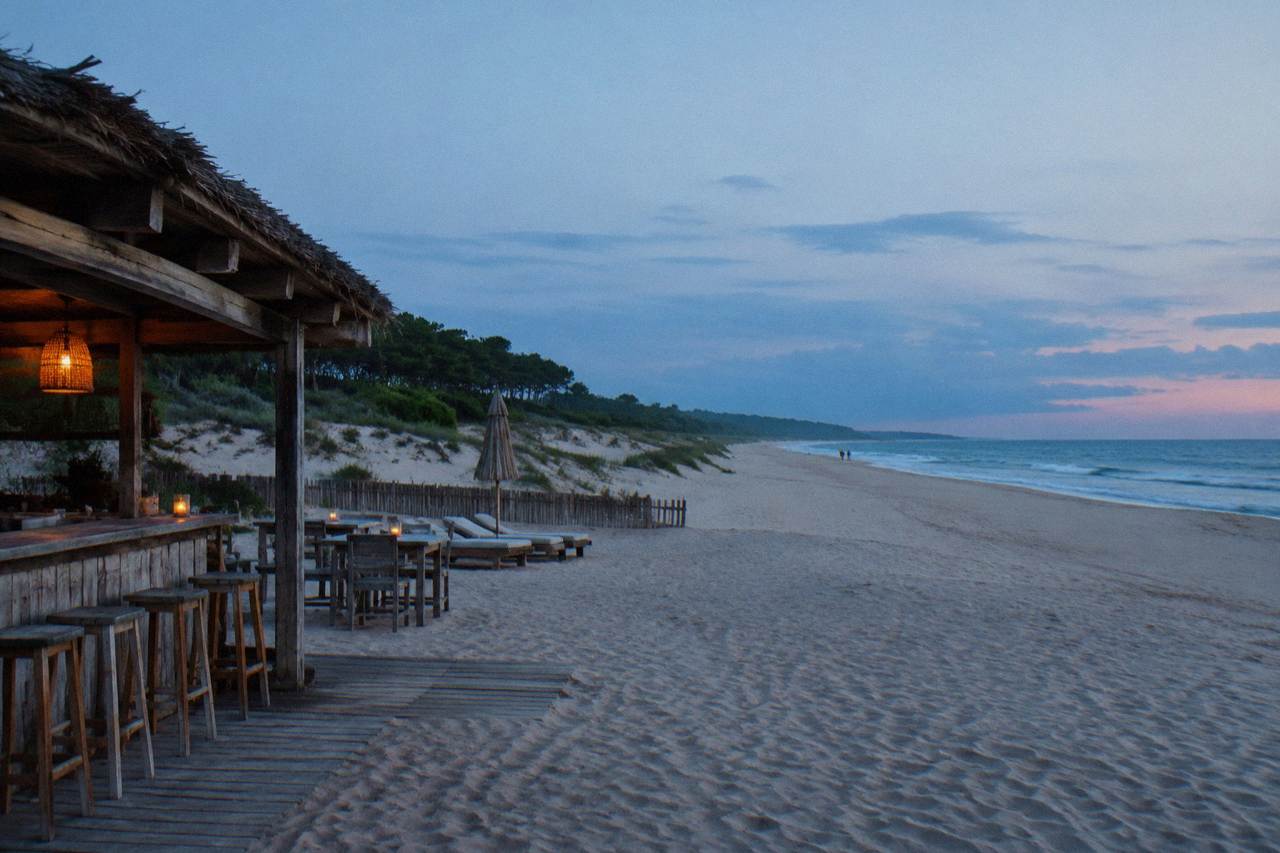
Comporta is the quiet, low-rise counterpoint to the Algarve: a village of fishermen's cottages, rice fields and one long Atlantic beach, with none of the high-rise resort strip that defines the southern coast, and with building that has stayed low and local. The Algarve is Portugal's mass-market resort region in the far south; Comporta belongs to the Alentejo's own short coastline, where the landscape between the road and the sea is still agricultural rather than built over. The comparison with the Algarve, like any comparison between Portuguese regions, is a matter of character rather than a measured verdict.
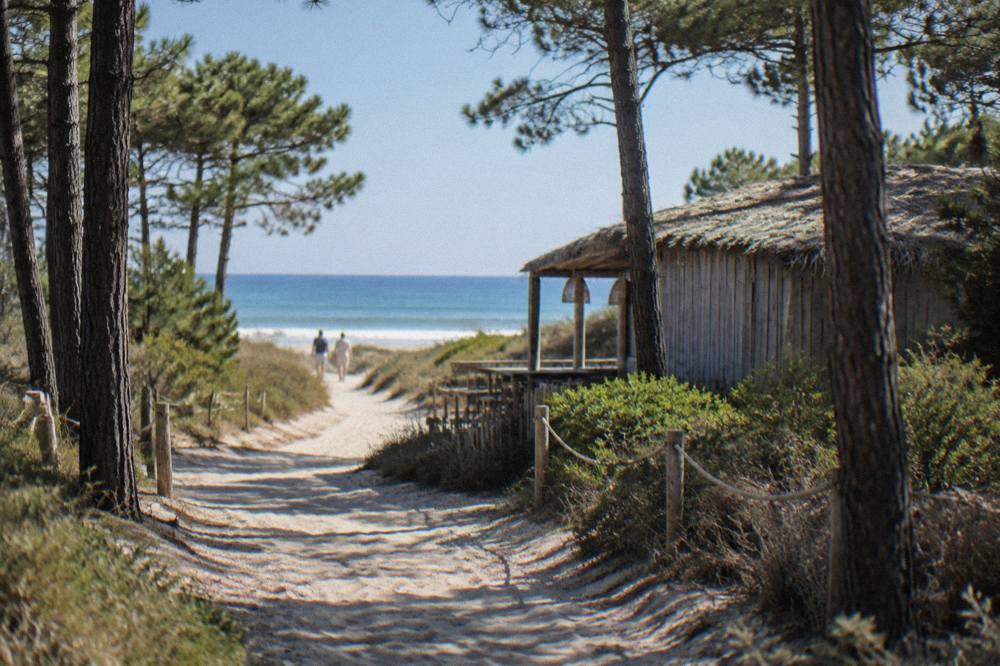
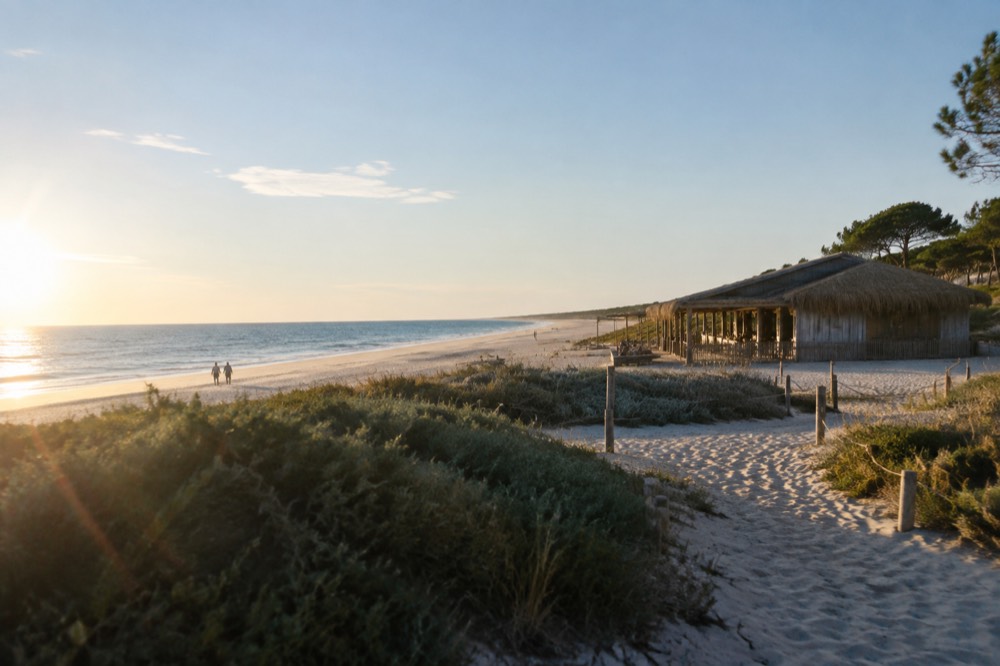
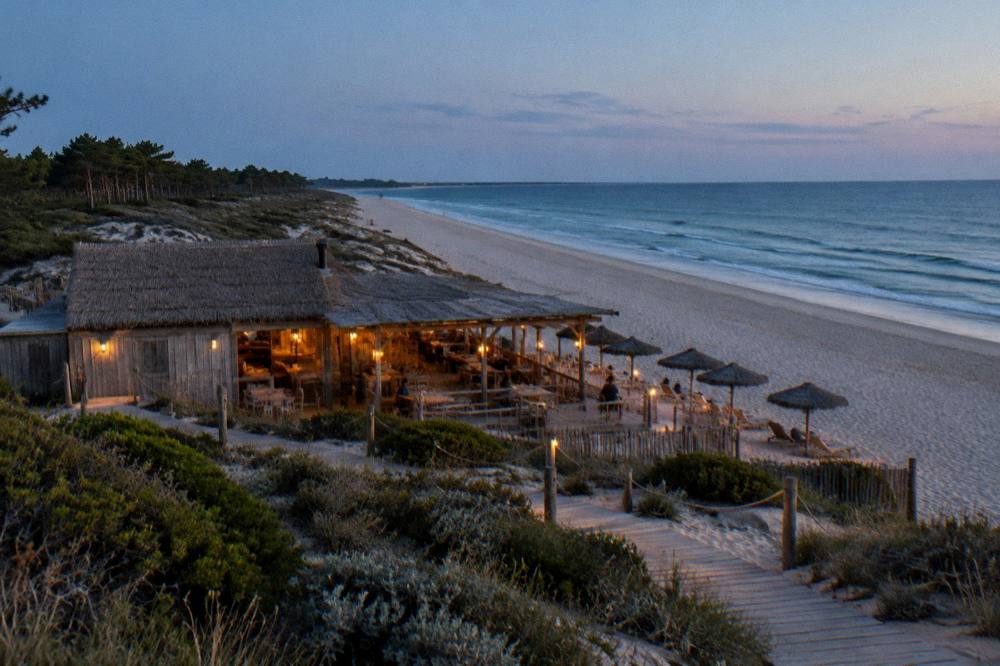
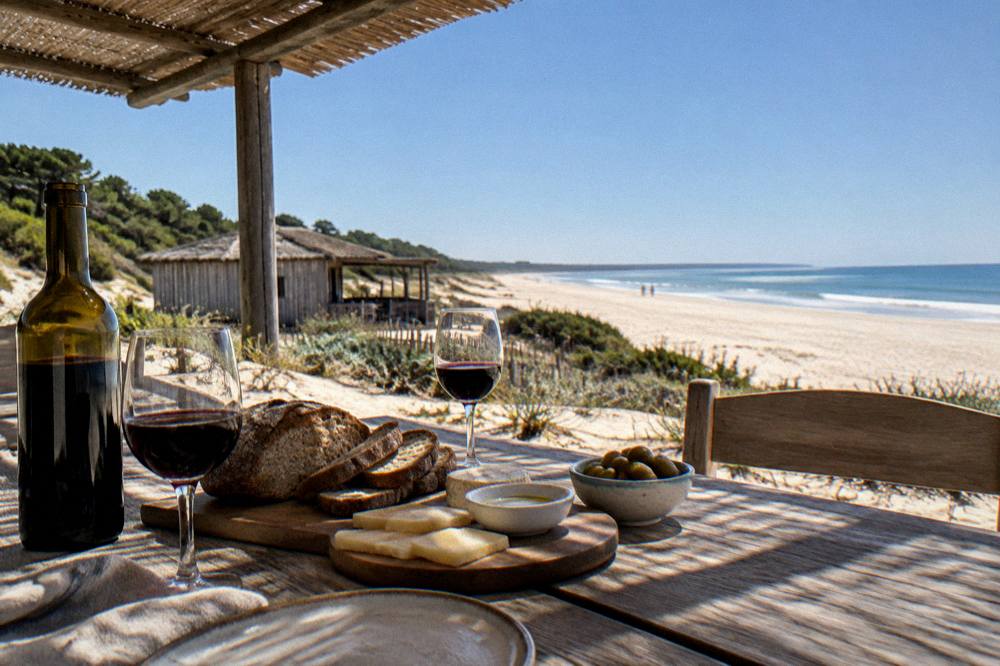
The village sits in a setting of rice paddies, a traditional activity in this corner of the Alentejo, and the beach in front of it runs unbroken along the shore. The vibe is deliberately simple: wooden walkways, whitewashed walls with blue trim, and a crowd that is small by national standards. That simplicity is also the constraint. There is no verified list of restaurants, beach clubs or facilities for this page, so plan food and parking loosely and check locally before you go.
For a sense of what the Alentejo itself is famous for beyond the coast, the guide to what the Alentejo is known for covers the cork, the wine and the slow pace that Comporta shares. The short version: this coast is the Alentejo with its feet in the water.
What Does The Route West From Évora Look Like?
The run from Évora to the coast crosses the classic Alentejo landscape in two distinct halves: rolling plain with cork oak and holm oak woodland first, then the rice country and pine forest of the coastal strip, before the dunes finally open out onto the beach itself. What can be said with confidence is the sequence of the landscape, because it follows the region's own geography from the inland plain down to the Atlantic shelf.
The cork oak is the signature tree of the first half of the drive. The Alentejo is Portugal's cork heartland, and the bark-stripped trunks are a common sight along the roads west of Évora. The Alentejo cork and cork oak guide explains how the harvest works and why the tree is never felled for its bark; on this drive it is mostly scenery, but scenery that pays for half the region.
The second half changes completely. Around the coast the land goes flat and green with flooded rice fields, and the air picks up salt. This is the transition that makes the day trip worthwhile even for visitors who never swim: the Alentejo is rarely seen from this end.
If a full day of driving does not appeal, the guided alternatives run the other way, inland. The Lisbon-started small-group tour that pairs Évora with a winery and the Chapel of Bones, Lisbon: Évora, Winery Tour, Bones Chapel & Tastings, covers the city and the wine country in one 10-hour day from the capital, from $89.45 per person and rated 5 from 121 reviews, with tastings included. Check availability if that shape of day suits you better than a beach.
What Can You Actually Do In Comporta For A Day?
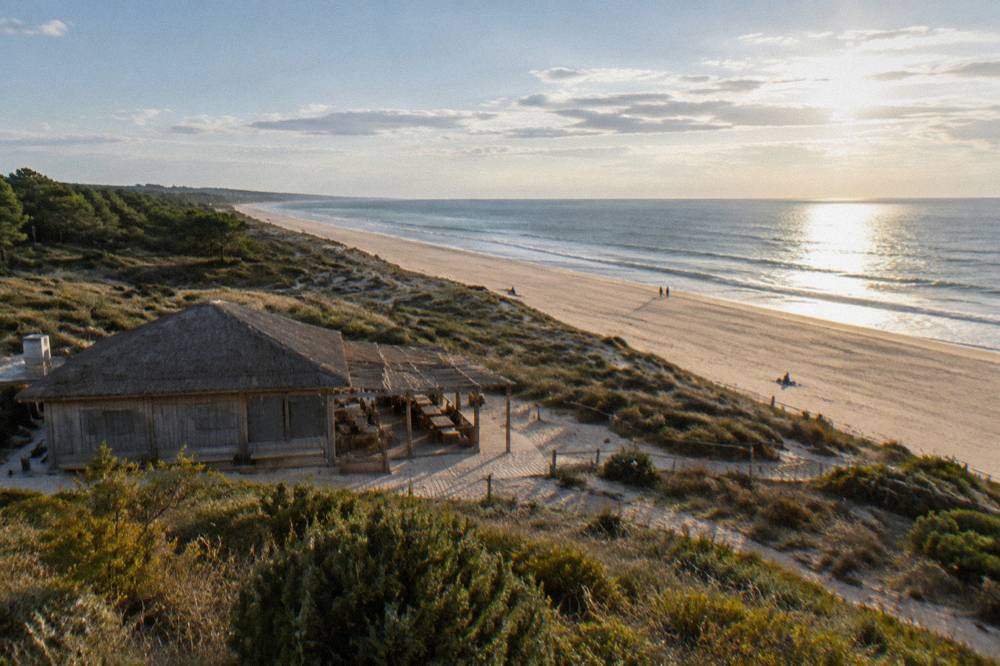
A Comporta day is built around three open-air things: the long sandy beach, the walkable village of fishermen's cottages, and the flat rice-field country around it, with no verified attraction hours, entry fees or facilities to plan around, so the day sets its own pace. That is not a gap in the guide so much as the nature of the place. Comporta's attractions are free-form: sand, sea, boardwalks and the light at the end of the afternoon. The honest advice is to arrive with nothing booked and let the day fill itself.
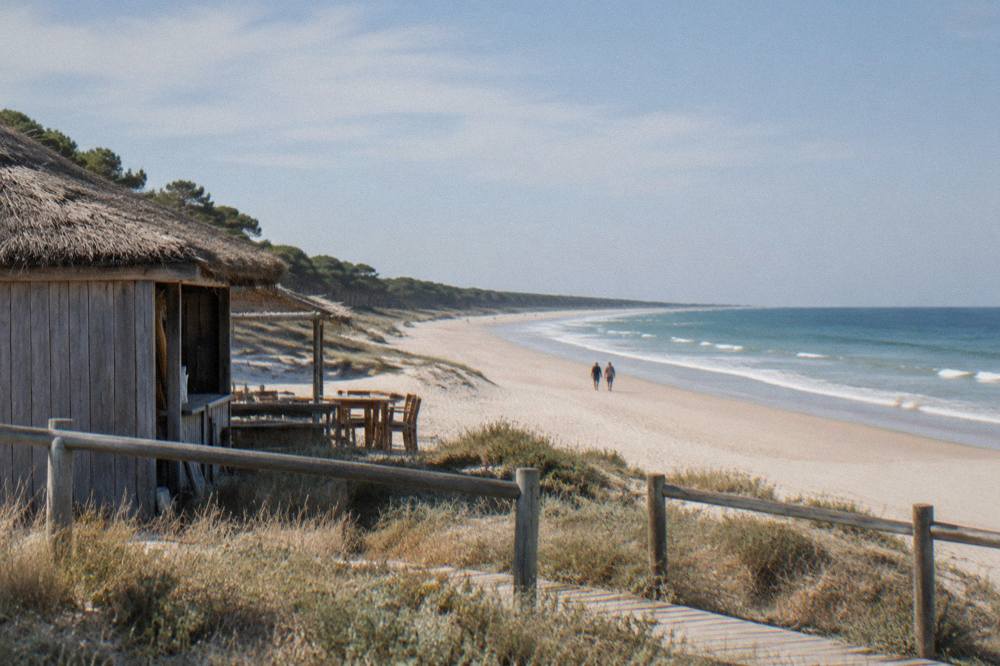
The beach is the main draw. It runs for kilometres along the shore in front of the village, backed by dunes and pine. Swimming is Atlantic swimming: the water is cooler than the Mediterranean and the shore is open, so the usual sea-safety care applies. No lifeguard season dates were verified for this page, so check the flags on the day.
The village itself takes an hour or two on foot. It is small, low and white, built originally around the rice and fishing economy, and the streets are more interesting than any single building in them. Beyond the village, the rice paddies and the salt marshes make the area unusual among Portuguese beach resorts: this is working farmland that happens to end at the sea.
What About Sines And The Southern Alentejo Coast?
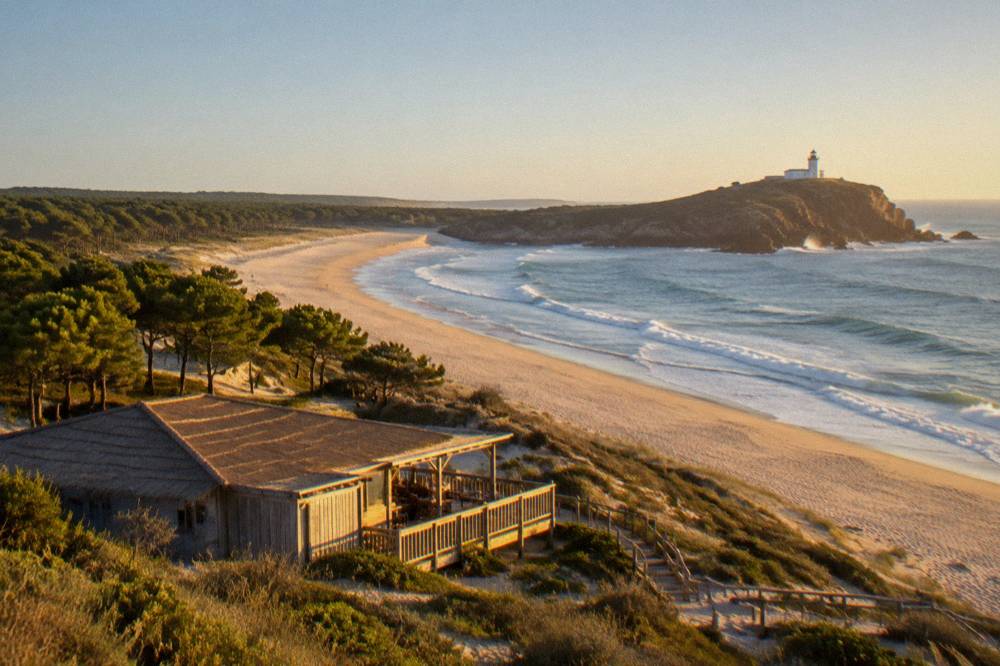
Sines is the Alentejo's other coastal anchor, a port and industrial town on the Atlantic southwest of Évora, and it makes a harder-edged, less polished day than Comporta, with the region's deep-water harbour and energy industry sitting right beside wild, thin-infrastructure beaches. The town is known in Portugal as a deep-water port and energy hub, which means the coast around it mixes working industry with open sand. Further along the same shore the beaches get emptier and the infrastructure thinner, and no hours, fees or access details for any of them were verified for this page.
The honest framing is this: Comporta is the polished end of the Alentejo coast, Sines the working end, and the beaches between them the empty end. A day trip from Évora can realistically cover one of these properly, or two briefly. Trying to do all three turns the day into driving.
Setúbal also belongs to this conversation, as the larger city on the coast north of Comporta that most routes from the Lisbon direction pass near. Like every other day-trip destination in this region, it carries no verified entry fees, hours or distances on this site, so it functions here as a name on the map rather than a planned stop. For the inland alternatives, the guide to day trips from Évora covers the full range of directions.
How Does A Coast Day Fit A Longer Alentejo Itinerary?
A Comporta day works best as the coastal counterweight to two or three inland days: monuments in Évora first, then marble towns, megaliths or Monsaraz on the following days, with the beach day placed wherever the forecast looks best, because the coast runs cooler than the plain on any hot afternoon. The Alentejo rewards slow travel, and the standard pattern that this site's itinerary pages follow is Évora as a base, then loops out in different directions. The coast is simply the western loop.
For a three-day pattern, the three days in Évora and the Alentejo itinerary gives the day-by-day structure, and the Alentejo road trip itinerary extends the same idea across the region. A coast slot fits naturally on the middle day, when the city sightseeing is done and the legs want sand instead of cobblestones.
| Day-trip direction from Évora | What defines the day | Kind of traveller it suits |
|---|---|---|
| West to Comporta | Rice fields, pine, long Atlantic beach | Beach day, slow lunch, photographers |
| Southwest to Sines | Working port, wilder and emptier shore | Travellers who like their coast unpolished |
| North toward Setúbal | Larger coastal city on the Lisbon side | Stopover on a Lisbon-linked route |
| East to Estremoz | Marble town, about 45 km | History and stone |
| Southeast to Monsaraz | Hilltop village over the Alqueva, about 40-45 km | Views, wine, sunset |
The distances above are the rounded "about" figures this site's facts hold for those inland towns; no equivalent figure was verified for the coast, which is why the coastal rows carry none. If the whole coast idea is too much car for one day, the guided market covers the inland half instead. is the 8-hour option that pairs the city with the Cromeleque dos Almendres, from $90.04 per person and rated 4.7 from 576 reviews, starting in Lisbon rather than Évora.
When Is The Best Time Of Year For This Trip?
The best window is late spring to early summer, or September: the sea is warmest at the end of summer, while Évora itself is at its most punishing in July and August, when IPMA's 1991 to 2020 normals show a mean daily maximum of 33.3 C and 33.5 C. The Alentejo plain is one of the hottest parts of Portugal, and the whole point of pairing the city with the coast is that the coast runs several degrees cooler than the plain on any given afternoon.
IPMA's 1991 to 2020 normals for the Évora station, number 558, give the year-round picture. The annual mean temperature is 16.6 C, total precipitation 596.1 mm, and the summer is almost completely dry: July averages just 2.7 mm of rain across the whole month, with 0.6 days of measurable rainfall.
| Month | Mean max (C) | Mean min (C) | Rain (mm) | Days with 1 mm+ rain |
|---|---|---|---|---|
| April | 20.7 | 8.5 | 62.1 | 8.0 |
| May | 25.0 | 10.9 | 46.6 | 6.0 |
| June | 30.2 | 13.8 | 10.6 | 1.7 |
| July | 33.3 | 15.6 | 2.7 | 0.6 |
| August | 33.5 | 16.0 | 6.0 | 0.7 |
| September | 29.5 | 14.6 | 33.9 | 3.6 |
| October | 24.1 | 12.3 | 81.5 | 7.7 |
All figures are the 1991 to 2020 averages for the Évora station, and they describe the inland city, not the shore. The coast moderates both ends of that table, but no coastal station's normals were verified for this page, so the numbers above should be read as the conditions you leave behind when you drive west.
The heat statistic that surprises first-time visitors is the count of extreme days. The same normals show 86.5 days a year with a maximum of 30 C or more, and 31.9 days a year at 35 C or more. The record maximum for the station is 45.4 C, set on 4 August 2018. None of this makes the Alentejo unvisitable in summer; it makes a beach day in July and August close to essential rather than optional. The guide to the best month to visit the Alentejo works through the same trade-off across the whole region.
| Season | Évora plain, 1991 to 2020 normals | What it means for a coast day |
|---|---|---|
| Spring | April mean max 20.7 C, 8.0 rain days | Green fields inland, cool sea |
| Early summer | June mean max 30.2 C, 1.7 rain days | Beach weather, hot drive out |
| High summer | July and August mean max 33.3 and 33.5 C | Coast at its busiest and warmest |
| Autumn | September mean max 29.5 C, 3.6 rain days | Warm sea, quieter village |
| Winter | December mean max 14.6 C, 8.7 rain days | A walk, not a swim |
Which Guided Tours Cover Évora And The Alentejo?
No guided tour in this site's selection covers the Comporta coast itself; the verified products run inland, pairing Évora with Monsaraz, wineries or the megaliths, mostly as full-day trips that start in Lisbon, so a beach day from Évora is a self-drive day by definition. That is a real limit worth knowing before you plan. If the coast is the priority, the drive is yours; if a guided day is the priority, the options below are the strongest, and all prices are the per-person figures on the operators' listings, in US dollars.
| Tour | Starts in | Length | From (per person) | Rating |
|---|---|---|---|---|
| Lisbon: Évora, Winery Tour, Bones Chapel & Tastings, small group | Lisbon | 10 hours | $89.45 | 5 from 121 reviews |
| Évora and Monsaraz with Regional Wine Tasting | Lisbon | 9 hours | $64.09 | 4.7 from 360 reviews |
| Évora and Megaliths Full-Day Tour | Lisbon | 8 hours | $90.04 | 4.7 from 576 reviews |
| Cromlech of Almendres and Great Dolmen of Zambujeiro | Évora | 3 hours | $33.76 | 5 from 54 reviews |
| Monsaraz and Wine from Évora, small group | Évora | 4 hours | $80.28 | 4.9 from 31 reviews |
The two Évora-started options in that table are the ones that fit a coast-and-city week: a half-day megaliths run in the morning, a Monsaraz and wine afternoon, and a beach day slotted between them. is the small-group Lisbon alternative at $65.31 per person, rated 4.5 from 232 reviews, for travellers who base themselves in the capital rather than in the Alentejo.
Wine deserves its own slot on any Alentejo week, coast or no coast. The Alentejo wine guide explains what the region's reds taste like and why they suit the food, and the Alentejo food guide does the same for the table that goes with them. A tasting stops the driving from becoming a commute.
Common Questions About Comporta And The Alentejo Coast
Does Évora itself have a beach?
No. Évora is an inland Alentejo city on a hot, dry plain, with the Atlantic roughly 90 km to the west. There is no sea view, no beach and no coastal district anywhere in the municipality. The nearest shore is the Comporta and Alentejo coast day trip described on this page.
Is Comporta worth the trip from Évora?
As a full day, yes, if what you want is the Alentejo's quiet coastal counterpoint: rice fields, pine, a long sandy beach and a low, whitewashed village. No drive time or distance for the run was verified for this page, so check your own route before committing, and treat it as a whole-day outing rather than a quick hop.
How hot is the drive in summer?
IPMA's 1991 to 2020 normals for the Évora station show a July mean daily maximum of 33.3 C and August 33.5 C, with 31.9 days a year reaching 35 C or more. The record for the station is 45.4 C, set on 4 August 2018. The coast runs cooler than the plain, which is the main argument for the beach day in high summer.
Can you visit Comporta on a guided tour?
Not through this site's selection. The verified guided products cover Évora with Monsaraz, wineries or the megaliths, and the ones that visit Évora start in Lisbon. A Comporta day is a self-drive day, which is also what keeps the village quiet.
What should you see in Évora before heading west?
The essentials are all in the UNESCO Historic Centre, inscribed in 1986: the Sé de Évora, whose complete-visit ticket covering cathedral, cloister, roof terrace and museum is 5.00 EUR, the Capela dos Ossos at the Igreja de São Francisco, whose museum ticket is 7.00 EUR for an adult, and the Museu de Évora at 8 EUR, closed Mondays. The Évora Ticket multi-site pass runs 8 EUR for one day, though it does not include those three.
Is the Alentejo worth visiting at all?
Yes, and the case is made in full in is the Alentejo worth visiting. The short version: UNESCO-listed Évora, megaliths older than any monument in most of Europe, marble towns, wine, cork and a coast that has none of the Algarve's crowds. The coast day is simply the westernmost piece of that.
Whether the day ends up on Comporta's sand or in a Monsaraz tasting room, the pattern is the same: one inland city as the base, and a region that runs unbroken from the Cromeleque dos Almendres to the Atlantic. Choose the western loop when the plain gets hot, and the Évora Travel Guide holds the rest of the map.