Is There A Stonehenge In Portugal?
Portugal has no Stonehenge, but the Cromeleque dos Almendres near Évora is the nearest equivalent: a prehistoric group of standing stones in the Alentejo plain, with an interpretation centre and guided tours.
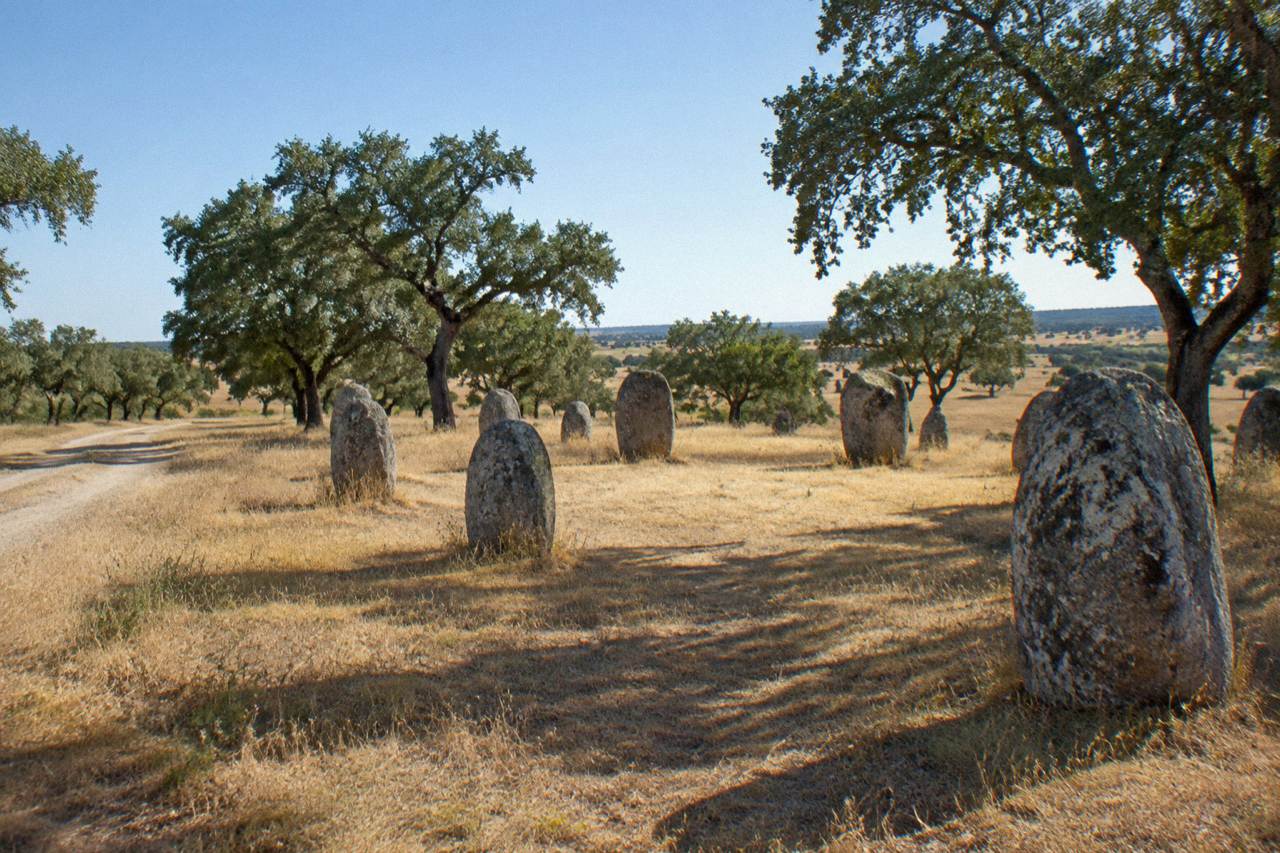
Portugal has no Stonehenge, and no monument in the country claims to be one. It sits in cork oak country, reached by a turn-off from the national road toward Lisbon, and it is the site most often put forward when the Stonehenge question comes up. This page explains what the Almendres cromlech actually is, how it compares with Stonehenge without inventing numbers, and how to visit it from Évora.
Is There A Stonehenge In Portugal?
No, there is no Stonehenge in Portugal, and nothing in the country is a copy of it. Both Almendres and Stonehenge are prehistoric standing-stone sites, and a cromlech is simply a circle or group of standing stones, but the two monuments are otherwise different places, built by different peoples in different landscapes.
That is the honest answer, and it is worth being precise about it because the comparison gets stretched in both directions online. Some travel copy calls Almendres "older than Stonehenge" or "the biggest in Europe"; no age, stone count or ranking for the site can be stated as fact here, so none appears on this page. What can be said is structural: Stonehenge is a ring of dressed sarsen and bluestone trilithons in southern England, while the Cromeleque dos Almendres is a group of standing stones, some arranged in a circular pattern, set on a hillside of cork oaks and olive trees in Central Alentejo. Both belong to the broad European family of prehistoric stone monuments, which stretches from Brittany to the Iberian Peninsula.
For a reader planning a trip, the practical point is that the Alentejo holds one of the densest concentrations of megalithic monuments in Iberia, and Évora is the natural base for it. The region's standing stones, dolmens and menhirs sit in open countryside, with no barriers, no visitor queues and, at the stones themselves, entry that is reported free. The interpretation infrastructure is modest and honest: a small municipal-partner centre in the village of Guadalupe, and a set of guided tours from Évora, several of them led by archaeologists. If the question behind the question is "can I see something Stonehenge-like on a Portugal trip", the answer is yes, and it makes an easy half-day from Évora.
What Is The Cromeleque Dos Almendres Near Évora?
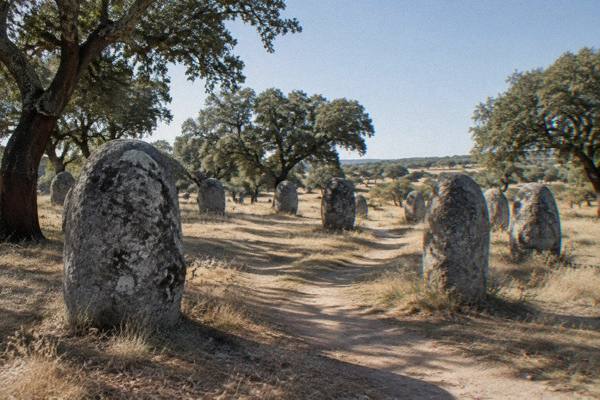
The Cromeleque dos Almendres is a prehistoric group of standing stones on the Alentejo plain west of Évora, and it is the site most often called the Portuguese answer to Stonehenge. The stones stand among cork oaks on a low hill, arranged partly in a circular pattern, and the site is open countryside rather than a fenced monument. It is looked after in partnership with the municipality, which runs an interpretation centre in the nearby village of Guadalupe.
The site's own visitor infrastructure is the Almendres Interpretation Centre, a partner of the Évora municipality, located in Guadalupe village on Rua do Cromeleque. The centre's published hours are seasonal: 10:00 to 18:00 in summer, defined as 1 May to 31 October, and 10:00 to 17:00 in winter, 1 November to 30 April. The centre's directions page describes the approach from Évora: take the national road toward Lisbon and, after 8 kilometres, follow the turn-off toward the site. Entry to the stones themselves is reported free, though that is worth confirming locally before you count on it.
| What | Detail |
|---|---|
| Site type | Prehistoric group of standing stones (cromlech) |
| Location | West of Évora, Alentejo, on the plain toward Lisbon |
| Interpretation centre | Almendres Interpretation Centre, Guadalupe village, Rua do Cromeleque |
| Centre hours, summer | 1 May to 31 October, 10:00-18:00 |
| Centre hours, winter | 1 November to 30 April, 10:00-17:00 |
| Entry to the stones | Reported free; confirm locally |
| Landscape | Cork oaks, olive trees, open hillside |
What the stones actually feel like is best described by what surrounds them. This is working Alentejo countryside: harvested cork oaks, grazing land, and long sightlines over the plain, with the Atlantic roughly 90 kilometres away and no coast in view. The stones sit on a slope, and the walk between them is short and uneven underfoot, so ordinary shoes serve better than city soles. There are no facilities at the stones themselves; water, shade and a toilet belong to the village and the interpretation centre, not the hillside.
The comparison with Stonehenge, for those who want it, is best kept structural. A cromlech is a circle or group of standing stones; Stonehenge is a particular and famous example of monumental stone architecture, with lintels and dressed blocks. Almendres has no lintels and no ticket barrier, and its setting is a working landscape rather than a managed enclosure. For the full breakdown of the terms, the companion page Stonehenge versus a cromlech explained covers the definitions without the hype.
How Do You Get To The Almendres Cromlech From Évora?
The simplest route from Évora is to take the national road toward Lisbon and, after about 8 kilometres, follow the turn-off signposted for the Almendres area, as the interpretation centre's own directions page describes. There is no verified bus route to the stones, and no local fare can be quoted, so the realistic options are a hire car, a taxi arranged in Évora, or a guided tour that includes transport. Allow a half-day for the visit.
Driving is the independent option. Évora is about 130 kilometres from Lisbon, and the cromlech sits a short drive west of the city on the plain; the road is ordinary rural tarmac for the final stretch, and parking at the site is informal. The Évora practical tips guide and the Évora parking guide cover what to expect in and around the city itself before you set out. For anyone without a car, the guided tours below solve the transport question entirely, and several of them are led by working archaeologists, which is the difference between seeing stones and understanding them.
For travellers coming from Lisbon, the rail link is solid. CP's Intercidades timetable, valid since 6 September 2026, lists six through trains a day from Lisboa Oriente to Évora, taking about 1 hour 40 to 1 hour 45, with a second-class fare of 13.90 EUR and first class at 18.50 EUR. From Évora station, the cromlech is a countryside hop, not a walk, which is why most visitors fold it into a tour or a hire-car day. Everything else covered here is indexed on Évora Travel Guide.
| Option | What it involves |
|---|---|
| Hire car from Évora | National road toward Lisbon, turn-off after about 8 km, informal parking at the site |
| Taxi from Évora | Arrange in the city; no fare can be quoted, agree it before setting out |
| Guided tour from Évora | Transport, guiding and often a second megalithic site included |
| Train from Lisbon | CP Intercidades, six through trains, about 1 h 40 to 1 h 45, 13.90 EUR second class |
| Interpretation centre visit | Guadalupe village, summer 10:00-18:00, winter 10:00-17:00 |
The archaeologist-led half-day option deserves a specific mention. The Half Day Megaliths Cromlech Tour from Évora by Archaeologists runs from $74.54 per person, is rated 5 from 77 reviews, and covers the cromlech with a guide whose day job is the archaeology of the region; the tour listing carries the current schedule and meeting point. Check availability if the dates matter to your planning.
What Other Megalithic Sites Sit Near Évora?
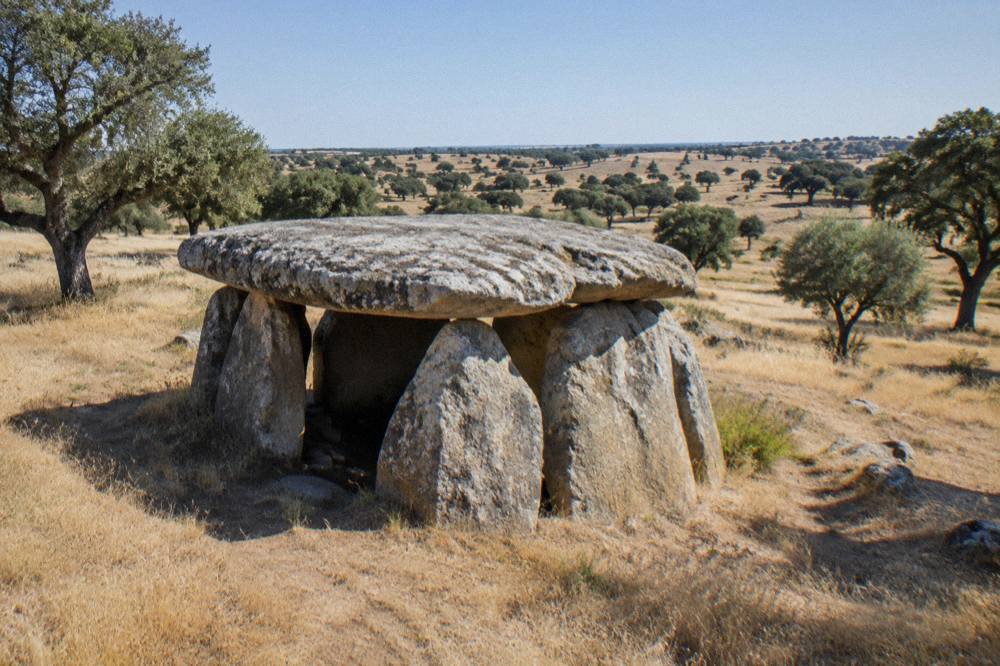
The Almendres cromlech is not alone: the plain around Évora carries a wider megalithic landscape of standing stones, dolmens and menhirs, including the Great Dolmen of Zambujeiro, which several guided tours from Évora visit in the same half-day as the cromlech. The region is one of the densest megalithic areas in Iberia, and a single guided circuit typically takes in more than one monument.
The pairing that appears most often on tour listings is Almendres with the Great Dolmen of Zambujeiro. A dolmen is a chambered tomb built from large upright stones and a capstone, a different structure from a cromlech, so the two together give a fuller picture of what prehistoric communities in the Alentejo built. The Évora: Cromlech of Almendres and Great Dolmen of Zambujeiro tour runs from $33.76 per person, is rated 5 from 54 reviews and lasts about 3 hours, which makes it the shorter and cheaper of the standard options.
For visitors who want the megaliths plus a taste of the Alentejo's other identity, cork and wine, the Megalithic and Cork Forest guided tour from Évora combines the stones with the montado, the cork oak landscape that covers the same hills; it runs from $50.65 per person and is rated 4.9 from 41 reviews over 4 hours. Travellers starting from Lisbon instead can reach the same country on the Évora and Megaliths Full-Day Tour from Lisbon, from $90.04 per person, rated 4.7 from 576 reviews, described accurately as a day trip that starts in Lisbon.
| Tour from Évora | Duration | From (USD) | Rating |
|---|---|---|---|
| Cromlech of Almendres and Great Dolmen of Zambujeiro | 3 hours | $33.76 | 5 from 54 reviews |
| Megalithic and Cork Forest guided tour | 4 hours | $50.65 | 4.9 from 41 reviews |
| Half Day Megaliths Cromlech Tour by Archaeologists | Half day | $74.54 | 5 from 77 reviews |
Is The Almendres Cromlech Worth Visiting On An Évora Trip?
Yes, for most visitors the Almendres cromlech is worth a half-day of an Évora itinerary, because it is the region's most distinctive sight outside the historic centre and it costs almost nothing to see. Entry to the stones is reported free, the interpretation centre charges nothing dramatic for context, and the site sits close enough to Évora to combine with lunch back in the city. Travellers with only a single day in Évora should weigh it against the UNESCO-listed centre itself.
The trade-off is real, though. Évora's historic centre has been UNESCO-listed since 1986, inscribed under criteria (ii) and (iv), with criterion (iv) calling it the finest example of a city of the golden age of Portugal after the 1755 Lisbon earthquake, which Évora was largely spared. The Roman temple, the cathedral with its roof-terrace ticket at 5.00 EUR, the Capela dos Ossos at 7.00 EUR and the Praça do Giraldo can fill a full day on their own, as the one day in Évora guide lays out. If the trip allows two days, the megaliths slot naturally into the second morning.
Season matters more here than in the city. IPMA's 1991 to 2020 normals for the Évora station show a July mean maximum of 33.3 C and an August mean of 33.5 C, with 31.9 days a year reaching 35 C or more and a record of 45.4 C set on 4 August 2018. The stones stand in open country with no shade, so spring and autumn mornings are the comfortable window; the best time to visit Évora guide covers the whole year. Évora is also a European Capital of Culture for 2027, which is already shaping the city's calendar and its crowds.
Common Questions About Stone Circles In Portugal
What is a cromlech?
A cromlech is a circle or group of standing stones. The Cromeleque dos Almendres is one example; Stonehenge is a different kind of prehistoric stone monument, with dressed blocks and lintels.
Is the Almendres cromlech free to visit?
Entry to the stones themselves is reported free. The Almendres Interpretation Centre in Guadalupe village keeps summer hours of 10:00 to 18:00 from 1 May to 31 October and winter hours of 10:00 to 17:00 from 1 November to 30 April.
Can you visit the Almendres stones without a car?
Yes, on a guided tour from Évora. Several operators run half-day megaliths tours with transport included, some led by archaeologists, and several also visit the Great Dolmen of Zambujeiro on the same circuit.
The short version: there is no Stonehenge in Portugal, but there is a prehistoric stone-circle group on a cork oak hillside a short drive from Évora, it is reported free to walk among, and an archaeologist-led half-day from the city will put it in context better than any roadside stop.