What Is The Difference Between Stonehenge And A Cromlech?
A cromlech is a circle or group of standing stones; Stonehenge is a specific English monument. What that means for the megalithic sites around Évora, Portugal, including the Cromeleque dos Almendres.
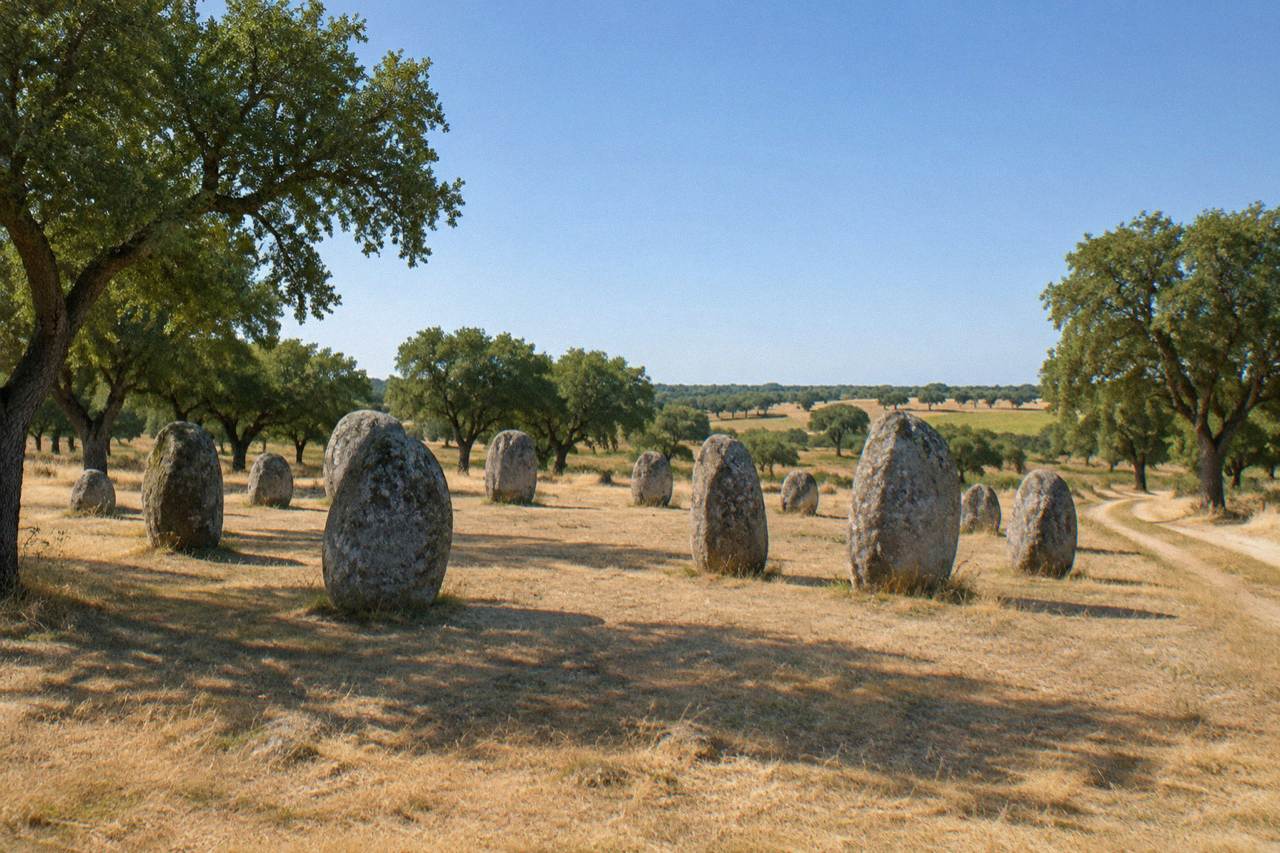
Évora, the capital of Portugal's Alentejo region, is one of the few European cities where the question of what a cromlech actually is stops being academic: the Cromeleque dos Almendres, a prehistoric circle of standing stones, stands in the cork oak country a short drive west of the city, and it is the reason many visitors arrive asking how it relates to Stonehenge. The two words get used almost interchangeably in travel writing, and they should not be. One is a category of monument found across Atlantic Europe, the other is a single, specific, much-visited site in southern England.
What Is A Cromlech?
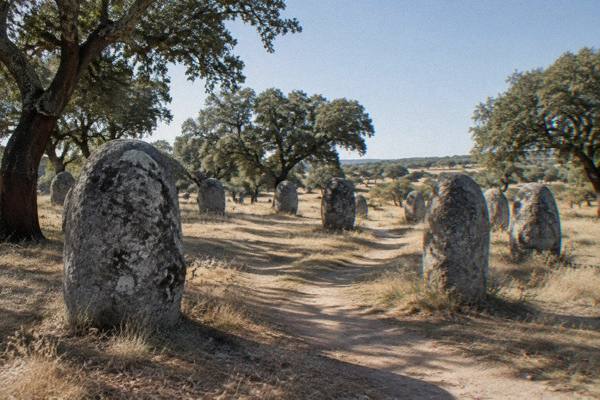
A cromlech is a prehistoric arrangement of standing stones, most often a circle or an oval of upright megaliths deliberately set into the ground, and the word names the whole family of such monuments rather than any single one of them. The term comes from Welsh, where it originally described a single capstoned stone, but in modern Portuguese and Spanish usage, cromeleque and crómlech refer to stone circles and stone groups. The Cromeleque dos Almendres near Évora is a cromlech in exactly this sense: a setting of standing stones arranged in an enclosed pattern on a low hillside in the Alentejo plain.
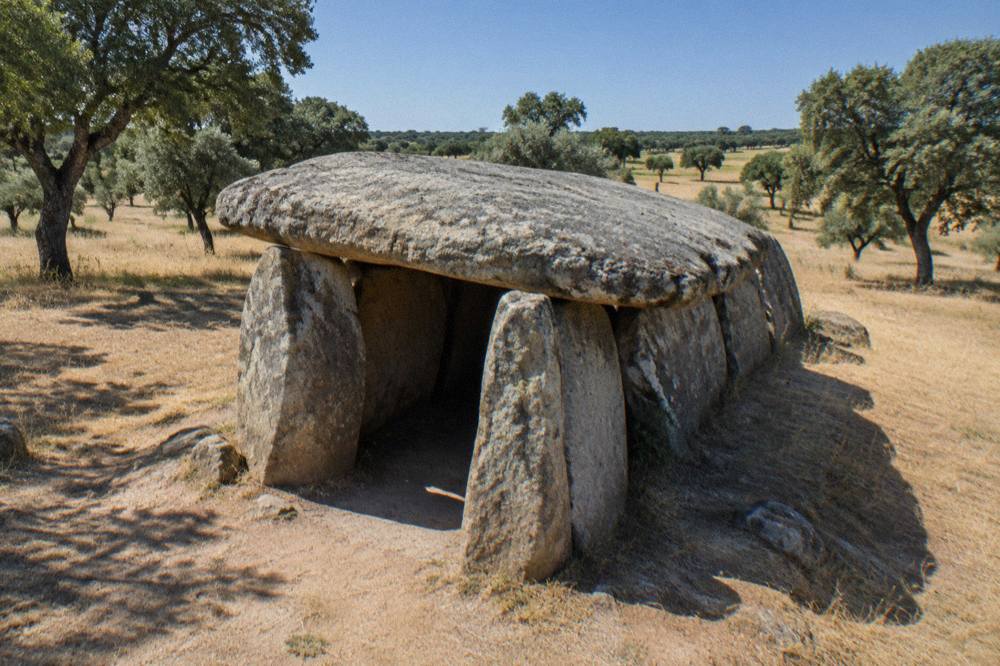
Cromlechs appear across Atlantic Europe, from Britain and Brittany to Iberia, and they belong to the same broad prehistoric world of megaliths that also produced dolmens, the chambered tombs known in Portuguese as antas. The Alentejo around Évora is unusually rich in both. A visitor based in Évora can reach a major cromlech, a great dolmen and several smaller sites without ever crossing out of the district, which is why the city has become the standard base for megalithic travel in Portugal.
The word also carries a practical warning for trip planning. Because "cromlech" describes a type, a sign or a listing that mentions one may be pointing at anything from a celebrated stone circle to a modest group of three or four uprights. Check what the specific site actually is before driving out to it, especially in rural Alentejo, where distances between sites add up quickly on small roads.
What Is The Difference Between Stonehenge And A Cromlech?
Stonehenge is one specific prehistoric monument in England, a celebrated circle of large standing stones with horizontal lintels on the Salisbury Plain; a cromlech is the general term for any circle or group of standing stones, of which Stonehenge is one famous example. The difference is between a category and a member of it. Every stone circle can be called a cromlech in the broad sense, but only the site on Salisbury Plain is Stonehenge, and only that site carries its particular arrangement of trilithons, its visitor centre and its crowds.
Put another way, if a guidebook says "Évora has its own Stonehenge", that is a loose piece of shorthand, not a claim of equivalence. The Cromeleque dos Almendres is a cromlech, a prehistoric standing-stone site, and it shares with Stonehenge the basic idea of stones deliberately set upright in a pattern by prehistoric people. This page's comparison stops there, because the verified information about the Almendres site does not extend to ages, dimensions or rankings, and an honest answer does not need them.
What the comparison is genuinely useful for is expectations. Stonehenge is a managed, ticketed, high-volume attraction; the Almendres cromlech is an open site in the countryside, reached by road from Évora, with a small interpretation centre in the nearby village of Guadalupe rather than a large visitor complex. Visitors who arrive expecting a Stonehenge-scale operation are sometimes surprised by how quiet and informal the Alentejo experience is, and many end up preferring exactly that.
The shorthand also matters for searchers. The question "is there a Stonehenge in Portugal" is a common one, and it has its own answer on this site, covering the megalithic sites of the Alentejo in more detail: is there a Stonehenge in Portugal. For the cromlech itself, the full attraction page, Cromeleque dos Almendres near Évora, covers the site, the interpretation centre and how the stones are arranged on the hillside.
Where To See A Cromlech Near Évora?
The Cromeleque dos Almendres, west of Évora on the road toward Lisbon, is the region's flagship cromlech, and it sits in open countryside near the village of Guadalupe, where the Almendres Interpretation Centre operates summer hours of 10:00 to 18:00 from 1 May to 31 October and winter hours of 10:00 to 17:00 from 1 November to 30 April. The centre is a partner of the Évora municipality and sits on Rua do Cromeleque in Guadalupe; the directions published with it say to take the national road from Évora toward Lisbon and, after 8 km, follow the turn-off toward the site. Entry to the stones themselves is reported free, though that is not confirmed on an official page, so treat it as a strong likelihood rather than a promise.
The Alentejo's megalithic landscape goes well beyond one circle. The Great Dolmen of Zambujeiro, one of the largest chambered tombs of its kind in the Iberian Peninsula, lies in the same area, and the region around Évora holds numerous smaller cromlechs, menhirs and antas scattered through the cork oak estates. This density is the reason archaeologists run regular guided visits from the city: the sites are individually modest but collectively remarkable, and they are easiest to understand with someone who can read the landscape.
For independent visitors, the practical division of labour is simple. The interpretation centre in Guadalupe is the place for orientation, maps and the published hours above; the stones themselves stand in the open and can be approached on foot once you have found the turn-off. A car is the normal way to reach the area, and there is no verified bus route or taxi fare to the site, so plan the drive yourself or join a tour. The full guide to megalithic sites near Évora lists the individual monuments in the area.
Do You Need A Guide For The Cromeleque Dos Almendres?
No, the site is reachable independently by car and the interpretation centre provides published hours and directions, but a guided visit adds the archaeological context that the stones themselves do not display, and Évora has tours led by working archaeologists that cover the cromlech and the Great Dolmen of Zambujeiro in a half day. The difference between the two experiences is the difference between seeing stones and understanding a landscape. Independent visitors get the setting, the silence and the hillside; guided visitors also get the sequence of sites, the drive between them on roads that are easy to miss, and an explanation of what a cromlech meant in the prehistoric society that built it.
The archaeologist-led option is the Half Day Megaliths Cromlech Tour from Évora, a roughly four-hour visit priced from $74.54 per person and rated 5 from 77 reviews on the operator's live listing. It starts in Évora, which makes it a natural fit for anyone staying in the city, and it pairs the cromlech with the dolmen so the two monument types, circle and tomb, are seen side by side. You can read more and Check availability on the tour's own page.
There is also a shorter, cheaper option that covers the same ground with a general guide: the three-hour Cromlech of Almendres and Great Dolmen of Zambujeiro tour, from $33.76 per person, rated 5 from 54 reviews. And for visitors who want the megaliths combined with the Alentejo's other famous landscape feature, the four-hour Megalithic and Cork Forest guided tour from Évora, from $50.65 per person and rated 4.9 from 41 reviews, pairs the stones with a walk through the cork oak woodland that surrounds them. Everything else covered here is indexed on Évora Travel Guide.
| Tour from Évora | Duration | From (per person) | Rating |
|---|---|---|---|
| Half Day Megaliths Cromlech Tour by Archaeologists | Half day | $74.54 | 5 from 77 reviews |
| Cromlech of Almendres and Great Dolmen of Zambujeiro | 3 hours | $33.76 | 5 from 54 reviews |
| Megalithic and Cork Forest Guided Tour | 4 hours | $50.65 | 4.9 from 41 reviews |
Prices and ratings sit on the operators' live listings and can change, so treat the table as a planning range and confirm the current figure when you book.
How Does A Cromlech Fit Into A Day In Évora?
A cromlech visit takes roughly half a day including the drive, which leaves the other half for Évora's walled historic centre, a UNESCO World Heritage site since 1986, where the Templo Romano, the Sé de Évora and the Capela dos Ossos line up within walking distance of one another. That combination, prehistoric stones in the morning and a Roman temple by afternoon, is something few European destinations can offer in a single day, and it is the pattern most first-time visitors follow. The city end of it is covered in detail in what to do in Évora for a day.
The sequencing works best with the opening hours in mind. The interpretation centre at Guadalupe runs its summer hours, 10:00 to 18:00, from 1 May to 31 October, and its winter hours, 10:00 to 17:00, the rest of the year, so a morning start fits either season. Back in the city, the Sé de Évora opens at 9:00 and the Igreja de São Francisco, which holds the Capela dos Ossos, keeps summer hours of 9:00 to 18:30 and winter hours of 9:00 to 17:00, open daily except 1 January, Easter Sunday, the afternoon of 24 December and 25 December. A megaliths morning therefore flows straight into an afternoon of monuments without any wasted time.
For visitors coming from Lisbon, the rail link makes the whole plan feasible without a car of your own. An early train, a guided megaliths tour and an evening walk inside the walls is a realistic single-day shape, though two days is calmer. How long to allow is weighed properly in how much time do you need in Évora.
Why The Alentejo Keeps Its Stones Quiet
The Alentejo's megalithic sites have not been developed into high-volume attractions, so the Cromeleque dos Almendres stands in working cork oak country, reached by a rural road, with a small interpretation centre in Guadalupe rather than a fenced visitor complex, and the practical consequence is access without timed tickets. The comparison with Stonehenge, for all its looseness, points at something real about the region. You can stand among the stones of a European cromlech, in silence, on an ordinary weekday. The trade-off is that you have to get yourself there, or pay a guide to do it, because the infrastructure that mass tourism would bring is not present.
That balance suits the Alentejo's character. The same open, low-lying landscape that made the region a place of estates and quiet towns makes its prehistory feel like part of the countryside rather than a fenced-off exhibit. For more on the region as a whole, see what is the Alentejo famous for, and for the city that anchors it, what is Évora famous for covers the monuments, the food and the university inside the walls. The Évora Travel Guide editorial desk keeps the megalithic pages current as the interpretation centre publishes changes.
Common Questions About Cromlechs And Stonehenge
What is the difference between Stonehenge and a cromlech?
Stonehenge is one specific prehistoric monument in England; a cromlech is the general term for a circle or group of standing stones, a category of monument to which Stonehenge belongs. The Cromeleque dos Almendres near Évora is a cromlech in this broad sense.
Is the Cromeleque dos Almendres the same as Stonehenge?
No. Both are prehistoric standing-stone sites, but they are different monuments in different countries. The Almendres site is a cromlech on the Alentejo plain near Évora; Stonehenge is a single famous site on Salisbury Plain in England. No age, size or ranking comparison is offered here.
How do I get to the Cromeleque dos Almendres from Évora?
The Almendres Interpretation Centre publishes directions: from Évora take the national road toward Lisbon and, after 8 km, follow the turn-off toward the site. The centre is on Rua do Cromeleque in the village of Guadalupe, open 10:00 to 18:00 from 1 May to 31 October and 10:00 to 17:00 from 1 November to 30 April. A car or a guided tour is the practical way to make the trip.
Does the Cromeleque dos Almendres charge admission?
Entry to the stones themselves is reported free, though this is not confirmed on an official page. The interpretation centre in Guadalupe is the place to check current access arrangements before you drive out.
Can I visit a cromlech and Évora's historic centre on the same day?
Yes. A cromlech visit takes roughly half a day including the drive, and Évora's walled UNESCO-inscribed centre, with the Templo Romano, the Sé and the Capela dos Ossos, fits into the other half on foot.
Are there guided tours to the Almendres cromlech?
Yes, several run from Évora, including a half-day tour led by archaeologists covering the cromlech and the Great Dolmen of Zambujeiro, from $74.54 per person, and a three-hour combined visit from $33.76 per person. Confirm current prices on the operators' live listings.