Lisbon To Évora By Bus
The bus is one of the two practical ways to reach Évora, Portugal from Lisbon, and this guide sets out the operators usually named for the route, how the coach option compares with CP's Intercidades trains, and what to plan for once you step off in the Alentejo.
Short answer
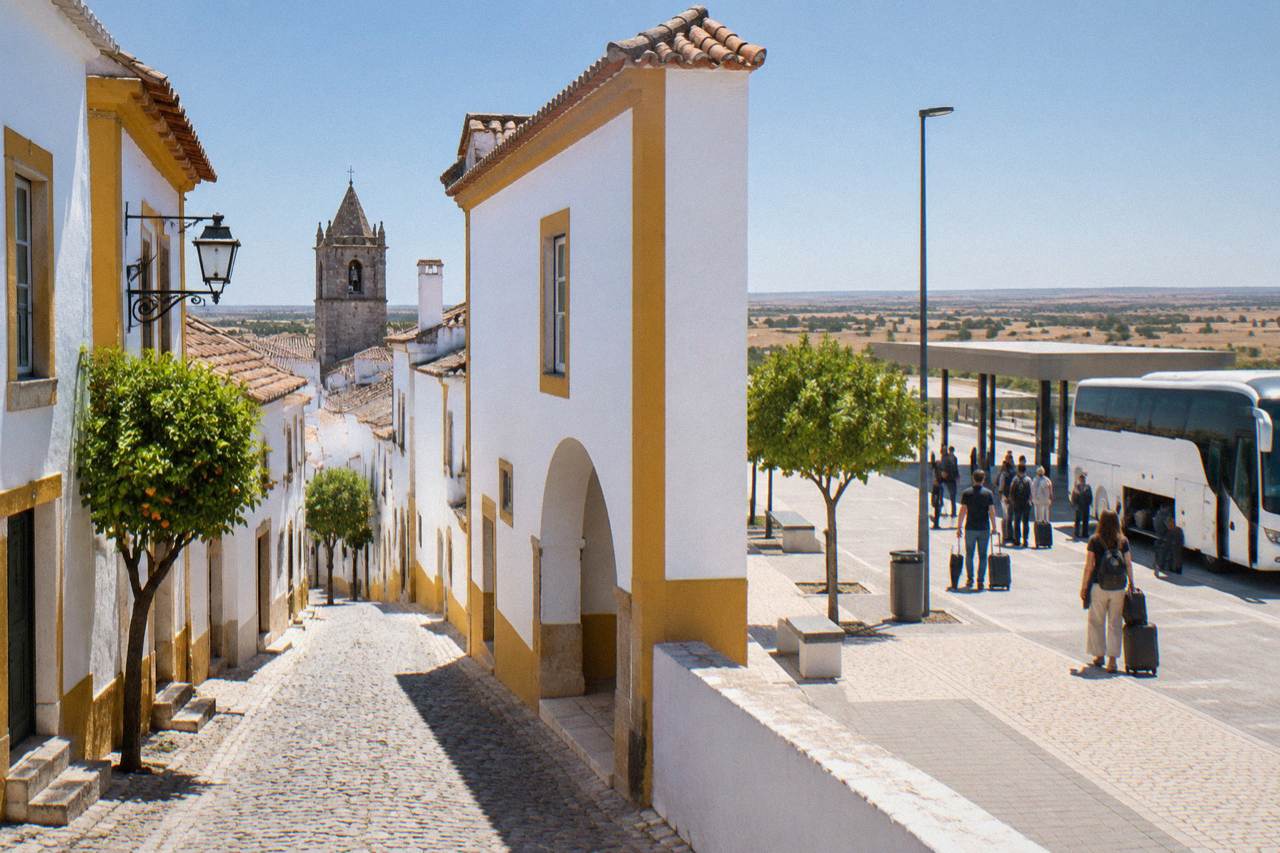
Rede Expressos and FlixBus are the two operators usually named for Lisbon to Évora, with services running from Lisbon into Évora's rodoviária near the historic centre. Journey times are usually a little under two hours, but fares and timetables change often, so check the operator's page before booking. The CP Intercidades train is the alternative, with six through trains listed in the 2026 timetable at 13.90 EUR second class.
Évora, the capital of the Alentejo region of Portugal, sits inland on a hot dry plain about 130 km from Lisbon, and the coach is one of the two practical ways of closing that gap. Rede Expressos and FlixBus are the two operators usually named for the Lisbon to Évora route, and both are reported to run direct services, including connections from Lisbon Airport's Humberto Delgado terminal. Journey times are usually a little under two hours, but fares, departure points and timetables change often enough that the only honest advice is to check the operator's live page before booking.
Who Runs The Lisbon To Évora Bus, And What Should You Check Before Booking?
Rede Expressos and FlixBus are the two operators usually named for the Lisbon to Évora route, with direct services reported from Lisbon and from Lisbon Airport into Évora's rodoviária. The journey usually takes a little under two hours, but no fare, timetable or exact duration should be treated as fixed: both operators change schedules by season, and the only reliable source is each operator's own booking page on the day you travel.
Neither operator publishes a simple flat rate for this corridor, and the price you pay depends on the date, the departure and how far ahead you book. That is normal for Portuguese long-distance coaching, and it means a figure quoted anywhere other than the operator's own page can be stale within weeks. What can be said with confidence is the shape of the route: coaches leave from Lisbon, some departures are reported from the airport terminal itself, and they arrive at Évora's Terminal Rodoviário, which sits a short distance from the historic centre. When you check the operator's page, look at three things in order: the departure point in Lisbon, because the city has more than one, the arrival point in Évora, and whether the service is direct or calls at intermediate Alentejo towns. A direct service is worth preferring on a day trip, because a connection through a town such as Vendas Novas or Montemor-o-Novo turns a short hop into a longer wait.
Booking in advance is generally cheaper than buying at the ticket window, and both operators use electronic tickets shown on a phone. If you are travelling in the summer months, when the Alentejo is at its hottest and Portuguese holiday traffic is at its thickest, an advance seat is less of a saving and more of a guarantee. For a fuller comparison of all four ways of making this journey, the Lisbon to Évora overview guide covers train, car, bus and tour options side by side.
How Does The Bus From Lisbon To Évora Compare With The Train?
The CP Intercidades train is the scheduled alternative to the coach: CP's timetable valid since 6 September 2026 lists six through trains from Lisboa Oriente, taking about 1 hour 40 to 1 hour 45, at 13.90 EUR second class or 18.50 EUR first class. The bus is usually a little under two hours with fares that vary by date and operator, so the train is the fixed, published option and the coach is the flexible, variable one.
That difference matters more than any marginal saving. The train's timetable and fares are published documents that hold until the next timetable change, so you can plan a day trip around them months ahead. The coach's pricing moves with demand, which can work in your favour on quiet winter weekdays and against you in the Feira de São João period in late June, when Évora fills with visitors. The train also arrives inside the city at Évora's station, a short walk from the walls, while coaches arrive at the rodoviária, which is similarly close but on a different side of the centre.
The CP timetable valid since 6 September 2026 lists these six through Intercidades services from Lisboa Oriente:
| Depart Lisboa Oriente | Arrive Évora | Class | Fare |
|---|---|---|---|
| 07:02 | 08:47 | 2nd class | 13.90 EUR |
| 09:02 | 10:45 | 2nd class | 13.90 EUR |
| 09:58 | 11:40 | 2nd class | 13.90 EUR |
| 13:35 | 15:13 | 2nd class | 13.90 EUR |
| 17:02 | 18:41 | 2nd class | 13.90 EUR |
| 19:02 | 20:46 | 2nd class | 13.90 EUR |
First class on the same route is 18.50 EUR. These trains call at Entrecampos, Sete Rios, Pragal, Pinhal Novo, Vendas Novas and Casa Branca, which means a departure from Entrecampos or Sete Rios is possible without crossing Lisbon to Oriente. The weekday remarks in CP's published timetable were not read for this guide, so before you lock a plan, confirm the days each service runs on cp.pt rather than assuming a seven-day pattern. The train guide covers the rail option in detail, and the direct train question answers the most common version of it.
If your reason for choosing the bus over the train is that you are starting at Lisbon Airport, that is a genuinely good reason: direct coach services from the airport terminal to Évora are reported, and they remove the cross-city transfer to Oriente that the train requires. If your reason is price, check both on the day, because an advance coach fare and a 13.90 EUR train ticket can land close together.
Where Does The Bus Arrive In Évora, And How Do You Reach The Historic Centre?
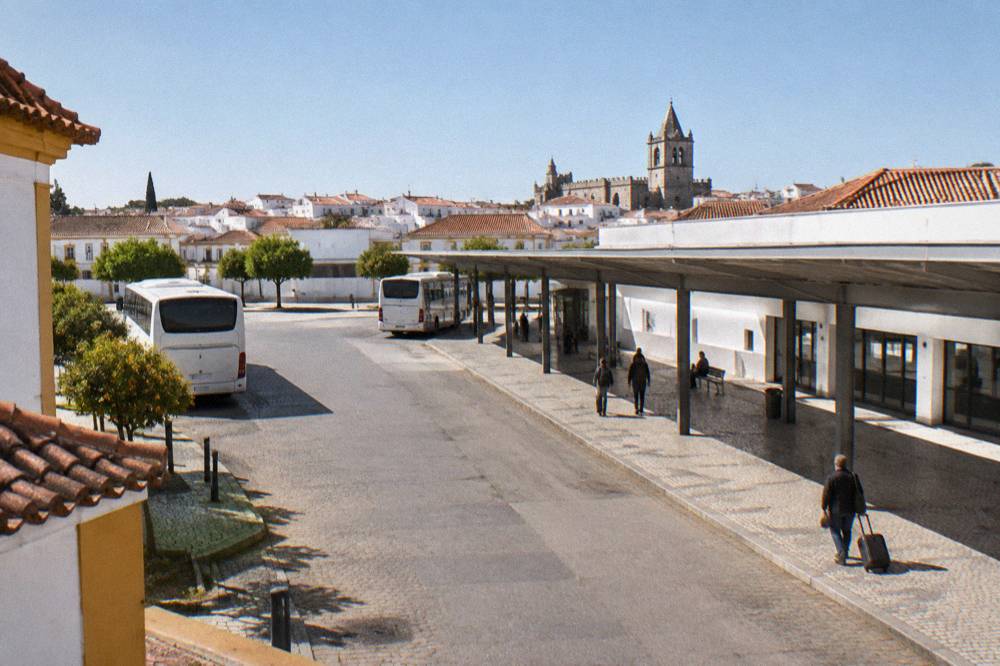
Coaches arrive at Évora's Terminal Rodoviário, the city's long-distance bus station, which sits close to the historic centre on the same scale of distances that makes Évora a walking city: the centre inside the walls is compact, and the walk from the rodoviária to Praça do Giraldo is short. No local bus fare or taxi fare can be stated here, because neither is published in a way this page can stand behind.
The practical point is that you do not need local transport on arrival unless your luggage makes walking unpleasant. Évora's walled centre is genuinely walkable, with the main squares, the Sé, the Capela dos Ossos and the Templo Romano all within a short stroll of one another, and the distances between them short enough that no minute count is needed. The getting around overview in the bus station guide covers the terminal, its facilities and the onward options in more detail.
Two arrival situations deserve a little planning. The first is a day trip with a late return: check your coach's last departure back to Lisbon against the closing time of whatever you most want to see, because the Sé closes at 17:00 and the Capela dos Ossos at 18:30 in summer legal time, and a monument you arrive too late for is a monument you paid a coach fare to miss. The second is a summer arrival: IPMA's 1991 to 2020 normals for the Évora station show a July mean maximum of 33.3 C and an August mean maximum of 33.5 C, so a walk from the rodoviária with a suitcase at two in the afternoon is a different proposition from the same walk in April.
If you would rather not manage arrival logistics at all, a tour that starts in Lisbon and brings you into Évora with a guide removes the question entirely. The Évora and Megaliths Full-Day Tour from Lisbon is an 8-hour private option rated 4.7 from 576 reviews, from $90.04 per person, and it pairs the city with the Cromeleque dos Almendres, the megalithic site that most day-trippers on public transport never reach.
How Much Does A Lisbon To Évora Bus Day Trip Cost Once You Are There?
The coach fare is only the first of three costs. Entry to Évora's main monuments is published and fixed: the Sé's complete-visit ticket is 5.00 EUR, the Capela dos Ossos museum ticket is 7.00 EUR for an adult, and the Museu de Évora is 8 EUR, while the Évora Ticket pass runs 8 EUR for one day, 10 EUR for two and 12 EUR for three, though it excludes the Sé, the Capela dos Ossos and the Museu de Évora.
The distinction between those last two sentences is where most budgets go wrong. The Évora Ticket covers the Cidade-Museu network of municipal sites, and it does not include the three biggest draws, which are run separately: the cathedral by its own chapter, the bone chapel by the Igreja de São Francisco, and the national museum by the state. A visitor who buys the pass expecting the headline sights will still be buying three more tickets at the door. The honest arithmetic for a one-day bus visitor who wants the three majors is 5.00 EUR plus 7.00 EUR plus 8 EUR on top of the coach fare, with the pass only making sense if your interest runs to the smaller municipal sites.
| Ticket | Adult Price | What It Covers | Closures To Know |
|---|---|---|---|
| Sé complete visit | 5.00 EUR | Cathedral, cloister, roof terrace, museum | 24 Dec afternoon, 25 Dec, 1 Jan |
| Capela dos Ossos museum ticket | 7.00 EUR | Bone chapel and all museum areas of the Igreja de São Francisco | 1 Jan, Easter Sunday, 24 Dec afternoon, 25 Dec |
| Museu de Évora | 8 EUR | Former Archbishop's Palace collections | Mondays, plus 1 Jan, Easter Sunday, 1 May, 29 June, 25 Dec |
| Évora Ticket, 1 day | 8 EUR | Cidade-Museu municipal network, not the three majors | Free to age 12 |
| Évora Ticket, 2 days | 10 EUR | Same network | Free to age 12 |
| Évora Ticket, 3 days | 12 EUR | Same network | Free to age 12 |
Concession rates exist on the church and museum tickets: the Igreja de São Francisco's own page lists youth to 25 and seniors over 65 at 5.00 EUR with a family ticket at 15.00 EUR, and the Museu de Évora halves its price for youth 13 to 24, seniors over 65 and families, with free entry to age 12 and free Sundays and holidays for residents of Portugal. The cathedral admits children up to 12 free with a parent or guardian. A municipal tourist tax applies to overnight stays, so it does not touch a day-tripper, but an overnight visitor should ask their hotel about it at booking. The cost and budget guide works through the full arithmetic of a visit, including food and lodging ranges.
What Can You Realistically See In Évora On A Bus Day Trip?
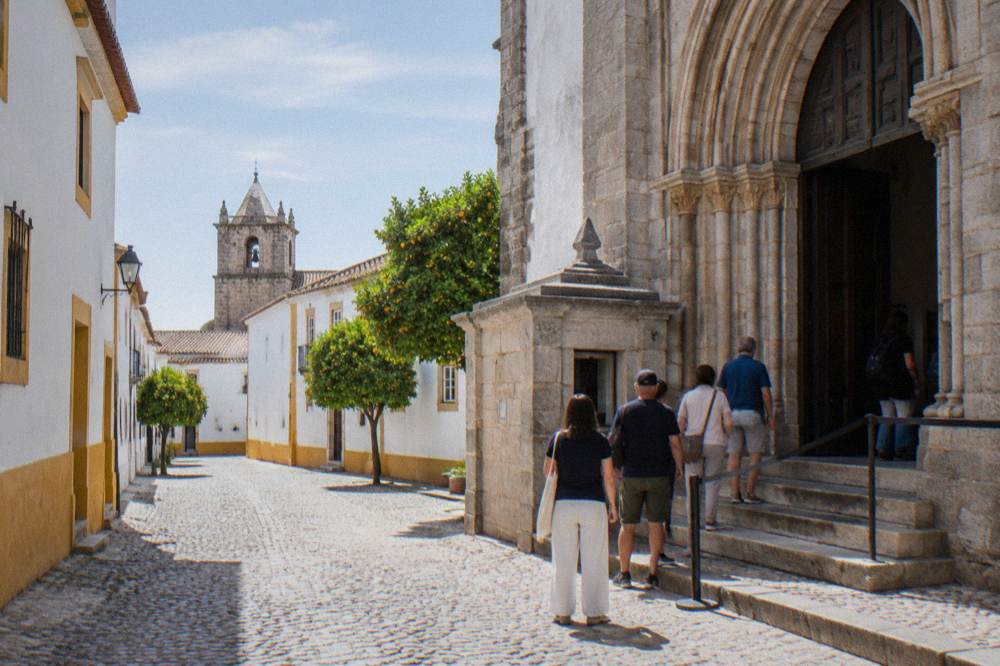
A bus day-tripper can cover the three majors and the open-air monuments in one visit: the Sé with its roof terrace, the Capela dos Ossos, the Templo Romano, which is an open-air monument with no ticket, and Praça do Giraldo, the main square, which is public space. The constraint is not distance but opening hours, since the Sé closes at 17:00 and the Museu de Évora closes on Mondays entirely.
The order you visit in matters more than the list. The Sé's complete-visit ticket includes the roof terrace, and the light over the Alentejo plain is at its best late in the day, so a sensible sequence puts the museum or the bone chapel in the middle of the day and the cathedral terrace toward the end of the afternoon, working backwards from the 17:00 closing time. The Templo Romano needs no ticket and no more time than you want to give it, and the municipal page for it records that it was probably dedicated to the imperial cult rather than to the goddess Diana, a name applied only since the 17th century, that it measures 25 x 15 m, that it was reused as a municipal butcher's, and that its walls were freed in 1870. It stands in a small open precinct you will pass anyway. The rest of the planning pages sit on Évora Travel Guide.
A guided walk is the efficient way to absorb the rest, and Évora has an unusual range of them. The Golden Era of Évora walking tour with a Portuguese wine tasting runs 2.5 to 3 hours from $23.92 per person, rated 4.4 from 33 reviews, and it pairs the historic-centre walk with a tasting, which suits a day-tripper who wants the city explained and a glass of Alentejo wine before the coach home. Check availability
At the other end of the price range, GuruWalk lists a free, tip-based Essential Free Tour of Évora, a 2-hour walk rated 4.93 from 774 reviews, where you pay the guru what you choose at the end. GuruWalk also carries a free History and Heritage walk rated 5 from 9 reviews and a free 2-hour walk titled Évora through history and how it shaped the city, rated 4.88 from 74 reviews. These are not this site's products and carry no price to print, but for a bus visitor with a fixed return time they are a low-commitment way to get oriented fast. The Évora walking tour guide compares the paid and free options in full.
| Guided Option In Évora | Length | Price | Rating |
|---|---|---|---|
| Golden Era walk with wine tasting | 2.5 to 3 hours | From $23.92 per person | 4.4 from 33 reviews |
| Essential Free Tour (GuruWalk, tip based) | 2 hours | Free, pay the guru what you choose | 4.93 from 774 reviews |
| History and Heritage walk (GuruWalk, tip based) | 2 hours | Free, tip based | 5 from 9 reviews |
| Évora through history (GuruWalk, tip based) | 2 hours | Free, tip based | 4.88 from 74 reviews |
| Small-group cultural walk with Capela dos Ossos | 2 hours | From $77.66 per person | 4.9 from 141 reviews |
| Medieval sidecar tour with wine tasting | 3 hours | From $61.90 per person | 4.9 from 16 reviews |
When Is The Best Time Of Year To Take The Bus To Évora?
IPMA's 1991 to 2020 normals for the Évora station show why spring and autumn are the comfortable seasons: July averages a maximum of 33.3 C and August 33.5 C, with 31.9 days a year reaching 35 C or more, while April and October average maximums of 20.7 C and 24.1 C. The trade-off is rain: October averages 81.5 mm and November 86.0 mm against July's 2.7 mm.
The Alentejo summer is not a mild Mediterranean summer. The record maximum at the Évora station is 45.4 C, set on 4 August 2018, and the normals count 25.0 days a year with a maximum of 30 C or more in August alone. A bus day trip in July or August means arriving into serious heat, walking stone streets that hold it, and doing the roof terrace of the Sé in the strongest sun of the day. If summer is when you are in Lisbon anyway, plan the monuments for the morning, accept that the middle of the day belongs to shade and a long Alentejo lunch, and treat the coach as an air-conditioned recovery.
| Month | Mean Max (C) | Mean Min (C) | Rain (mm) | Days 30 C+ |
|---|---|---|---|---|
| March | 18.7 | 6.9 | 60.8 | 0.0 |
| April | 20.7 | 8.5 | 62.1 | 0.3 |
| May | 25.0 | 10.9 | 46.6 | 5.5 |
| June | 30.2 | 13.8 | 10.6 | 15.1 |
| July | 33.3 | 15.6 | 2.7 | 23.7 |
| August | 33.5 | 16.0 | 6.0 | 25.0 |
| September | 29.5 | 14.6 | 33.9 | 13.9 |
| October | 24.1 | 12.3 | 81.5 | 2.9 |
All figures are the 1991 to 2020 averages from IPMA's normals for station Évora, number 558. Late June carries one more consideration: the Feira de São João ran from 23 June to 5 July in 2026 at the Rossio de São Brás, and the 2026 edition's theme was "Évora: Capital Europeia ao Sul". The fair is a reason to go, not a reason to avoid going, but it fills the city, and a coach seat booked late in that window is a coach seat you may not get. The best time to visit guide and the weather guide cover the seasons month by month.
Which Alentejo Day Trips Work Once The Bus Has Brought You To Évora?
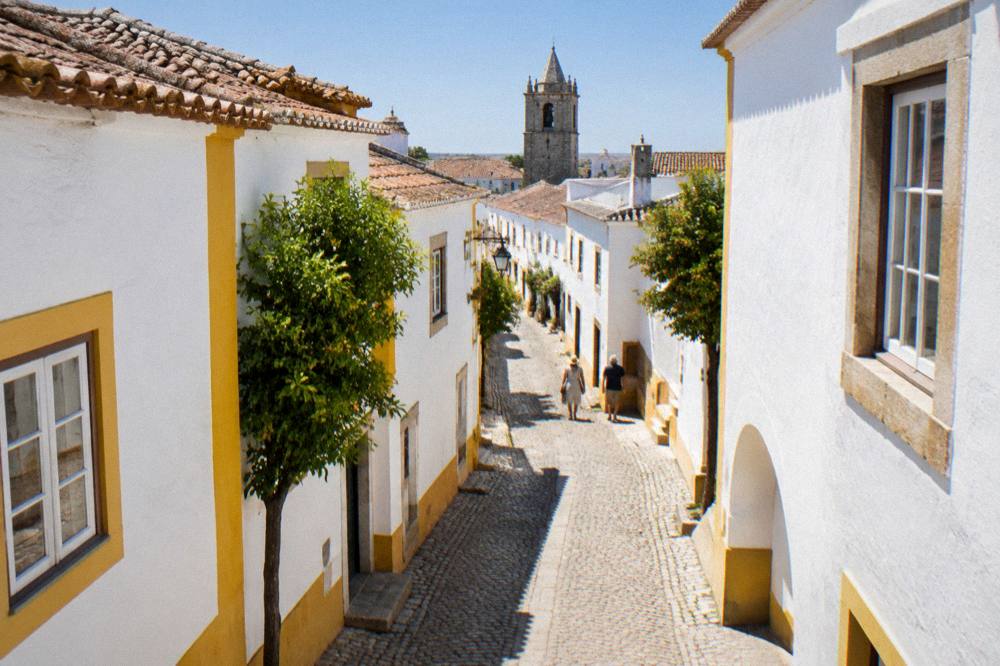
Évora is the natural base for the Central Alentejo, and the rounded distances are workable: Arraiolos is about 20 km away, Monsaraz about 40 to 45 km, Estremoz about 45 km, Vila Viçosa about 60 km, Elvas about 80 km and Marvão about 120 km. None of these is reachable by a stroll from the rodoviária, so a day trip beyond Évora means a tour, a rental car or a regional connection you check locally.
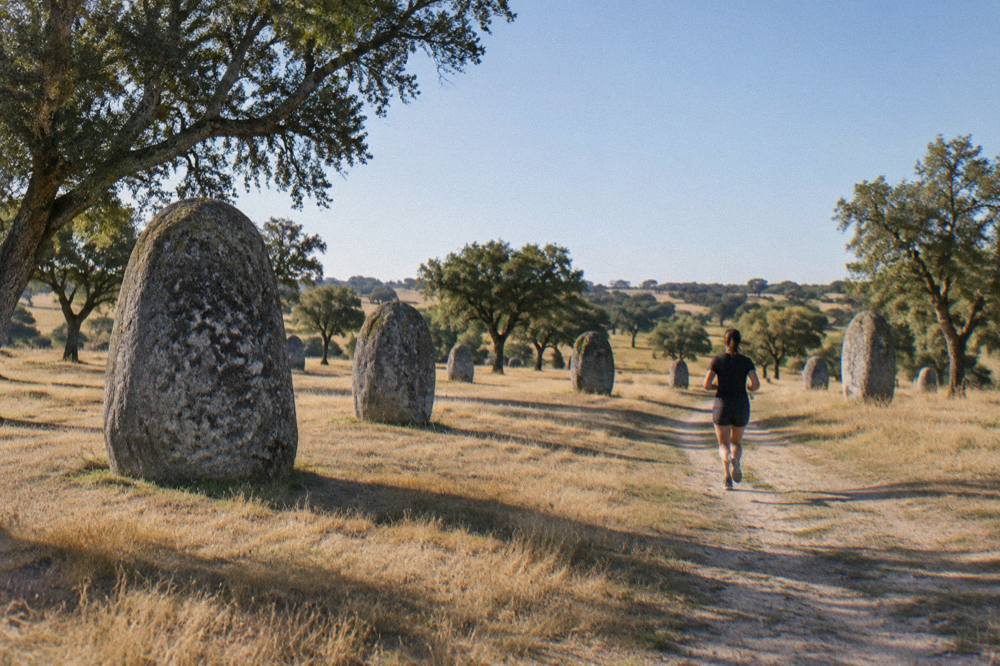
The megalithic sites are the exception that matters most, because the Cromeleque dos Almendres lies about 8 km from Évora along the national road toward Lisbon with a turn-off after that, and the Almendres Interpretation Centre in the village of Guadalupe publishes its hours: 10:00 to 18:00 in summer, meaning 1 May to 31 October, and 10:00 to 17:00 in winter. The stones themselves are an open site. A bus day-tripper cannot reach the cromlech on foot, and a taxi fare for the run cannot be stated here, so the realistic options are a guided megaliths tour from Évora or a car.
| Alentejo Destination | Distance From Évora | What It Is Known For |
|---|---|---|
| Arraiolos | About 20 km | Handmade needlework carpets |
| Monsaraz | About 40 to 45 km | Walled hill village over the Alqueva lake |
| Estremoz | About 45 km | Marble and a hilltop castle |
| Vila Viçosa | About 60 km | Ducal palace and marble quarries |
| Elvas | About 80 km | Fortified UNESCO border town |
| Marvão | About 120 km | Mountain-top walled village |
For the coach visitor who wants the megaliths without hiring a car, two tours from Évora stand out. The Cromlech of Almendres and Great Dolmen of Zambujeiro tour runs 3 hours from $33.76 per person, rated 5 from 54 reviews, and a half-day cromlech tour led by archaeologists runs from $74.54 per person, rated 5 from 77 reviews. The megalithic sites guide covers the archaeology, and the best day trips guide works through the towns. If your whole plan is a single day out of Lisbon and you want the megaliths included from the start, the Évora and Megaliths Full-Day Tour from Lisbon does the whole circuit from the capital, described in the listing as an 8-hour private tour from $90.04 per person, rated 4.7 from 576 reviews.
Is The Bus Or A Tour The Better Choice For A Lisbon To Évora Day Trip?
The bus suits the independent traveller who wants to control the clock: it is cheap, it runs into a station near the centre, and Évora rewards wandering on foot. A tour suits the traveller who wants the megaliths, the wine country or a guide's context included, because those lie beyond walking distance and a tour bundles transport, tickets and a fixed return into one booking from $64.09 per person for the cheapest Lisbon-start option.
The dividing line is simple. Everything inside Évora's walls is doable on a bus day trip with a pair of good shoes and a monument ticket or two. Everything outside the walls, the Cromeleque dos Almendres, the wineries, Monsaraz, the cork forests, needs wheels of some kind, and a tour is the version of that which does not require you to drive on unfamiliar roads after a tasting. The is Évora worth a day trip from Lisbon question works through the yes-or-no decision, and the one-day itinerary gives an hour-by-hour plan for the independent version.
For the tour version, the range of Lisbon-start options is wide. The From Lisbon: Évora and Monsaraz with Regional Wine Tasting tour runs 9 hours from $64.09 per person, rated 4.7 from 360 reviews, and pairs the city with the hill village and a tasting. The Small-Group Évora and Monsaraz Tour with Wine Tasting from Lisbon starts from $65.31 per person, rated 4.5 from 232 reviews. A private option with a guide, Tour Évora and Alentejo with private guide, starts from $160.55 per person, rated 4.9 from 128 reviews. All of these are described accurately as starting in Lisbon, and they belong on this comparison because a bus traveller weighing the coach fare against a tour price is making exactly this choice. The Alentejo tour from Lisbon page collects the full range.
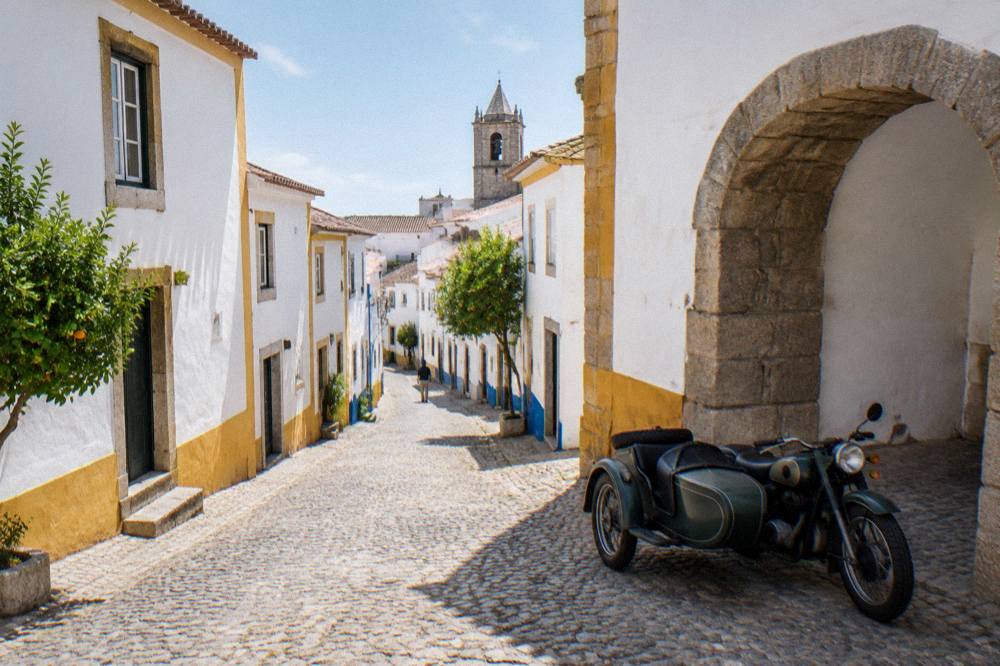
One more option sits between the two camps, and it is worth knowing about because it is unusual: the Medieval Tour of Évora on a Sidecar with wine tasting, a 3-hour ride from $61.90 per person, rated 4.9 from 16 reviews, which covers the historic centre from the sidecar of a classic motorcycle and ends with a tasting.
Common Questions About The Lisbon To Évora Bus
How do you get from Lisbon to Évora by bus?
Rede Expressos and FlixBus are the two operators usually named for the route, with direct services reported from Lisbon and from Lisbon Airport into Évora's Terminal Rodoviário. The journey usually takes a little under two hours. Check the operator's own page for the current timetable, fares and departure points before booking, because none of these is fixed.
How much does the Lisbon to Évora bus cost?
No fare can be stated as fact, because coach pricing on this corridor varies by date, departure and how far ahead you book. The honest comparison figure is the train: CP's 2026 price table lists Lisboa Oriente to Évora at 13.90 EUR second class and 18.50 EUR first class. Check both the coach operator's page and cp.pt on the day you plan to travel.
Is the bus or the train better from Lisbon to Évora?
The train has the published, fixed schedule: CP lists six through Intercidades from Lisboa Oriente in the timetable valid since 6 September 2026, taking about 1 hour 40 to 1 hour 45. The bus is usually a little under two hours and can be cheaper or dearer depending on demand, and some coach services are reported to start at Lisbon Airport, which the train does not. If you start at the airport, the bus has a real advantage.
Where does the bus arrive in Évora?
Coaches arrive at Évora's Terminal Rodoviário, the long-distance bus station, which sits close to the historic centre. The walled centre is compact and walkable, with the main monuments within a short stroll of one another, so most visitors walk in from the station rather than taking local transport.
Can you do Évora as a bus day trip from Lisbon?
Yes, and many visitors do. The constraint is closing times rather than distance: the Sé closes at 17:00, the Capela dos Ossos at 18:30 in summer legal time, and the Museu de Évora is closed on Mondays. Plan your return coach departure against those times, and buy monument tickets for the sights you most care about first.
Do you need a car in Évora once the bus arrives?
Not for the city itself, which is walkable inside its walls. You need wheels only for the sites beyond walking distance, such as the Cromeleque dos Almendres about 8 km out along the national road toward Lisbon, or the wine country and hill villages of the Alentejo. For those, a guided tour from Évora is the alternative to renting a car.
The bus from Lisbon to Évora is a straightforward, low-cost way into the heart of the Alentejo, and it hands you a UNESCO-listed city that is small enough to walk and rich enough to fill a day. Whether you go on to explore it on a guided walk, from the sidecar of a classic motorcycle, or out to the standing stones of the Cromeleque dos Almendres, the coach fare has already done the hardest part of the journey.