Best Hotels In Évora
Évora, Portugal, is a small walled city where the choice of where to sleep matters more than in most: inside the walls everything is walkable, outside them you will want a plan for the car. This guide sets out the areas, the costs you can verify and the ones you cannot, and how to match a stay to the trip.
Short answer
Stay inside the historic walls if you want to walk to the Sé, the Capela dos Ossos and the Praça do Giraldo without a car; stay in the university quarter for a calmer, leafier base; stay outside the walls if you are driving the Alentejo. A municipal tourist tax applies to hotel stays, and the city's paid monuments are cheap enough that location matters more than ticket strategy.
Évora, the capital of the Alentejo region of Portugal, packs a UNESCO-listed historic centre, a Roman temple, a bone chapel and a working university into a space you can cross on foot in well under an hour, and that compactness is the single fact that should drive any hotel decision here. Where you sleep decides whether you walk to dinner or drive to it, whether you hear the church bells or the ring road, and whether the megalithic plains are a short drive or a chore. This page, written by the Évora Travel Guide editorial desk from official sources, walks through the areas one by one, the costs that can be stated with a figure and the ones that can only be checked, and the practical questions that come up once the room is booked.
Where Should You Stay In Évora?
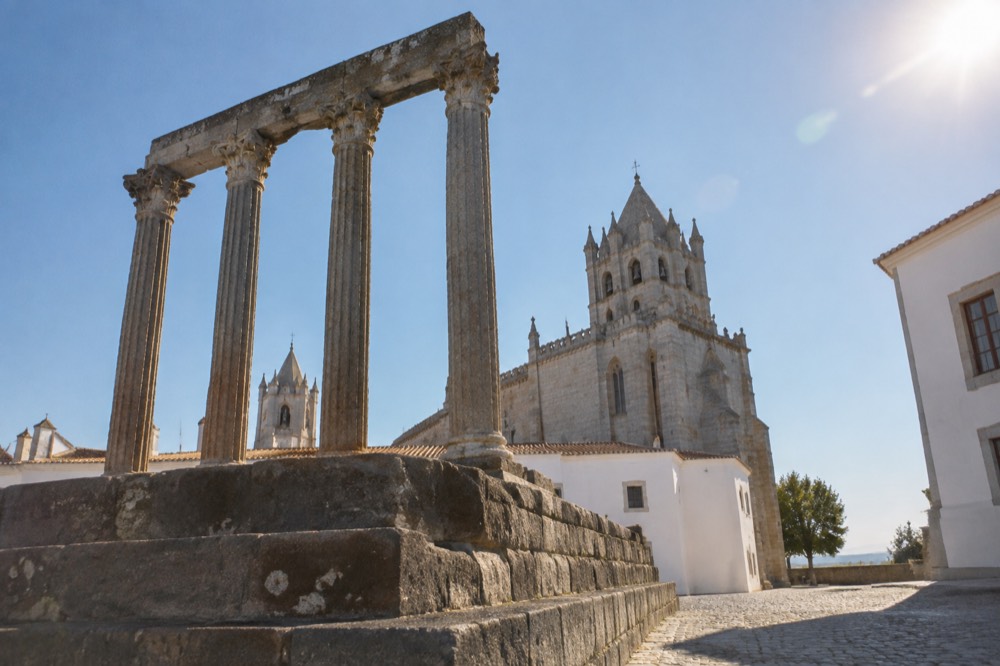
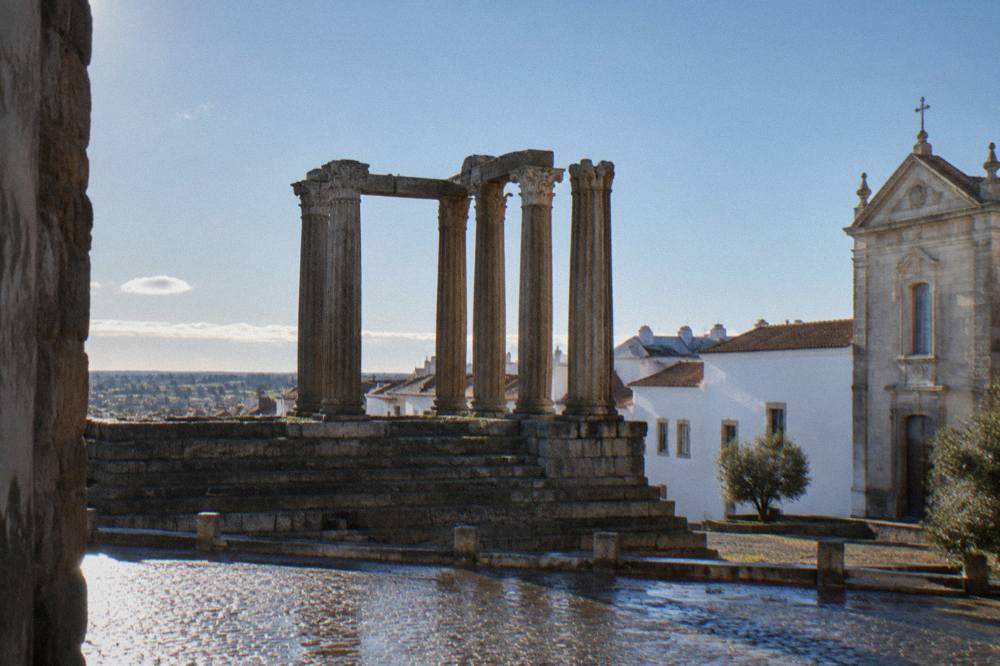
The practical answer is to stay inside the historic walls if your trip is Évora itself, in the university quarter if you want quiet and shade, and outside the walls if the Alentejo day trips are the point of the visit. Inside the walls, the Praça do Giraldo, the Sé, the Capela dos Ossos and the Templo Romano are all within one continuous walk. Outside them, you will almost certainly want a car, and Évora's parking and one-way streets become a daily consideration.
The city's shape explains the choice. The Roman and medieval walls enclose the entire old centre, and the UNESCO inscription of the Historic Centre of Évora in 1986, under criteria (ii) and (iv), covers exactly that core: the golden-age city that the 1755 Lisbon earthquake largely spared. Criterion (iv) calls it the finest example of a city of the golden age of Portugal, which is a fair summary of what a visitor is paying to sleep beside.
A note on what this page can and cannot tell you. Hotel names, prices and ratings change constantly, so the editorial desk does not print them here; the areas are described by character and location, and the figures below are the ones that come from official sources and attach to things you will actually pay for: monument tickets, the train, the multi-site pass. For the full neighbourhood-by-neighbourhood picture, see the companion page on where to stay in Évora, and for the budget end of the market, cheap hotels and hostels in Évora.
What Is It Like To Stay Inside The Historic Walls?
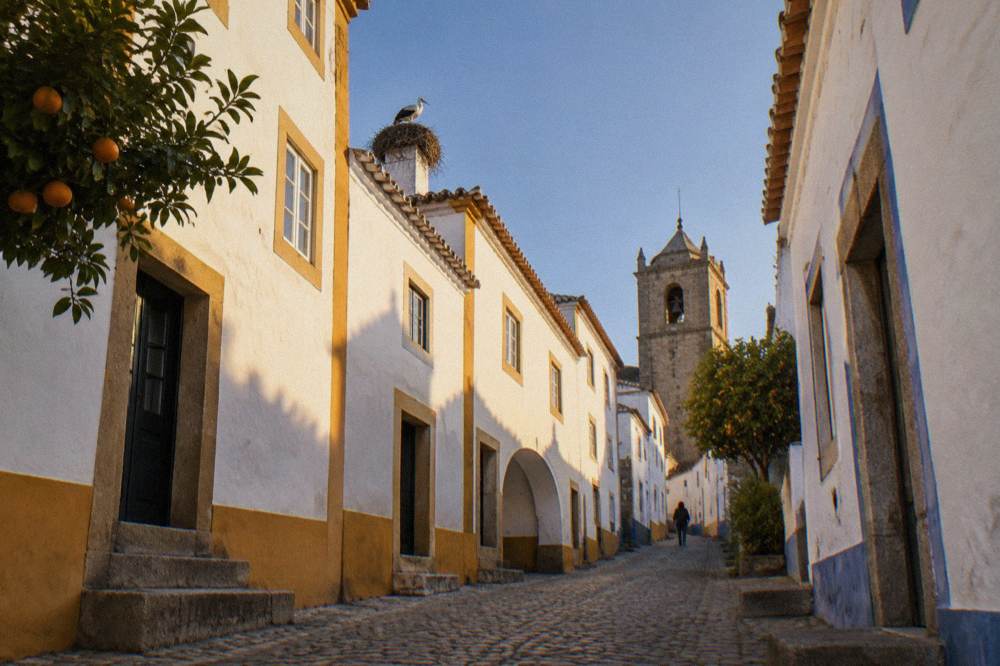
Staying inside the walls means the whole UNESCO core is your neighbourhood: you step out onto cobbled streets and reach the Praça do Giraldo, the Sé de Évora, the Capela dos Ossos and the Templo Romano on foot, with no parking, no bus and no timetable to think about. The trade-offs are narrow streets, limited car access and evening noise around the main squares, plus real summer heat, because the 1991 to 2020 averages for the Évora station put the July mean maximum at 33.3 C.
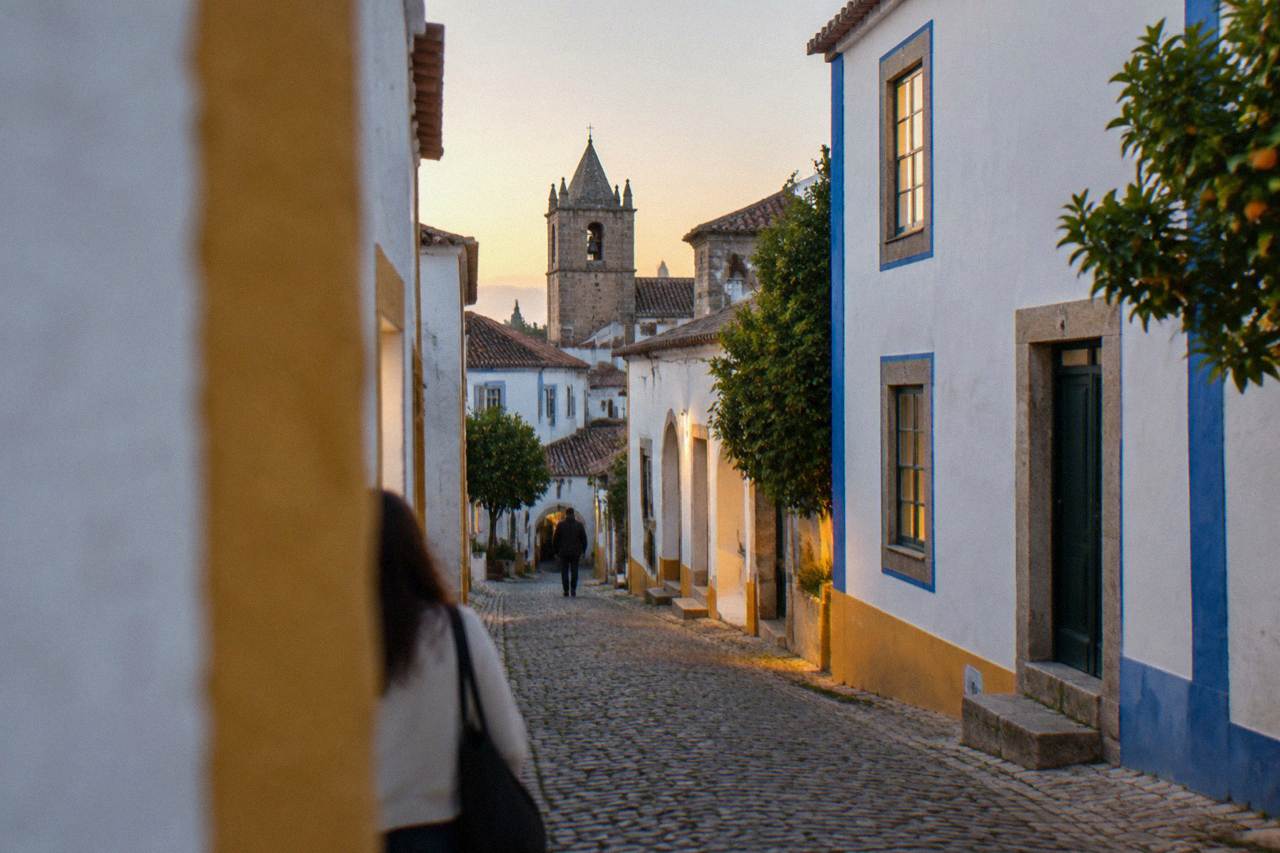
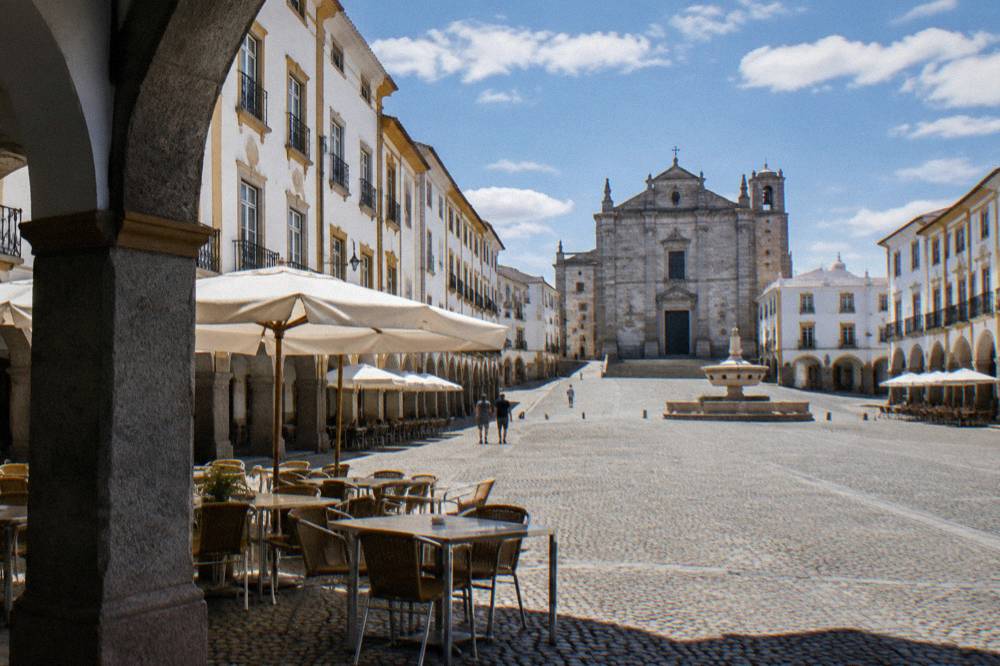
The character changes street by street. Around the Praça do Giraldo, the arcaded main square, you get the busiest, most central feel: cafés, the tourist office at number 73, and the shortest possible walk to everything. Down toward the Porta de Moura quarter and the Rua de Alcárcova the streets narrow and calm down, with small squares and the Renaissance fountain of the same name. Along the Água de Prata aqueduct line, on the eastern edge, the old water channel runs right through the houses, one of Évora's strangest and most photographed sights.
The walls themselves are a real boundary, not a symbolic one. Streets inside are one-way, tight and partly pedestrian; the practical pattern most visitors settle on is to arrive, park, and not move the car until departure. The parking guide for Évora covers the options in detail.
A guided walk is genuinely useful at the hotel-planning stage, because it shows you the streets you would be living on. The Évora: Tales and Legends Guided Walking Tour, from $52.90 per person and rated 4.8 from 40 reviews, runs two and a half hours through the historic centre's stories, and there is a cheaper, even more flexible option in the Évora: Personal and Flexible Walking Tour in Historic Center, from $13.51 per person, rated 4.8 from 105 reviews. Walking the centre once before booking tells you more about noise, light and slope than any map does.
Which Évora Area Suits Your Trip?
Match the area to the trip, not to a ranking: the core inside the walls suits a first visit of one or two nights focused on the monuments; the university quarter suits longer, quieter stays and anyone who wants gardens and shade; the area outside the walls suits drivers building day trips to Monsaraz, Estremoz or Vila Viçosa into the itinerary. No honest guide ranks them, because a two-night monument sprint and a week of Alentejo touring are different trips that deserve different bases.
The university quarter, around the Colégio do Espírito Santo and the Jardim Público, is the calmest part of the centre: the building's Jesuit history dates to 1553, the order was expelled in 1759, and today it is a working university, so the area has students, bookshops and long shaded walks. The Porta de Moura quarter, inside the walls but off the main drag, mixes Renaissance houses with small taverns and feels residential in the evenings. Outside the walls, the modern city spreads south and west, with wider streets, easier parking and the bus terminal.
| Area | Character | Suits |
|---|---|---|
| Core inside the walls, near Praça do Giraldo | Arcaded square, cafés, tourist office at number 73, everything walkable | First visits, one to two nights, no car |
| Porta de Moura quarter | Narrow Renaissance streets, residential evenings, fountain square | Visitors who want quiet but still inside the walls |
| University quarter | Jesuit college, gardens, students, shade | Longer stays, spring and autumn trips |
| Along the Água de Prata | Aqueduct arches built into houses, eastern edge | Photographers, walkers, second visits |
| Outside the walls | Wider streets, easier parking, bus terminal | Road-trip drivers, day-trip bases |
For the relaxation-focused traveller, the spa hotels of Évora are covered on their own page, and for trips that range across the whole region, the Alentejo hotels guide looks at splitting a stay between Évora and other towns.
How Much Does A Stay In Évora Cost?
The parts of an Évora stay that carry verifiable figures are cheap: the Sé's complete-visit ticket is 5.00 EUR, the Capela dos Ossos museum ticket is 7.00 EUR for an adult, the Museu de Évora is 8 EUR, and the multi-site Évora Ticket runs 8 EUR for one day, 10 EUR for two and 12 EUR for three, free to age 12. Hotel rates are not published on this page, and a municipal tourist tax applies to stays, so check your hotel for the amount.
The ticket prices are worth knowing because they change the arithmetic of a short stay. If you are inside the walls for two nights, you can see the cathedral, the bone chapel and the museum for 20.00 EUR in total entry fees, and children up to 12 enter the Sé free. The Évora Ticket does not include the Sé, the Capela dos Ossos or the Museu de Évora, so it is a complement to those tickets, not a replacement: read its network list on the official page before buying.
| Item | Figure | Notes |
|---|---|---|
| Sé de Évora complete visit | 5.00 EUR | Cathedral, cloister, roof terrace, museum; children to 12 free |
| Capela dos Ossos museum ticket, adult | 7.00 EUR | Youth to 25 and seniors over 65 pay 5.00 EUR; family 15.00 EUR |
| Museu de Évora, adult | 8 EUR | Closed Mondays |
| Évora Ticket, one day | 8 EUR | Does not include the Sé, the Capela dos Ossos or the Museu de Évora |
| CP Intercidades Lisboa Oriente to Évora, second class | 13.90 EUR | First class 18.50 EUR |
| Municipal tourist tax | Applies to stays | Amount not stated here; check your hotel |
For the wider budget picture, including food and the cost of days out, see the cost and budget guide for Évora, and for the argument over whether the city justifies the fare at all, is Évora worth visiting works through it honestly.
When Is The Best Time To Book And Visit?
The best months to sleep well in Évora are April, May, June, September and October, when the 1991 to 2020 averages show mean maximums of 20.7 C, 25.0 C, 30.2 C, 29.5 C and 24.1 C, against 33.3 C in July and 33.5 C in August. The same normals count 31.9 days a year at 35 C or more, almost all of them in June through August.
The heat is not a footnote; it is the main planning fact. The record maximum at the Évora station is 45.4 C, set on 4 August 2018, and even the averages put August nights at a 16.0 C mean minimum, which is exactly the difference between a room with air conditioning and one without. Anyone booking a summer stay inside the walls should confirm air conditioning with the property before paying, because old buildings in the historic centre vary enormously.
| Month | Mean max (C), 1991 to 2020 | Mean min (C) | Rain (mm) | Days at 35 C or more |
|---|---|---|---|---|
| April | 20.7 | 8.5 | 62.1 | 0.0 |
| May | 25.0 | 10.9 | 46.6 | 0.7 |
| June | 30.2 | 13.8 | 10.6 | 5.6 |
| July | 33.3 | 15.6 | 2.7 | 11.5 |
| August | 33.5 | 16.0 | 6.0 | 10.9 |
| September | 29.5 | 14.6 | 33.9 | 3.1 |
| October | 24.1 | 12.3 | 81.5 | 0.1 |
The event calendar matters too. Évora and the Alentejo are the European Capital of Culture in 2027, the fourth Portuguese city after Lisbon, Porto and Guimarães, and 2026 is a preparation year built on the concept of "Vagar". The GUADIANA festival of Afro-Ibero-American literatures ran its first edition on 9 to 11 October 2026 with 28 authors from nine countries. Anyone planning a 2027 stay should expect demand and should watch the official programme, which was not fully published as of the research for this page. The month-by-month detail is in the best time to visit Évora and the Évora weather guide.
What Should You Check Before Booking An Évora Hotel?
Check four things before you pay: air conditioning if you are going between June and September, because the 1991 to 2020 normals average 33.3 C in July; parking arrangements if you are driving, because the walled centre is narrow and partly pedestrian; walking distance to the Praça do Giraldo if you want to be car-free, since the tourist office sits at number 73 on that square; and the municipal tourist tax, which applies to stays and whose amount your hotel can confirm.
A fifth check is quieter: which side of the building the room faces. The main squares stay lively late into the evening in warm months, and a room facing an inner courtyard in the same property can be a different world from one facing the arcade. This is a question for the property directly, and it is the kind of thing a good booking note can fix at no cost.
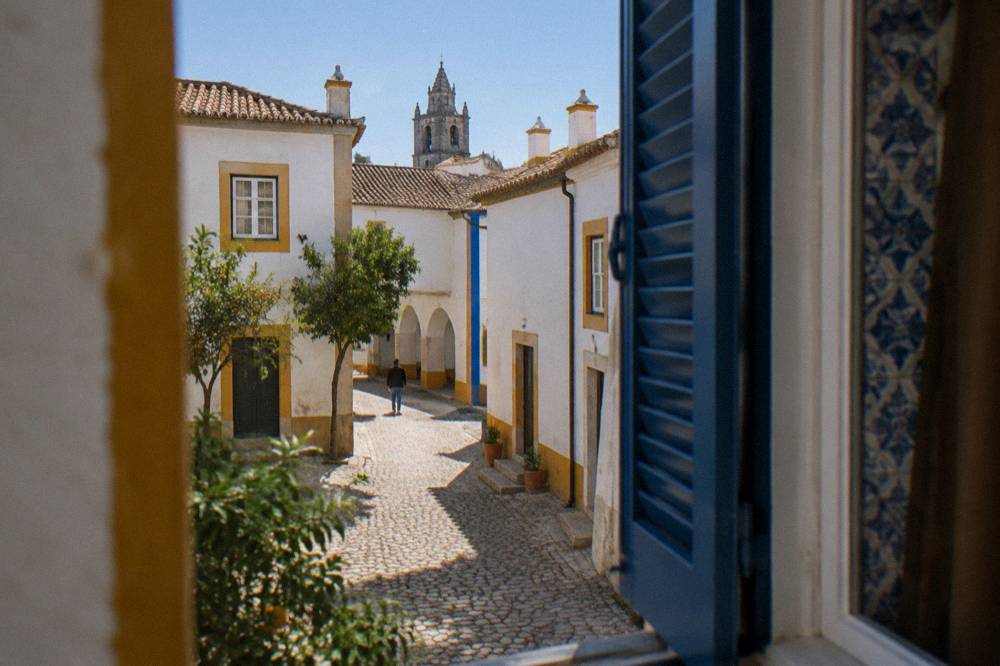
Drivers should also read the small print on the walls. The one-way system inside is genuinely confusing on a first arrival, and several streets are restricted to residents. The getting to Évora from Lisbon guide, together with the train option and the bus option, may remove the car from the equation entirely, which for a walls-inside stay is often the best decision of the trip.
How Do You Get From Lisbon To Your Évora Hotel?
The train is the cleanest link: CP's Intercidades timetable, valid since 6 September 2026, lists six through services from Lisboa Oriente to Évora, departing 07:02, 09:02, 09:58, 13:35, 17:02 and 19:02 and arriving 08:47, 10:45, 11:40, 15:13, 18:41 and 20:46, a journey of about 1 hour 40 to 1 hour 45, at 13.90 EUR second class and 18.50 EUR first. From the station it is a short hop to the walls.
The station sits just outside the historic centre, which makes a walls-inside hotel reachable without a car from the moment you step off the train. Coaches also run the corridor, but the editorial desk does not state coach fares or times, because no operator page verified them for this build; check the operator's notice before you go. Drivers cover about 130 km from Lisbon, and the driving route and the return leg, Évora to Lisbon, cover the practicalities.
| Train from Lisboa Oriente | Arrives Évora | Journey |
|---|---|---|
| 07:02 | 08:47 | about 1 h 40 to 1 h 45 |
| 09:02 | 10:45 | about 1 h 40 to 1 h 45 |
| 09:58 | 11:40 | about 1 h 40 to 1 h 45 |
| 13:35 | 15:13 | about 1 h 40 to 1 h 45 |
| 17:02 | 18:41 | about 1 h 40 to 1 h 45 |
| 19:02 | 20:46 | about 1 h 40 to 1 h 45 |
The morning arrivals matter for hotel planning: an 08:47 arrival gives you a full first day, and most properties inside the walls will hold bags even when the room is not ready, a thing to confirm at booking rather than assume.
What Can You Do Within Reach Of An Évora Hotel?
From any base in or near the centre, the paid monuments alone fill a day: the Sé's complete visit at 5.00 EUR including the roof terrace, the Capela dos Ossos at 7.00 EUR, and the Museu de Évora at 8 EUR, with the free Templo Romano standing open in its square.
Beyond the walls, the rounded distances are Arraiolos about 20 km, Monsaraz about 40 to 45 km, Estremoz about 45 km, Vila Viçosa about 60 km, Elvas about 80 km and Marvão about 120 km.
The split is that simple. Inside the walls, the things to do in Évora run from the Roman temple, probably dedicated to the imperial cult rather than to Diana according to the municipal page, to the Jewish quarter and the rooftop views. Outside, the Alentejo opens up: marble in Vila Viçosa, the hill village of Monsaraz above the Alqueva reservoir, the castle towns of Estremoz and Elvas.
| Day trip from Évora | Distance (about) | Known for |
|---|---|---|
| Arraiolos | 20 km | Handmade needlework carpets |
| Monsaraz | 40 to 45 km | Walled hill village above the Alqueva |
| Estremoz | 45 km | Marble and a hilltop castle |
| Vila Viçosa | 60 km | Ducal palace and marble quarries |
| Elvas | 80 km | Fortified border town |
| Marvão | 120 km | Mountain-top walled village |
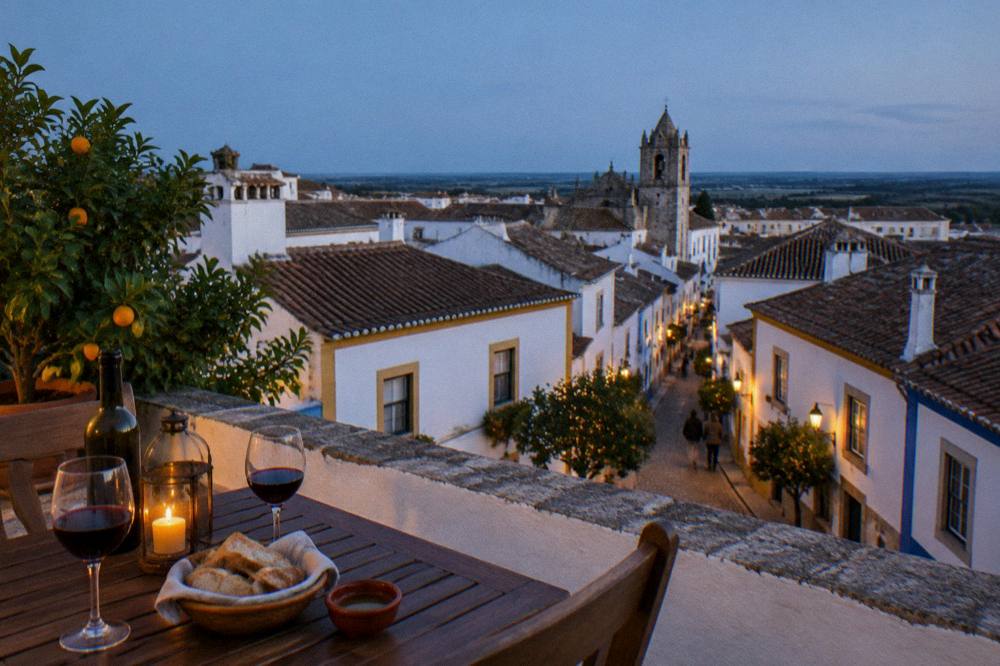
Evenings belong to the city, and they are part of what you are paying a central room for. The food side is covered in the Évora restaurants guide and the wider Évora food guide, with the Alentejo's own dishes in the Alentejo food page and its wines in the Alentejo wine guide. A small-group walk with the monuments built in, such as the Évora: Small-Group Cultural Walking Tour & Chapel of Bones, from $77.66 per person and rated 4.9 from 141 reviews, pairs well with a first evening in a central base, and a private option, the Évora Private Walking Tour with Cathedral & Chapel of Bones, from $111.42 per person and rated 5 from 106 reviews, suits anyone who wants the itinerary bent around a particular stay.
How Long Should You Stay, And How Many Days Should You Book?
Book one night if Évora is a stop on a Lisbon loop and you only need the core monuments; two nights for the walls, the museums and one evening of food; three or more if the Alentejo day trips are part of the plan, because Monsaraz, Estremoz and Vila Viçosa each eat a half-day or more. The Évora Ticket's own durations, 8 EUR for one day, 10 EUR for two and 12 EUR for three, are a decent proxy for how much paid sighting the city supports.
The one-night version works, but it is tight: the Sé, the Capela dos Ossos and the Museu de Évora have real hours, the museum closes on Mondays, and the bone chapel's summer hours run 9:00 to 18:30, winter 9:00 to 17:00, closed on 1 January, Easter Sunday, the afternoon of 24 December and 25 December. Two nights let you see the city slowly, which is the way it rewards being seen; the "Vagar" concept of the 2027 culture programme, roughly a culture of slow travelling, is not a marketing invention but a description of how the place already works.
For trip-shaping, the Évora tours overview collects the guided options, and the comparison pages, Évora versus Sintra and the best day trips from Lisbon, help decide whether Évora is the base or the excursion.
Common Questions About Hotels In Évora
Is it better to stay inside or outside the Évora walls?
Inside the walls if the trip is Évora's monuments and food, because everything from the Praça do Giraldo to the Capela dos Ossos is one walk. Outside the walls if you are driving day trips to Monsaraz, Estremoz or Vila Viçosa, because parking and access are easier there.
Does Évora have a tourist tax?
Yes, a municipal tourist tax applies to hotel stays in Évora. The amount is not stated on this page; check your hotel when booking so the figure does not surprise you at checkout.
Is Évora too hot for a summer hotel stay?
The 1991 to 2020 averages for the Évora station put the July mean maximum at 33.3 C and August at 33.5 C, with 31.9 days a year at 35 C or more. Book a room with confirmed air conditioning for June through September, and prefer April, May, September or October if heat is a concern.
Can you visit Évora without a car?
Yes. CP's Intercidades timetable valid since 6 September 2026 lists six through trains from Lisboa Oriente, from 13.90 EUR second class, and the historic centre itself is entirely walkable. Day trips beyond the city generally want a car or a guided tour.
How many nights are enough in Évora?
Two nights cover the walled city, the main monuments and a good evening of Alentejo food. Add a third and fourth for the day trips: Arraiolos is about 20 km away, Monsaraz about 40 to 45 km, Estremoz about 45 km and Vila Viçosa about 60 km.
Are hotels in Évora expensive?
This page prints no hotel rates, because they change constantly and the editorial desk only publishes figures it can verify. The verifiable costs of an Évora stay are low: 20.00 EUR covers the Sé, the Capela dos Ossos and the Museu de Évora at adult rates, and the train from Lisbon is 13.90 EUR second class.
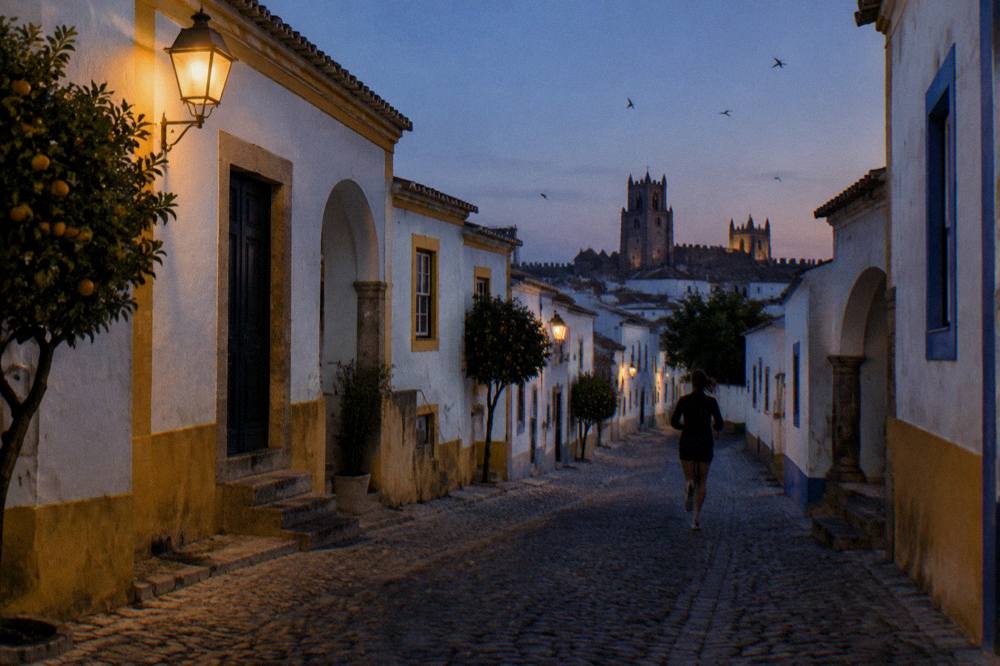
The last word on choosing: pick the area that matches the trip, confirm air conditioning if the month is a hot one, ask about parking before you drive in, and let the Évora Travel Guide walking pages tell you which streets deserve your mornings. A hotel in Évora is mostly a bed inside a monument; the choice that matters is which monument you want to live in.