Evening And Night In Évora
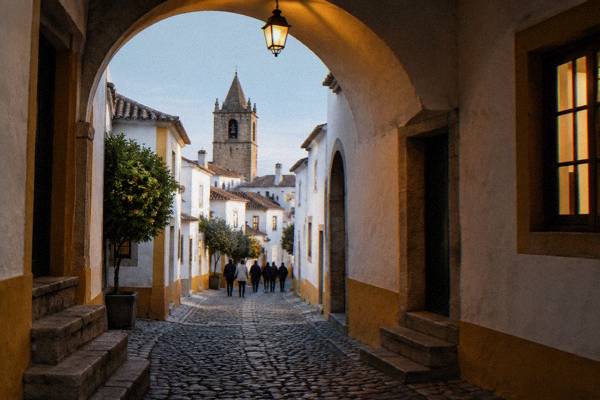
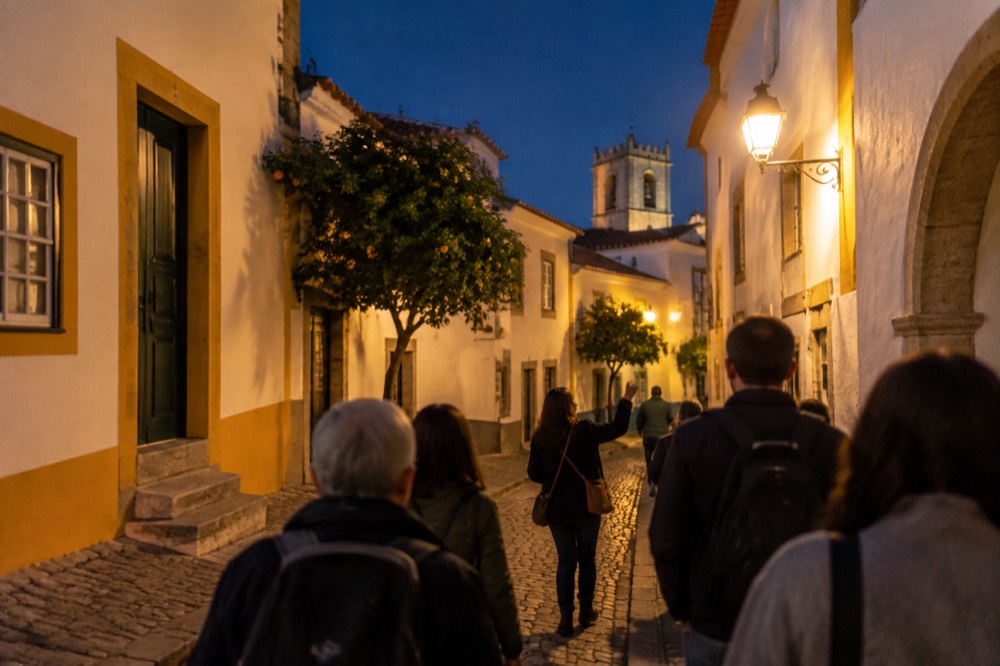
Évora, the inland capital of the Alentejo, changes character once the day-trip coaches pull out: the monuments shut by early evening, but the lanes, squares and taverns of the historic centre stay warm and busy late into the night.
Short answer
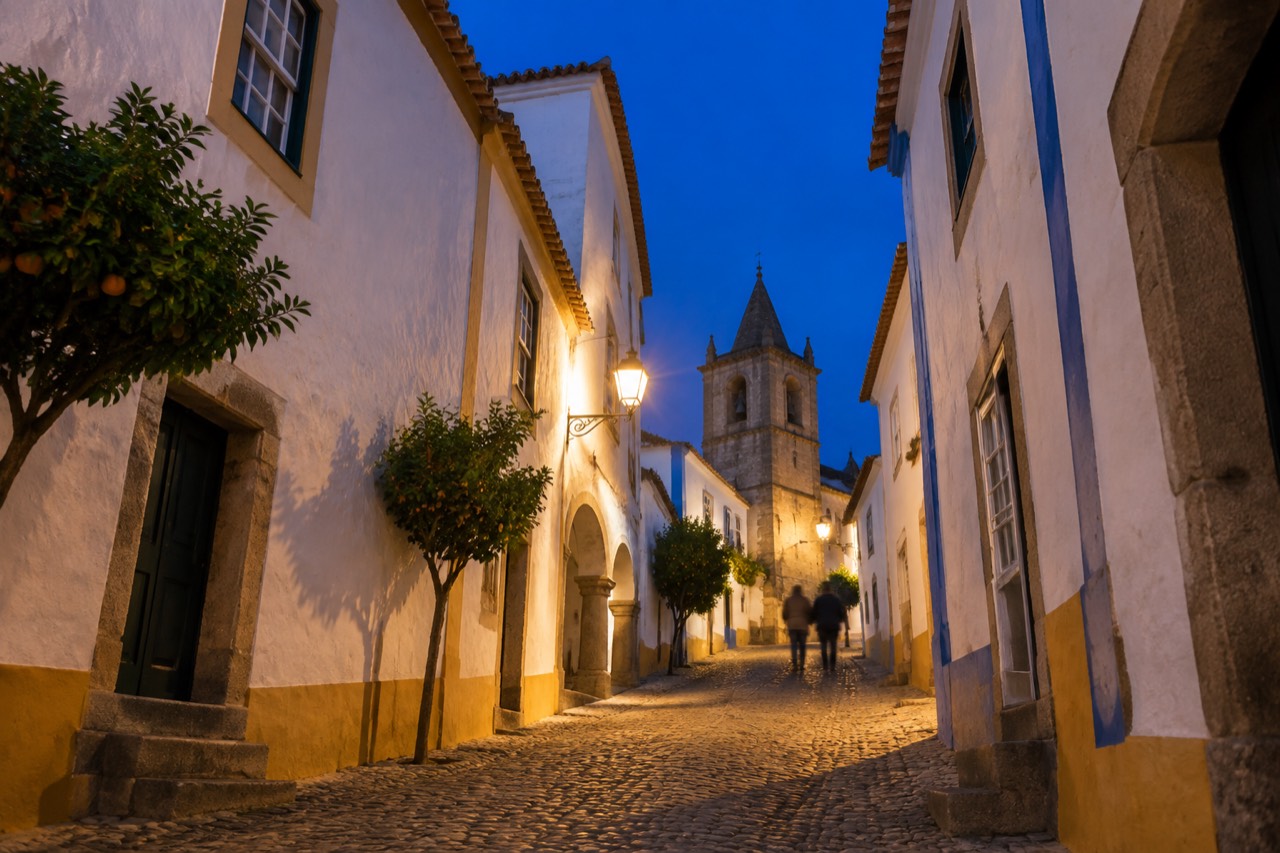
Évora at night is a walking city: the Capela dos Ossos closes at 18:30 in summer and 17:00 in winter, the Sé at 17:00, so the evening belongs to the streets, Praça do Giraldo, and the Alentejo food and wine tables rather than to ticketed sights. July and August nights average a low of 15.6 and 16.0 C, warm enough to sit outside, and the compact UNESCO-listed centre is walkable end to end.
Évora, the capital of the Alentejo region of Portugal, is a city that saves a large part of its character for after sunset. The day belongs to the ticketed monuments, the Sé, the Capela dos Ossos, the Museu de Évora, and to the coaches that bring visitors in from Lisbon about 130 km away. The evening belongs to the people who stay. Once the day crowds thin, the UNESCO-listed historic centre, inscribed in 1986 under criteria (ii) and (iv), becomes a quiet grid of lamplit lanes where dinner starts late, conversation runs long, and the summer heat finally lets go. IPMA's 1991 to 2020 normals for the Évora station show why: July and August, with mean maximums of 33.3 C and 33.5 C, push daytime life indoors, and the evening, with mean minimums of 15.6 C and 16.0 C, pulls it back out onto the street.
The Évora Travel Guide itinerary library covers the daytime half, from One Day In Évora to Two Days In Évora; this is the hours between the last ticket and the last train.
What Is Évora Like At Night?
Évora at night is a small, walkable, lamplit city of about 53,000 people whose historic centre empties of day visitors and fills instead with locals eating late. The monuments close early, by 18:30 at the latest in summer, so the night is spent in squares, lanes and at the table rather than inside sights. Summer evenings are genuinely warm, with 1991 to 2020 average minimums of 15.6 C in July and 16.0 C in August.
That last point matters more than visitors expect. Évora is inland Alentejo, a plain at 247.6 m altitude, and the Atlantic is roughly 90 km away, so there is no sea breeze to cool the streets quickly. The IPMA normals for station 558 record 31.9 days a year reaching 35 C or more, with a record of 45.4 C on 4 August 2018. Daytime heat in the high summer does not dissolve at dusk; it eases. The practical consequence is that the evening paseo, the slow loop through the historic centre, starts later than in coastal Portuguese cities and dinner tables stay full well past what a northern European visitor might expect.
The city's size is the other defining fact. Everything that matters after dark sits inside or just outside the medieval walls. The distance from Praça do Giraldo to the Templo Romano is a few minutes' walk, and the whole UNESCO perimeter is crossed in well under an hour at a strolling pace. Nobody needs a car at night, and the lanes are too narrow and too old for one to help.
Which Évora Monuments Stay Open In The Evening?
Almost none. The latest ticketed sight in Évora is the Capela dos Ossos museum complex in the Igreja de São Francisco, open to 18:30 in summer legal time and 17:00 in winter, daily except 1 January, Easter Sunday, 24 December afternoon and 25 December. The Sé closes at 17:00 year round. The Museu de Évora closes at 17:30 with a midday break, and is shut on Mondays. An evening visit to Évora is therefore a streets-and-squares visit, not a monuments visit.
The full picture, from the operators' own pages:
| Sight | Last entry window | Closed |
|---|---|---|
| Capela dos Ossos / Igreja de São Francisco museum areas | 9:00-18:30 summer, 9:00-17:00 winter | 1 Jan, Easter Sunday, 24 Dec afternoon, 25 Dec |
| Sé de Évora complete visit (cathedral, cloister, roof, museum) | 9:00-17:00, museum last admission 30 min before closing | 24 Dec afternoon, 25 Dec, 1 Jan |
| Museu de Évora | 9:30-13:00 and 14:00-17:30, Tue-Sun | Mondays, 1 Jan, Easter Sunday, 1 May, 29 June, 25 Dec |
| Templo Romano | Open-air precinct, no ticket or hours listed | Nothing published |
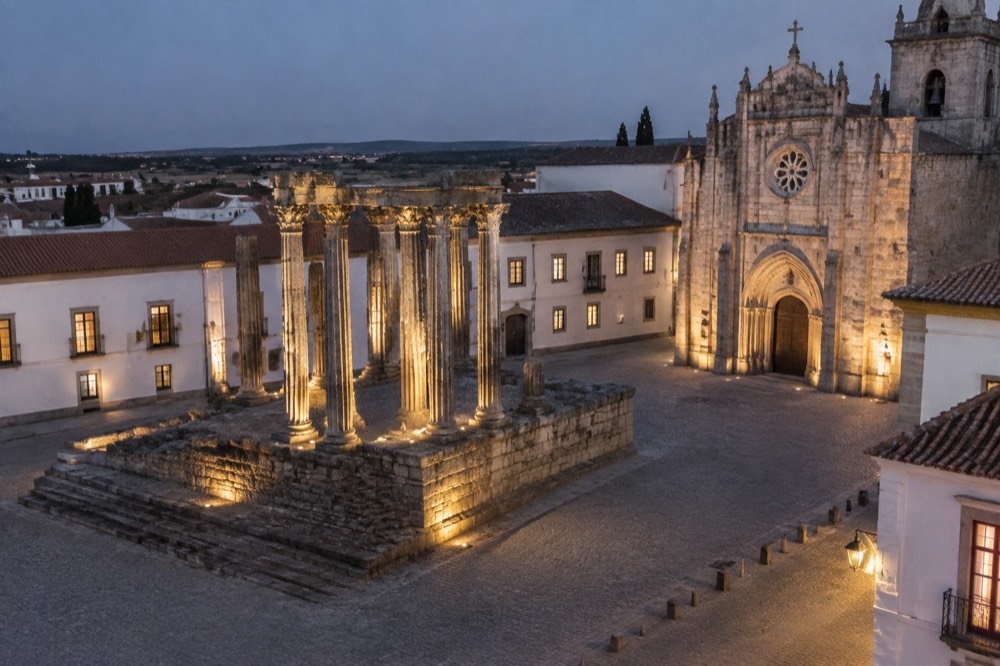
The one genuine evening sight opportunity is architectural. The Templo Romano, popularly called the Temple of Diana, stands free in the open air; the municipal page says it was probably dedicated to the imperial cult rather than to the goddess, measures 25 x 15 m, was reused for centuries as a butcher's shop and had its walls freed in 1870. It cannot close. Lit at night and framed by the cathedral and the Convento dos Lóios, it is the single most photographed evening view in the city, and it costs nothing. The Roman Temple Of Évora page covers its history in full.
Ticket prices, for anyone fitting monuments in before closing:
| Ticket | Price | Notes |
|---|---|---|
| Sé complete visit | 5.00 EUR | Cathedral, cloister, roof terrace, museum; children to 12 free |
| Capela dos Ossos museum ticket, adult | 7.00 EUR | Youth to 25 and seniors over 65 at 5.00 EUR; family 15.00 EUR |
| Museu de Évora, adult | 8 EUR | Youth 13-24, seniors and family ticket 50% off; free to 12 |
| Évora Ticket | 8 EUR one day, 10 EUR two days, 12 EUR three days | Does not include the Sé, the Capela dos Ossos or the Museu de Évora |
A guided walk is the practical way to give the early evening a spine, and the flexible historic-centre walking tour runs 3 hours from $13.51 per person, rated 4.8 from 105 reviews, on the operator's live listing. Check availability. It pairs naturally with the Chapel Of Bones and the Évora Cathedral pages if you want the daytime detail behind the evening streets.
What Should An Evening Walking Route Through Évora Look Like?
A good evening route in Évora runs a rough loop of about an hour: start on Praça do Giraldo while the café tables are still full, walk down to the Templo Romano and the Sé for the floodlit stone, drop along Rua 5 de Outubro toward the Igreja de São Francisco, then loop back through the small squares behind the Praça. Nothing on this loop needs a ticket, every stretch is inside the walls, and the whole circuit is walkable at a slow pace with stops.
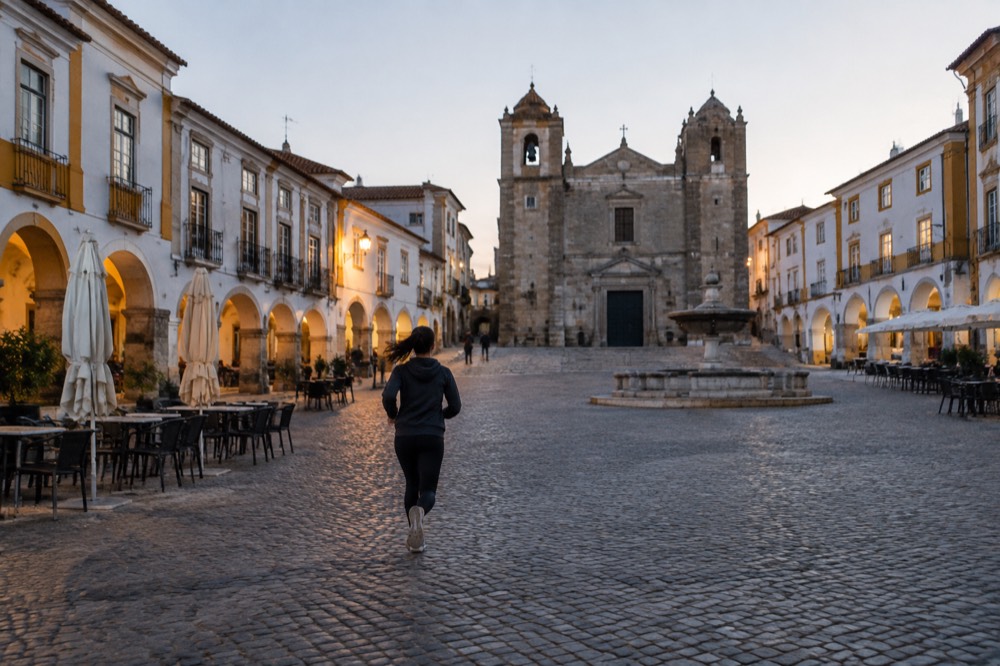
Begin at Giraldo Square, the city's living room. The arcaded square is where the evening actually starts in Évora: it is a public space with no hours and no price, and the municipal tourist office sits at number 73 if a question needs answering before the day ends. From there, the route east toward the Sé is short. The cathedral's mass of granite and the Roman temple columns beside it are the night image of Évora, and the terrace of the nearby Jardim Público, whose own hours are not published, is worth a look for the view over the Aqueduto da Água de Prata's arches marching into the dark.
The middle stretch of the evening belongs to the lanes. Rua da Moeda Rua and the streets off Praça do Giraldo hold most of the evening trade, and the Jewish quarter streets on the western side of the centre are quieter, older-feeling and, in the last light, the most atmospheric part of the walk. The walls themselves can be followed for long stretches; the Roman Walls And Medieval Wall page maps them, and at night the gates become landmarks for finding your way home.
Two guided formats suit this loop well. The Évora: Tales and Legends Guided Walking Tour runs 2.5 hours from $52.90 per person, rated 4.8 from 40 reviews, and its storytelling format is built for the hours after the museums shut. The Medieval Tour of Évora on a Sidecar & Wine Tasting, 3 hours from $61.90 per person and rated 4.9 from 16 reviews, covers the same ground with an engine and ends at a tasting table.
For anyone arriving from the capital with only the evening in hand, the Évora Day Trip From Lisbon itinerary explains the timing trade-offs, and Things To Do In Évora lists the full daytime set this route skips.
What Does Evening Food And Wine Look Like In Évora?
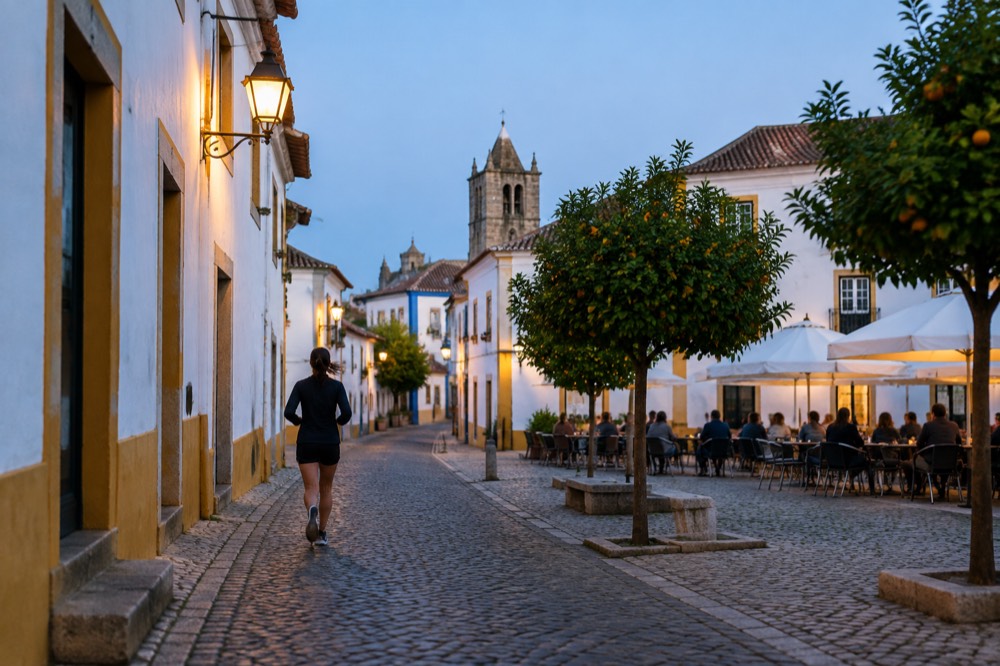
Evening food in Évora is Alentejo food eaten late: bread-based dishes, pork, sheep's cheese, Alentejo red wine and long tables, served in taverns and restaurants concentrated inside the historic centre, where dinner service runs well into the night in summer. No specific restaurant, bar or price can be honestly recommended here, so the reliable move is to eat inside the walls, order regional dishes, and let the evening stretch.
The Alentejo table has a shape that suits the night. The region's cooking leans on bread, olive oil, pork and slow methods, with Alentejo wine, one of Portugal's most distinctive red styles, poured freely. The Évora Food Guide and the Alentejo Dishes To Try pages carry the detail, and the Évora Wine Tasting page covers the glass itself. What the evening adds is the setting: tables spill into lanes that hold the day's heat, and the pace is unhurried by design.
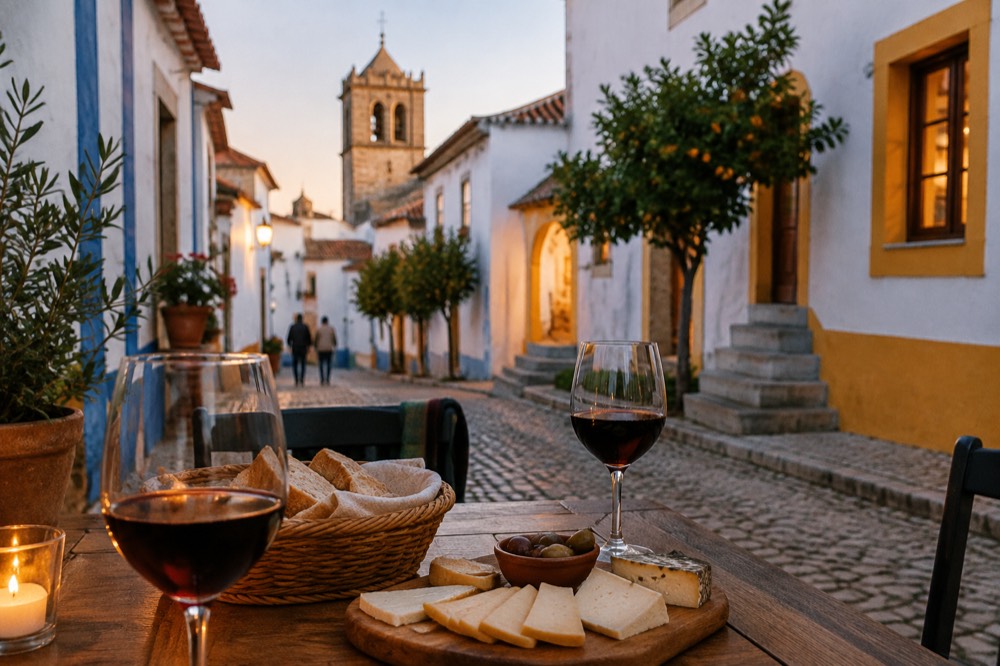
The guided version of this is the Évora: Evening Food & Wine Crawl, a 3-hour walk from $83.28 per person, rated 4.6 from 19 reviews on the operator's listing. It exists precisely because the night food culture is hard to read from outside: which lane, which door, which hour. A visitor planning independently should simply reserve ahead in the high months of July and August, when the whole city eats outdoors and tables are scarce.
For the wine half of the evening, the regional context is on the Alentejo Wine page, and the full daytime version of the idea is the Évora Wine And Food Day itinerary. A municipal tourist tax applies to stays in the city; check your hotel for the current arrangement when you check in.
Is Évora Safe To Walk Around At Night?
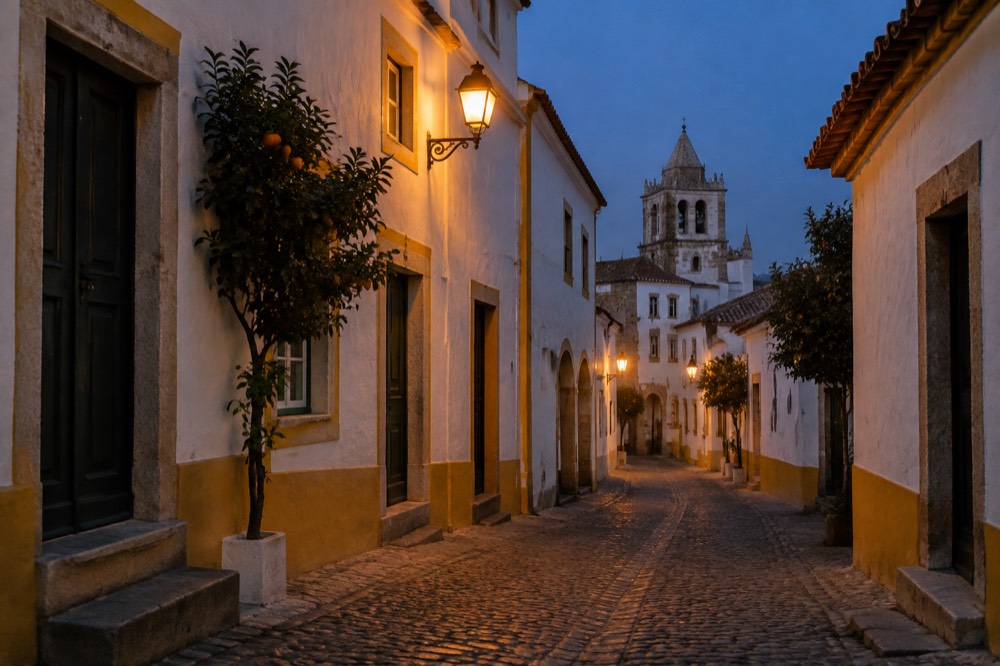
Évora is a small, low-crime regional capital where the historic centre at night is generally considered safe to walk: the streets are lit, the evening pedestrian traffic is steady, and the city's scale means short distances between busy areas. Normal city caution applies, as anywhere: keep valuables out of easy reach and know your route back to your accommodation. The Is Évora Safe page carries the fuller assessment.
The physical facts support the calm. The centre is compact, so no night walk in Évora is long or isolated; the main squares stay populated until late in the summer season; and the city functions as the district capital, with a resident population of about 53,000 keeping ordinary evening life on the streets. The lanes are narrow, whitewashed and, on the whole, lit. The main practical hazard on a summer night is the residual heat: the 1991 to 2020 normals put the mean July minimum at 15.6 C after days that average a 33.3 C maximum, so carry water on the walk to dinner.
One caution the climate table does support: winter evenings are genuinely cold for Portugal. The mean January minimum is 4.5 C and the record low is -4.2 C, recorded on 4 December 1998 and 23 January 2000. A December or January night walk in Évora wants a real coat, not a layer thrown over a summer shirt. The seasonal breakdown:
| Month | 1991-2020 mean minimum (C) | 1991-2020 mean maximum (C) | Days with 1 mm+ rain |
|---|---|---|---|
| January | 4.5 | 14.1 | 8.6 |
| April | 8.5 | 20.7 | 8.0 |
| July | 15.6 | 33.3 | 0.6 |
| October | 12.3 | 24.1 | 7.7 |
The evening hours are also when the free walking tours of the city cluster. GuruWalk lists several: The Essential Free Tour of Évora, rated 4.93 from 774 reviews over 2 hours, Évora through history and how it shaped the city, rated 4.88 from 74 reviews, also 2 hours, and the History & Heritage walk, rated 5 from 9 reviews. Each is led by its own guru on the GuruWalk platform, free to book and paid by tip at the end, which makes them an easy, low-commitment way to anchor an evening's wandering. The Évora Walking Tour page compares all the formats.
Can You See Stars Near Évora At Night?
Yes, and this is one of the Alentejo's quiet strengths: Évora sits on an inland plain with small towns and little heavy industry around it, so the night sky outside the city is dark by Portuguese standards. The Alqueva reservoir area to the southeast is the region's best-known stargazing destination, about 40 to 45 km from Monsaraz and reachable as an evening or overnight trip.
Specific observatory hours, boat prices and designation details are not carried on this page, so check the operator's notice before you go.
The honest framing is that stargazing from inside Évora's own walls is mediocre: a small city still emits light. The gain comes with distance. The Alqueva page in the Best Day Trips From Évora set explains the area, and the Alqueva Dark Sky Stargazing guide covers what the experience involves. Summer is the natural season, since IPMA's normals show July averaging just 0.6 days with a millimetre or more of rain, though the same summer nights are the warm ones, with a 15.6 C mean minimum in July.
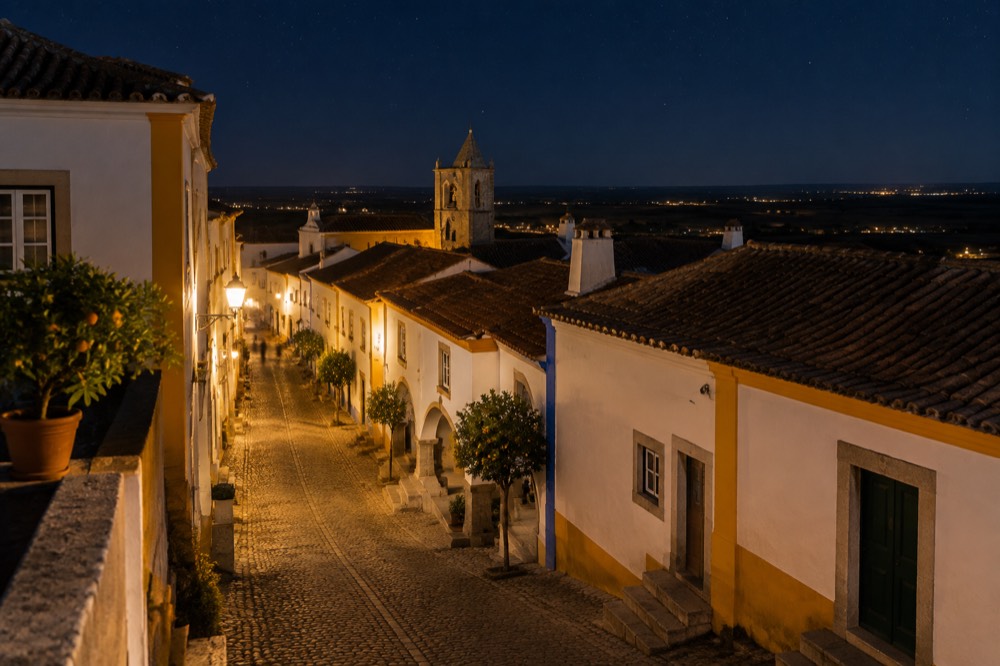
For a night anchored in Évora itself, the sky over the Templo Romano and the roofline of the Sé is the consolation prize, and a good one: the terrace views described on the Évora Rooftop Views page are mostly daytime experiences, but the silhouette of the city against a clear evening sky is free and always open.
How Do You Get Back To Lisbon After An Evening In Évora?
Plan the return before dinner, not after it. CP's Intercidades timetable, valid since 6 September 2026, lists six through trains between Lisboa Oriente and Évora, with arrivals into Évora from 08:47 to 20:46 and a journey of about 1 hour 40 to 1 hour 45, at 13.90 EUR second class or 18.50 EUR first class. The departure times from Évora back to Lisbon are on the same CP document; check the PDF for the last service and time the evening around it.
The six daily through departures from Lisboa Oriente run at 07:02, 09:02, 09:58, 13:35, 17:02 and 19:02, calling at Entrecampos, Sete Rios, Pragal, Pinhal Novo, Vendas Novas and Casa Branca. That last arrival into Évora at 20:46 is the fact that shapes late-evening planning in both directions: it is a realistic evening arrival if you are coming to Évora for the night, and a reminder that the railway's own evening is finite. The Lisbon To Évora guide and the Lisbon To Évora By Train page carry the full breakdown, including the fare table.
Coach services also connect Lisbon and Évora, but no fare or journey time can be stated for them; check the operator's own site for the current schedule. The Lisbon To Évora By Bus page explains the options in general terms. Anyone whose evening in Évora is part of a wider loop should look at the Three Days In Évora And Alentejo or Alentejo Road Trip itineraries, which build overnight stops into the region rather than racing back to the capital.
For visitors who would rather not run against the railway clock at all, the private walking formats end where you choose. The Évora Private Walking Tour with Cathedral & Chapel of Bones, 2.5 hours from $113.53 per person and rated 5 from 256 reviews, is the most-booked premium option on the operator's listing.
Which Guided Evening Options Are Worth Booking In Évora?
The strongest evening formats in Évora are the flexible historic-centre walk at $13.51 per person for 3 hours, the tales-and-legends walk at $52.90 for 2.5 hours, the sidecar tour with wine tasting at $61.90 for 3 hours, and the evening food and wine crawl at $83.28 for 3 hours. All prices are per person from the operators' live listings, where current ratings and availability sit.
The comparison, drawn from the operators' own listings:
| Tour | Length | From (per person) | Rating |
|---|---|---|---|
| Évora: Personal & Flexible Walking Tour in Historic Center | 3 hours | $13.51 | 4.8 from 105 reviews |
| Évora: Tales and Legends Guided Walking Tour | 2.5 hours | $52.90 | 4.8 from 40 reviews |
| Medieval Tour of Évora on a Sidecar & Wine Tasting | 3 hours | $61.90 | 4.9 from 16 reviews |
| Évora: Evening Food & Wine Crawl | 3 hours | $83.28 | 4.6 from 19 reviews |
| Évora Private Walking Tour with Cathedral & Chapel of Bones | 2.5 hours | $113.53 | 5 from 256 reviews |
The pattern is clear: Évora's evening products are walking products, because the city's night is a walking night. The food crawl is the only one built around the table, and the sidecar tour is the only one with wheels. Everything else is a guide, a lamplit lane and two hours of stories.
Common Questions About Évora At Night
Is Évora good at night?
Yes, if you want the night to be about streets, squares and food rather than monuments. The last ticketed sight, the Capela dos Ossos, closes at 18:30 in summer and 17:00 in winter, after which the historic centre belongs to walkers and diners. Summer evenings are warm, averaging a 15.6 C minimum in July.
Is it safe to walk in Évora at night?
Évora is a small regional capital of about 53,000 people and its historic centre at night is generally considered safe, with lit lanes and steady evening foot traffic. Ordinary city caution applies. In winter, note that the mean January minimum is 4.5 C.
What time do monuments close in Évora?
The Sé closes at 17:00, the Capela dos Ossos museum areas at 18:30 in summer legal time and 17:00 in winter, and the Museu de Évora at 17:30 with a midday break, closed Mondays. The Templo Romano is an open-air monument with no ticket and no closing time.
Is there nightlife in Évora?
Évora's evening culture is taverns, restaurants and squares rather than clubs, and this page names no specific venue or price. The reliable approach is to eat inside the historic centre, where dinner service runs late in summer, or join the evening food and wine crawl, a 3-hour guided format from $83.28 per person.
Can you see stars near Évora?
Yes. The Alentejo plain around Évora is dark by Portuguese standards, and the Alqueva reservoir area to the southeast is the region's best-known stargazing destination. Check the operator's notice for observatory hours and prices before you go.
What is the last train from Évora to Lisbon?
CP's timetable valid since 6 September 2026 lists six through trains each way between Lisboa Oriente and Évora, with the last arrival into Évora at 20:46 and a journey of about 1 hour 40 to 1 hour 45. Check the CP document for the last departure time from Évora before planning your evening.
The evening in Évora is the part of the day the city keeps for itself, and it rewards anyone who slows down enough to notice: a loop of the walls, a table inside them, and the last train, or not, depending on how long the wine lasts.