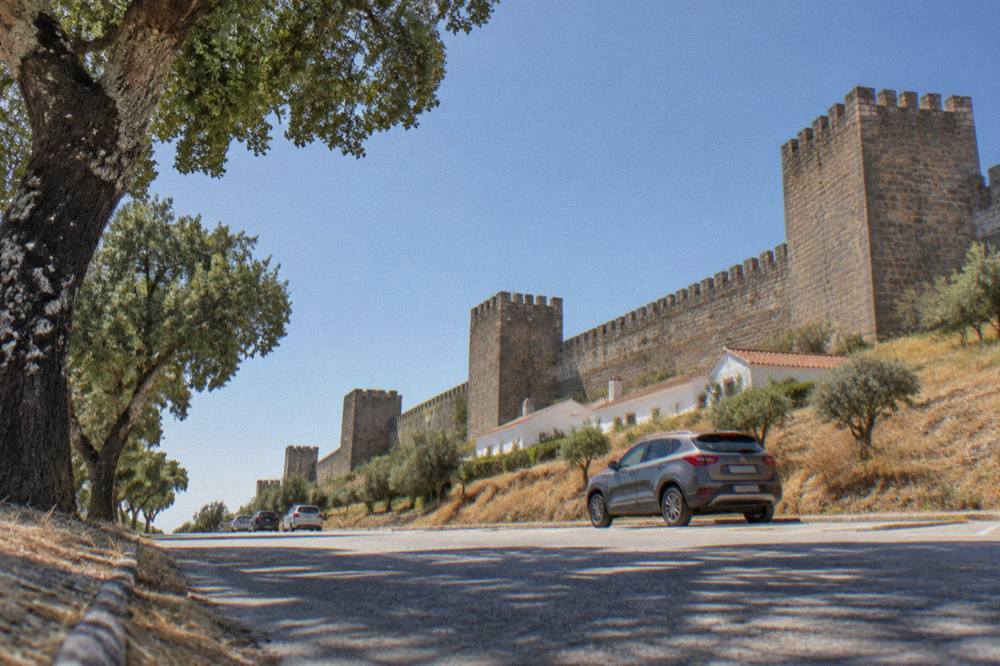
Faro To Évora
Évora, the inland capital of the Alentejo, sits about 130 km from Lisbon and has no sea anywhere near it, so the trip from Faro is a cross-country journey through the south of Portugal rather than a coastal hop.
Short answer
There is no direct long-distance link between Faro and Évora. The usual plan is to travel from Faro to Lisbon first, then take a CP Intercidades train from Lisboa Oriente to Évora, a leg the current CP timetable covers with six through trains a day at 13.90 EUR in second class.
Évora is the capital of the Alentejo, an inland city on the southern plain of Portugal, roughly 130 km east of Lisbon and a world away from the beaches of the Algarve. Travelling from Faro means crossing the whole width of the south of the country, and that crossing shapes the whole trip: there is no direct long-distance train or coach between the two cities, so every plan runs through Lisbon, or through a chain of smaller Alentejo towns on the road north.
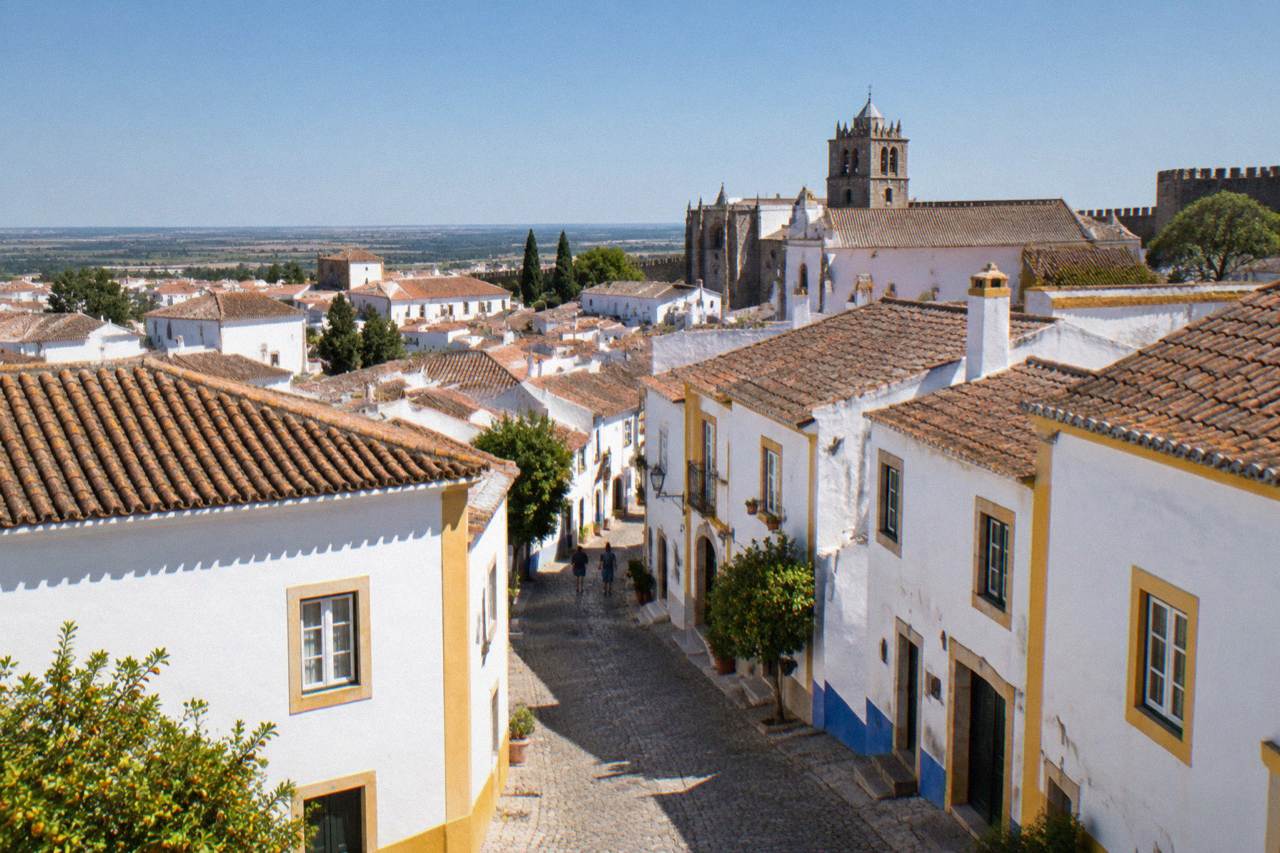
The reward at the end is considerable. The Historic Centre of Évora has been on the UNESCO World Heritage list since 1986, inscribed under criteria (ii) and (iv), and UNESCO's criterion (iv) calls it the finest example of a city of the golden age of Portugal, preserved because Évora was largely spared the destruction the 1755 Lisbon earthquake visited on the capital. Roman temples, a medieval cathedral, a bone chapel and a university all stand inside walls you can walk around in an afternoon. The Évora Travel Guide editorial desk has assembled the verified figures below so the journey can be planned with real numbers rather than guesses.
How Do You Get From Faro To Évora, Portugal?
The journey from Faro to Évora is a two-leg trip for almost everyone: first get yourself from the Algarve to Lisbon, Portugal's main transport hub, then take a CP Intercidades train from Lisboa Oriente station to Évora, a leg the timetable valid since 6 September 2026 serves with six through trains a day. There is no direct train or coach between Faro and Évora, and driving means crossing the Alentejo on national roads and motorways. Lisbon is the practical gateway, and the second leg is short.
The reason is geography and rail history. Évora's rail line runs north to Lisbon, not south to the Algarve, so the two cities sit on different branches of the network with no through connection. Anyone starting in Faro therefore faces a choice: route through Lisbon and arrive by train, or drive and treat the Alentejo itself as part of the holiday.
For train travellers, the practical shape of the day is simple. Travel from Faro to Lisbon in the morning, allow time to cross the city to Lisboa Oriente, and take an afternoon Intercidades train to Évora. The CP timetable valid since 6 September 2026 lists six through departures from Lisboa Oriente, and the fare from Lisboa Oriente to Évora is 13.90 EUR in second class or 18.50 EUR in first class. What the Faro-to-Lisbon leg costs and how long it takes is a matter for the operators on that route: check CP's own pages and the coach operators before booking, because those figures change with the season and the timetable.
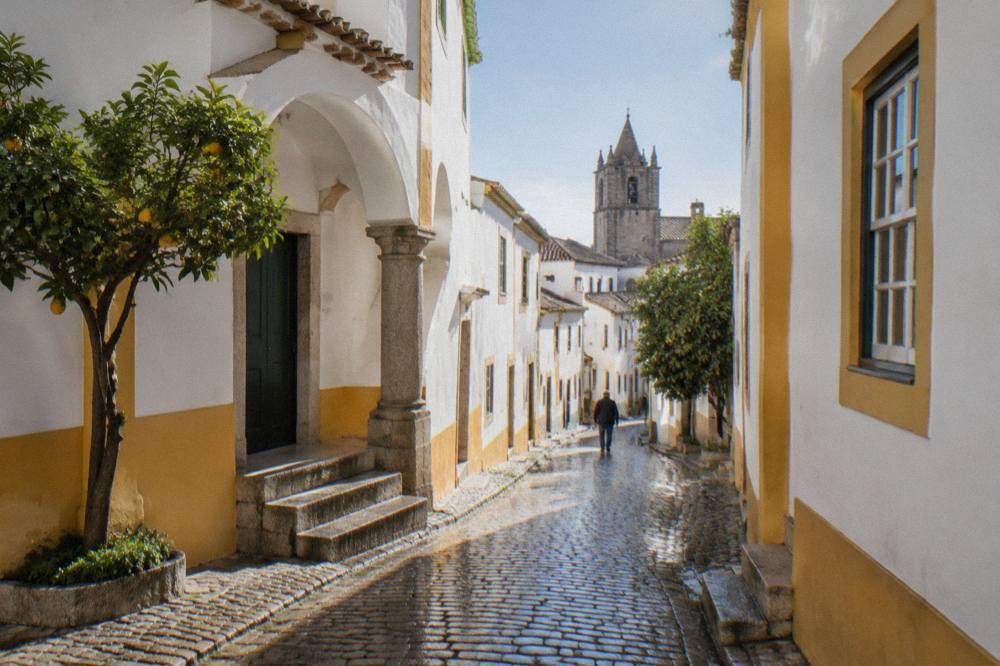
Drivers have a freer hand. The route runs north out of the Algarve and into the Alentejo, and the region between Faro and Évora is precisely the part of Portugal most visitors rush through: cork forests, wheat plains, whitewashed hill towns and very few people. If you are weighing car against train generally, the Lisbon to Évora by car guide covers the driving side of reaching the city, and much of it applies to the southern approach too.
Why Lisbon Is The Usual Gateway From The Algarve To Évora
Lisbon works as the gateway because every Faro-to-Évora plan already passes through or near it: the Algarve's rail and coach spine runs to Lisbon, and Évora's only fast rail connection starts at Lisboa Oriente. Six through trains a day make the second leg, at 13.90 EUR second class, and the two legs join at the same station complex you arrive at from the south. The alternative is a slow chain of regional connections through the Alentejo.
The gateway logic is worth understanding before booking anything. Faro's long-distance links, by rail and by coach, point overwhelmingly at Lisbon. Évora's fast link, the Intercidades service, also starts in Lisbon, at Oriente. That means the two legs of the trip meet at a hub rather than in the middle of nowhere, and the transfer is a station change rather than a city crossing, provided your first leg terminates at Oriente or the adjacent metro.
The timetable valid since 6 September 2026 gives these departures from Lisboa Oriente, all through trains with no change needed at Casa Branca:
| Depart Lisboa Oriente | Arrive Évora | Class | Fare |
|---|---|---|---|
| 07:02 | 08:47 | 2nd | 13.90 EUR |
| 09:02 | 10:45 | 2nd | 13.90 EUR |
| 09:58 | 11:40 | 2nd | 13.90 EUR |
| 13:35 | 15:13 | 2nd | 13.90 EUR |
| 17:02 | 18:41 | 2nd | 13.90 EUR |
| 19:02 | 20:46 | 2nd | 13.90 EUR |
First class on the same leg is 18.50 EUR. Each journey takes about 1 hour 40 to 1 hour 45, calling at Entrecampos, Sete Rios, Pragal, Pinhal Novo, Vendas Novas and Casa Branca on the way. The 13:35 departure is the natural friend of a morning arrival from Faro: it puts you in Évora by mid-afternoon with the whole evening ahead of you.
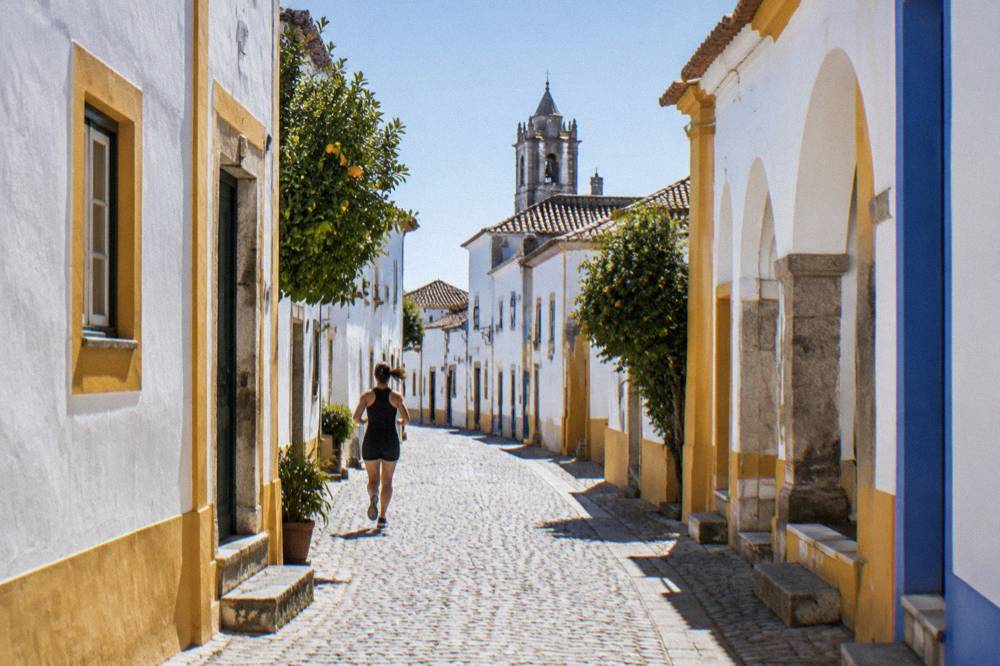
A note on timing the transfer. Check the CP page for the current weekday remarks before locking a tight connection, because the six-train pattern is the through service, not a promise about every calendar day. The Lisbon to Évora by train guide goes deeper on tickets, seating and what the train is like, and the Lisbon to Évora overview compares the train with the coach and the car.
Once you are committed to the rail plan, the guided options below fit the arrival day well, because they start in Évora itself and need no onward travel.
What The Alentejo Leg Of The Journey Looks Like
The final stretch into Évora runs through the Central Alentejo, a flat, sparsely populated plain of cork oaks, wheat fields and olive groves, and the city itself rises as a compact walled hill town of roughly 53,000 people in its municipality. The train calls at Vendas Novas and Casa Branca before Évora, small Alentejo towns that give the journey its character. Arriving overland, the landscape changes long before the station does.
The Alentejo is the emotional opposite of the Algarve, and the journey makes the contrast physical. The Algarve is about the coast; the Alentejo is about the interior, and Évora is about as interior as Portugal gets, a city of the plain where the summer heat is real. IPMA's 1991 to 2020 normals for the Évora station show a July mean maximum of 33.3 C and an August mean of 33.5 C, with 31.9 days a year reaching 35 C or more and a station record of 45.4 C set on 4 August 2018. The sea that moderates Faro's summers is roughly 90 km away and has no influence here.
That has planning consequences. A summer crossing from the Algarve should land you in Évora late afternoon rather than at midday, and the 17:02 or 19:02 departures from Oriente do exactly that. Spring and autumn are the gentler windows: the same normals show October mean maxima of 24.1 C and 7.7 days with a millimetre or more of rain, against November's 8.8. The Évora weather and best time to visit Évora guides carry the full monthly picture.
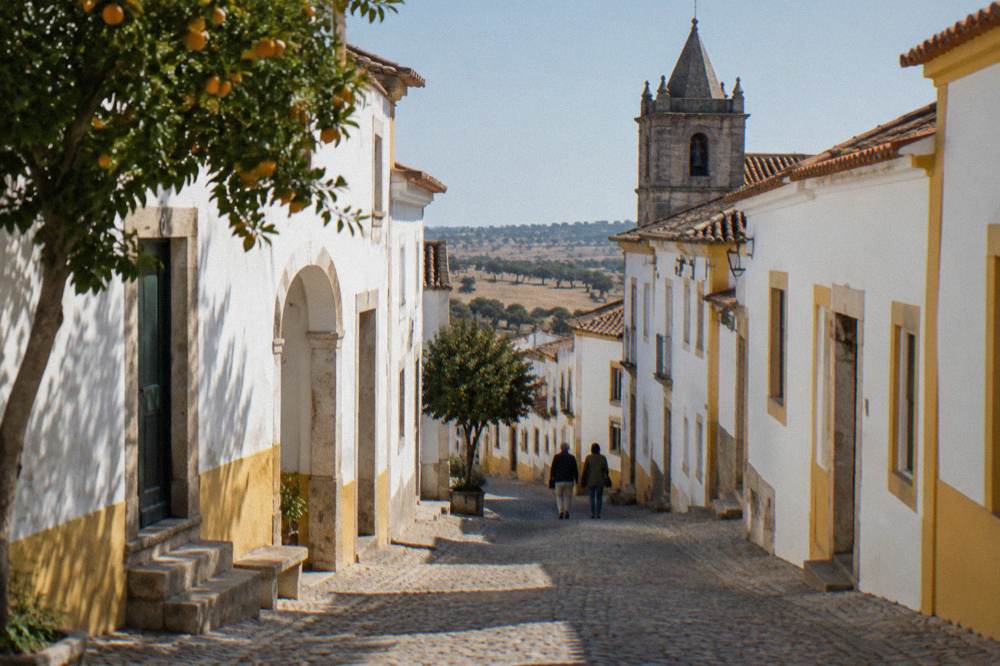
The landscape is also the reason the region has the products it has. Cork bark is harvested from those oak forests, and the Alentejo produces the bulk of the world's supply; the plains grow the wheat and graze the pigs that define Alentejo cooking. If the journey is starting to sound like part of the destination rather than a delay, that instinct is correct, and the Alentejo travel guide expands on the whole region.
Where To Stop Between Faro And Évora
The best stops between Faro and Évora are the Alentejo towns that sit on or near the approach roads: Beja to the south-east, Estremoz about 45 km from Évora, Vila Viçosa about 60 km, and Elvas about 80 km near the Spanish border, each a hill town of marble, castles and convents. Arraiolos, about 20 km from Évora, is famous for its hand-stitched carpets and makes an easy first or last stop.
Drivers can turn the transfer into a two-day traverse of the region, and it is hard to imagine a better one. The rounded distances from Évora are the useful anchors: Arraiolos about 20 km, Estremoz about 45 km, Vila Viçosa about 60 km, Elvas about 80 km, Marvão about 120 km at the far northern edge, and Monsaraz about 40 to 45 km to the south-east above the Alqueva lake. Beja is the natural gateway town on the southern side, the direction you come from when leaving the Algarve.
| Alentejo stop | Distance from Évora | Known for |
|---|---|---|
| Arraiolos | about 20 km | Hand-stitched wool carpets |
| Monsaraz | about 40-45 km | Walled village above the Alqueva lake |
| Estremoz | about 45 km | Marble quarries and a castle |
| Vila Viçosa | about 60 km | Ducal palace and marble |
| Elvas | about 80 km | Fortifications and border history |
| Marvão | about 120 km | Mountain-top walled village |
Train travellers get a thinner slice of this, because the rail line approaches from the north-west, not the south. The realistic plan on rails is to stop in Lisbon itself, or to make Évora the base and radiate outward on day trips once arrived. That is the better strategy anyway: Évora is the region's transport hub, and the best day trips from Évora overview and the individual town guides cover the radiating options in detail.
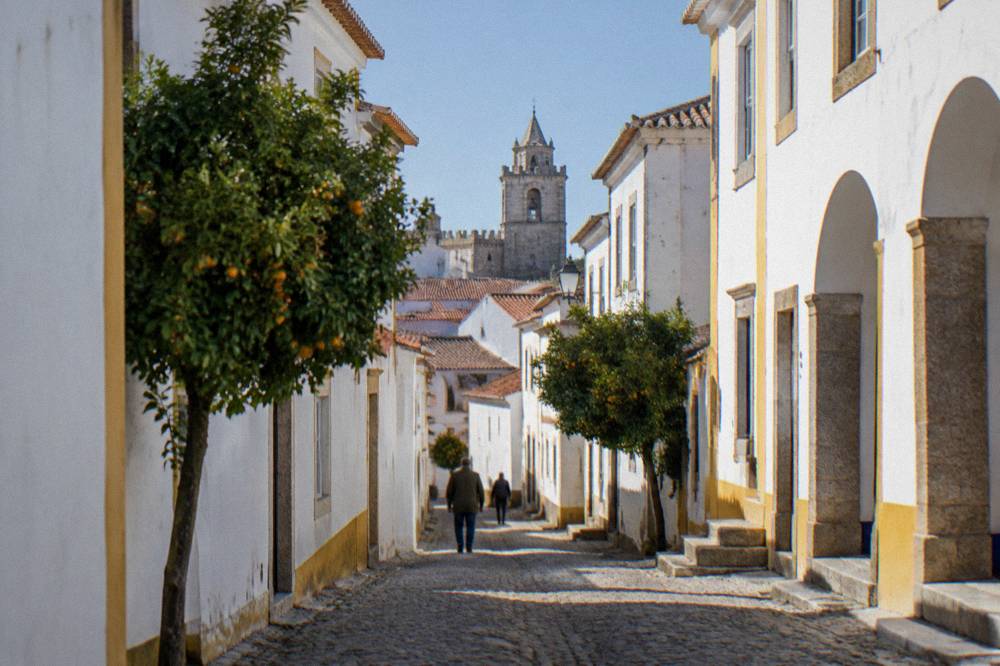
One stop deserves special mention for wine travellers. The Reguengos de Monsaraz wine route and the Cartuxa winery near Évora itself sit at the end of the journey, and the Cartuxa monastery and winery guide explains why the region's reds carry the reputation they do. The Alentejo wine page is the full picture.
How Many Days To Give Évora After The Journey
Give Évora at least one full day and ideally two: one day inside the walls for the Sé, the Capela dos Ossos, the Templo Romano and the Praça do Giraldo, and a second for the megaliths at Almendres, the wineries and a day trip to Monsaraz or Vila Viçosa. A single afternoon, arriving on the 13:35 train, covers the historic core at a walk but leaves the countryside unseen.
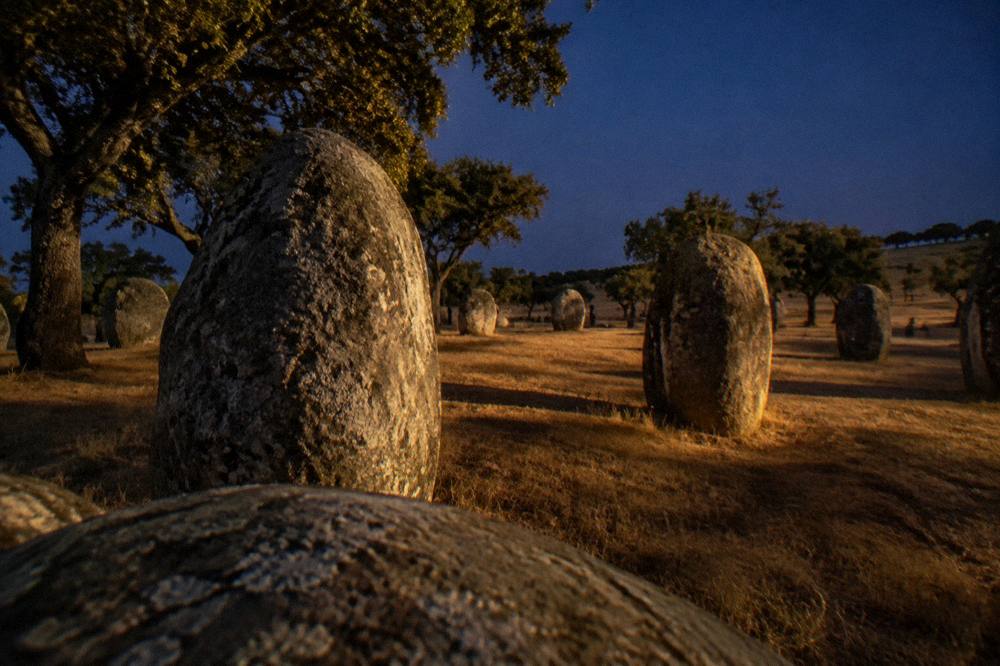
The one-day version works because Évora is compact. The one day in Évora itinerary strings the monuments together on foot, and the two days in Évora version adds the depth. What the single day cannot absorb is the megalithic landscape around the city, the cromlech at Almendres and the great dolmen of Zambujeiro, which sit out in the countryside and reward a half day of their own. The megalithic sites near Évora guide covers them.
The Almendres Interpretation Centre in the village of Guadalupe, a municipal partner, opens 10:00-18:00 in summer, defined as 1 May to 31 October, and 10:00-17:00 in winter, 1 November to 30 April. The centre's own directions say to take the national road from Évora toward Lisbon and follow the turn-off after 8 km. The cromlech stones themselves stand in the open countryside.
Where you sleep matters more here than in most cities, because the walls concentrate everything. The where to stay in Évora guide maps the neighbourhoods inside and outside the walls, and the Évora cost and budget page puts realistic daily numbers on the whole stay, from the 5.00 EUR cathedral ticket to the price of a tavern dinner.
What The Monuments Of Évora Cost To Enter
The headline figures are these: the Sé de Évora complete-visit ticket is 5.00 EUR including the cloister, roof terrace and museum, the Capela dos Ossos museum ticket at the Igreja de São Francisco is 7.00 EUR for an adult, the Museu de Évora charges 8 EUR, and the multi-site Évora Ticket costs 8 EUR for one day, 10 EUR for two and 12 EUR for three, though it does not include the Sé, the Capela dos Ossos or the Museu de Évora.
Those four prices cover almost everything a first visit touches, and the detail matters because the pass and the big three do not overlap. The Évora Ticket buys entry to the Cidade-Museu network's other sites, so anyone planning the cathedral, the bone chapel and the museum should budget them separately and treat the pass as a top-up rather than a shortcut.
| Monument | Adult ticket | Concessions | Hours |
|---|---|---|---|
| Sé de Évora (complete visit) | 5.00 EUR | Children up to 12 free | 9:00-17:00 |
| Capela dos Ossos / Igreja de São Francisco | 7.00 EUR | Youth to 25 and seniors over 65: 5.00 EUR; family 15.00 EUR | Summer 9:00-18:30, winter 9:00-17:00 |
| Museu de Évora | 8 EUR | Youth 13-24, seniors, family 50% off; free to 12 | Tue-Sun 9:30-13:00, 14:00-17:30 |
| Évora Ticket (1 day) | 8 EUR | Free to 12 | Network sites only |
| Évora Ticket (2 days) | 10 EUR | Free to 12 | Network sites only |
| Évora Ticket (3 days) | 12 EUR | Free to 12 | Network sites only |
Closing days are few but firm. The Sé closes on 24 December in the afternoon, on 25 December and on 1 January. The Igreja de São Francisco opens every day except 1 January, Easter Sunday, 24 December afternoon and 25 December. The Museu de Évora closes Mondays, plus 1 January, Easter Sunday, 1 May, 29 June and 25 December. The Convento dos Lóios currently shows no ticket price on its official page, so check the notice there before planning a visit.
The Templo Romano, the colonnade everyone photographs, stands in the open air with no ticket at all. The municipal page says it was probably dedicated to the imperial cult rather than to the goddess Diana, a name applied only since the 17th century, and that its walls were freed in 1870 after centuries of being built into other structures, including a spell as the town's butcher's shop.
When To Make The Faro To Évora Trip
The best months for the Faro to Évora trip are April, May, late September and October, when IPMA's 1991 to 2020 normals for the Évora station show mean maxima of 20.7 C in April, 25.0 C in May, 29.5 C in September and 24.1 C in October, against July and August means of 33.3 C and 33.5 C. October brings 81.5 mm of rain across about 7.7 wet days, which is still the gentler side of the year.
The numbers deserve a table, because the swing between the Algarve coast and the Alentejo plain is the single biggest surprise for travellers making this crossing:
| Month | Mean max (C) | Mean min (C) | Rain (mm) | Days 30 C+ |
|---|---|---|---|---|
| April | 20.7 | 8.5 | 62.1 | 0.3 |
| May | 25.0 | 10.9 | 46.6 | 5.5 |
| June | 30.2 | 13.8 | 10.6 | 15.1 |
| July | 33.3 | 15.6 | 2.7 | 23.7 |
| August | 33.5 | 16.0 | 6.0 | 25.0 |
| September | 29.5 | 14.6 | 33.9 | 13.9 |
| October | 24.1 | 12.3 | 81.5 | 2.9 |
All figures are the 1991 to 2020 averages for the Évora station. What the table does not carry is sunshine hours, wind or humidity, and none of those should be assumed. Winter is its own proposition: the Évora in winter guide covers it, and the station's record low of -4.2 C, recorded on 4 December 1998 and again on 23 January 2000, is a reminder that an inland plain cools properly at night.
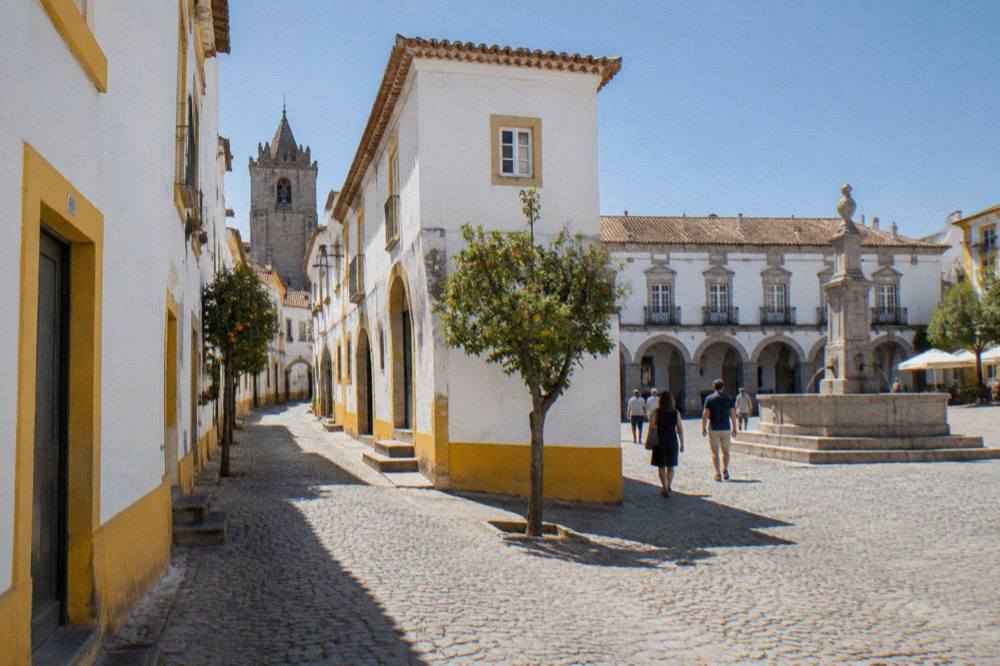
There is a cultural calendar to weigh too. The Feira de São João ran from 23 June to 5 July 2026 on the Rossio de São Brás under the theme Évora: Capital Europeia ao Sul, and the GUADIANA festival of Afro-Ibero-American literatures held its first edition from 9 to 11 October 2026 with 28 authors from nine countries, both part of the run-up to 2027. Exact dates for the 2027 editions are not yet published, so check the municipal pages before building a trip around either.
Guided Tours That Start Once You Arrive In Évora
The strongest first-day option is a private skip-the-line walking tour covering the university, the cathedral and the Capela dos Ossos with tickets arranged and a wine tasting at the end, from $91.39 per person and rated 5 from 48 reviews; a sidecar tour of the medieval city with wine, from $61.90 per person, and a classic guided walk from $53.90 round out the set. All three start in Évora, so they bolt straight onto the train arrival.
The skip-line private tour is the natural companion to a travel day, because it removes the one thing a long journey leaves you least equipped for: queueing at three box offices in the late-afternoon heat. The tour runs about 3 hours, and its rating sits at a perfect 5 from 48 reviews on the operator's live listing.
| Tour | Length | From (USD) | Rating |
|---|---|---|---|
| Private skip-line monuments and wine | 3 hours | $91.39 | 5 from 48 reviews |
| Small-group cultural walk with Capela dos Ossos | 2 hours | $77.66 | 4.9 from 141 reviews |
| Tales and legends evening walk | 2.5 hours | $52.90 | 4.8 from 40 reviews |
| Sidecar tour with wine tasting | 3 hours | $61.90 | 4.9 from 16 reviews |
| Evening food and wine crawl | 3 hours | $83.28 | 4.6 from 19 reviews |
For a first evening, the food and wine crawl is the one that turns arrival into a reward, moving between Alentejo taverns and tasting rooms rather than monuments. The Évora food guide and the Alentejo food pages set out what the plates will be, and the Évora restaurants guide covers where to eat them.
Beyond the walls, the options widen. A Monsaraz and wine tour from Évora, from $80.28 per person and rated 4.9 from 31 reviews, reaches the walled lake-side village that the road trip crowd raves about, and a half-day megaliths tour led by archaeologists, from $74.54 per person and rated 5 from 77 reviews, takes the Almendres story far deeper than a self-drive visit can. The Évora tours overview lists the full range.
For anyone travelling on a thin budget, GuruWalk runs a free, tip-based Essential Tour of Évora, about 2 hours with a local guru, which covers the historic core and costs nothing up front. It is not this site's product, and it is listed here because a pay-what-you-want walk is a legitimate way to spend a first evening when the travel budget has already gone on trains.
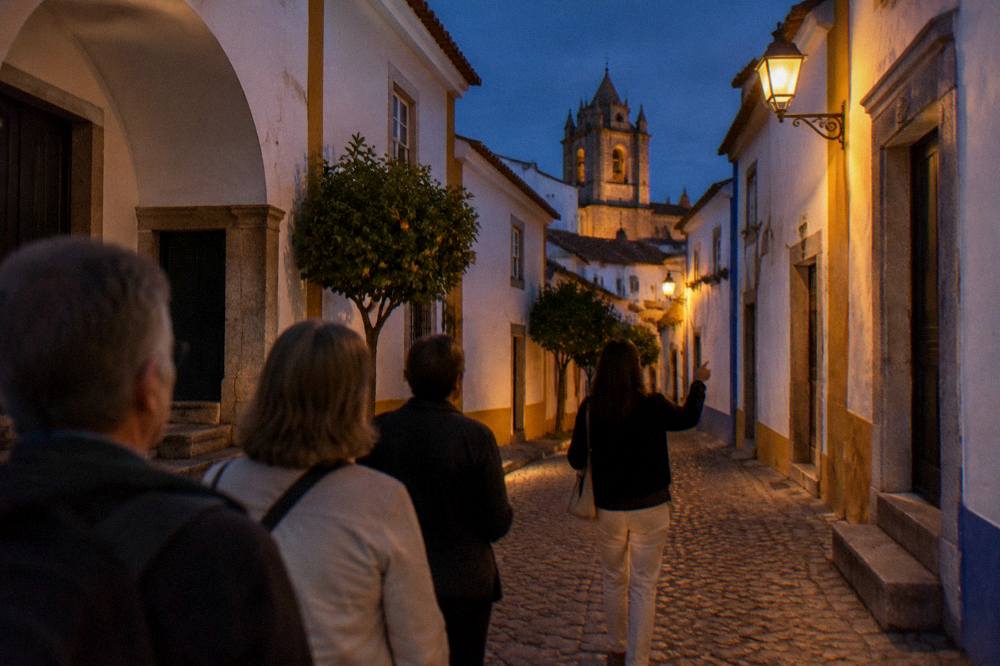
The evening food crawl deserves its solo mention too: at $83.28 per person and 4.6 from 19 reviews it is the most direct route from the train station to the Alentejo table, and it starts late enough in the day to catch even the 20:46 arrival's following evening comfortably.
Whichever of these three shapes the arrival takes, a private walk with monument tickets, a small-group cultural tour or an evening of food and wine, the practical advice is the same: book before the travel day, because the guided options in Évora run on small groups and the popular evening slots fill first. The operator's live listing carries the current times and the cancellation terms, and free-cancellation bookings mean a delayed train from the south costs nothing but a rebooking.
Common Questions About Travelling From Faro To Évora
Is there a direct train from Faro to Évora?
No. Évora's rail line connects to Lisbon, not to the Algarve, so the standard rail plan is Faro to Lisbon and then a CP Intercidades train from Lisboa Oriente to Évora. The timetable valid since 6 September 2026 lists six through trains on that second leg, at 13.90 EUR second class or 18.50 EUR first class.
How far is Évora from Faro?
Faro sits at the southern end of the Algarve and Évora inland in the Alentejo, so the trip crosses the whole width of southern Portugal. The verified reference distance on this route is Évora to Lisbon at about 130 km, with the Algarve leg beyond that; check the operator pages or a routing tool for the current figure before planning a drive.
Is Évora worth the journey from the Algarve?
Yes, if the interest is history rather than beaches. The Historic Centre of Évora has been UNESCO-listed since 1986, and the city holds a Roman temple, a medieval cathedral with a roof-terrace view, the Capela dos Ossos and the Jesuit University of the Holy Spirit, which dates from 1553, inside walkable walls. The is Évora worth visiting guide weighs the question in full.
Can you do Faro to Évora as a day trip?
It is a long day and not the best use of the journey. The realistic plan is one night in Évora, arriving on an afternoon Intercidades train and leaving the next evening, which gives a full day for the monuments and a morning for the megaliths or a winery. The what to do in Évora for a day rundown shows what a single day can hold.
What is the cheapest way to get from Faro to Évora?
On the verified leg, the CP Intercidades fare from Lisboa Oriente to Évora is 13.90 EUR in second class. The Faro-to-Lisbon leg varies by operator and season, so compare the rail and coach options on their own pages before booking; coach services on that corridor are generally the budget choice, but the current fares sit with the operators.
Do you need a car in Évora once you arrive?
No. The historic centre is compact and pedestrian, and the main monuments sit within a short walk of one another. A car earns its keep only for the megalithic sites, the wineries and the hill towns, and even those are reachable on the guided tours from Évora. The getting around Évora guide covers the options.
The crossing from Faro to Évora is a change of country within a country, from the coast to the plain, and the city at the end of it repays every kilometre of the transfer. Plan the legs around the six through trains from Lisboa Oriente, give Évora a night or two rather than a rushed hour, and the Algarve holiday turns into something considerably bigger.