Évora Nightlife
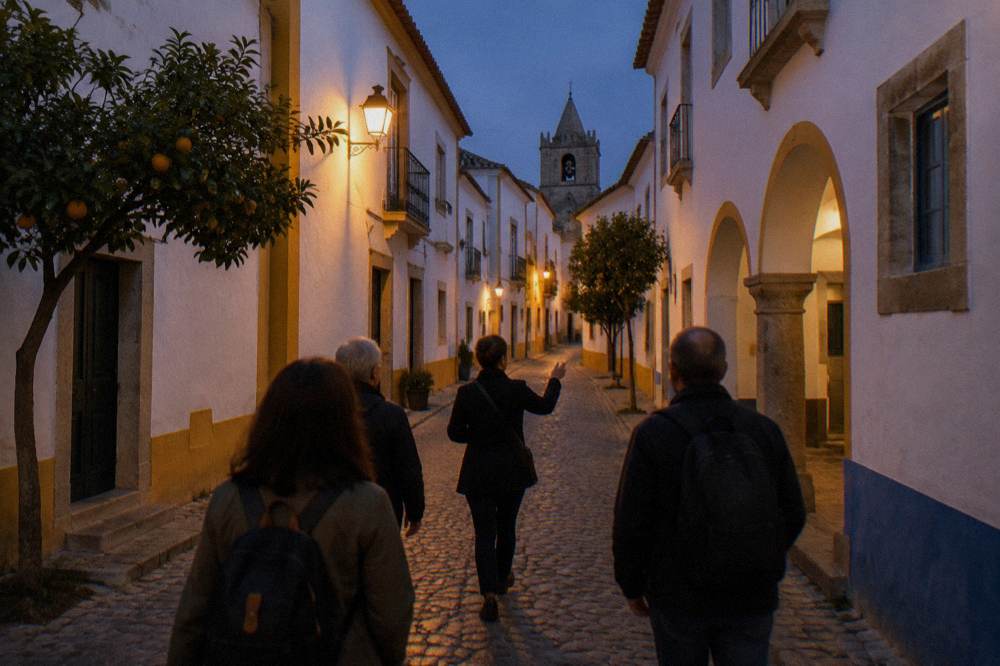
Évora after dark is a small, safe, lantern-lit city where nightlife means late dinners, evening walks through the UNESCO historic centre, and a handful of guided tours that use the night to tell the city's oldest stories.
Short answer
Évora nightlife is quiet and food-centred rather than club-driven: the historic centre fills up around dinner time, monuments close in the late afternoon or early evening, and the best after-dark experiences are guided evening walks, a food and wine crawl, and seasonal festivals such as the Feira de São João.
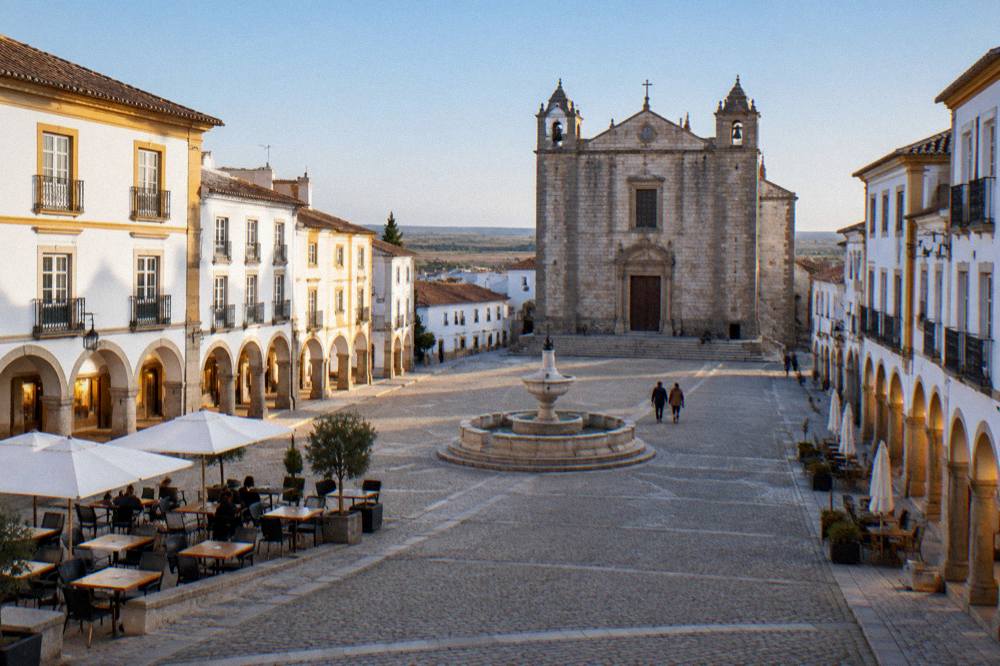
Évora, the capital of the Alentejo region of Portugal, is a walled university city of about 53,000 people whose historic centre has been UNESCO-listed since 1986, and whose nightlife runs on dinner tables, lantern light and church bells rather than dance floors. The evening here belongs to the Praça do Giraldo, the lanes of the old Jewish quarter and the tables that spill onto cobbles once the day's heat breaks. It is an inland city, roughly 130 km from Lisbon and about 90 km from the Atlantic, so there is no sea breeze and no waterfront promenade: the night is dry, warm in summer and crisp the rest of the year.
That is not a limitation. The compactness that makes Évora a walking city by day makes it an unusually easy city at night, because everything worth seeing sits inside walls that take a slow half hour to cross. What changes after sunset is the light on granite, the temperature, and the fact that the monuments mostly close while the streets stay open. Planning around that split, early dinner and monuments, late walk and stories, is what this guide does.
What Is Évora Nightlife Actually Like?
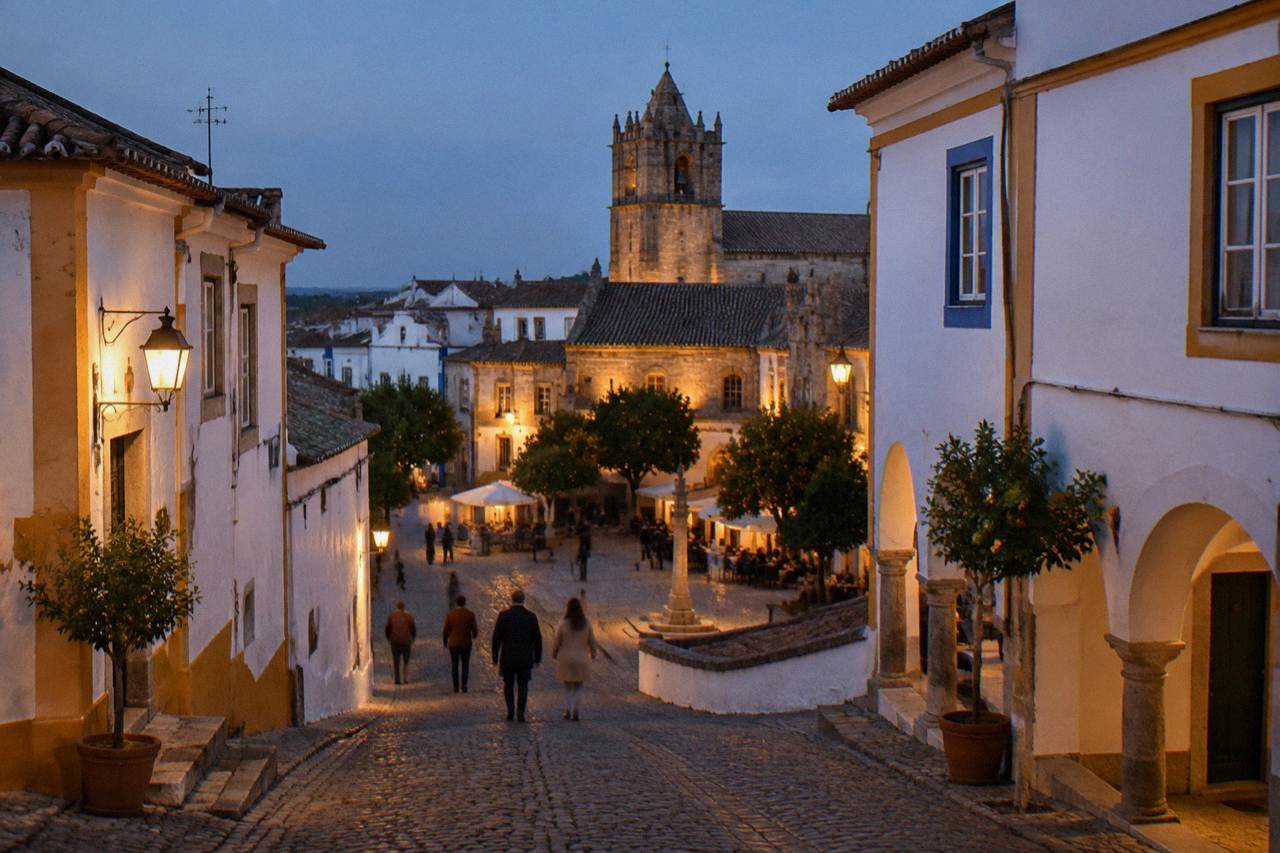
Évora nightlife is a late, table-centred, low-volume affair: dinner starts around eight or later in the Alentejo style, the historic centre's bars and taverns cluster in a walkable handful of lanes, and the loudest sounds after dark are conversation, fado on certain nights, and church bells. There is no club district and no waterfront strip, and the city's own character, a UNESCO-listed core of granite and whitewash, is the main attraction once the sun goes down.
The rhythm follows the Alentejo day. Summer afternoons are hot enough that locals retreat indoors, and IPMA's 1991 to 2020 normals for the Évora station show a July mean maximum of 33.3 C and an August mean of 33.5 C, with 31.9 days a year reaching 35 C or more. Evening is when the city reclaims its own streets. In spring and autumn the same streets fill earlier, and in winter the night is cold enough, the January mean minimum is 4.5 C, that the night market of choice becomes a fireplace and a glass of red.
The student population matters too. The University of Évora, whose Jesuit college dates from 1553, keeps a young population in a small city, which is why a place of 53,000 supports a livelier evening economy than its size suggests. The action concentrates rather than spreads: a few lanes near the Praça do Giraldo and the Rua 5 de Outubro carry most of it, and everything is within a short walk of everywhere else.
For visitors comparing options, the honest framing is that Évora rewards an evening walk and a long dinner more than a night out. The Évora cost and budget guide covers what a night here typically runs, and the Évora restaurants guide covers the table side in detail.
When Do The Streets Of Évora Fill Up In The Evening?
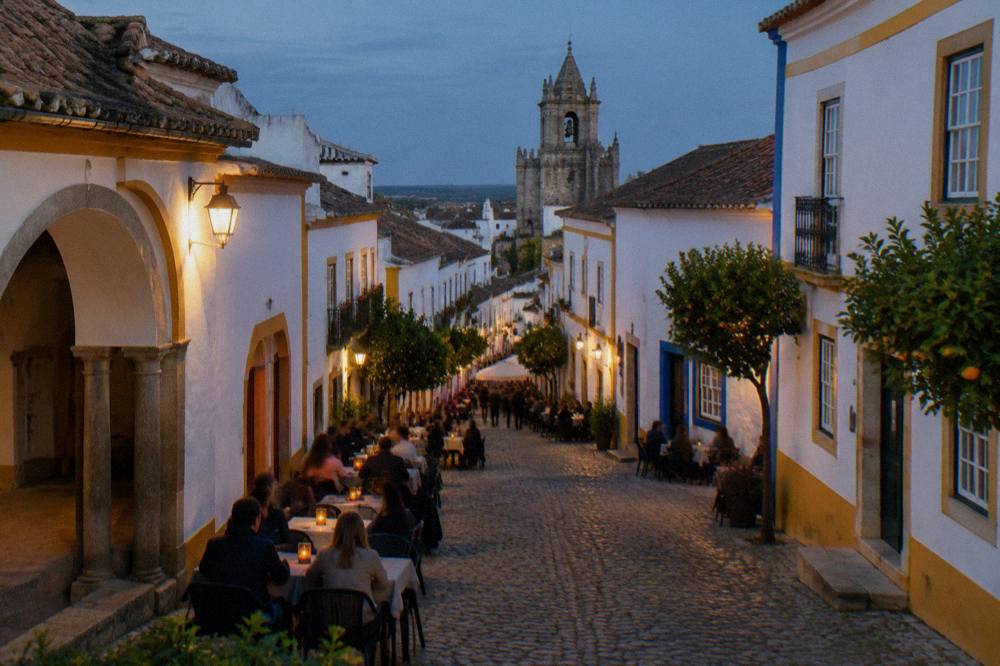
The streets of Évora begin filling in the early evening as shops close and café terraces turn over from coffee to wine, the dinner crowd emerges around eight, and the peak of street life runs from about nine until midnight in summer, earlier in winter, because the Alentejo day is built around avoiding the afternoon heat. The main squares, the Praça do Giraldo and the smaller praças around the Sé, are where the evening concentrates.
The transition is visible and quick. Day-trippers from Lisbon, who arrive on the CP Intercidades trains that reach Évora in about 1 hour 40 to 1 hour 45, largely leave on the late-afternoon services, and by the time the last arrival from Lisboa Oriente pulls in at 20:46, per the CP timetable valid since 6 September 2026, the city has already shifted to its own tempo. What remains is a smaller, slower crowd.
Monuments close well before the evening proper, which is the single most useful fact for planning a night here. The official pages publish these hours, and they mean the monument circuit is a daytime activity:
| Monument | Official Hours | Evening Note |
|---|---|---|
| Sé de Évora (complete visit) | 9:00-17:00, closed 24 Dec afternoon, 25 Dec, 1 Jan | Roof terrace closes with the ticket |
| Capela dos Ossos / Igreja de São Francisco | Summer 9:00-18:30, winter 9:00-17:00, daily except 1 Jan, Easter Sunday, 24 Dec afternoon, 25 Dec | Latest closing of the major sights |
| Museu de Évora | Tue-Sun 9:30-13:00 and 14:00-17:30, closed Mondays | Split day, no evening opening |
| Évora Ticket | 8 EUR one day, 10 EUR two days, 12 EUR three days | Pass, not an opening hour |
The pattern to plan around is simple: monuments by late afternoon, dinner from eight, walk after. The Capela dos Ossos, at 7.00 EUR for an adult museum ticket, keeps the longest hours of the big three, and the Sé's complete-visit ticket at 5.00 EUR, which includes the cloister, the roof terrace and the museum, is a late-afternoon purchase in summer if you want the golden light from the terrace before closing.
The guided evening options are the most reliable way to use the hours after the ticket windows shut, and the trio below covers the range: a cultural walk that includes the Chapel of Bones, a sidecar tour with a wine tasting, and a tales-and-legends walk built for the after-dark imagination.
Which Évora Monuments Look Best After Dark?
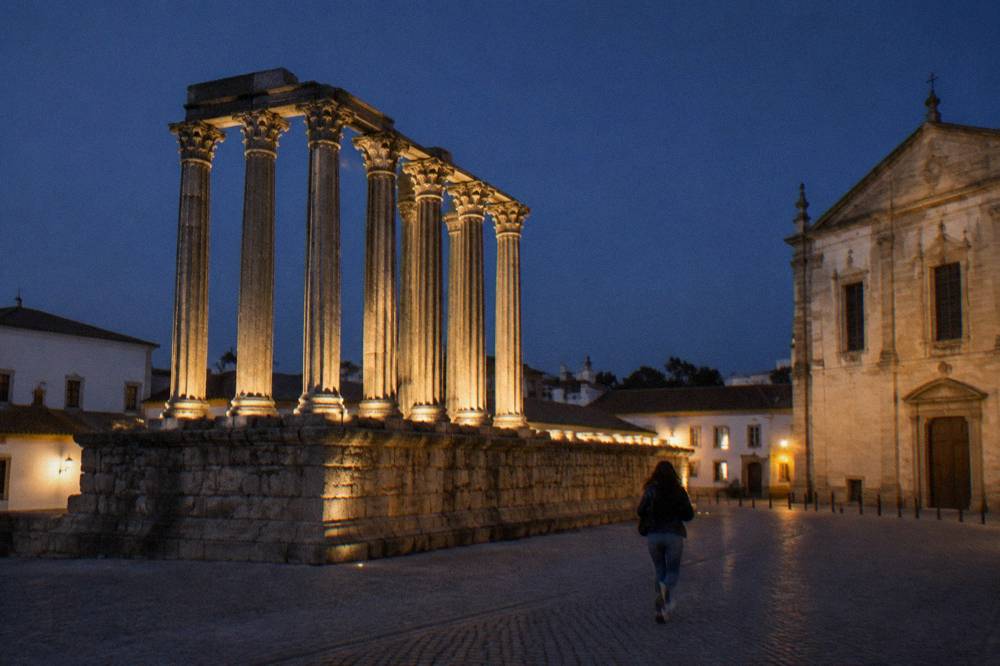
The monuments that reward the evening most are the ones that are free to look at from outside: the Templo Romano, floodlit against the sky; the Sé's massive west front; the aqueduct arches of the Água de Prata running into the city; and the Praça do Giraldo's arcade, which turns into a lantern-lit stage once the day crowd leaves. None of these needs a ticket at night, because the exteriors are public space and the light does the work.
The Templo Romano, popularly called the Temple of Diana, is the emblem. The municipal page says the temple was probably dedicated to the imperial cult rather than to Diana, a name applied only since the 17th century, that it measures 25 x 15 m, and that its walls were freed in 1870 after centuries of being built into other structures, including a spell as a municipal butcher's shop. Standing before it at night, with the columns lit and the square empty, you see the layering the city is famous for: Roman granite under a medieval street plan under a UNESCO inscription from 1986.
The Sé, the Convento dos Lóios, the Igreja de São Francisco and the churches of the old quarter all read differently by night, when the whitewash goes grey-blue and the granite glows. The Água de Prata aqueduct is the sleeper pick: its arches stride into the city from the east, and houses were built into and against them in later centuries, so a night walk along its line is a walk along a piece of living, centuries-old infrastructure. No hours or prices are published for the aqueduct, the University, the Palácio de Dom Manuel or the Jardim Público, so treat all of these as open public exteriors and check any notice at the spot before counting on interior access.
The rooftop view is the one monument experience that competes with the night streets, and it is a daytime one: the Sé's roof terrace, included in the 5.00 EUR complete-visit ticket, closes at 17:00. Sunset chasers should buy that ticket for the last admission window of the day in summer and then come down into the evening city.
For those who want the stories attached to the stones, the guided walks below are the practical answer, since they run in the hours when the interiors are shut and the exteriors are at their best.
The tales-and-legends walk runs 2.5 hours and is rated 4.8 from 40 reviews, from $52.90 per person. It is built exactly for the after-dark frame of mind: Évora's legends, its Inquisition history and its layered past, told in the lanes where they happened. For a fuller treatment of the city's darker chapters, see the Évora history guide and the dedicated Évora Inquisition history page.
What Are The Best Night Tours In Évora?
The best night-compatible tours in Évora are the small-group cultural walking tour with the Chapel of Bones, from $77.66 per person and rated 4.9 from 141 reviews over 2 hours; the medieval sidecar tour with wine tasting, from $61.90 and rated 4.9 from 16 reviews over 3 hours; and the tales-and-legends walking tour, from $52.90 and rated 4.8 from 40 reviews over 2.5 hours. All three start in Évora itself, and prices are per person in US dollars.
The sidecar tour deserves its own paragraph, because it is the only motorised way to see the evening city. A classic sidecar carries you through the medieval lanes with a driver-guide, and the wine tasting closes the loop between the city and the Alentejo countryside that surrounds it. It runs 3 hours from $61.90 per person and carries a 4.9 rating from 16 reviews.
The free walks deserve a separate mention, because GuruWalk is the one platform that can and should be named here. Évora has four free, tip-based GuruWalk walks, and while they are not night tours as such, they are the cheapest way to learn the city's layout well enough to wander it confidently after dark:
| GuruWalk Free Tour | Duration | Rating |
|---|---|---|
| The Essential Free Tour of Évora | 2 hours | 4.93 from 774 reviews |
| Évora through history and how it shaped the city | 2 hours | 4.88 from 74 reviews |
| Évora Walking Tour: History & Heritage | 2 hours | 5 from 9 reviews |
| Mystical Journeys Évora: Roman Ebora | 2.5 hours | 5 from 1 review |
The Essential Free Tour of Évora, on GuruWalk, is the workhorse: 2 hours, tip-based, rated 4.93 from 774 reviews. It is a daytime orientation tool that pays for itself at night, because an evening walk is only as good as your mental map. The Roman Ebora walk, 2.5 hours and rated 5 from a single review, is the specialist option for the ancient layers.
For a comparison of everything bookable, the Évora tours guide breaks the options down by kind, and the Évora walking tour page covers the walking options in depth.
Where Do Locals Eat And Drink In Évora At Night?
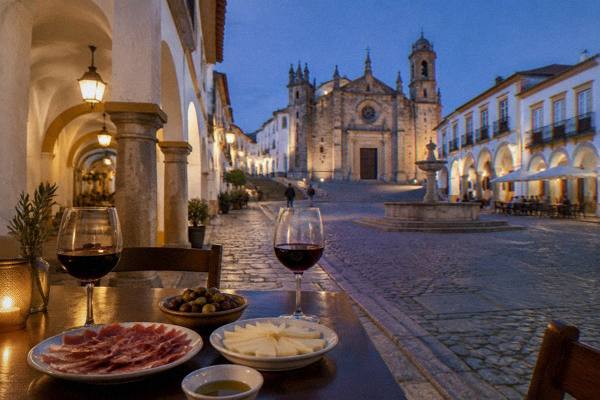
Evening eating in Évora means Alentejo table food served late: grilled meats, pork dishes, soups, sheep's cheese, bread and olive oil, and red wine by the glass or jug, with dinner tables filling from about eight and kitchens running late into the night. The lanes around the Praça do Giraldo, the Rua 5 de Outubro and the streets running down from the Sé carry most of the evening trade, and no single venue is required: the regional table is the point, not a shortlist of names.
The Alentejo table is one of Portugal's most distinctive. The Alentejo food guide and the Évora food guide cover the dishes in detail, but the evening frame matters here: this is slow food, cooked for people who ate a light lunch and waited out the heat. Wine is the region's other half, and the Alentejo wine guide explains the styles; what a visitor needs at night is simply that the local reds are built for exactly this kind of meal.
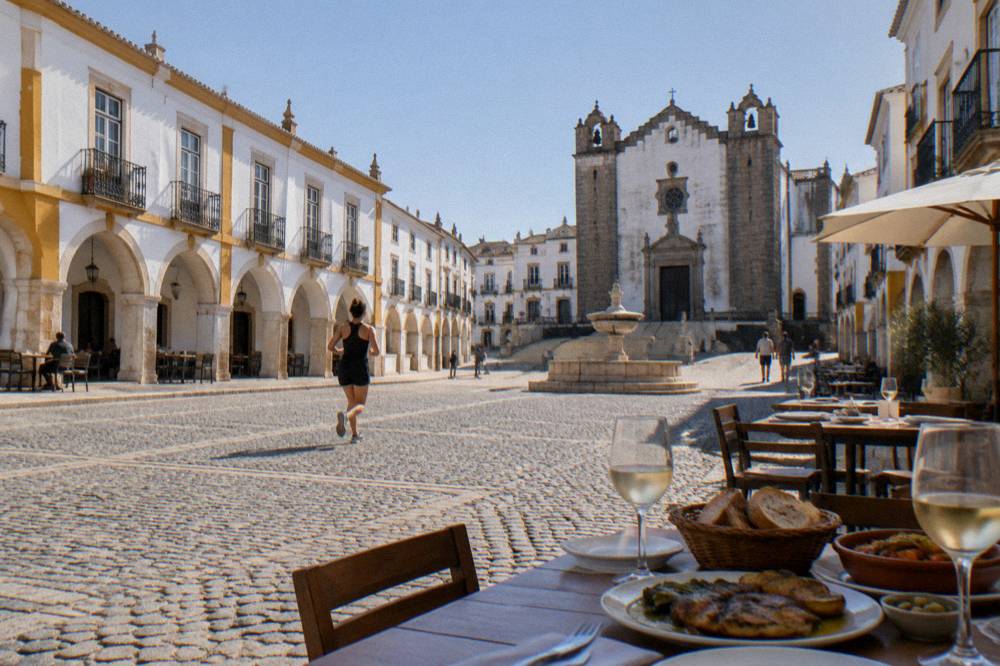
Reservations matter on summer weekends and whenever the university calendar fills the city. The rest of the planning pages sit on Évora Travel Guide.
The bookable alternative is a guided evening that builds the food into the walk. The evening food and wine crawl, from $83.28 per person and rated 4.6 from 19 reviews over 3 hours, moves between tables with a local lead, which solves both the where-to-eat problem and the what-to-order problem in one evening. Its card carries the current details.
For the daytime version of the same appetite, the Évora wine tasting page and the regional wine route pages cover the cellar side of the Alentejo.
Is Évora Safe At Night?
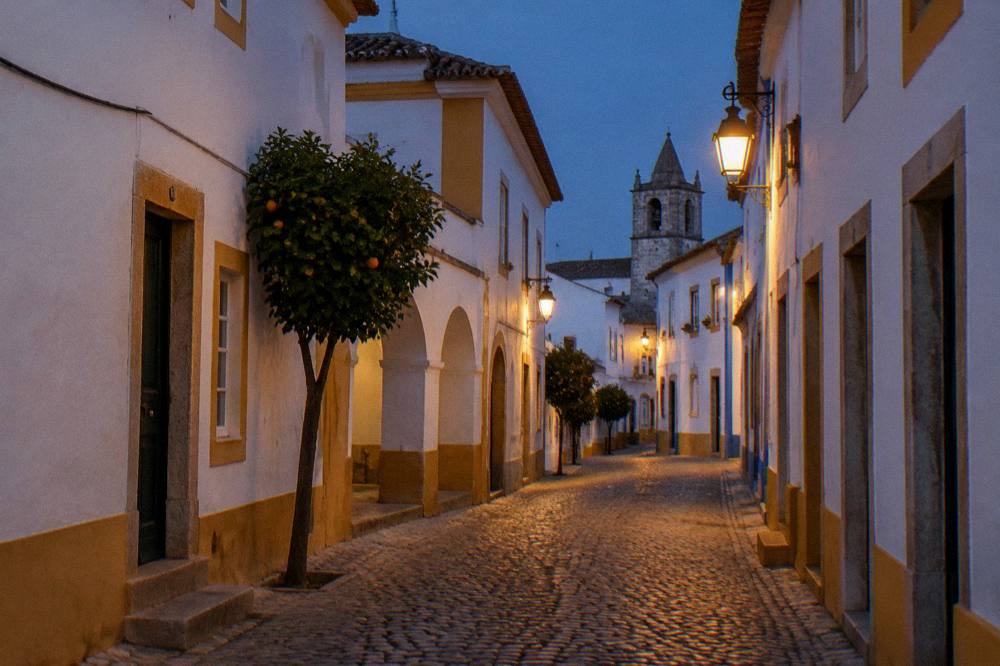
Évora is a small, low-crime university city where the historic centre at night is generally as safe as southern Europe gets: the streets are lit, the evening crowd stays out late, and the main risks are practical ones, uneven cobbles, dark lanes away from the main squares, and summer heat earlier in the day, rather than crime. Standard city precautions apply as they would anywhere, and the compact walled centre means you are rarely far from people.
The city's scale does most of the work. A night walk from the Praça do Giraldo to the Templo Romano to the Sé takes minutes, and the lanes between them are residential as well as touristic, so there is foot traffic late. The Is Évora safe page carries the fuller treatment, including the practical notes on walking the walls and the outlying streets.
Two specific cautions are worth their own lines. First, the cobbles: Évora's streets are granite setts, and after dark, or after rain, they are the most likely thing in the city to bring a visitor down. Shoes matter. Second, the summer evening heat: IPMA's 1991 to 2020 normals show July and August mean minimums of 15.6 C and 16.0 C, so nights are warm rather than cooling, and water carried through the evening is not a tourist cliché here.
For solo travellers and families, the Évora with kids guide and the accessibility page cover the evening city from those angles. The general rule is that Évora rewards the confident walker: the centre is small enough that getting lost is a ten-minute problem, not an evening's.
What Does The Weather Do To An Évora Evening?
The weather defines Évora's evenings more than most visitors expect: summer nights stay warm, with 1991 to 2020 average minimums of 15.6 C in July and 16.0 C in August, spring and autumn evenings are mild, and winter nights are genuinely cold, averaging 4.5 C in January, because this is an inland plain with no sea to moderate it. Rain is rare in the summer evening and common from October onward.
The IPMA climate normals for the Évora station, covering 1991 to 2020, give the full picture for evening planning:
| Month | Mean Minimum (C), 1991-2020 | Days With 1 mm+ Rain |
|---|---|---|
| Jan | 4.5 | 8.6 |
| Feb | 5.0 | 7.0 |
| Mar | 6.9 | 7.5 |
| Apr | 8.5 | 8.0 |
| May | 10.9 | 6.0 |
| Jun | 13.8 | 1.7 |
| Jul | 15.6 | 0.6 |
| Aug | 16.0 | 0.7 |
| Sep | 14.6 | 3.6 |
| Oct | 12.3 | 7.7 |
| Nov | 7.9 | 8.8 |
| Dec | 5.3 | 8.7 |
The evening implications are direct. June through August, the night is the best part of the day, because the afternoon mean maximums run 30.2 C, 33.3 C and 33.5 C and the record maximum is 45.4 C, set on 4 August 2018. October through March, the evening is the coldest part of the day, and the rain days climb back toward nine a month, so a night walk needs a layer and possibly an umbrella. The Évora weather guide and the best time to visit guide carry the month-by-month detail.
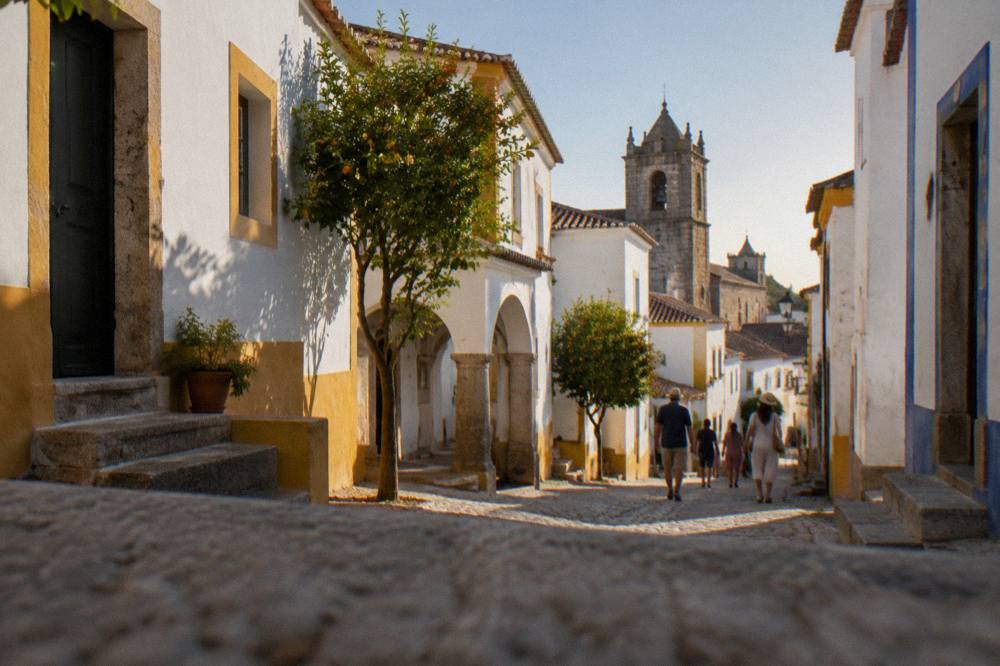
The shoulder seasons are the sweet spot for night walking. May and September sit between the extremes: warm enough for terraces, cool enough for a long walk, and past or before the peak of the summer heat. The trade-off is rain, at 6.0 and 3.6 days with a millimetre or more respectively, which is a coat problem, not a plan problem.
Which Festivals Light Up Évora After Dark?
The festivals that change Évora's nights are the Feira de São João, which ran 23 June to 5 July 2026 at the Rossio de São Brás with the theme 'Évora: Capital Europeia ao Sul'; the GUADIANA festival of Afro-Ibero-American literatures, 9 to 11 October 2026, with 28 authors from nine countries; and the build-up to Évora 2027, when the city becomes a European Capital of Culture. The Feira de São João is the one that fills the streets at night.
The Feira de São João is the city's big summer fair, an annual June event held at the Rossio de São Brás, and its 2026 edition ran from 23 June to 5 July. The 2026 theme, "Évora: Capital Europeia ao Sul", pointed forward to 2027. A fair of this kind means evening crowds, food stalls and late streets in a city that already runs late, so it is the one date range that genuinely transforms the night. The 2027 dates follow the late-June-into-early-July pattern of the 2026 edition, and the municipal page is the place to confirm them before planning.
| Event | Dates | What It Does to the Night |
|---|---|---|
| Feira de São João 2026 | 23 June to 5 July 2026, Rossio de São Brás | Fairground evenings, food and crowds |
| GUADIANA literature festival | 9 to 11 October 2026, first edition | 28 authors from nine countries, evening readings |
| Évora 2027, European Capital of Culture | 2027, full programme not yet published | City-wide cultural year with the Alentejo |
GUADIANA, the Festival of Afro-Ibero-American Literatures, is a first-edition October event under the Évora 2027 umbrella, and it is the night event for readers: 28 authors from nine countries over three days. The 2026 programme is a preparation year built on the concept of "Vagar", a word that means taking one's time, which is as good a description of an Évora evening as any.
For visitors timing a trip around any of this, the Évora events and festivals guide carries the calendar, and the Évora Christmas page covers the winter night season.
How Late Can You Stay Before Heading Back To Lisbon?
You cannot see Évora's night and return to Lisbon the same evening by train, because CP's timetable valid since 6 September 2026 shows six through trains from Lisboa Oriente with the last arrival into Évora at 20:46, and the listed services run morning through evening rather than overnight. Staying the night is the practical answer, and the city's small size means one night is enough to catch both the late streets and the early light.
The train is the right way to arrive for an evening. The Intercidades fare is 13.90 EUR second class and 18.50 EUR first class for the Lisboa Oriente to Évora run, about 1 hour 40 to 1 hour 45, and the Lisbon to Évora by train guide covers the practical detail. The Lisbon to Évora guide compares train, bus and car, and the Évora to Lisbon airport page handles the departure side.
Once the stay is decided, the night itself is short to plan. The where to stay in Évora guide covers the neighbourhoods, and a municipal tourist tax applies to stays, so check the amount with your hotel at booking. The evening then arranges itself: monuments by late afternoon, dinner from eight, a walk past the Templo Romano and the Sé, and one of the guided options below for the stories.
The small-group cultural walking tour with the Chapel of Bones, from $77.66 per person and rated 4.9 from 141 reviews over 2 hours, is the one to book if the evening has a single slot in it, because it pairs the city's most famous interior with a guide who can carry the conversation past midnight. Check availability on the operator's live listing, or read more on the tour's own page.
Common Questions About Évora Nightlife
Is Évora good for nightlife?
Évora is good for a particular kind of nightlife: late dinners, wine, evening walks through a UNESCO-listed centre and small bars in a walkable core. It is not a club city. The evening peaks between roughly nine and midnight in summer, and the atmosphere is student-influenced thanks to the University of Évora.
What time do people go out at night in Évora?
The Alentejo evening starts late: cafés turn to wine in the early evening, dinner tables fill from around eight, and the streets stay busy until midnight or later in summer. In winter everything shifts earlier because the nights are cold, with a January mean minimum of 4.5 C in the 1991 to 2020 normals.
Are Évora monuments open at night?
No. The Sé closes at 17:00, the Capela dos Ossos at 18:30 in summer and 17:00 in winter, and the Museu de Évora closes at 17:30 with a midday break, per the official pages. Night viewing in Évora is about the exteriors: the Templo Romano, the Sé's west front, the Água de Prata arches and the lit squares.
Is it safe to walk around Évora at night?
Generally yes: the historic centre is small, lit and busy until late, and the main hazards are uneven granite cobbles and, in summer, heat carried over from the afternoon rather than crime. Normal city precautions apply, and the lanes away from the main squares are quieter.
Can you do an evening tour in Évora?
Yes. The tales-and-legends walking tour runs 2.5 hours from $52.90 per person and is built around the city's stories, the medieval sidecar tour with wine tasting runs 3 hours from $61.90, and the small-group cultural walk with the Chapel of Bones runs 2 hours from $77.66. GuruWalk also lists four free, tip-based walks for orientation.
Do I need to stay overnight to enjoy Évora at night?
In practice, yes. The last through train from Lisbon arrives at 20:46, per the CP timetable valid since 6 September 2026, and the same evening's return options are not a night service. One overnight stay is the standard way to catch both the late streets and the morning light on the monuments.
An evening in Évora ends the way the Alentejo intends it to: a last glass at a table on the cobbles, a slow walk past the lit Templo Romano, and the bells of the Sé counting the city into night.