Évora Car Rental: A Practical Guide To Driving In Portugal's Alentejo
Évora, the inland capital of Portugal's Alentejo, is a walkable museum city, but the plain around it holds megaliths, marble towns and hilltop villages that buses barely touch. This guide sets out when a rental car is worth it and how to use it well.
Short answer
You do not need a car inside Évora itself: the historic centre is compact and best explored on foot. A car pays for itself when the plan includes the Alentejo beyond the walls, places like the Cromeleque dos Almendres, Monsaraz, Estremoz or Vila Viçosa, where public transport is thin. Most visitors collect a car in Lisbon, about 130 km away, or arrange one locally and drive out on day trips.
Évora, Portugal, is the capital of the Alentejo district of that name, an inland city of whitewashed houses and Roman stone sitting on a plain roughly 90 km from the Atlantic. Its UNESCO-inscribed historic centre, a maze of cobbled lanes inside medieval walls, is small enough that almost nobody who visits it wishes they had a car inside it. The question that actually matters is different: whether the Alentejo around Évora, the megalithic sites, the marble towns, the hilltop fortress villages, is part of the trip. If it is, a car changes what is possible in a way no timetable does.
This guide works through the decision honestly. It covers what a car is for in this region, where most visitors pick one up, what driving into Évora involves, which day trips justify the keys, and what the road rules and the climate do to your plans. It also sets out what you can manage perfectly well without a car, because the answer is more than most people expect.
Do You Need A Car In Évora?
For the city itself, no: Évora's historic centre is compact, largely pedestrian in feel, and every major monument from the Sé to the Capela dos Ossos sits within a few minutes' walk of Praça do Giraldo. A car becomes genuinely useful the moment the trip extends beyond the walls to the megaliths, Monsaraz or the marble country around Vila Viçosa, where public transport is sparse and tour coverage selective. Plenty of visitors arrive by train, stay two nights, and never miss a set of keys.
The distinction matters because Évora splits cleanly into two products. The first is the walled city, the things to do in Évora proper: the cathedral, the bone chapel, the Templo Romano, the aqueduct arches threading between houses. All of it is walkable, and the distances involved are the kind a city break assumes. The second product is the Alentejo plain, and that is where the calculus flips.
Public transport across the plain exists but is built for residents, not for a visitor trying to see a cromlech at golden hour. The megalithic sites southwest of the city sit at the end of small roads with no bus service worth planning around. Hilltop towns like Marvão and Monsaraz are reachable by coach in some cases, but the schedules assume you are going home, not touring. A driver can string three towns into one loose loop; a bus passenger gets one.
There is a third category that is easy to miss: the guided tour. A good share of what people assume requires a car, the megaliths, the wineries, Monsaraz, is covered by small-group and private tours that start in Évora itself. Those are worth pricing against a rental day before committing to either, and the Évora tours overview gathers them in one place. For some travellers, two guided days beat three driving days on cost, fatigue and the quality of the commentary alike.
Where Do You Pick Up A Rental Car For Évora?
Most visitors collect a car in Lisbon, about 130 km west of Évora, and drive out on the A6 motorway, because Lisbon holds the region's main airports and the widest range of rental desks. A smaller number rent in Évora itself for the day-trip phase of their stay, picking up and dropping off without ever touching a motorway. Which of the two suits you depends on one thing: whether the car is a tool for the whole trip or just for the Alentejo leg.
The Lisbon route is the default for a reason. The Lisbon to Évora by car guide covers it in detail, and the general shape is simple: a motorway run across the Tagus plain into Alentejo country. If the plan is a loop that starts and ends in Lisbon, with Évora as the inland anchor, renting at the Lisbon end and keeping the car is almost always the sensible shape. The Alentejo road trip guide sketches what such a loop can hold.
The alternative is to arrive car-free and rent locally for part of the stay. This is the pattern for visitors who come by train, spend a day or two inside the walls, and only then want wheels for the plain. Local availability exists in Évora, but this guide does not name firms or prices: check the operators directly for current fleets, deposits and opening hours, and book ahead in the July and August peak, when small-town fleets run thin.
A third pattern is worth naming because it is often the best of all: no car at all, and guided days instead. The megaliths and Monsaraz are the two destinations where this competes hardest with driving, and both have strong options.
One practical note on timing: whichever end you rent at, plan the handover day carefully. A car collected in Lisbon on an afternoon arrival tends to mean a night in Lisbon before the drive; a car collected in Évora on a morning means the whole day belongs to the plain. The Lisbon to Évora overview compares the train, bus and car options side by side if the arrival logistics are still open.
What Does Driving Into Évora Involve?
Évora's historic centre is a walled, largely medieval street plan, and the practical rule is simple: park outside or at the edge of the centre and walk in. Cars can physically enter parts of the old town, but the lanes are narrow, cobbled and shared with pedestrians, and hotel access often means unloading and then moving the car to a public car park. The full detail, including where the car parks sit, is covered in the Évora parking guide, and reading it before arrival saves a stressful first hour.
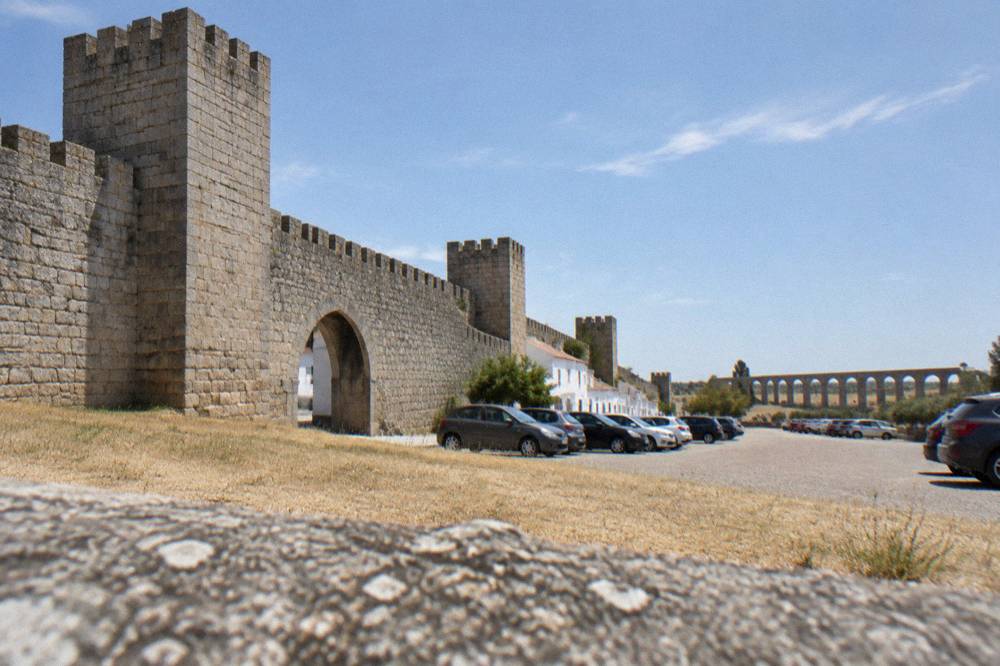
The walls are the mental boundary. Inside them, the car is a liability; outside them, it is an asset. The Évora parking guide maps the practical options, and the general experience across the Alentejo's walled towns is the same: a short walk from car park to old town is the normal rhythm of the region, not an inconvenience unique to Évora.
What the drive in looks like depends on the approach. From Lisbon the arrival is by motorway and then a short run into the city. From the south and east, the approach roads cross open plain, cork oak and wheat fields, and the last stretch slows into town traffic. None of it is difficult driving by the standards of a European regional city; the only genuinely demanding part is the last few hundred metres, and that is solved by parking early.
Two habits make the whole stay easier. The first is treating the car as parked once you arrive: everything inside the walls is better on foot, and the Évora walking tour options explain why, from the Praça do Giraldo to the Convento dos Lóios, the city rewards slow passage. The second is planning each day trip as a loop that starts and ends at the same car park, so the car becomes a fixed base rather than something you shuffle around town.
Before the plain, though, the city deserves at least one unhurried day. A private skip-line tour of the university, the cathedral and the Capela dos Ossos, ending in a wine tasting, is one of the strongest ways to spend it, and it needs no car at all.
Which Day Trips From Évora Are Easiest By Car?
The day trips that reward a car most are the ones public transport serves thinly: the Cromeleque dos Almendres megalithic complex, the hilltop village of Monsaraz about 40 to 45 km away, the marble towns of Estremoz about 45 km and Vila Viçosa about 60 km, and the border fortress of Elvas about 80 km. Arraiolos, about 20 km, is the easiest loop of all. Marvão, about 120 km, is the longest single run and pairs better with an overnight than a dash.
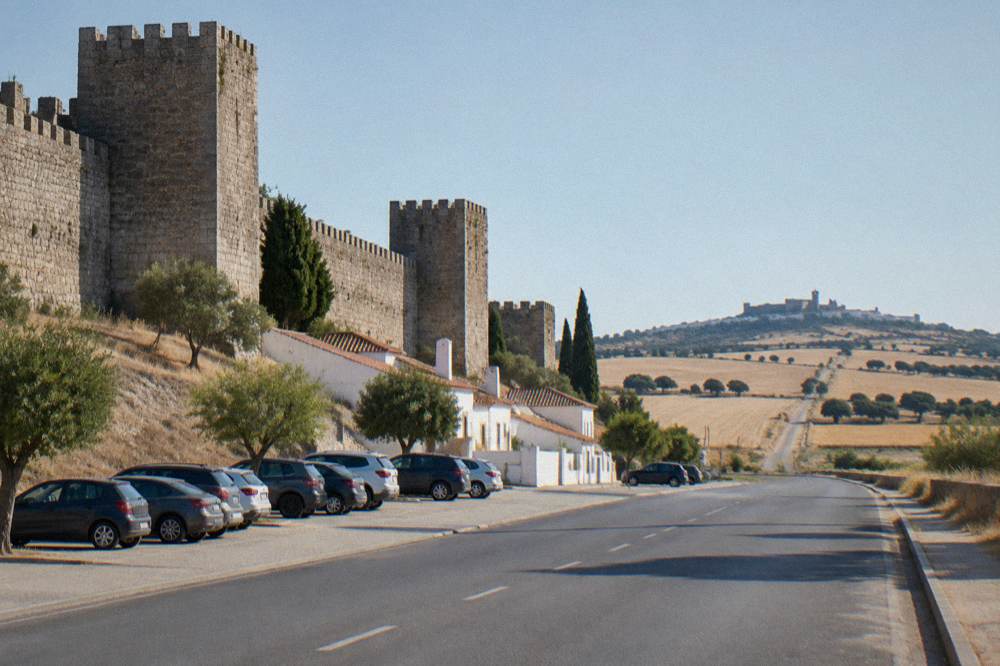
These are rounded distances, and the point of listing them is not precision but shape: which trips are short hops, which are half-days, and which need a full day of your energy. The table below groups them the way a driver actually thinks about them.
| Destination | Approximate distance from Évora | What the trip is really about |
|---|---|---|
| Arraiolos | about 20 km | The embroidery town, an easy half-day loop |
| Monsaraz | about 40-45 km | A walled hilltop village over the Alqueva lake country |
| Estremoz | about 45 km | Marble town and castle, market country |
| Vila Viçosa | about 60 km | Ducal palace and marble quarries |
| Elvas | about 80 km | Border fortifications, a full day out |
| Marvão | about 120 km | A spectacular ridge village, best with an overnight |
| Lisbon | about 130 km | The gateway city, motorway most of the way |
The megaliths deserve their own word because they are the trip that most often converts a car sceptic. The Cromeleque dos Almendres sits at the end of small roads off the national route toward Lisbon, and the Almendres Interpretation Centre in the village of Guadalupe, a municipal partner, keeps summer hours of 10:00 to 18:00 from 1 May to 31 October and winter hours of 10:00 to 17:00 from 1 November to 30 April. The stones themselves stand in open country. An archaeologist-led half-day tour is the alternative to driving it yourself, and for the megalith-curious without a car it is a strong one.
Monsaraz is the other big draw southward, and it comes in two flavours: drive it yourself, or take a guided morning that pairs the village with a wine tasting.
The marble country east of Évora, Estremoz, Vila Viçosa and Borba, is the region where the car quietly excels, because the pleasure is in the hopping: one town for the castle, the next for the quarries, a third for lunch. A guided marble walk in Vila Viçosa covers the town's story on foot, which pairs neatly with a driver who handles the getting there.
What Are The Rules Of The Road In The Alentejo?
Portugal drives on the right, and the Alentejo's roads are a mix of quiet motorway, fast national routes and narrow municipal lanes, so the practical discipline is speed discipline on the open plain and patience in the villages. Fuel, tolls and rental terms vary by operator and are not fixed facts this guide can quote: check the terms of your own agreement before driving off, and ask the desk about toll transponders if the route includes motorway sections.
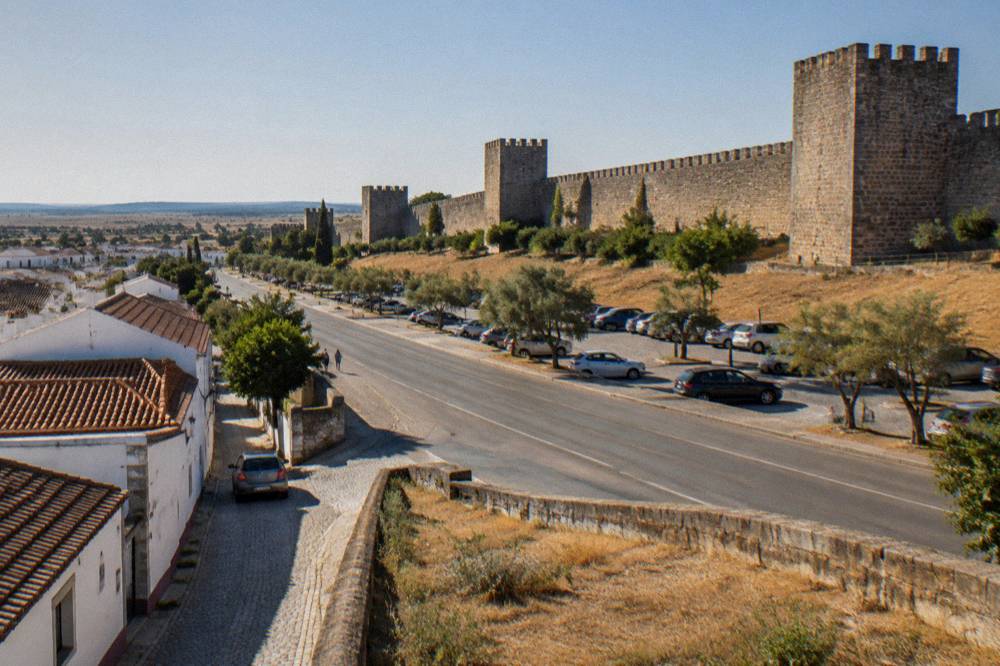
The plain itself is where new drivers relax too much. The national roads are fast, straight and lightly trafficked, and the temptation is to treat them like motorways. They are not: farm traffic, tractors and the occasional loose animal appear with little warning, and the verges are soft. The regional habit is to drive briskly but leave generous following distance, and it is a good habit to borrow. Other pages covering the same trip are gathered on Évora Travel Guide.
In the villages, the rule is the opposite of the plain. Lanes between whitewashed walls are barely a car wide, mirrors fold, and the right of way is negotiated with a nod. The universal answer is the one from Évora itself: park at the edge and walk. Every one of the day-trip towns in the table above is better entered on foot, and every one has somewhere to leave a car within a short walk of its centre.
A few practicalities are worth settling before the driving starts. The table below collects the ones that come up most.
| Practicality | What to do |
|---|---|
| Fuel | Fill in Évora or a larger town before a long loop; village pumps keep short hours |
| Tolls | Ask the rental desk how the car handles motorway tolls before leaving |
| Navigation | Download offline maps; mobile coverage thins on the plain |
| Parking | Use edge-of-town car parks in every walled village, not the lanes |
| Heat | Never leave anything in a parked car between June and September |
| Documents | Carry the licence and rental agreement; the desk will say what else |
One seasonal note belongs here rather than anywhere else. The Alentejo summer is serious heat, not a Mediterranean suggestion: IPMA's 1991 to 2020 normals for the Évora station show a July mean maximum of 33.3 C and an August mean maximum of 33.5 C, with 31.9 days a year reaching 35 C or more and a record of 45.4 C set on 4 August 2018. A car in that heat is a furnace when parked and a lifeline when moving, so plan day trips for morning departures, keep water in the cabin, and treat the middle of the day as time for a long lunch. The Évora weather guide carries the full monthly picture.
When Is The Best Season To Drive In The Alentejo?
Spring and autumn are the best driving seasons: IPMA's 1991 to 2020 normals for the Évora station show April and May mean maxima of 20.7 C and 25.0 C, and October 24.1 C, all comfortable for long loops. July and August are the hottest months, with mean maxima above 33 C and almost no rain, workable only with early starts. Winter is mild by day, with a January mean maximum of 14.1 C, but nights drop to a mean minimum of 4.5 C.
The monthly numbers tell the story better than adjectives, and they are worth having in front of you when you pick dates. The best time to visit Évora guide expands on what each season does to the whole trip; the table here is the driving-specific cut.
| Month | Mean maximum (C), 1991-2020 | Mean minimum (C) | Rain (mm) | Days 30 C or more |
|---|---|---|---|---|
| March | 18.7 | 6.9 | 60.8 | 0.0 |
| April | 20.7 | 8.5 | 62.1 | 0.3 |
| May | 25.0 | 10.9 | 46.6 | 5.5 |
| June | 30.2 | 13.8 | 10.6 | 15.1 |
| July | 33.3 | 15.6 | 2.7 | 23.7 |
| August | 33.5 | 16.0 | 6.0 | 25.0 |
| September | 29.5 | 14.6 | 33.9 | 13.9 |
| October | 24.1 | 12.3 | 81.5 | 2.9 |
Two readings of that table matter for a driver. The first is the rain column: the wettest months are October through December, with 81.5 to 86.0 mm, but the rain concentrates into a handful of days, 7.7 to 8.8 days a month with a millimetre or more, so a wet week is possible and a wet fortnight is not. The second is the 30 C column: from June through September the hot days are the norm, not the exception, and a summer itinerary should assume them rather than hope around them.
There is a cultural layer on top of the climate, and it is worth planning around. Évora is a European Capital of Culture in 2027, and the city's own programme describes 2026 as a preparation year built on the concept of "Vagar". The Feira de São João, the city's great annual fair, ran from 23 June to 5 July 2026 at the Rossio de São Brás under the theme "Évora: Capital Europeia ao Sul". Fairs and festivals fill the towns and fill the car parks, so if your dates collide with a named event, arrive early in the day or be ready to walk from further out.
What Can You See Without A Car In Évora?
A great deal: the entire UNESCO-listed historic centre, the Sé de Évora with its roof terrace, the Capela dos Ossos, the Museu de Évora, the Templo Romano and the Água de Prata aqueduct are all inside or on the edge of the walkable old town, and the CP Intercidades trains from Lisboa Oriente, six a day on the timetable valid since 6 September 2026, make a car-free arrival straightforward. The car-free gaps are the megaliths and the far towns, and guided tours cover both.
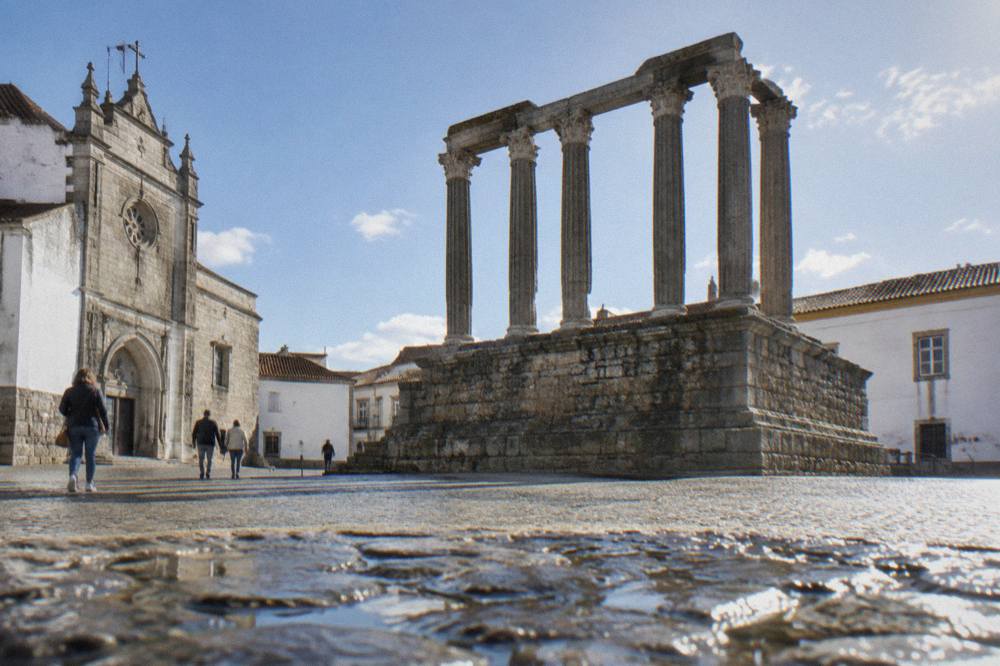
The monument economics inside the walls are worth knowing, because they are the same whether you arrive by car or not. The Sé's single complete-visit ticket, covering the cathedral, cloister, roof terrace and museum, is 5.00 EUR, with children up to 12 free. The Capela dos Ossos museum ticket at the Igreja de São Francisco is 7.00 EUR for an adult, 5.00 EUR for youth up to 25 and seniors over 65, and 15.00 EUR for a family. The Museu de Évora is 8 EUR for an adult and closes on Mondays. The Évora Ticket, a multi-site pass for the Cidade-Museu network, runs 8 EUR for one day, 10 EUR for two and 12 EUR for three, free to age 12, and does not include the Sé, the Capela dos Ossos or the Museu de Évora.
| Site | Ticket | Notes |
|---|---|---|
| Sé de Évora | 5.00 EUR complete visit | Cathedral, cloister, roof terrace, museum; under 12s free |
| Capela dos Ossos | 7.00 EUR adult museum ticket | Youth to 25 and over-65s 5.00 EUR; family 15.00 EUR |
| Museu de Évora | 8 EUR adult | Closed Mondays; youth, seniors and family 50% off |
| Évora Ticket | 8 EUR one day | 10 EUR two days, 12 EUR three days; excludes the three above |
| Almendres Interpretation Centre | Open access, hours posted | Summer 10:00-18:00, winter 10:00-17:00 |
The train deserves its own sentence because it is the backbone of the car-free case. CP's timetable valid since 6 September 2026 lists six through Intercidades trains from Lisboa Oriente, departing at 07:02, 09:02, 09:58, 13:35, 17:02 and 19:02 and reaching Évora about 1 hour 40 to 1 hour 45 later, with a second-class fare of 13.90 EUR and first class at 18.50 EUR. The train guide works through it in full, and the bus alternative covers the coach option for travellers who prefer it.
Inside the walls, the guided choices are strong enough that many visitors never feel the missing keys.
And if the budget is tight, the free-walking scene is real: the Essential Free Tour of Évora on GuruWalk, a tip-based walk of about two hours, is one of the best-reviewed introductions to the city on any platform, and GuruWalk's model, pay what you think the walk was worth, suits a first evening perfectly. Never treat it as a substitute for the paid tours if depth matters, but as a first orientation it is hard to beat.
How Do You Decide Between A Car And Guided Tours?
Compare the two on three things: how many far-flung places you want in one day, how much you value commentary over independence, and what the arithmetic of rental days versus tour prices looks like for your group. A car wins on flexibility and multi-stop loops across the plain; guided tours win on the megaliths and wine country, where local knowledge and access matter, and on any trip where the driver would rather be looking out of the window than at the road.
The honest way to run the comparison is per day. A rental day has a fixed cost in money and a fixed cost in attention: someone navigates, someone parks, someone stays sober at lunch. A guided day has a per-person price, and on this site's tour cards those run in US dollars, from about $33.76 per person for a three-hour Almendres and dolmen trip to about $78.78 for a Monsaraz and wine half-day, with full-day Lisbon-start combos around $64 to $91. For a couple, a single guided day can sit close to a rental day's all-in cost; for a family of four, the car usually wins on money and loses on ease.
| Your trip shape | Better fit |
|---|---|
| Two nights in Évora, monuments only | No car at all |
| Évora plus the megaliths | Guided megaliths tour, or a car for that day |
| Évora, Monsaraz and wine country | Guided combo, or a car for a two-stop loop |
| A week looping the whole Alentejo | A car for the whole trip |
| Lisbon arrival, one Évora night | Train in, walk, train out |
The pattern that recurs in every version of this decision is that the car is a plains instrument. Inside the walls of Évora it is dead weight; on the plain it is the difference between one destination a day and three. The megaliths are the purest case: a scatter of sites on small roads, no timetable, best at the day's edges when the light is low. Wine country is the counter-case, where a driver who wants to taste properly is a driver who is not driving, and the guided wine and cork options earn their price exactly there.
Whatever the mix, the Évora cost and budget guide helps with the wider arithmetic, and the is Évora worth visiting question, which most first-time visitors are really asking, is answered by the city itself on any first walk from the Praça do Giraldo to the Templo Romano. A municipal tourist tax applies to stays in the city, so check your hotel's final bill rather than the advertised rate, and ask at the desk if it is not itemised.
Common Questions About Renting A Car In Évora
Do I need a car in Évora?
No, not for the city. The historic centre is compact and walkable, and every major monument sits within a short walk of Praça do Giraldo. A car only earns its keep for the Alentejo beyond the walls: the megaliths, Monsaraz, the marble towns and the hilltop villages.
Where should I pick up a rental car for Évora?
Most visitors rent in Lisbon, about 130 km away, and drive out, because Lisbon has the main airports and the widest choice of desks. Renting in Évora itself for the day-trip phase of a stay is the alternative; check operators directly for current availability, prices and opening hours.
Can I drive inside Évora's old town?
Physically, in parts, yes; practically, it is a bad idea. The lanes are narrow, cobbled and shared with pedestrians. Park at or outside the edge of the centre and walk in; the Évora parking guide covers the options.
Can I visit the Cromeleque dos Almendres without a car?
Yes, by guided tour. Several megalith-focused tours run from Évora, including an archaeologist-led half-day, and the Almendres Interpretation Centre in Guadalupe is the municipal partner site for the complex.
Is driving in the Alentejo difficult?
No, but it demands two modes. The open plain invites speed and should be driven with restraint and following distance; the villages are single-car-width lanes best handled by parking at the edge and walking. Summer heat is the main hazard for a parked car, with IPMA's 1991 to 2020 normals showing July and August mean maxima above 33 C.
Train or car from Lisbon to Évora?
The train is excellent for a city-focused stay: CP's timetable valid since 6 September 2026 lists six through Intercidades trains a day from Lisboa Oriente, about 1 hour 40 to 1 hour 45, at 13.90 EUR second class. The car wins if the Alentejo loop is the point of the trip.
The short version of all of this: arrive car-free if Évora is the destination, rent or book guided days if the plain is, and never let the car inside the walls. The Alentejo rewards whichever choice you make with the thing it is famous for, which is space, and space is the one thing you cannot rent, drive or book ahead.