Are There Any Roman Aqueducts In Portugal?
Roman aqueducts in Portugal explained through Évora: what survives, what the Templo Romano's official page says, and how the Água de Prata fits in.
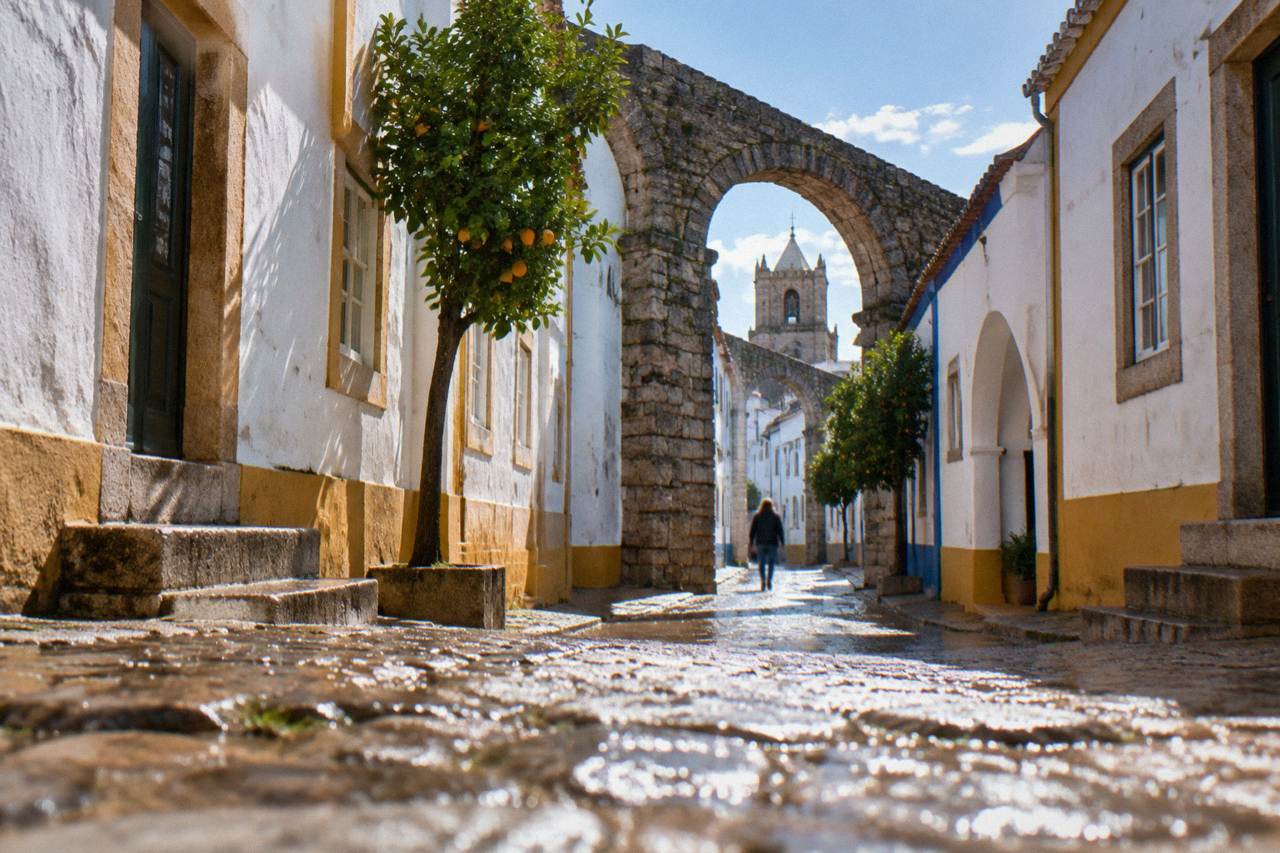
Évora, the capital of the Alentejo district of that name in southern Portugal, keeps its ancient past standing in the open air: a temple of granite columns beside the cathedral, bath remains folded into later buildings, and the arches of an aqueduct threading between the houses south of the centre. So the question of Roman aqueducts in Portugal has a two-part answer in this one city, and the distinction matters for anyone planning what to see. The Évora Travel Guide editorial desk lays out what the official pages actually say, and what to check before you go.
Are There Any Roman Aqueducts In Portugal?
Yes, Roman aqueducts were built in Portugal: the province the Romans called Lusitania was crossed by water channels, bridges and bath complexes, and fragments of that hydraulic network survive across the country. In Évora the answer is more specific. The arches every visitor photographs here, the Água de Prata, belong to a later era of Portuguese engineering, and the city's standout Roman monument is the Templo Romano, standing free in the open air beside the Sé.
That split is the heart of the matter. Roman Évora, Roman Ebora to its founders, was a city of temples, baths and walls, and the UNESCO inscription of the Historic Centre of Évora from 1986 explicitly names its Roman remains, under criteria (ii) and (iv). Criterion (iv) calls Évora the finest example of a city of the golden age of Portugal after the 1755 Lisbon earthquake, an earthquake Évora was largely spared, which is why so much older fabric survives here at all.
Aqueducts are a different story. Water did reach Roman towns by channel, but the tall, house-swallowing arches that run through Évora's streets today were raised long after the Romans left, when the city needed a new supply. Nothing about their date, length or builder appears on the municipal pages, so this article prints none of those figures. What a visitor can do is stand under them, free, at any hour, and see how the city literally grew around its water.
What Roman Engineering Survives In Évora Today?
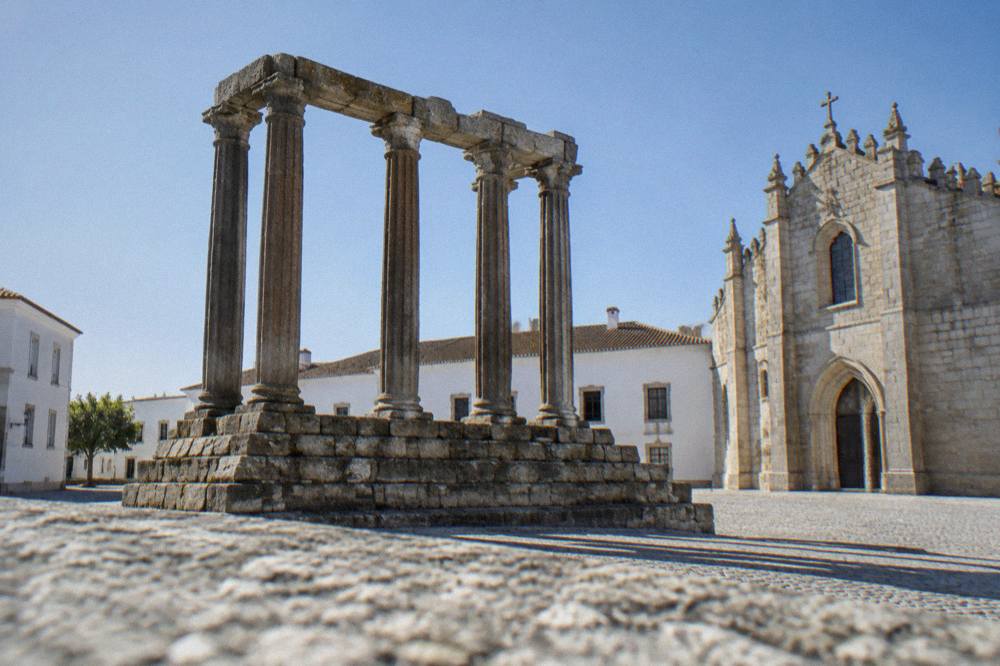
The Templo Romano, popularly called the Temple of Diana, is the centrepiece: the municipal page says it measures 25 x 15 m, was probably dedicated to the imperial cult rather than to the goddess Diana, and had its buried walls freed in 1870. Beyond the temple, Évora keeps Roman bath remains inside the historic centre, stretches of older defensive wall, and a UNESCO inscription from 1986 whose text names the Roman temple among the city's remains.
The temple's popular name is itself a piece of history. "Temple of Diana" has been in use since the 17th century, but the municipal page for the Templo Romano says the building was probably dedicated to the imperial cult, not to the goddess. It measures 25 x 15 m, it was reused for centuries as a municipal butcher's shop, and its walls were freed in 1870 under Cinatti. It is an open-air monument with no ticket or hours listed on the page, which in practice means you walk up to it whenever the square is open.
The wider Roman layer is easy to miss if you only tick off the famous sights. The ancient and Roman sites of Évora include the bath remains inside the historic centre and the wall fragments that later masons absorbed into medieval defences. Moorish rule in Évora ended in 1165, the Jesuit University of the Holy Spirit dates from 1553, and the Jesuits were expelled in 1759, so the city you walk is a stack of eras in which the Roman layer is the deepest and the least signposted.
| Sight | What the official pages say | Seeing it |
|---|---|---|
| Templo Romano | 25 x 15 m; probably dedicated to the imperial cult; "Temple of Diana" in use since the 17th century; walls freed in 1870 | Open-air monument, no ticket listed |
| Termas Romanas (Roman baths) | Remains within the historic centre | Check arrangements before visiting |
| Água de Prata | A later aqueduct carrying water into the city; no hours or ticket on the municipal pages | Visible from the street, any hour |
A half-day is enough to walk all three, and a local guide turns the stack of eras into a story. The Personal and Flexible Walking Tour in the Historic Center, from $13.51 per person and rated 4.8 from 105 reviews over 3 hours, is the budget-friendly way to do it, and you can Check availability on the operator's live listing.
Where To See The Água De Prata Aqueduct In Évora
The Água de Prata carries its arches through the streets on the southern side of Évora's historic centre, threading between and sometimes straight through the houses, and it can be viewed from the public street at any hour with no ticket and no gate. It is the aqueduct every visitor ends up photographing here, and it belongs to the period after the Middle Ages rather than to Roman Ebora.
The visual effect is the reason people assume it is Roman. Tall stone arches marching over a modern street look ancient in the way most people imagine antiquity, and comparisons with the great aqueducts of Mérida or Segovia come naturally. But dating a structure by its silhouette is exactly how travel myths get started, and the municipal pages publish no construction date, length or architect for the Água de Prata, so none belongs on this page either.
What the aqueduct does give you is a free walk. Follow the arches as they thread between the whitewisted, whitewashed houses and you cross some of the quietest lanes inside the walls, far from the Praça do Giraldo crowds. The structure is part of the everyday streetscape here: washing lines, doorways and satellite dishes all share the arches. Bring a camera for the stretch where the street narrows and the stonework closes overhead.
Pair the walk with the ticketed monuments nearby, since the aqueduct itself costs nothing.
| Monument | Official ticket |
|---|---|
| Sé de Évora, complete visit (cathedral, cloister, roof terrace, museum) | 5.00 EUR, children up to 12 free |
| Capela dos Ossos and Igreja de São Francisco museum areas | 7.00 EUR adult, 5.00 EUR youth to 25 and senior over 65, 15.00 EUR family |
| Museu de Évora | 8 EUR adult, closed Mondays |
| Évora Ticket | 8 EUR one day, 10 EUR two days, 12 EUR three days, free to age 12 |
Note the catch with the Évora Ticket: it does not include the Sé, the Capela dos Ossos or the Museu de Évora, so check what it covers against your own list before buying. The Capela dos Ossos keeps long hours, 9:00 to 18:30 in summer legal time and 9:00 to 17:00 in winter, and closes only on 1 January, Easter Sunday, the afternoon of 24 December and 25 December.
How Do You Reach Roman Évora From Lisbon?
CP's Intercidades timetable valid since 6 September 2026 lists six through trains from Lisboa Oriente to Évora, taking about 1 hour 40 to 1 hour 45 and costing 13.90 EUR in second class or 18.50 EUR in first. The trains call at Entrecampos, Sete Rios, Pragal, Pinhal Novo, Vendas Novas and Casa Branca, and no change is needed on these through services.
Lisbon is the gateway for almost every visitor, about 130 km away. The six daily departures below come straight from the CP timetable, though you should check the PDF's weekday remarks before locking a plan around a specific train, and the direct train question is answered in full on its own page.
| Depart Lisboa Oriente | Arrive Évora |
|---|---|
| 07:02 | 08:47 |
| 09:02 | 10:45 |
| 09:58 | 11:40 |
| 13:35 | 15:13 |
| 17:02 | 18:41 |
| 19:02 | 20:46 |
Once you arrive, everything Roman is walkable. The train station sits a short stroll from the walls, the Templo Romano stands beside the Sé in the centre, and the aqueduct arches are on the walking route between them. This is a compact city: the question of how much time you need in Évora usually resolves to one full day for the core sights and two if you add the megaliths or a wine trip.
Which Guided Tours Cover Roman Évora?
Three guided options cover the ground well: the Personal and Flexible Walking Tour in the Historic Center from $13.51 per person, the Medieval Tour of Évora on a Sidecar and Wine Tasting from $61.90, and the Tales and Legends Guided Walking Tour from $52.90, each rated 4.8 or better on its listing. A guide is the simplest way to keep the Roman, medieval and Renaissance layers of Évora in the right order.
The walking options make sense for the Roman core, because the temple, the baths and the aqueduct arches sit inside fifteen minutes of each other on foot. The sidecar tour adds a different pleasure: you cover the streets at open-air speed with a wine tasting folded in, which suits a hot afternoon when walking the plain feels ambitious. IPMA's 1991 to 2020 normals for the Évora station put the July mean maximum at 33.3 C and August at 33.5 C, with 31.9 days a year reaching 35 C or more, so summer touring rewards an early start.
The Tales and Legends walk, 2.5 hours and rated 4.8 from 40 reviews, leans into the stories rather than the dates, which pairs nicely with the harder facts of the temple and the museum. Whichever you choose, book the flexible walking tour early in your stay and use it to orient yourself; the rest of the city then unfolds on foot almost by itself.
Common Questions About Roman Évora
Is there a direct train from Lisbon to Évora?
Yes. CP's timetable valid since 6 September 2026 lists six through trains from Lisboa Oriente to Évora with no change needed, taking about 1 hour 40 to 1 hour 45. The second-class fare is 13.90 EUR and first class is 18.50 EUR.
What is Évora famous for?
A UNESCO-listed historic centre inscribed in 1986, the Templo Romano standing beside the cathedral, the Capela dos Ossos at the Igreja de São Francisco, and its role as the capital of the Alentejo. Évora is also a European Capital of Culture in 2027.
How much time do you need in Évora?
One full day covers the Templo Romano, the Sé with its roof terrace, the Capela dos Ossos and the aqueduct arches. Two days allow the Museu de Évora and a megaliths or wine half-day outside the walls.
Can I take a day trip from Lisbon to Évora?
Yes, and the train makes it easy: the 07:02 from Lisboa Oriente arrives at 08:47 and the 17:02 return-departure window fits a full day of sights, with the six through trains spread across the day for flexibility.
The short version: Portugal has Roman aqueducts in its past, Évora's own aqueduct is a later masterpiece you can walk beneath for free, and the Roman city itself is still standing at the Templo Romano, waiting in the open air beside the Sé.