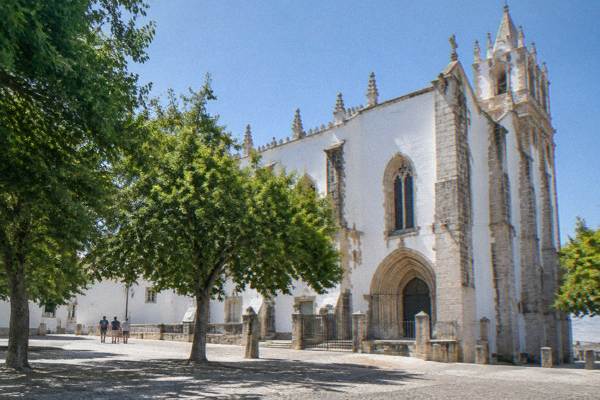
Jewish Quarter Of Évora
The Jewish quarter of Évora survives as a street pattern rather than a monument: lanes off the Praça do Giraldo, doorways and street names carrying a story of commerce, conversion and memory inside the UNESCO-listed walls.
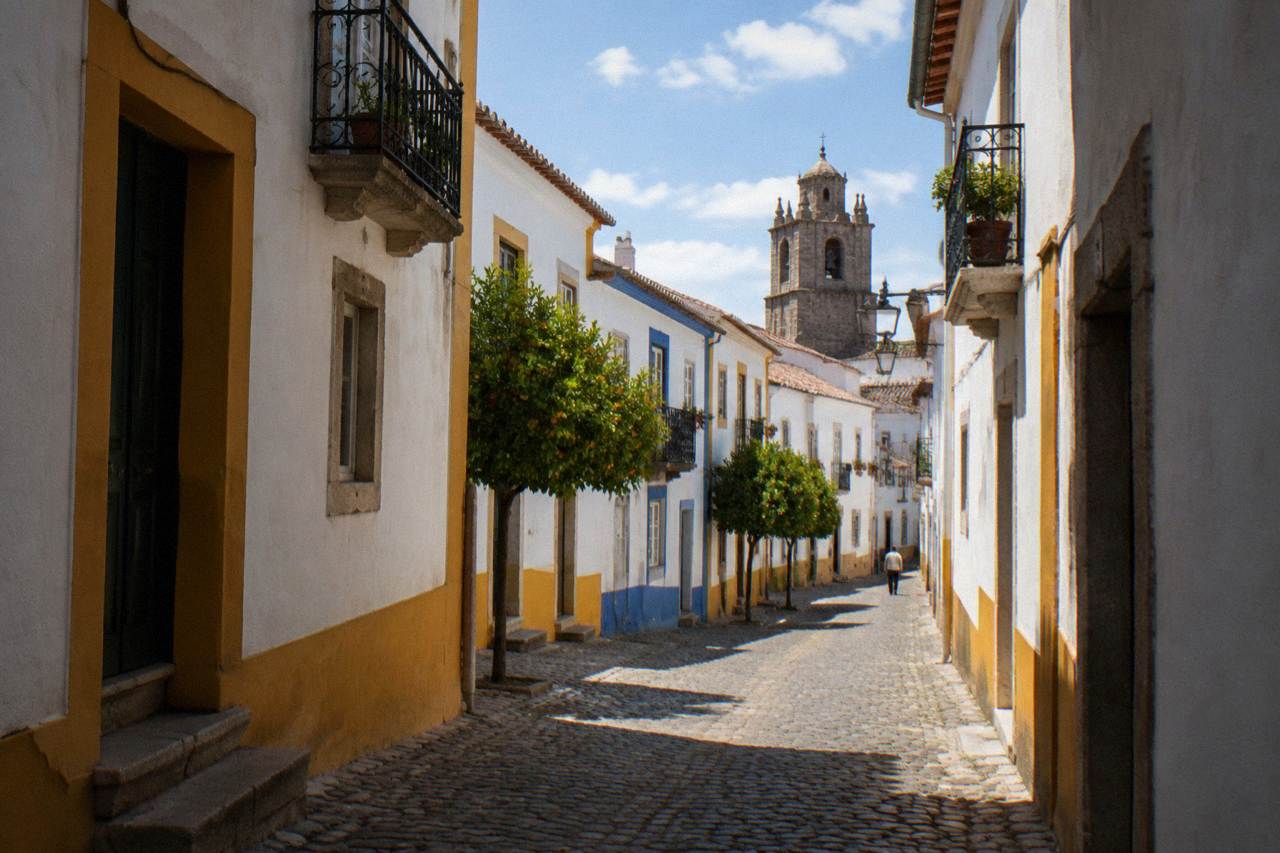
Short answer
The Jewish quarter of Évora sits in the lanes around the Praça do Giraldo inside the UNESCO-listed historic centre. It is free to walk, read through street names and layout rather than through a single building, and pairs naturally with the Sé, the Templo Romano and the Capela dos Ossos.
The Jewish quarter of Évora, the inland capital of Portugal's Alentejo, is not a gated enclave with an entrance fee and a boundary wall: it is a pattern of lanes, doorways and street names woven into the oldest part of the city, a short stroll from the arcades of the Praça do Giraldo. That pattern is exactly why the neighbourhood rewards a slow visit. Read the streets with a little context and the medieval city comes back into focus: the commercial lanes, the modest housing stacked above them, and the great monuments that rose all around. This guide covers where the quarter sits, what survives of it, how to walk it in the company of the Sé and the Capela dos Ossos, and how to fold it into the rest of a stay in the Alentejo.
Where Is The Jewish Quarter In Évora?
The Jewish quarter of Évora lies in the tangle of lanes immediately around the Praça do Giraldo, inside the UNESCO-listed historic centre of this inland Alentejo city, with the Sé and the Templo Romano only a short level stroll beyond it. There is no gate, no ticket office and no official boundary: the quarter is read through its street names, its doorways and the shape of its blocks, and the Praça do Giraldo is the natural place to start.
The centre of gravity is the square itself. The Praça do Giraldo is the city's living room, arcaded on its long sides, with a fountain at one end and café tables spilling across the cobbles for most of the year, and every lane that matters to the quarter's story runs off it or off the streets that radiate from it. The Giraldo Square guide covers the square itself in detail, from its role as the site of the city's market and its darker Inquisition-era gatherings to its present life as the place every visitor passes through sooner or later.
South and east of the square the streets narrow. The lanes that run down towards the Porta de Moura, among them streets whose names are usually explained by the money changers and traders who worked there, are commonly included in the footprint of the medieval judiaria, the quarter where the city's Jewish community lived, traded and worshipped within sight of the main square. Nobody will hand you a boundary map, and that is part of the point: this is a neighbourhood you read, not one you enter through a turnstile. The Porta de Moura square makes a good far marker for a wander through these lanes.
All of it sits inside the line of the old fortifications. Évora's walls, Roman in origin and rebuilt in the medieval period, still shape the historic centre, and the quarter's lanes sit well within them; the Roman and medieval walls of Évora explain how to read the surviving circuits. The whole ensemble has been on UNESCO's World Heritage list since 1986, inscribed under criteria (ii) and (iv), which is the strongest single reason the street pattern that carries the quarter's memory is still legible at all.
What Remains Of The Jewish Quarter Today?
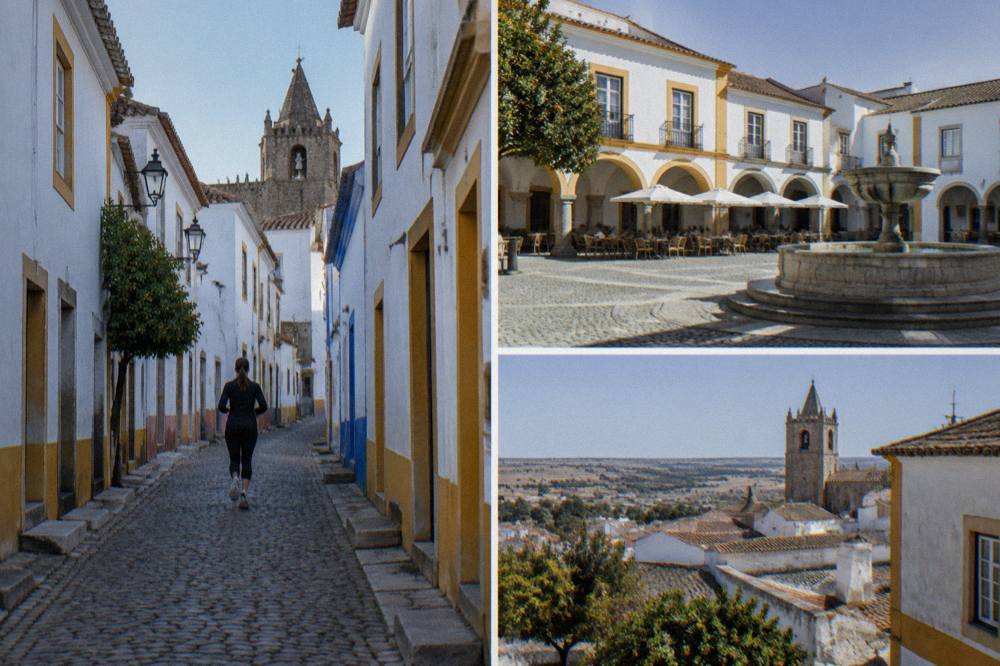
What survives today is urban fabric rather than a single showpiece: lanes, modest facades, framed doorways and street names that carry the memory of the medieval community, all inside a centre UNESCO inscribed in 1986 under criteria (ii) and (iv). The story is told by the street plan itself and by the monuments that grew up around it, from the Sé to the Igreja de São Francisco, rather than by one dedicated building.
UNESCO's criterion (iv) calls Évora the finest example of a city of the golden age of Portugal, a city largely spared by the 1755 earthquake that levelled so much of Lisbon. That sparing is why the quarter's lanes keep their pre-modern scale. Buildings were rebuilt and refronted over the centuries, but the blocks, the lane widths and the relationship between the commercial square and the residential tangle behind it were never flattened and replanned, which is precisely the fabric a visitor comes to read.
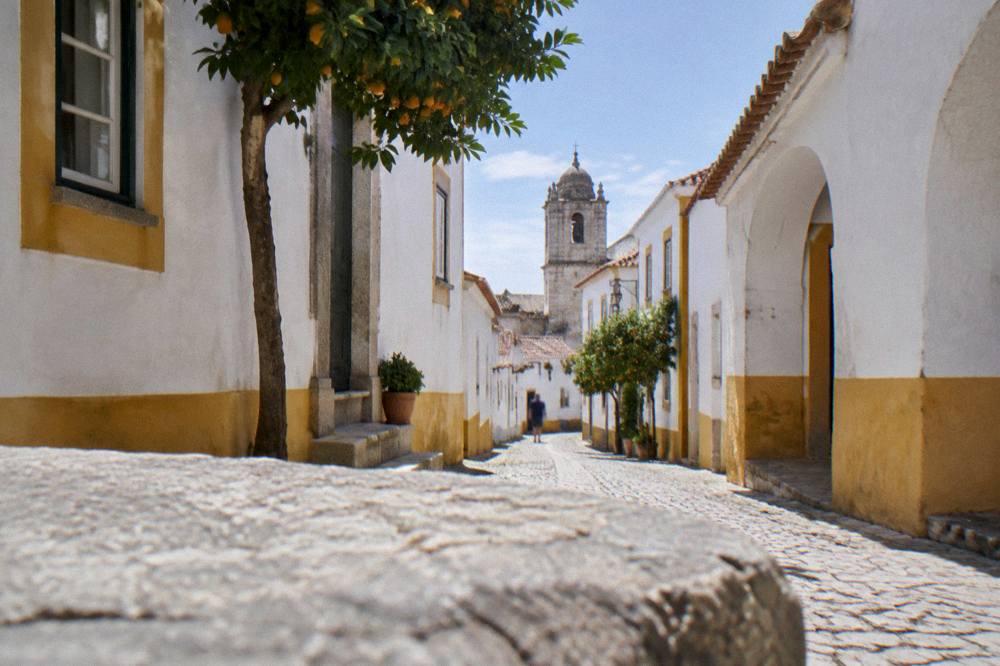
What that means in practice is a walk of small rewards. A granite or marble doorframe on a lane barely wide enough for two people. A street name that recalls coins or a trade. An upper floor jutting over a lane to catch the shade. Whitewash and ochre over walls that are older than either treatment. None of it announces itself, and a passer-by moving between the Sé and the Capela dos Ossos will walk through the middle of it without a flicker of recognition. This is the gap a guided walk fills, and the difference between passing through the quarter and actually seeing it.
It also means the quarter is free, open at all hours and owned by everyone who lives in it. The lanes are working streets, with washing on the lines and scooters parked against the walls, and the respectful visit is a quiet one: walk softly, look up, and let the residents get on with their lives.
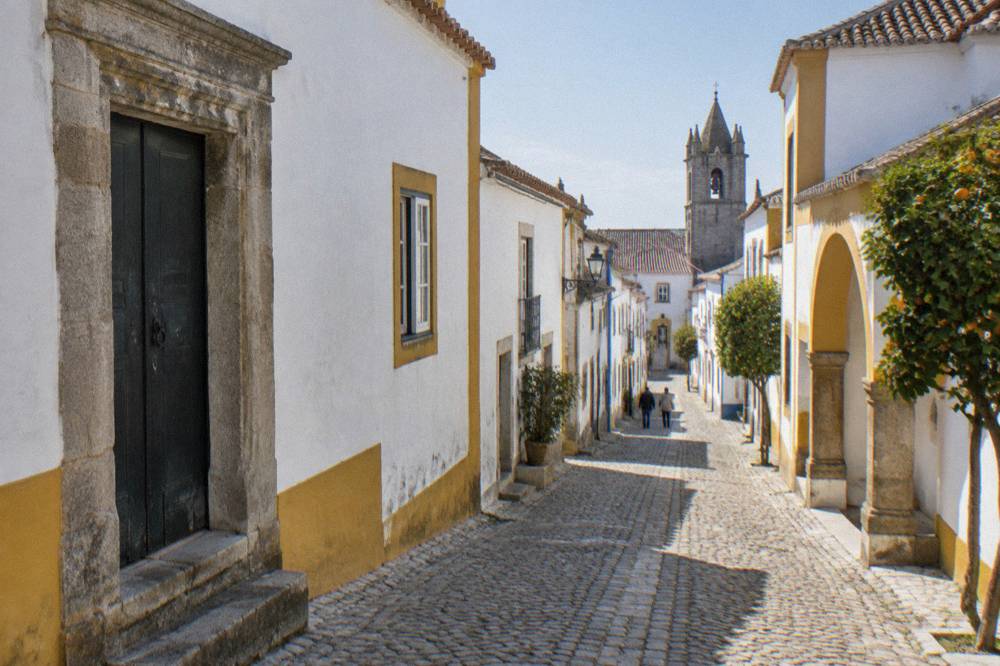
For visitors who want the old city explained rather than only explored, the guided options below all work: a small-group cultural walk that ends at the Capela dos Ossos, a private walk that adds the cathedral, and a sidecar tour that covers the medieval street plan on three wheels.
How Do You Walk The Jewish Quarter With The Rest Of The Old City?
A natural circuit starts on the Praça do Giraldo, works through the lanes of the old quarter towards the Porta de Moura, then continues to the Sé, the Templo Romano and the Convento dos Lóios before looping back past the Igreja de São Francisco and its Capela dos Ossos. Every stop sits inside the compact UNESCO centre, so the route links neighbouring monuments rather than crossing the city.
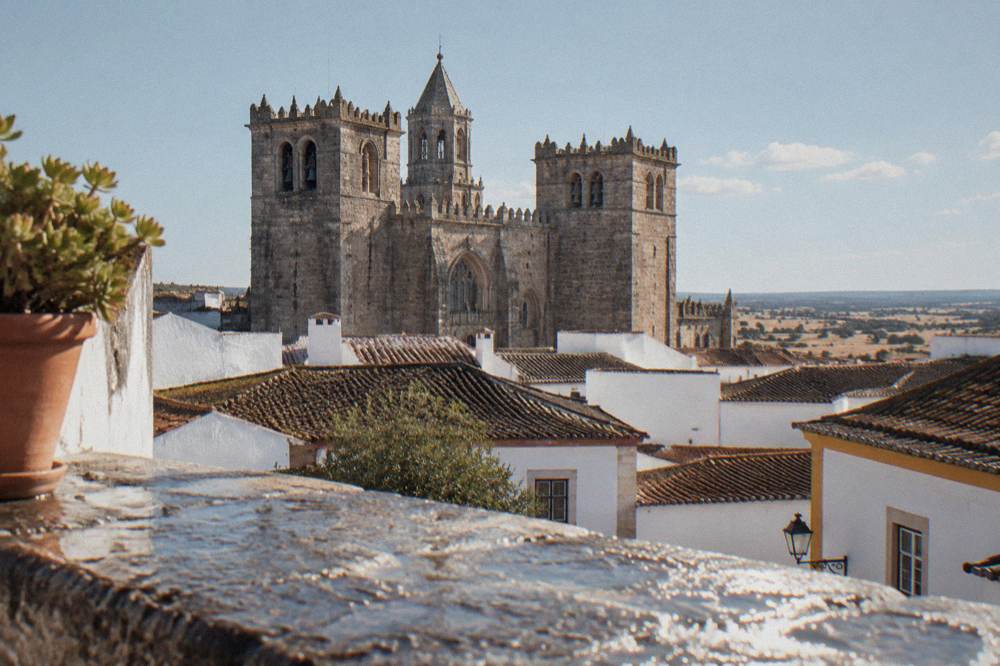
The logic of the walk is that the quarter and the monuments are one continuous piece of urban fabric, not two separate visits. Start on the square with a coffee and a look at the arcades. Then drop into the lanes south of the square and let them narrow around you; there is no wrong turn in a district this small, and the lanes all drain back towards the square or the walls eventually. Come back up to the high ground by the cathedral, where the Sé de Évora dominates the skyline with its fortress-like west front, and take in the Templo Romano on the way: the municipal page for the temple says it was probably dedicated to the imperial cult rather than to Diana, measures 25 x 15 m, and spent part of its later life reused as a butcher's shop before its walls were freed in 1870.
| Stop On The Walk | What It Is | What You Pay |
|---|---|---|
| Praça do Giraldo | Arcaded main square, the city's traditional heart | Nothing, a public square |
| Lanes of the old quarter | The street fabric of the medieval city | Nothing, public streets |
| Sé de Évora | Cathedral with cloister, roof terrace and museum | 5.00 EUR complete visit, children up to 12 free |
| Templo Romano | Open-air Roman temple, 25 x 15 m | No ticket listed on the municipal page |
| Convento dos Lóios | Convent church steps from the square | Ask at the entrance for the current situation |
| Igreja de São Francisco | Church housing the Capela dos Ossos | 7.00 EUR museum ticket, all museum areas |
From the temple, the Convento dos Lóios sits a few steps away, its official page currently showing its admission price as temporarily unavailable, so the honest instruction is simply to ask at the entrance. The loop then drops back downhill to the Igreja de São Francisco and its famous Capela dos Ossos, where one 7.00 EUR museum ticket covers the chapel and all the adjoining museum areas. Finish, if the legs are willing, along the line of the Água de Prata aqueduct, whose arches march through the gardens outside the walls and make a quiet coda to a morning in the lanes.
Visitors short on time can treat this circuit as the spine of a first day and hang everything else off it; the things to do in Évora overview puts the quarter in the context of the city's full range, from the megaliths to the wine routes.
What Happened To Évora'S Jewish Community?
Évora's Jewish community was one of the significant medieval communities of Portugal, living and trading in the lanes off the Praça do Giraldo until forced conversion dissolved the visible community into the wider city. Évora then became one of the seats of the Portuguese Inquisition, and the quarter's later story is one of converso families, suspicion and quiet persistence rather than of a neighbourhood that simply vanished.
In the medieval centuries the community was woven into the city's economy the way such communities were across Iberia: as traders, physicians, craftsmen and money changers, occupations that left their fingerprints on street names and on the commercial geography around the main square. A street whose name recalls the coin, in the heart of the old quarter, is usually read as the trace of the money changers who worked there. That commercial intimacy with the square is the reason the quarter's footprint is described where it is, wrapped around the city's busiest crossroads rather than pushed to its edge.
The rupture came with the forced conversions that ended open Jewish life in Portugal. Families that stayed became conversos, nominally Christian and watched accordingly, and the community's public identity dissolved into the wider population. Évora's weight in that story is heavy: the city hosted one of the tribunals of the Portuguese Inquisition, and the tribunal's presence shaped the city for generations. The Praça do Giraldo itself, today the scene of café tables and evening passeios, was in that era a place where the machinery of suspicion played out in public.
What makes the quarter worth walking now is that none of this erased the fabric. The lanes kept their names, their scale and their relationship to the square, and the layers beneath the whitewash stayed put. A visitor who knows the outline of the story reads the streets differently: not as a picturesque old neighbourhood, but as a document of coexistence, rupture and survival inside a city that UNESCO would eventually judge the finest surviving example of Portugal's golden age.
Which Guided Walks Cover The Jewish Quarter And The Old City?
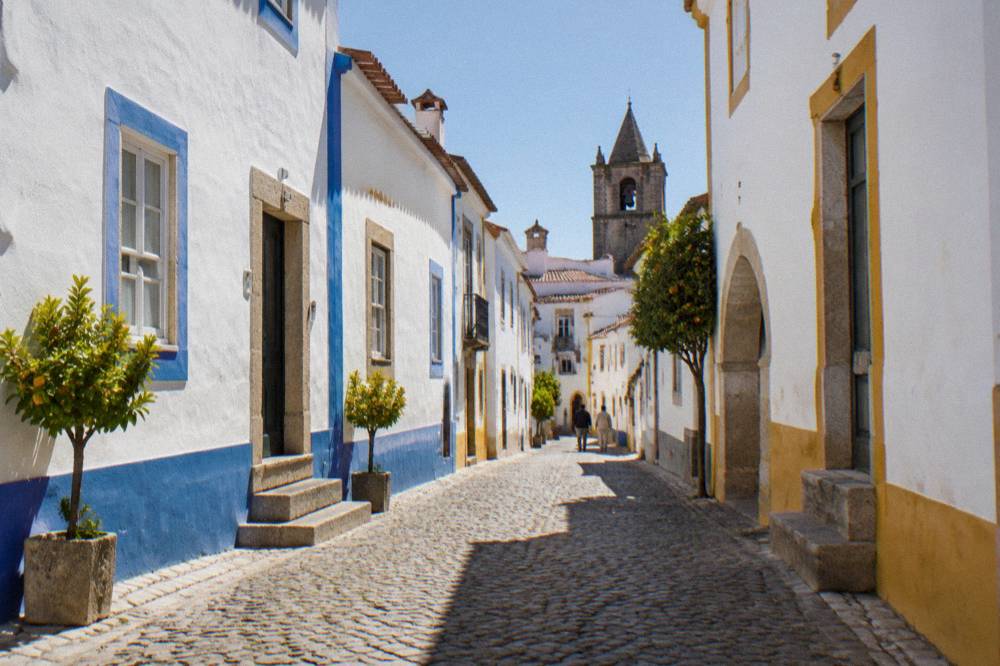
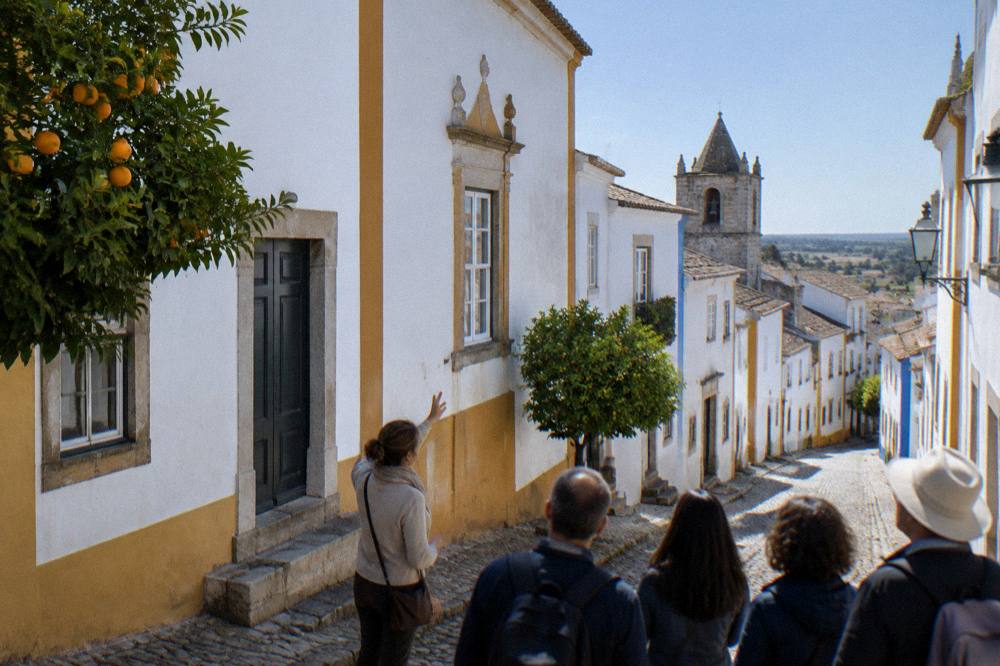
A guided walking tour is the most reliable way to have the quarter's street names and building fabric explained, because much of the story lives in details a passer-by misses. The small-group cultural walk pairs the old city with the Capela dos Ossos, a private walking version adds the Sé and its cloister, and a sidecar tour covers the medieval street plan with a wine tasting built in.
The natural first choice is the small-group cultural walking tour of Évora, a two-hour walk rated 4.9 from 141 reviews, from $77.66 per person, that works through the historic centre and finishes at the Capela dos Ossos with the chapel's story told by a guide rather than guessed from a plaque. For visitors who want the quarter's street names decoded and the bone chapel put in context in one move, it is the most direct option. Check availability before locking a date, since small groups fill first in the shoulder seasons.
| Guided Option | Length | From (Per Person) | Rating |
|---|---|---|---|
| Small-Group Cultural Walking Tour & Chapel of Bones | 2 hours | $77.66 | 4.9 from 141 reviews |
| Private Walking Tour with Cathedral & Chapel of Bones | 2.5 hours | $113.53 | 5 from 256 reviews |
| Medieval Tour of Évora on a Sidecar & Wine Tasting | 3 hours | $61.90 | 4.9 from 16 reviews |
| Tales and Legends Guided Walking Tour | 2.5 hours | $52.90 | 4.8 from 40 reviews |
The private alternative goes further on the monuments. The private walking tour with cathedral and chapel is rated a perfect 5 from 256 reviews and runs from $113.53 per person, taking in the Sé alongside the old city and the bone chapel with a guide to a single group.
For something less conventional, the sidecar tour of medieval Évora covers the same street plan from the bucket of a motorcycle sidecar, three hours with a wine tasting included, from $61.90 per person and rated 4.9 from 16 reviews. It suits visitors who want the lanes covered without the walking, or who want a story-heavy spin through the old city with a tasting at the end.
The budget end is well served too. The tales and legends walking tour runs 2.5 hours from $52.90 per person, rated 4.8 from 40 reviews, and leans into the city's stories, the kind of telling that makes a lane with an odd name suddenly mean something.
What Do The Monuments Around The Quarter Cost To Enter?
The Sé de Évora charges 5.00 EUR for one complete-visit ticket covering the cathedral, the cloister, the roof terrace and the museum, with children up to 12 free. The Capela dos Ossos museum ticket at the Igreja de São Francisco is 7.00 EUR for adults, 5.00 EUR for youth up to 25 and seniors over 65, and the Museu de Évora is 8 EUR. The Évora Ticket pass, 8 EUR for one day, includes none of those three.
The quarter itself costs nothing, so the budget question is really about the monuments around it, and the three big ones each sell a single ticket that bundles a lot. The Sé's complete visit is the best value of the three for visitors who want the roof terrace, since there is no cheaper roof-only tier on the official page. The Igreja de São Francisco's 7.00 EUR ticket is a museum ticket that covers all the museum areas, not just the bone chapel, and the church notes that as a private religious entity it does not apply state museum discounts. The Museu de Évora, founded officially in 1915 and housed in the former Archbishop's Palace, charges 8 EUR with 50% off for youth aged 13 to 24, seniors over 65 and the family ticket, and free entry to age 12.
| Site | Ticket Covers | Price |
|---|---|---|
| Sé de Évora | Cathedral, cloister, roof terrace, museum | 5.00 EUR, children up to 12 free |
| Igreja de São Francisco | All museum areas including the Capela dos Ossos | 7.00 EUR adult, 5.00 EUR youth to 25 and seniors over 65, 15.00 EUR family |
| Museu de Évora | Adult admission, former Archbishop's Palace | 8 EUR, 50% off for youth 13-24, seniors over 65 and families |
| Évora Ticket | One day, Cidade-Museu network sites | 8 EUR, free to age 12 |
| Évora Ticket | Two days | 10 EUR |
| Évora Ticket | Three days | 12 EUR |
The detail most first-time visitors miss is what the Évora Ticket does and does not reach. The pass, sold for the Cidade-Museu network at 8 EUR for one day, 10 EUR for two and 12 EUR for three, does not include the Sé, the Capela dos Ossos or the Museu de Évora. Anyone planning to walk the quarter and then visit those three should budget for their tickets separately, and treat the pass as covering the other network sites instead. The current network list can be checked at the tourist office on the Praça do Giraldo before anything is bought.
When Is The Best Time Of Year To Walk The Jewish Quarter?
Spring and autumn are the comfortable walking seasons: the 1991 to 2020 IPMA normals for the Évora station put the April mean maximum at 20.7 C and the October mean maximum at 24.1 C, against 33.3 C in July and 33.5 C in August. July averages only 2.7 mm of rain but 23.7 days at 30 C or more, so a summer visit wants the cooler hours of the morning.
The Alentejo is inland plains, and Évora behaves like it. There is no sea breeze to take the edge off a July afternoon, and the station's 1991 to 2020 record counts 31.9 days a year reaching 35 C or more, with the all-time recorded maximum of 45.4 C set on 4 August 2018. The lanes of the old quarter, narrow and whitewashed, hold their shade longer than the open squares, but a midsummer afternoon walk is still a hot business, and the guided walks that cover the quarter are best booked for the morning hours in that season.
| Month (1991 To 2020 Averages) | Mean Maximum | Mean Minimum | Rain Days (1 mm Or More) |
|---|---|---|---|
| January | 14.1 C | 4.5 C | 8.6 |
| April | 20.7 C | 8.5 C | 8.0 |
| July | 33.3 C | 15.6 C | 0.6 |
| October | 24.1 C | 12.3 C | 7.7 |
Winter is mild by northern European standards but wet by Alentejo ones, with 68.6 mm of rain on average in January spread over 8.6 days, and the lanes can run with water after a downpour. October sits close to the sweet spot, warm at 24.1 C on average by day, cooling to 12.3 C at night, with the first autumn rains arriving but not yet dominating. April is its mirror: 20.7 C by day, 8.5 C at night, the plains green from the winter rains and the walking at its easiest.
How Do You Reach Évora For A Jewish Quarter Visit?
Évora is about 130 km from Lisbon by road, and CP's Intercidades timetable valid since 6 September 2026 lists six through trains from Lisboa Oriente, taking about 1 hour 40 to 1 hour 45, with a second-class fare of 13.90 EUR and first class at 18.50 EUR. The trains call at Entrecampos, Sete Rios, Pragal, Pinhal Novo, Vendas Novas and Casa Branca before Évora, and no change is needed on the through services.
The train is the simplest way in for anyone starting from the capital. The six daily departures from Lisboa Oriente are spread across the day, from an early train that lands visitors in Évora before nine in the morning to an evening service, and the through trains require no change at Casa Branca, which was once the awkward junction on this line. Second class at 13.90 EUR each way is the standard choice; first class at 18.50 EUR buys wider seats and quieter cars on the same timings.
| Depart Lisboa Oriente | Arrive Évora |
|---|---|
| 07:02 | 08:47 |
| 09:02 | 10:45 |
| 09:58 | 11:40 |
| 13:35 | 15:13 |
| 17:02 | 18:41 |
| 19:02 | 20:46 |
Coaches also connect Lisbon and Évora, including services that start at the airport, and for travellers landing at Humberto Delgado the coach can beat the train for convenience by removing the transfer across Lisbon. Fares and timings vary by service and date, so the honest instruction is to check the operator's page for the specific day before booking. Drivers follow the A6 from Lisbon and should expect the last stretch of the approach to deliver the first sight of the walls and the aqueduct arches; parking is best settled before entering the old centre, whose lanes were not drawn with cars in mind.
Which Alentejo Towns Pair Well With The Jewish Quarter?
The quarter sits at the centre of a region built for slow touring: Arraiolos lies about 20 km away, Estremoz about 45 km, Vila Viçosa about 60 km, Elvas about 80 km and Marvão about 120 km, while Monsaraz is about 40 to 45 km to the southeast. Each town works as a day trip from Évora, and each adds a castle, a marble town or a wine route to a stay based in the city.
The Alentejo rewards visitors who treat Évora as a base rather than a box to tick, and the towns around it are close enough that a morning in the quarter and an afternoon in a hilltop village is a realistic day. Arraiolos, the nearest at about 20 km, pairs its hilltop castle with a tradition of embroidered rugs that has made its name across Portugal. Monsaraz, about 40 to 45 km away, is the region's postcard: a walled village above the plains, tiny, luminous and best entered on foot.
| Town | Distance From Évora | What It Adds |
|---|---|---|
| Arraiolos | about 20 km | A hilltop castle and a tradition of hand-embroidered rugs |
| Monsaraz | about 40 to 45 km | A walled village above the Guadiana plains, walked end to end in an easy stroll |
| Estremoz | about 45 km | A marble town with a hilltop castle and a lively market heritage |
| Vila Viçosa | about 60 km | A marble ducal town, seat of the house of Bragança |
| Elvas | about 80 km | A bastioned fortress town near the Spanish border |
| Marvão | about 120 km | A castle village perched on a high ridge, the farthest fling of the set |
Estremoz and Vila Viçosa share the marble that dressed so much of the region's architecture, including doorframes of the kind a visitor notices in Évora's own lanes, and both sit within an hour's drive through cork oak and olive country. Elvas and Marvão are the border pair, fortress towns with the longest journeys and the biggest payoffs, better saved for a full day than a half one. For everything else in the region, from the wine routes to the megaliths, Évora Travel Guide covers each town and each theme in its own guide.
How Does The Jewish Quarter Fit Into A Longer Stay In Évora?
The quarter is a morning's worth of walking at most, which leaves the rest of a stay free for the megaliths, the wine country and the towns of the Alentejo. A two-night base in Évora covers the old city and the quarter comfortably, a third night opens the cromlech and a wine route, and the guided options below cover the old city, the medieval lanes and the monuments in one booking.
The practical rhythm most visitors settle into is a first day given to the UNESCO centre, with the quarter's lanes folded into the walk between the Praça do Giraldo and the Sé, and a second day given to the region beyond the walls. The Cromeleque dos Almendres, the great stone circle out on the plains, is the signature second-day trip, and the wine and cork country around the city fills the other half of it. Visitors with a taste for the monastic side of the Alentejo can add the Cartuxa monastery and winery, whose estate sits just outside the city and whose wines carry the region's name furthest.
For the old city itself, the three guided options below are the ones that fit the quarter best: the small-group cultural walk that ends at the Capela dos Ossos, the sidecar tour of the medieval street plan, and the private walk that adds the cathedral and the cloister.
Whichever way the visit is built, the quarter asks for little and gives back a lot: an hour of slow walking, a willingness to read doorframes and street names instead of rushing between ticket windows, and a sense that the most interesting part of Évora is not any single monument but the city that holds them all.
Common Questions About The Jewish Quarter Of Évora
Is the Jewish quarter of Évora free to visit?
Yes. The quarter is a pattern of public streets and lanes around the Praça do Giraldo, with no gate, no ticket office and no boundary wall. The costs come only from the monuments around it, such as the 5.00 EUR complete-visit ticket at the Sé and the 7.00 EUR museum ticket at the Igreja de São Francisco.
Where exactly is the Jewish quarter in Évora?
It lies in the lanes immediately around the Praça do Giraldo, running down towards the Porta de Moura, inside the UNESCO-listed historic centre. There is no official boundary: the quarter is identified through its street names, its doorways and the shape of its blocks.
What can you actually see of the Jewish quarter today?
Lanes, modest facades, framed doorways and street names that carry the memory of the medieval community, inside a centre UNESCO inscribed in 1986. The story is told by the street plan and the monuments around it rather than by one dedicated building, which is why a guided walk adds so much.
Is a guided tour needed to appreciate the Jewish quarter?
A guide is not required, since the streets are free and public, but much of the story lives in details a passer-by misses. The small-group cultural walking tour, two hours from $77.66 per person and rated 4.9 from 141 reviews, works through the historic centre and finishes at the Capela dos Ossos with the stories told along the way.
How long does a walk through the Jewish quarter take?
The lanes themselves can be wandered in under an hour, since the district is small and every lane drains back towards the square or the walls. Most visitors fold the quarter into a half-day circuit that also takes in the Sé, the Templo Romano and the Capela dos Ossos.
When is the best time of day to walk the quarter in summer?
Early morning. The 1991 to 2020 IPMA normals for the Évora station put the July mean maximum at 33.3 C with 23.7 days a month at 30 C or more, and the narrow lanes hold their shade longer than the open squares, so the cooler hours are the comfortable ones.