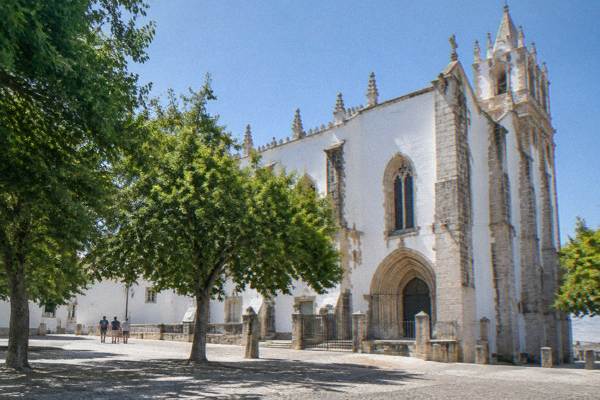
What Does Alentejo Mean In Portuguese?
The name Alentejo is usually explained as 'beyond the Tagus', and it tells you exactly where Évora, Portugal sits: on the great inland plain south of that river.
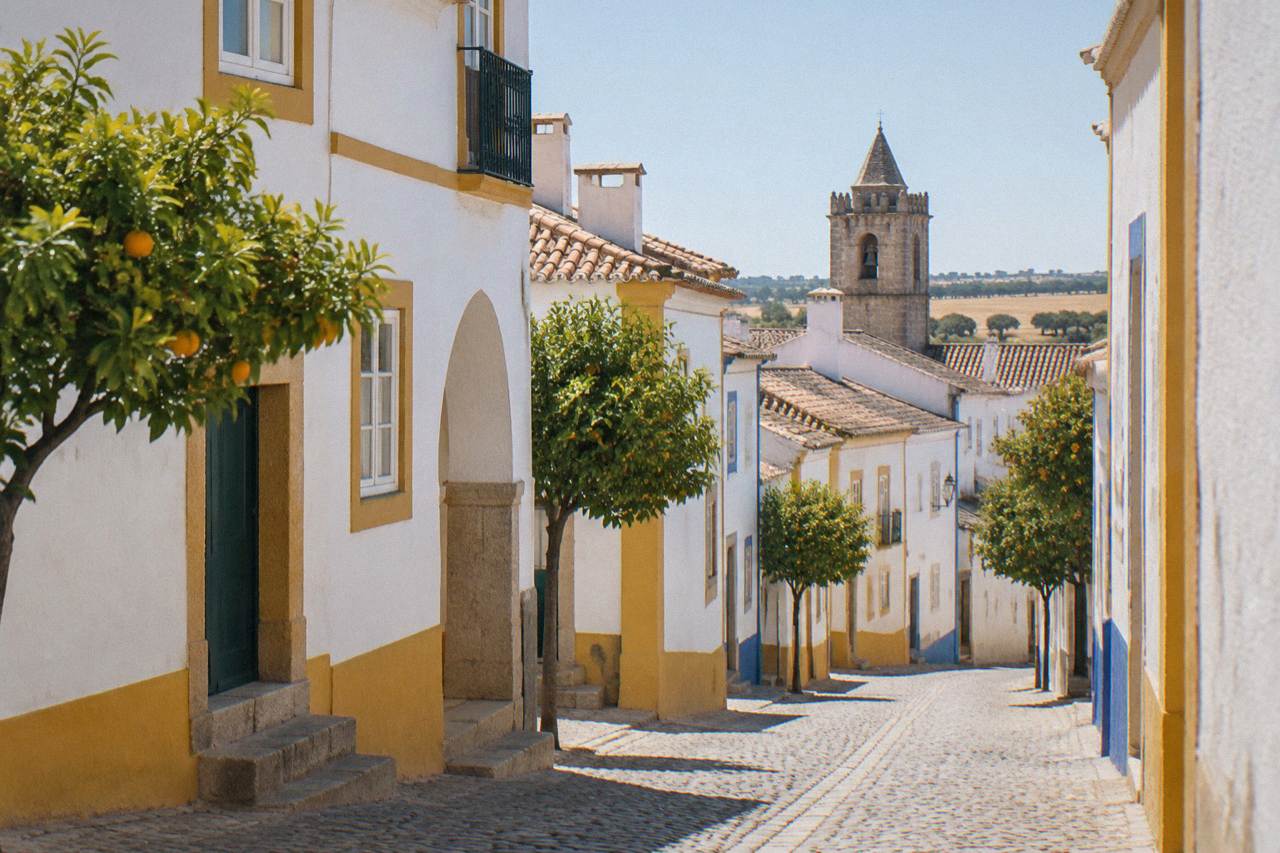
Alentejo is usually explained as "beyond the Tagus", and the name makes sense the moment you look at a map of Portugal. Évora, the capital of the district and of the Central Alentejo sub-region, sits inland on the plain that the Tagus river separates from the rest of the country, roughly 130 km, about, from Lisbon and about 90 km from the Atlantic. The word names a direction as much as a place: everything south of the great river, seen from the old capital on its north bank. This page explains what the name means, where the region begins, and why the city that anchors it grew so rich on land that outsiders once called empty.
What Does Alentejo Mean In Portuguese?
In Portuguese the name Alentejo is usually explained as "beyond the Tagus", from "além do Tejo", the phrase used from Lisbon's side of the river for the wide country south of it. The Tagus, the Tejo in Portuguese, cuts Portugal in half, and the Alentejo is everything on the far, southern bank: a vast inland plain of wheat, cork oaks, olive groves and vineyards, with Évora as its historic capital. No date and no philologist is attached to the explanation, which is simply the one Portuguese speakers give.
The structure of the word is plain to any Portuguese speaker. "Além" means beyond or on the other side of, and "Tejo" is the Tagus, the longest river on the Iberian peninsula. Put together and worn down over centuries of everyday speech, they give Alentejo: the land beyond the Tagus. It is a name that carries a viewpoint inside it, because "beyond" only makes sense from somewhere, and that somewhere was Lisbon and the court cities to the north.
That viewpoint shaped how the region was seen for a long time. From the north, the Alentejo looked like a frontier: flat, hot, thinly peopled, fought over with Moors and Castilians for centuries. The people who actually lived there saw something different, some of the richest farmland and finest marble in the country, and a network of towns, Évora chief among them, wealthy enough to build in white marble and golden limestone. The where the Alentejo sits in the country question is answered by the river as neatly as any border drawn on a map.
Where Is The Alentejo, And Where Does Évora Sit Inside It?
The Alentejo is southern Portugal's largest region, everything south of the Tagus and north of the Algarve, and Évora stands at its centre as capital of both the Évora district and the Central Alentejo sub-region. The city is inland: the Atlantic is roughly 90 km away, so there is no coast, no beach and no sea view anywhere in the municipality. About 53,000 people live in the municipality, at the 2021 count, on a plain that runs to cork forests and wheat in every direction.
Geographically the region is a huge, gently rolling plateau, hot and dry in summer, and Évora sits on a low rise in the middle of it. That rise, watered by the Água de Prata aqueduct, is why a city could grow here at all. The UNESCO-inscribed Historic Centre of Évora, listed in 1986 under criteria (ii) and (iv), preserves the golden-age Portugal that the 1755 Lisbon earthquake destroyed in the capital: UNESCO's criterion (iv) calls it the finest example of a city of that golden age, precisely because Évora was largely spared.
The distances that frame an Alentejo trip are all rounded, about figures: Arraiolos about 20 km from Évora, Estremoz about 45 km, Vila Viçosa about 60 km, Elvas about 80 km, Marvão about 120 km, and Lisbon about 130 km. They read as a ring of marble towns, hilltop castles and megalithic country around the capital, which is why so many visitors base themselves in Évora and radiate outward. The full Alentejo travel guide covers that ring in detail.
Why Is Évora Called The Capital Of The Alentejo?
Évora is the capital because it holds the region's administration, its university and its most complete historic monument set: it is the seat of the Évora district and of the Central Alentejo sub-region, and its walled centre, inscribed by UNESCO in 1986, carries the region's whole story in stone. Roman temple, Moorish street plan, medieval walls, a Jesuit university founded in 1553, marble from the region's own quarries: the city is the Alentejo in miniature, and every other town in the region is measured against it.
The claim is administrative fact, not marketing. The district of Évora is one of Portugal's eighteen, and the city is its seat. The University of Évora, the Jesuit University of the Holy Spirit, dates from 1553, and the Jesuits were expelled in 1759; the institution that stands today in the Colégio do Espírito Santo is the region's main centre of higher learning. Moorish rule in Évora ended in 1165, and the Templo Romano, popularly called the Temple of Diana, probably honoured the imperial cult rather than the goddess, according to the municipal page, which also records that its walls were freed in 1870 after centuries of being reused, even as a butcher's shop. More of these guides are collected on Évora Travel Guide.
| Alentejo Town | Rounded Distance From Évora | What It Is Known For |
|---|---|---|
| Arraiolos | about 20 km | Hand-stitched carpets and a hilltop round church |
| Estremoz | about 45 km | White marble quarries and a castle keep |
| Vila Viçosa | about 60 km | Ducal palace of the House of Bragança |
| Elvas | about 80 km | Star-fort walls, a UNESCO site in their own right |
| Marvão | about 120 km | A walled village perched on a granite ridge |
Each of those towns answers the question what the Alentejo is famous for in a different material: wool, marble, palace limestone, fortification granite. The thread is the same plain, the same hot summers, the same slow agricultural wealth that the name "beyond the Tagus" once dismissed as remoteness.
How The Name Meets You In Évora'S Streets
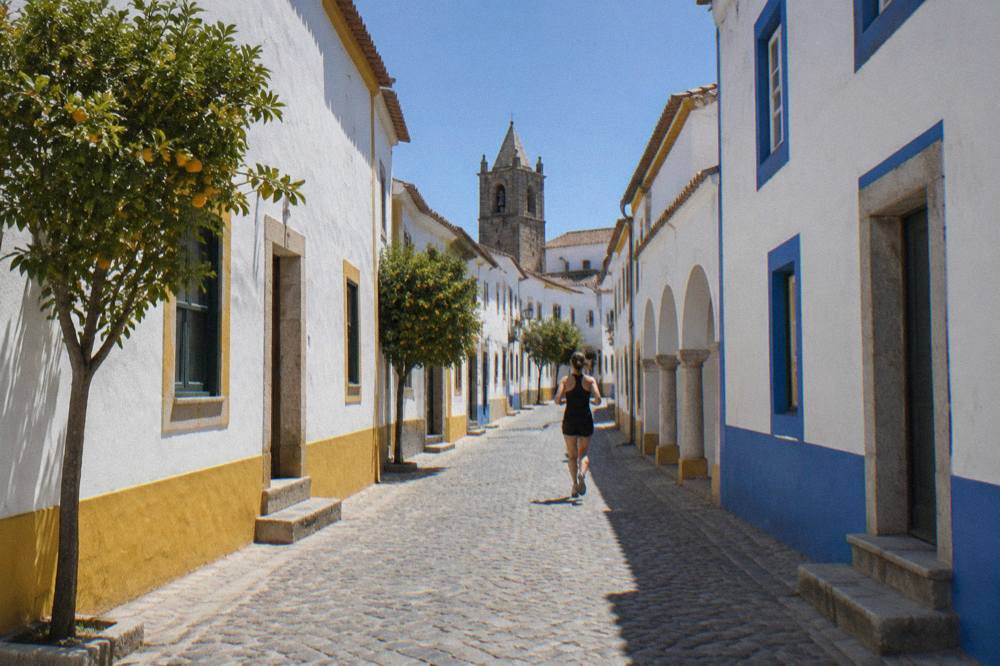
The meaning of Alentejo stops being a dictionary entry the moment you walk out of Évora's Praça do Giraldo: the plain the name describes is visible from the city's own walls, and the economy that plain created, wheat, cork, wine, marble and sheep's cheese, built the churches and palaces around you. The white limestone, the azulejo-covered facades, the cork oak montados outside the walls and the marble doorframes inside them are all products of the land beyond the Tagus, spent locally.
Summer explains the architecture as much as the name does. IPMA's 1991 to 2020 normals for the Évora station show July mean maxima of 33.3 C and August 33.5 C, and 31.9 days a year reaching 35 C or more; the record is 45.4 C, set on 4 August 2018. Whitewashed walls, thick stone, narrow streets and shaded cloisters are the Alentejo's answer to those numbers, and the question of which month to visit is really a question about heat. Rain is a winter thing here: the same normals show July averaging 2.7 mm and November 86.0 mm.
| Month | Mean Maximum (C), 1991-2020 | Mean Minimum (C), 1991-2020 | Precipitation (mm), 1991-2020 |
|---|---|---|---|
| January | 14.1 | 4.5 | 68.6 |
| April | 20.7 | 8.5 | 62.1 |
| July | 33.3 | 15.6 | 2.7 |
| October | 24.1 | 12.3 | 81.5 |
The plain also feeds the city literally. Alentejo bread, migas, açorda, lamb and pork dishes, and the sheep's cheese of the region all appear on menus inside the walls, and the region's wines, full-bodied reds from native grapes grown on exactly this plateau, carry the name on every label. The Alentejo food guide and the Alentejo wine guide follow those threads further, from the bread oven to the tasting room.
A guided walk is the most efficient way to see how the name translates into architecture, because the evidence is compressed inside walls you can cross in twenty minutes of easy walking. The flexible historic-centre walking tour, from $13.51 per person and rated 4.8 from 105 reviews, is the budget end of that idea; Check availability on the operator's live listing if that fits your plans.
The cork forest deserves its own word here, because it is the single most Alentejo landscape of all. A two-hour walk in a cork forest from Évora, from $71.10 per person and rated 4.7 from 43 reviews, puts you inside the montado, the grazed oak woodland that covers the plain beyond the Tagus and gives Portugal its cork. The medieval sidecar tour with wine tasting, from $61.90 per person and rated 4.9 from 16 reviews, covers the same story from the saddle, city walls first, plain afterwards.
Common Questions About The Alentejo Name
What does alentejo mean in portuguese?
The name is usually explained as "beyond the Tagus", from "além do Tejo". It names the region south of the Tagus river, the great inland plain of southern Portugal whose historic capital is Évora.
Is Alentejo a city or a region?
It is a region, the largest in Portugal, covering everything between the Tagus and the Algarve. Évora, with about 53,000 residents in its municipality, is its capital city and the usual base for visiting it.
Is Évora in the Alentejo?
Yes. Évora is the capital of both the Évora district and the Central Alentejo sub-region, inland on the plain, about 130 km from Lisbon and roughly 90 km from the Atlantic coast.
What is the Tagus?
The Tagus, the Tejo in Portuguese, is the longest river on the Iberian peninsula. It flows through Toledo and Lisbon and forms the northern boundary of the Alentejo, which is why the region's name means "beyond" it.
What language is spoken in the Alentejo?
Portuguese, as everywhere in Portugal. The Alentejo has its own accent and vocabulary, slower and with distinctive vowels, but the name of the region is the one word every visitor already meets in the language itself.
Why is the Alentejo associated with slowness?
The region's own cultural programme says it: Évora's 2027 European Capital of Culture preparation year is built on the concept of "Vagar", a local word for moving slowly and taking one's time, which the plain's distances and heat have always encouraged.
The name Alentejo, in the end, is a direction that became a place. Everything the word points to, the wheat, the cork, the marble, the heat and the slow golden plain, is waiting inside and around the walls of Évora, the city the region calls its capital.