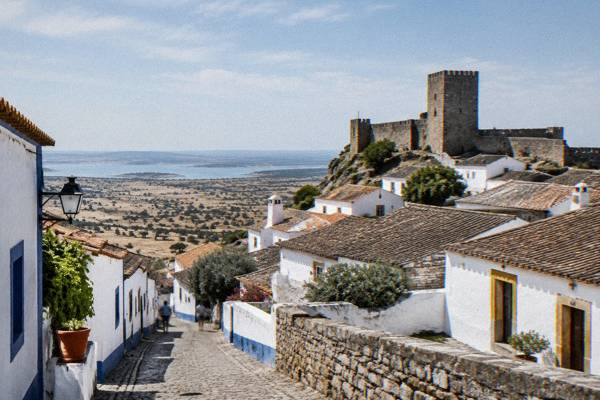
Is Évora Worth A Day Trip From Lisbon?
Is Évora worth a day trip from Lisbon? A direct answer with 2026 train times and fares, monument ticket prices, climate data and honest advice on going alone or with a tour.
Évora is a walled university city in the Alentejo region of Portugal, about 130 km by road from Lisbon, and the question of whether it repays a day trip has a short answer: it does, for reasons the timetable and the ticket offices make plain. The city's historic centre was inscribed by UNESCO in 1986, under criteria (ii) and (iv), and criterion (iv) calls it the finest example of a city of the golden age of Portugal, preserved because Évora was largely spared the 1755 earthquake that reshaped Lisbon. That inheritance sits inside walls you can cross on foot in under half an hour.
What makes the day trip work is the combination of density and distance. A Roman temple stands open to the sky in the middle of town. A cathedral sells one ticket that covers its cloister, roof terrace and museum. The Capela dos Ossos sits a few streets away, attached to the Igreja de São Francisco. None of this needs a car once you arrive, and the trains from Lisbon run often enough that the question becomes one of pacing rather than possibility.
Is Évora Worth A Day Trip From Lisbon?
Yes, Évora earns a day trip from Lisbon more convincingly than almost any other inland city in Portugal, because its UNESCO-listed historic centre concentrates a Roman temple, a Gothic cathedral with a roof terrace, the Capela dos Ossos and a university square into a walkable core, and CP's 2026 timetable lists six through trains from Lisboa Oriente taking about 1 hour 40 to 1 hour 45 at 13.90 EUR second class.
The case rests on what you get per hour travelled. Lisbon day-trippers usually weigh Évora against Sintra, Óbidos or Cascais, and those coastal choices trade distance for crowds. Évora trades them for space: a plain city of about 53,000 people in its municipality, inland, with no sea anywhere near it, the Atlantic lying roughly 90 km away.
The city is also honest about what it is. Moorish rule ended here in 1165, the Jesuit University of the Holy Spirit dates from 1553, and the Jesuits were expelled in 1759. Those layers are visible in the street plan, not staged for visitors. The rest of Évora Travel Guide breaks the individual monuments down in depth, but the short version is that a first visit delivers a Roman temple, a fortress cathedral and a bone chapel within ten minutes' walk of one another.
For anyone weighing the broader question, can you take a day trip from Lisbon to Évora covers the mechanics, and the itinerary page for one day in Évora sequences the sights hour by hour.
How Do You Get From Lisbon To Évora?
CP lists six through Intercidades trains a day from Lisboa Oriente to Évora in the timetable valid since 6 September 2026, departing at 07:02, 09:02, 09:58, 13:35, 17:02 and 19:02 and arriving at 08:47, 10:45, 11:40, 15:13, 18:41 and 20:46, a journey of about 1 hour 40 to 1 hour 45, with the fare at 13.90 EUR second class and 18.50 EUR first class.
The trains call at Entrecampos, Sete Rios, Pragal, Pinhal Novo, Vendas Novas and Casa Branca, and no change is needed on these through services. The CP PDF carries weekday remarks that are worth a glance on cp.pt before you commit to a specific departure, because service patterns can carry exceptions the summary does not show.
| Depart Lisboa Oriente | Arrive Évora |
|---|---|
| 07:02 | 08:47 |
| 09:02 | 10:45 |
| 09:58 | 11:40 |
| 13:35 | 15:13 |
| 17:02 | 18:41 |
| 19:02 | 20:46 |
That spread of departures is the quiet argument for the day trip. An early train puts you inside the walls before most shops open, and the afternoon services give you a way back after dinner. The full detail, including what a direct service means on this line, is in is there a direct train from Lisbon to Évora, and the rail-focused planning page at Lisbon to Évora by train covers tickets and stations.
Coaches also run the route, though no fare or timetable is published here for them; check the operator's page before booking. Driving is the third option, and the parking guide for the city explains where to leave a car, though most day-trippers arriving by train never need one.
What Can You See In Évora In One Day?
The realistic one-day core is the Sé de Évora with its cloister, roof terrace and museum for a 5.00 EUR complete-visit ticket, the Capela dos Ossos museum at 7.00 EUR adult, the open-air Templo Romano, Praça do Giraldo, and the Museu de Évora at 8 EUR, which closes on Mondays, all inside or on the edge of the walled centre.
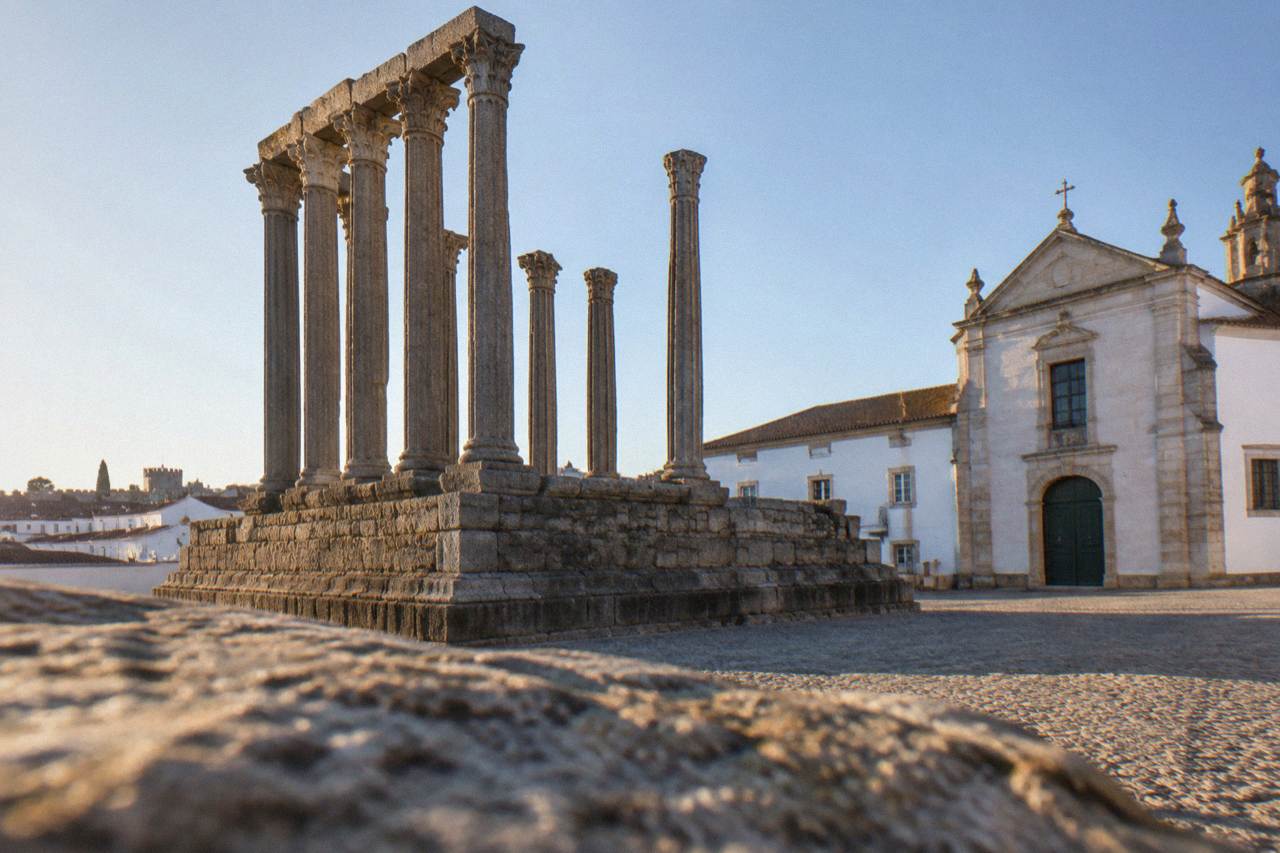
Start with the geometry. The Templo Romano, popularly called the Temple of Diana, stands beside the Sé, and the municipal page says it was probably dedicated to the imperial cult rather than to the goddess, a name applied only since the 17th century. It measures 25 x 15 m, was reused for centuries as a municipal butcher's shop, and had its walls freed in 1870. It is an open-air monument with no ticket listed, so it costs nothing but time.
The Sé sells one ticket for everything: cathedral, cloister, roof terrace and museum, 5.00 EUR, children up to 12 free with a parent or guardian, open 9:00 to 17:00. The Capela dos Ossos, inside the Igreja de São Francisco complex, charges 7.00 EUR for adults, 5.00 EUR for youth up to 25 and seniors over 65, and 15.00 EUR for a family ticket, open 9:00 to 18:30 in summer and 9:00 to 17:00 in winter, every day except 1 January, Easter Sunday, the afternoon of 24 December and 25 December. The church notes it is a private religious entity and does not apply State Museum discounts.
| Sight | Adult ticket | Notes |
|---|---|---|
| Sé de Évora, complete visit | 5.00 EUR | Cloister, roof terrace and museum included; children up to 12 free |
| Capela dos Ossos museum | 7.00 EUR | Youth to 25 and seniors over 65 at 5.00 EUR; family 15.00 EUR |
| Museu de Évora | 8 EUR | Closed Mondays; youth, seniors and families 50% off |
| Évora Ticket, one day | 8 EUR | Also 10 EUR for two days, 12 EUR for three days |
| Templo Romano | No ticket listed | Open-air monument |
One warning worth the ink: the Évora Ticket, the multi-site pass for the Cidade-Museu network, does not include the Sé, the Capela dos Ossos or the Museu de Évora. Buying it expecting those three would be the most common way to waste 8 EUR in this city. Read the network list on the pass's own page before deciding.
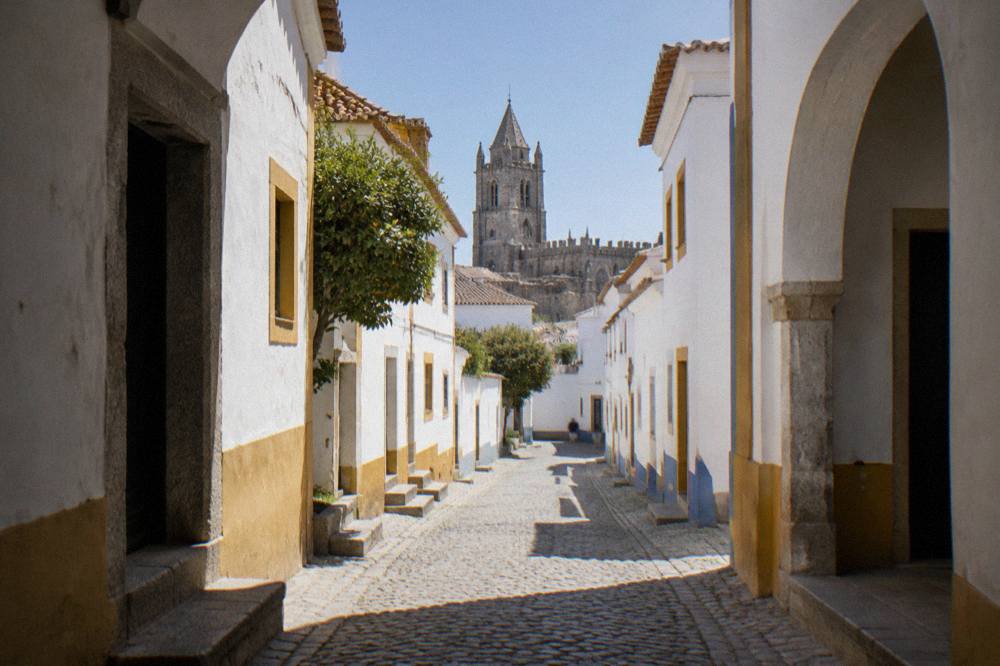
Beyond the headliners, Praça do Giraldo is the main square and the natural midpoint of any walk, and the Água de Prata aqueduct cuts through the eastern side of town. If the bone chapel is the thing pulling you here, is the Chapel of Bones worth visiting answers that question on its own terms. For a fuller ordering of the day, what to do in Évora for a day lays out a sequence.
How Much Does An Évora Day Trip Cost?
Counting the return rail fare at 13.90 EUR second class each way and entry to the Sé and the Capela dos Ossos at 5.00 EUR and 7.00 EUR, a self-guided day trip from Lisbon costs roughly 40 EUR per adult before lunch, while guided small-group day trips from Lisbon run from about $65 per person with transport and a guide included.
The independent version is cheap because the expensive parts, the monuments, are not expensive. A traveller who skips the paid interiors and walks the walls, the temple precinct, Praça do Giraldo and the university square spends nothing beyond the train fare. The Museu de Évora adds 8 EUR, and free Sundays apply to residents in Portugal, not to foreign visitors.
The guided version prices differently. A small-group Évora and Monsaraz tour with wine tasting from Lisbon starts at $65.31 per person, and the small-group winery and bones-chapel version starts at $89.45. Those prices are in US dollars on the operators' listings and include the drive from Lisbon, which removes the train connection, the parking question and the pacing decisions in one stroke. Whether that convenience is worth the premium depends on how much of the Alentejo you want beyond the walls, since several of these trips continue to Monsaraz or a winery rather than returning straight to Lisbon.
A municipal tourist tax applies to overnight stays, but a day trip never pays it, and no amount is published here. Food in Évora is the remaining variable; no restaurant detail appears on this page, so budget from what you would spend in Lisbon and check any tavern's posted menu before sitting down.
When Is The Best Time Of Year For An Évora Day Trip?
Spring and autumn are the best seasons, because IPMA's 1991 to 2020 normals for the Évora station show July averaging a maximum of 33.3 C and August 33.5 C, with 31.9 days a year reaching 35 C or more and a record of 45.4 C on 4 August 2018, while April, May, September and October combine mean maxima of 20.7 to 29.5 C with modest rainfall.
The Alentejo plain is inland and there is no sea to moderate it. What the normals actually show, month by month, is a city that is genuinely cold in winter, with a January mean minimum of 4.5 C, and genuinely hot in summer. The table below pulls the months a day-tripper is most likely to be choosing between.
| Month | Mean maximum (C), 1991 to 2020 | Days with 1 mm or more of rain |
|---|---|---|
| April | 20.7 | 8.0 |
| May | 25.0 | 6.0 |
| July | 33.3 | 0.6 |
| August | 33.5 | 0.7 |
| September | 29.5 | 3.6 |
| October | 24.1 | 7.7 |
Two readings follow. If heat does not deter you, July and August are the driest months on the sheet, with under one rainy day each on average, and the stone streets empty during the midday hours. If you would rather walk comfortably, May and late September trade a few degrees for the same near-empty rain columns.
The calendar adds one more reason to look at 2026 and 2027. Évora is a European Capital of Culture in 2027, promoted by an executive board led by the municipality, with 2026 running as a preparation year built on the concept of "Vagar". The GUADIANA festival of Afro-Ibero-American literatures runs 9 to 11 October 2026 with 28 authors from nine countries, and the Feira de São João filled the Rossio de São Brás from 23 June to 5 July 2026. The full 2027 programme is not yet published, so check the official calendar rather than assuming dates.
Should You Take A Guided Tour From Lisbon Or Go On Your Own?
Going independently is straightforward because six through trains a day and a walkable centre remove the usual friction, but a guided day trip from Lisbon suits travellers who want the megaliths, the wineries or Monsaraz bundled into the same day, since sites like the Cromeleque dos Almendres sit well outside the city and are awkward without a car.
The honest dividing line is the megalithic question. The Almendres cromlech and the Great Dolmen of Zambujeiro lie in the countryside around Évora, and the Almendres Interpretation Centre in the village of Guadalupe keeps summer hours of 10:00 to 18:00 from 1 May to 31 October and winter hours of 10:00 to 17:00, but reaching the stones by public transport from a day trip's tight schedule is not realistic. A tour that starts in Lisbon and carries you there solves it.
The featured option on this page is the Évora and Megaliths Full-Day Tour from Lisbon, an 8-hour trip rated 4.7 from 576 reviews, starting at $90.04 per person. It is a Lisbon-start product: you are collected in the capital, shown Évora's historic centre, and taken on to the stones, which is the sequence that makes both halves possible in one day.
If you arrive by train and want a guide only inside the city, the guided options below cover that case too, from a 2.5-hour tales-and-legends walk to a general history walk. GuruWalk also lists free, tip-based walks of the historic centre led by local gurus, including a 2-hour essential tour rated 4.93 from 774 reviews, which is a way to get an orientation before spending anything.
For travellers whose day trip is really about the wider Alentejo, the comparison worth making is not Évora against nothing but Évora against the region's other draws. The pages on Monsaraz and the wider best day trips from Lisbon set out those alternatives, and is the Alentejo worth visiting answers the regional question directly.
Whichever way you build the day, the decision that matters most is the departure you choose from Lisboa Oriente, because everything else in Évora is close enough to walk to.
Common Questions About An Évora Day Trip From Lisbon
Is Évora worth a day trip from Lisbon?
Yes. The UNESCO-listed centre is compact enough to see its main monuments on foot in a day, and CP's 2026 timetable lists six through trains each way taking about 1 hour 40 to 1 hour 45, so the travel cost in time is low for what the city offers.
How far is Évora from Lisbon?
About 130 km by road, on the Alentejo plain inland from the capital. The rail journey takes about 1 hour 40 to 1 hour 45 on the through Intercidades services.
Do you need a car in Évora?
No. The walled centre is fully walkable and the main monuments sit within a few minutes of one another. A car only becomes useful for megalithic sites and country towns such as Monsaraz or Estremoz.
What does the Évora Ticket include?
It is the multi-site pass for the Cidade-Museu network, at 8 EUR for one day, 10 EUR for two and 12 EUR for three, free to age 12. It does not include the Sé de Évora, the Capela dos Ossos or the Museu de Évora, so check the network list on the pass's page before buying.
Is the Museu de Évora open every day?
No. It opens Tuesday to Sunday, 9:30 to 13:00 and 14:00 to 17:30, and closes on Mondays as well as 1 January, Easter Sunday, 1 May, 29 June and 25 December. An adult ticket is 8 EUR.
The short version stands: six trains a day, a wall's worth of monuments inside a walkable core, and a plain that rewards whoever steps off at Évora's station with an hour or two of patience.