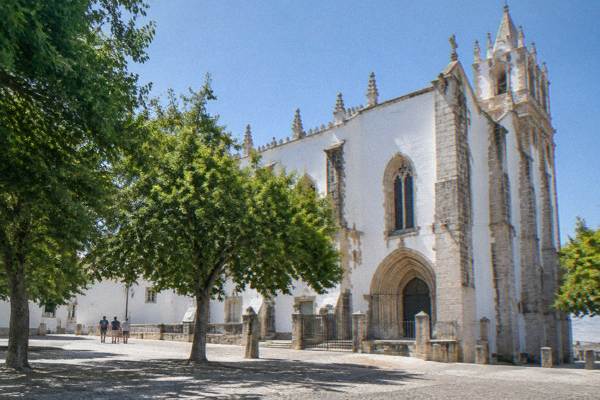
What Is Special About Évora, Portugal?
Évora, Portugal is special for its UNESCO-listed historic centre, Roman temple, Capela dos Ossos and Alentejo setting. Here is what makes the city unique.
Évora, the capital of the Alentejo region of Portugal, is a small inland city where a Roman temple, a medieval cathedral, a Renaissance university and a chapel lined with human bones stand within a few minutes' walk of one another. The Atlantic is roughly 90 km away, so the setting is a hot, dry plain of cork oaks and wheat rather than a coast, and the city's golden limestone glows in a light that feels closer to Andalusia than to Lisbon. About 53,000 people live in the municipality, yet the historic core inside the walls is compact enough to cross on foot in well under an hour. That concentration is the short answer to why Évora keeps drawing visitors, and the rest of this page unpacks it in detail.
What Is Special About Évora, Portugal?
What makes Évora special is an unmatched density of history inside intact walls: a UNESCO World Heritage historic centre inscribed in 1986, a Roman temple standing in the main square, a cathedral with a roof terrace, a Renaissance university and the Capela dos Ossos, all walkable in a compact city of about 53,000 people, set on the hot, dry Alentejo plain with no coast and no crowds on the scale of Lisbon or Porto.
The city's nickname, "museum city", is not marketing. The Câmara Municipal's own tourism material describes Évora as a cidade-museu because the historic centre functions as an open-air collection of two thousand years of building, from Roman Évora through Moorish rule, which ended in 1165, to the golden age of Portugal that UNESCO's criterion (iv) names. The Jesuit University of the Holy Spirit, founded in 1553, still operates in its original college building, and the Jesuits were only expelled in 1759, long after the city's peak.
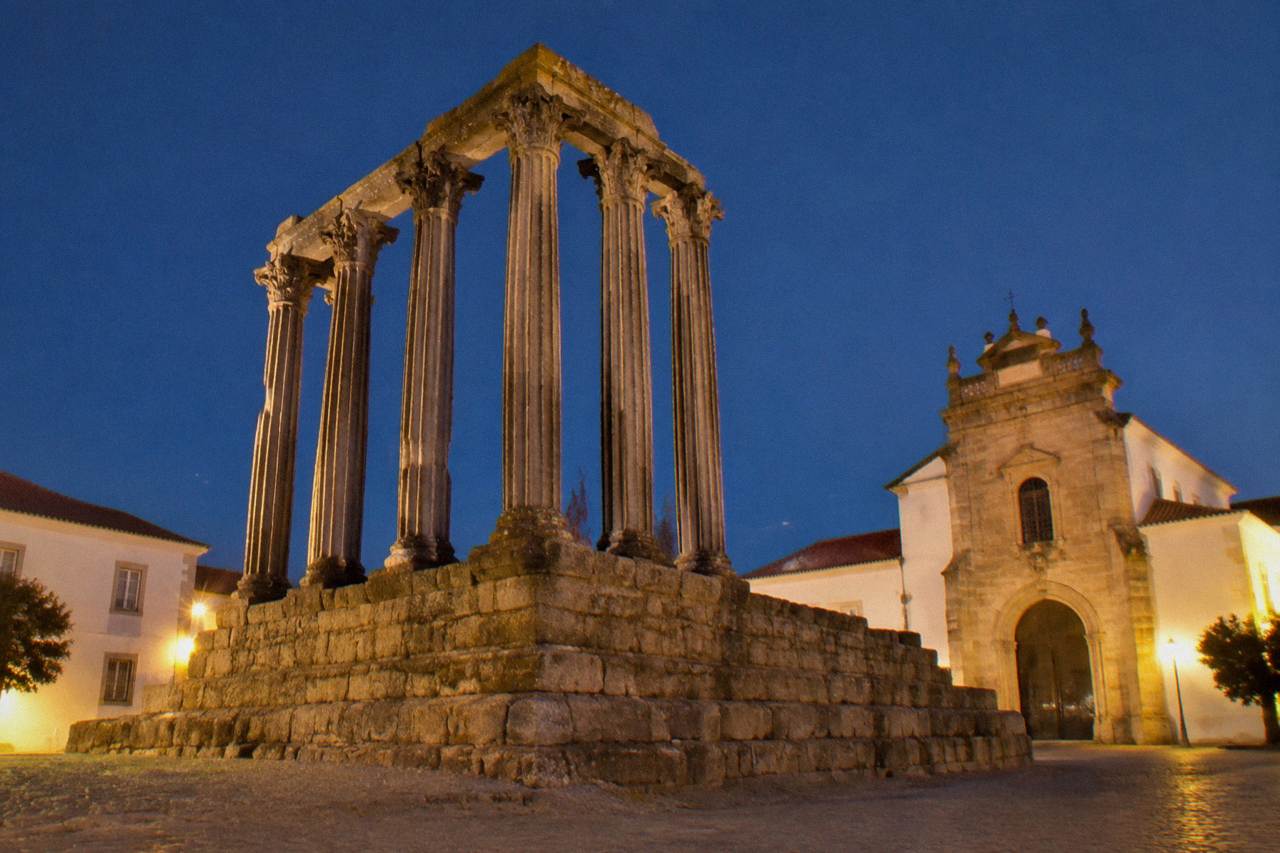
There is also a layering you can physically see. The Templo Romano, popularly called the Temple of Diana, rises beside the cathedral; the municipal page notes the temple was probably dedicated to the imperial cult rather than to the goddess, that it measures 25 x 15 m, that it was reused as a municipal butcher's shop for centuries and that its walls were only freed in 1870. A Roman aqueduct, the Água de Prata, still runs into the city with houses built into its arches. Few European cities of this size offer that range without a car.
For a first visit, the Évora Travel Guide overview of things to do in Évora maps the full list of monuments, and the question of how much time you need in Évora matters more than in most cities, because the sights are close together but each deserves more than a glance.
Why Is Évora A UNESCO World Heritage City?
The Historic Centre of Évora was inscribed on the UNESCO World Heritage list in 1986 under criteria (ii) and (iv). Criterion (iv) describes it as the finest example of a city of the golden age of Portugal, preserved because the 1755 Lisbon earthquake largely spared Évora, leaving intact a townscape of Roman, Moorish, medieval and Renaissance monuments unmatched elsewhere in the country.
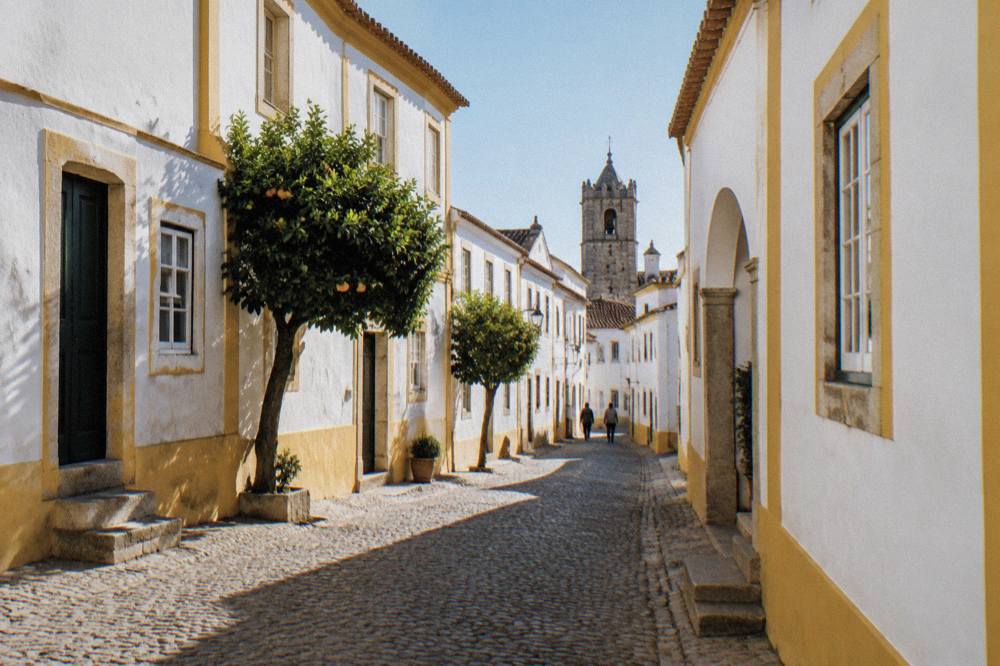
Criterion (ii) recognises the exchange of influences the city absorbed: Roman Ébora, the Moorish period that ended in 1165, and the Portuguese royal court that made Évora a favoured residence in the era UNESCO's own listing calls the golden age of Portugal. The inscription covers the historic centre as a whole rather than a single monument, which is why the walls, the narrow streets and the whitewashed houses with their yellow and blue trim matter as much as the individual landmarks.
What the listing means practically for a visitor is that the old town is protected from demolition and unsympathetic change. Streets stay narrow, buildings stay low, and the view from the cathedral's roof terrace across terracotta roofs to the plain beyond has no modern towers interrupting it. The must-see attractions in Évora are almost all inside this listed zone, so a single hotel base puts the whole World Heritage area on foot.
| Monument | What the official pages state | Ticket |
|---|---|---|
| Sé de Évora | One complete-visit ticket covering cathedral, cloister, roof terrace and museum; children up to 12 free | 5.00 EUR |
| Capela dos Ossos / Igreja de São Francisco | One museum ticket for all areas, adult price, youth to 25 and seniors over 65 at 5.00 EUR, family 15.00 EUR | 7.00 EUR |
| Museu de Évora | Tue-Sun 9:30-13:00 and 14:00-17:30, closed Mondays, adult ticket | 8 EUR |
| Évora Ticket | Multi-site pass, one day 8 EUR, two days 10 EUR, three days 12 EUR, free to age 12; does not include the Sé, the Capela dos Ossos or the Museu de Évora | 8-12 EUR |
| Templo Romano | Open-air monument, no ticket listed on the municipal page | Free to view |
The Évora Ticket is worth understanding before buying, because it covers the Cidade-Museu network of smaller sites rather than the three biggest paid attractions, and the difference surprises visitors who assumed otherwise.
What Monuments Make Évora Famous?
Évora is famous above all for the Capela dos Ossos, the chapel whose interior walls are lined with human bones, attached to the Igreja de São Francisco; for the Templo Romano; for the Sé de Évora with its roof-terrace view; and for the Água de Prata aqueduct, whose arches have houses built into them. Together these four define the city's image.
The Capela dos Ossos is the one sight most visitors arrive specifically for, and the question is the Chapel of Bones worth visiting divides people honestly: it is small, it is intense, and the Igreja de São Francisco's own page states that a single 7.00 EUR museum ticket covers the chapel, the chapter room, the nativity collection and the terraces, open daily in summer from 9:00 to 18:30 and in winter from 9:00 to 17:00, closed only on 1 January, Easter Sunday, the afternoon of 24 December and 25 December. The church notes it is a private religious entity and does not apply State Museum discounts, which matters to holders of Portuguese museum passes.
The Sé, the largest cathedral in Portugal by some measures of its footprint, sells one 5.00 EUR complete-visit ticket covering the church, the cloister, the roof terrace and the museum, with children up to 12 free. The roof terrace is the best vantage point over the listed town, and there is no separate cheaper roof-only ticket, so budget for the full price.
Beyond the headline four, the Museu de Évora, housed in the former Archbishop's Palace and founded officially in 1915, holds the city's art collection, and the University of Évora's Renaissance college, with its tiled cloister, is a Jesuit foundation of 1553. The Templo Romano's story is itself part of the city's charm: the municipal page records that the name Temple of Diana only dates from the 17th century, that the building was probably dedicated to the imperial cult, and that it spent centuries as a butcher's shop before being cleared in 1870.
How Far Is Évora From Lisbon And How Do You Get There?
Lisbon is about 130 km from Évora, and CP's Intercidades trains cover the direct route from Lisboa Oriente in about 1 hour 40 to 1 hour 45, with a second-class fare of 13.90 EUR and first class at 18.50 EUR. Six through trains a day run on the timetable valid since 6 September 2026, so the city works as a day trip or an overnight base.
The train is the usual recommendation: it is direct, it avoids Alentejo summer motorway heat, and it arrives within walking distance of the walls. The question of whether there is a direct train from Lisbon to Évora is answered plainly by the CP timetable, which lists departures from Lisboa Oriente at 07:02, 09:02, 09:58, 13:35, 17:02 and 19:02, arriving in Évora at 08:47, 10:45, 11:40, 15:13, 18:41 and 20:46. Coaches also run from Lisbon, but no verified fare can be stated here, so check the operator's own site before booking.
Whether the city works as a day trip from the capital is a fair follow-up, and the honest answer is that it does, with a trade-off: the Évora day trip from Lisbon question is answered in detail elsewhere, but the short version is that the train times above give a comfortable ten hours in the city if you take the 07:02 out and the 19:02 back.
| Month | Mean max (C) | Mean min (C) | Days with 1 mm+ rain |
|---|---|---|---|
| April | 20.7 | 8.5 | 8.0 |
| May | 25.0 | 10.9 | 6.0 |
| June | 30.2 | 13.8 | 1.7 |
| July | 33.3 | 15.6 | 0.6 |
| August | 33.5 | 16.0 | 0.7 |
| September | 29.5 | 14.6 | 3.6 |
| October | 24.1 | 12.3 | 7.7 |
Those are IPMA's 1991-2020 climate normals for the Évora station, and they explain two things about the city: why summer visits start early in the morning, and why spring and autumn are the sweet spots. Évora records 31.9 days a year at 35 C or more, with an all-time high of 45.4 C on 4 August 2018, so the Alentejo heat is a real planning factor, not a footnote.
What Makes The Alentejo Setting Special?
Évora's setting is special because it sits on the open Alentejo plain, an inland region of cork oaks, vineyards, marble towns and megalithic stones, roughly 90 km from the Atlantic, so the city works as a compact base for exploring a region most Lisbon itineraries skip entirely.
The Alentejo is Portugal's largest region by area and its least densely populated, and Évora is its capital in every sense: administrative, cultural and culinary. Each of these is a genuine day trip, and the rounded distances are the only honest way to quote them.
The region's food and wine identity also centres on Évora. Alentejo reds, made largely from native grape varieties, are among Portugal's most decorated, and the city's restaurants serve the region's bread-based, pork-heavy cooking. Cork is the other signature: the Alentejo produces most of the world's cork, and the landscape around Évora is the montado, the cork-oak woodland harvested in nine-year cycles, which several local tours visit directly.
Culturally, the city is about to step onto a bigger stage. Évora and the Alentejo are a European Capital of Culture in 2027, the fourth Portuguese city to hold the title, with a preparatory 2026 programme built around the concept of "Vagar", or taking one's time. The Feira de São João, the city's great annual fair, ran from 23 June to 5 July 2026 on the Rossio de São Brás under the telling theme "Évora: Capital Europeia ao Sul". The full 2027 programme is not yet published, which is itself a reason to check the official calendar before planning a visit that year.
Common Questions About Évora
What Is Special About Évora, Portugal?
Évora's special quality is concentration: a UNESCO World Heritage historic centre inscribed in 1986, a Roman temple, a cathedral with a roof terrace, a bone chapel and a Renaissance university, all inside intact walls in a small city on the Alentejo plain, about 130 km from Lisbon and reachable by direct train in under two hours.
Is Évora Worth Visiting Compared With Sintra?
The two answer different needs, and the which is better, Sintra or Évora comparison is worth reading in full. In short, Sintra offers palaces and hills close to Lisbon; Évora offers a complete historic city, fewer queues and a regional food and wine culture Sintra cannot match.
What Is Évora Most Famous For?
The Capela dos Ossos is the single most famous sight, followed by the Templo Romano and the UNESCO-listed old town. The fuller answer to what Évora is famous for covers the food, the university and the aqueduct as well.
How Many Days Should You Spend In Évora?
One full day covers the historic centre's headline monuments; two days allow the museums at a civilised pace plus a megaliths or wine half-day trip. The how much time you need in Évora page breaks the options down by itinerary.
Is Évora A Good Base For The Alentejo?
Yes. Direct trains from Lisbon, a walkable centre and day-trip distances to Monsaraz, Estremoz, Vila Viçosa and the Almendres cromlech make it the region's most practical base, and the Alentejo's own case is set out in is Alentejo worth visiting.
Whatever draws you there, the chapel, the temple or the plain itself, Évora rewards the same thing its 2027 Capital of Culture programme is built around: taking your time.