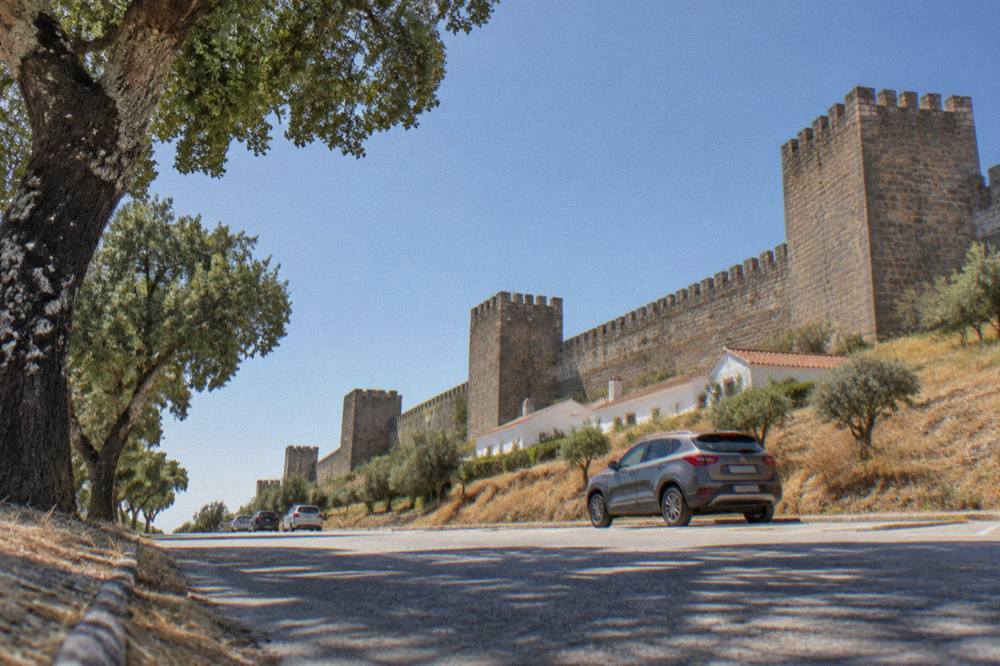
Arraiolos Day Trip From Évora
Arraiolos sits about 20 km from Évora, close enough for an easy half-day or full-day escape from the Alentejo's capital, and it is the town Portugal associates with hand-embroidered wool carpets.
Short answer
Arraiolos is a small Alentejo hill town about 20 km from Évora, known for its hand-embroidered carpets, a hilltop castle, and whitewashed streets. It works as a half-day trip on its own or as part of a loop with Estremoz and Vila Viçosa.
Arraiolos is a small town in the Central Alentejo, about 20 km from Évora, and it is the place Portugal thinks of first when it thinks of carpets. The tapetes de Arraiolos, hand-embroidered wool rugs stitched stitch by stitch on frames, have made this quiet hill town's name across the country, and the craft still shapes its streets, shops, and rhythm of life. For anyone using Évora as a base, which is how most visitors experience the Alentejo, Arraiolos is the easiest excursion on the map: close, compact, and different enough from the UNESCO-listed historic centre to feel like a genuine change of scene. This Évora Travel Guide article sets out what the town offers, how to think about getting there, and how to fold it into a wider loop of the Alentejo's marble and market towns.
Why Visit Arraiolos On A Day Trip From Évora?
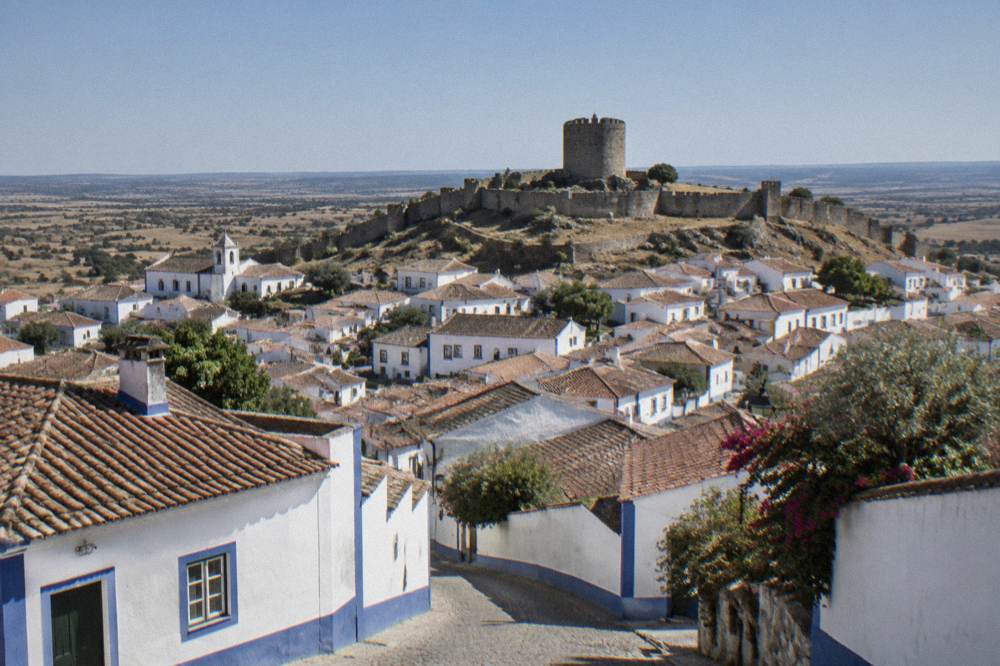
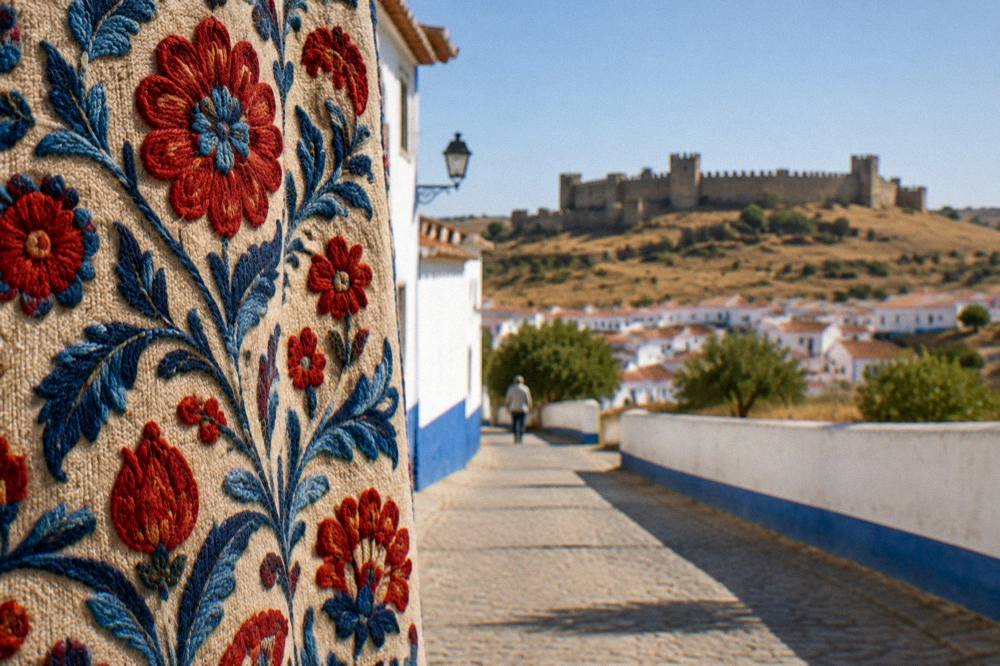
Arraiolos rewards a day trip because it compresses the Alentejo into one small, walkable town: a hilltop castle with a rare round keep, whitewashed lanes with coloured trim, and a living carpet-making tradition you can see in workshops and shops around the main square. It lies about 20 km from Évora, the closest of the region's classic excursion towns, so it costs the least travel of any day out from the city.
The town's scale is its charm. Évora is a district capital with a cathedral, a university, and a UNESCO inscription covering its whole historic centre; Arraiolos is a town you can wander in a morning. That contrast is exactly what makes it work as a day trip. You leave the monuments behind and spend a few hours in a place whose identity is a craft rather than a castle-and-church itinerary, though it has a castle too, and a striking one.
The keep at Arraiolos is round, which is unusual among Portuguese hilltop fortresses and gives the skyline a silhouette visitors remember. The walls sit above the town, and the walk up delivers the wide Alentejo plain in every direction: cork oaks, olive groves, wheat fields, and the low white sprawl of the town itself. No ticket price or opening hours for the castle are published in the verified sources for this page, so check locally on arrival rather than planning around a schedule.
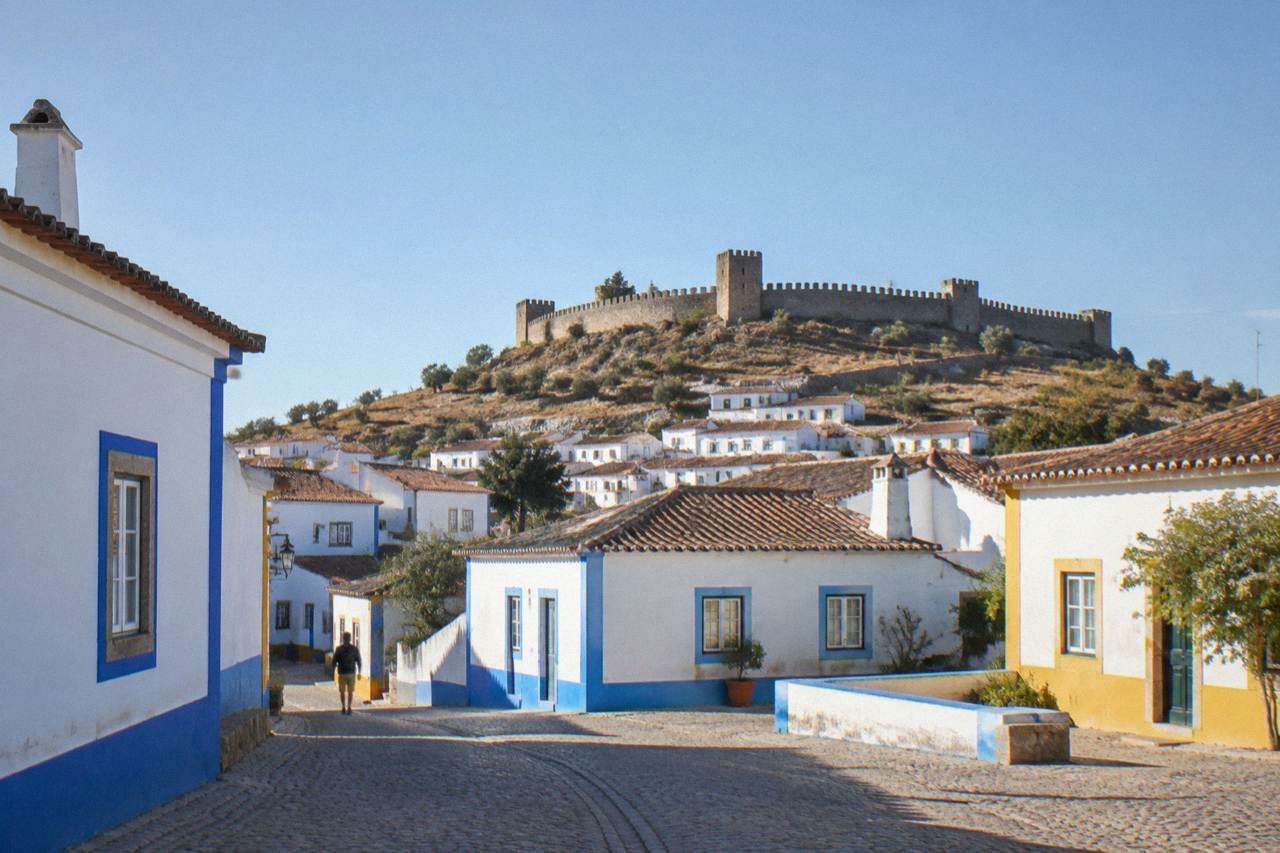
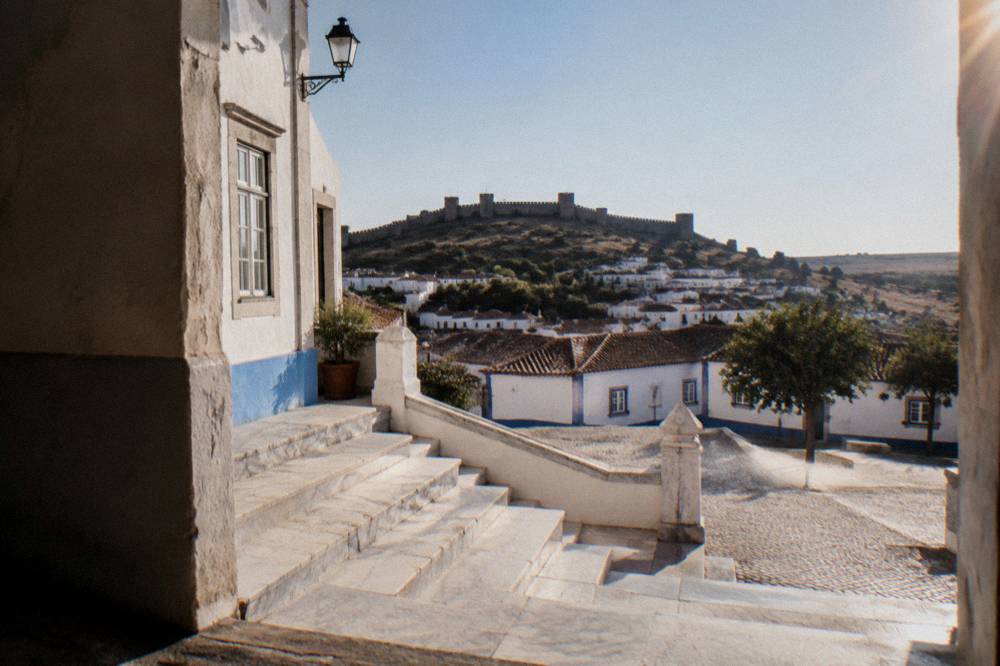
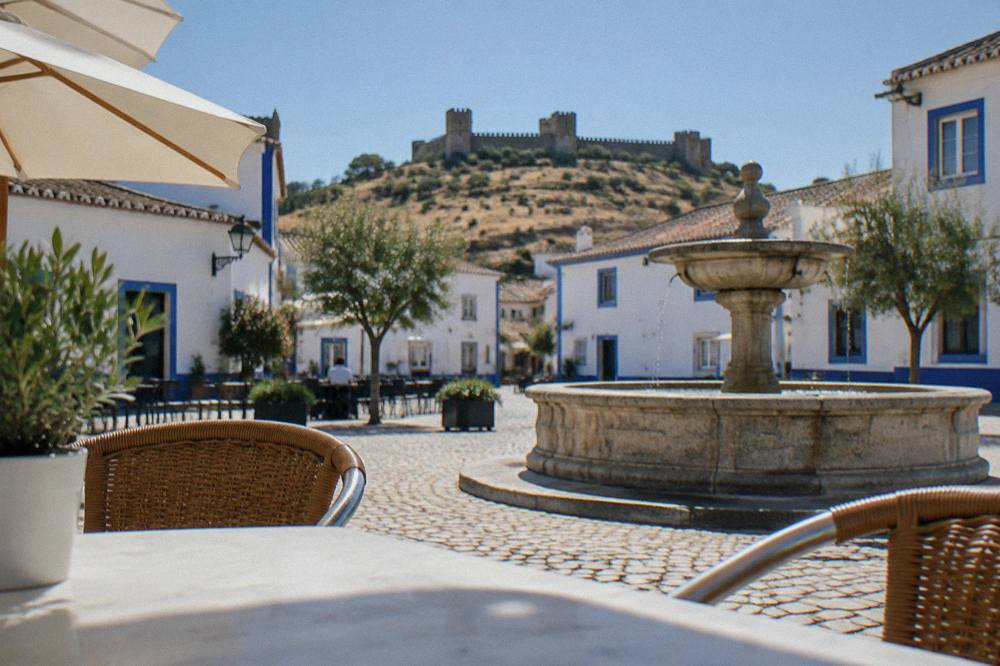
Down in the town, the practical pleasures are simple: a main square with cafés, streets where the houses wear the Alentejo's blue and yellow borders, and shop after shop of carpets in every size and pattern. It is a town for slow looking, not for ticking off sights, and that is a fair description of the Alentejo as a whole.
What Is Arraiolos Known For?
Arraiolos is known for one thing above all: the tapetes de Arraiolos, hand-embroidered wool carpets made in the town for generations. The rugs are stitched with a needle on canvas stretched over frames, using dense wool pile that makes them famously durable, and the patterns draw on floral and geometric motifs. The craft is the town's economy and identity, and it is why a place of modest size has a name that travels across Portugal.
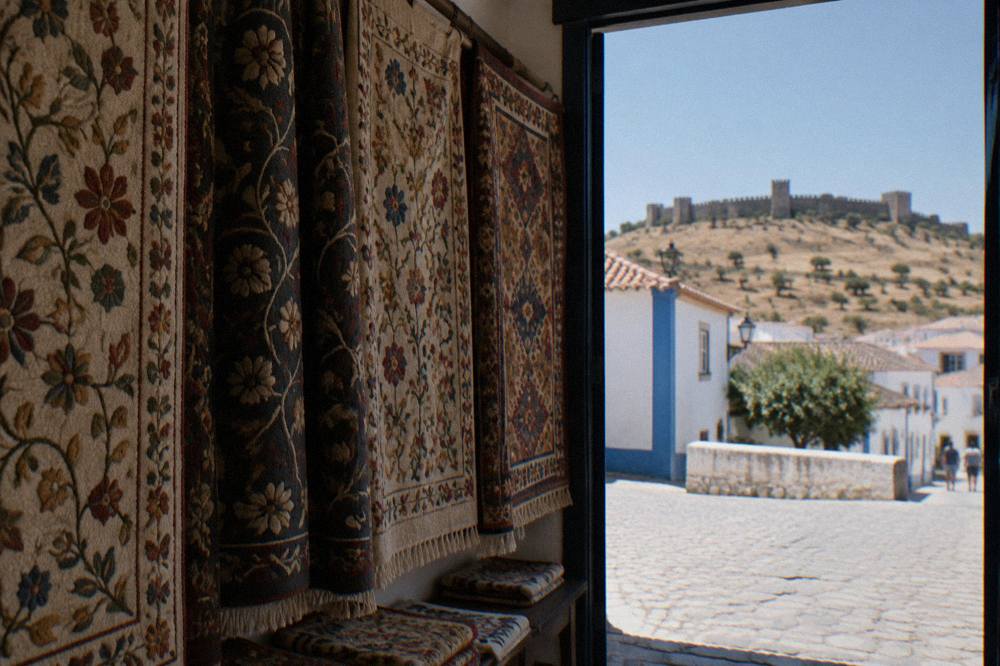
The carpets are everywhere in Arraiolos. Shops along the main streets display finished rugs hanging like tapestries, and the range runs from small mats to room-sized pieces, in palettes from deep reds and blues to soft Alentejan earth tones. Because each carpet is embroidered by hand, two pieces of the same pattern still differ slightly, and buyers are paying for weeks of stitching, not a print run.
The craft has shaped the town's social history too. Carpet embroidery was traditionally work done at home, and generations of Arraiolos families have been involved in it, from spinning and dyeing the wool to selling the finished pieces. Visitors will see the results rather than the process in most shops, but the town's identity as a making place, a counterpart to Estremoz's marble and Vila Viçosa's ducal pomp, is unmistakable.
| Alentejo Town | About How Far From Évora | What It Is Known For |
|---|---|---|
| Arraiolos | about 20 km | Hand-embroidered wool carpets, hilltop castle |
| Monsaraz | about 40-45 km | Walled village above the Alqueva lake |
| Estremoz | about 45 km | Marble, hilltop castle, market town |
| Vila Viçosa | about 60 km | Ducal palace, marble quarries |
| Elvas | about 80 km | Fortified border city |
| Marvão | about 120 km | Mountain-top walled village |
That table is the honest planning picture: Arraiolos is the nearest of the classic day trips, and the rest stretch out across the Alentejo in a chain that suits a multi-day loop rather than a single dash. For more on the further options, see the round-ups of day trips from Évora and the walled village of Monsaraz.
If you would rather have someone else handle the driving between the Alentejo's small towns, the guided options below cover the marble country that sits just beyond Arraiolos.
How Do You Get From Évora To Arraiolos?
Arraiolos lies about 20 km from Évora by road, which makes it the shortest of the region's classic day trips. No train serves the town, and the verified sources for this page carry no bus timetable or fare for the route, so the practical answer is a hire car, a taxi arranged in Évora, or a guided tour that includes the town in a wider loop. Check the operator's notice or the local bus station board before assuming any scheduled service.
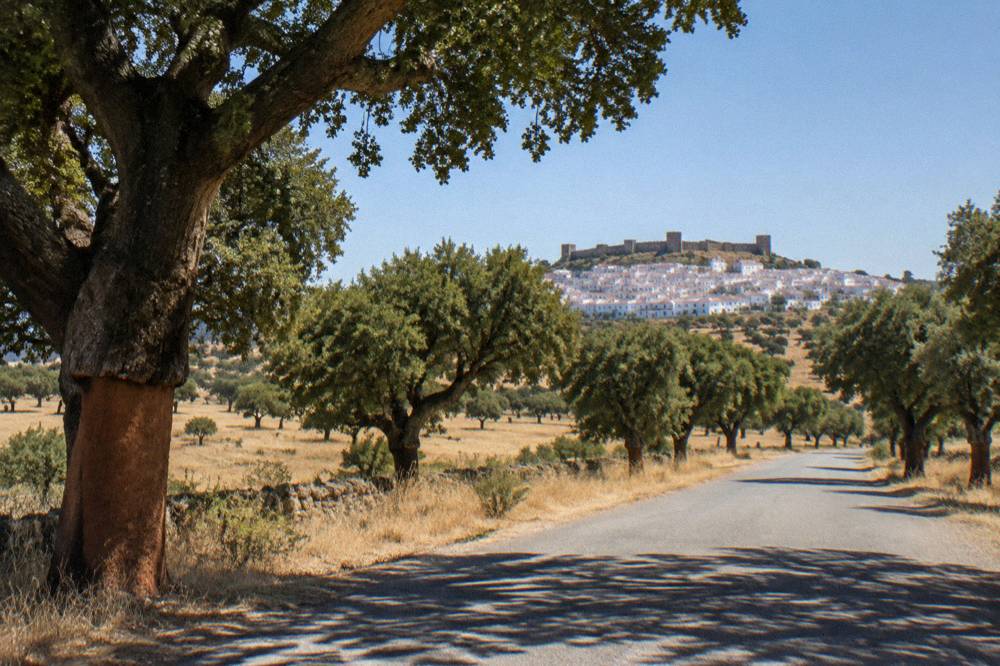
The drive itself is classic Alentejo: flat to rolling country, cork oaks in open fields, and the road threading between estate walls. Because the distance is short, the journey is not the day, and that changes how you plan it. A trip to Monsaraz or Marvão commits most of the day to movement; Arraiolos does not, which is why it pairs so well with a slower morning in Évora or with a second town in the afternoon.
For visitors arriving into Évora from Lisbon first, the rail link is the practical backbone. CP lists six through Intercidades trains from Lisboa Oriente to Évora in the timetable valid since 6 September 2026, taking about 1 hour 40 to 1 hour 45, with a second-class fare of 13.90 EUR and first class at 18.50 EUR. The table below shows the listed departures; check cp.pt for the current PDF before you travel.
| Lisboa Oriente Departure | Évora Arrival | Class | Fare |
|---|---|---|---|
| 07:02 | 08:47 | 2nd / 1st | 13.90 EUR / 18.50 EUR |
| 09:02 | 10:45 | 2nd / 1st | 13.90 EUR / 18.50 EUR |
| 09:58 | 11:40 | 2nd / 1st | 13.90 EUR / 18.50 EUR |
| 13:35 | 15:13 | 2nd / 1st | 13.90 EUR / 18.50 EUR |
| 17:02 | 18:41 | 2nd / 1st | 13.90 EUR / 18.50 EUR |
| 19:02 | 20:46 | 2nd / 1st | 13.90 EUR / 18.50 EUR |
Once in Évora, the car-free traveller has a real decision to make. Arraiolos without a car is awkward; the guided tours that cover the region's towns solve that problem entirely, and the marble-country tours starting from the towns east of Évora are the natural fit. The Marble Trail tour from Vila Viçosa is one option worth reading in full before you commit to a plan.
What To See In Arraiolos In Half A Day?
A half day in Arraiolos covers the essentials comfortably: the hilltop castle walls and round keep with their views over the plain, the walk down through the whitewashed lanes to the main square, the carpet shops where the town's signature craft is displayed and sold, and a long Alentejan lunch in the square. Nothing in the verified sources sets opening hours or ticket prices for the castle, so treat the town as open-air and self-guided.
Start high. The castle sits at the top of the hill, and the walk up through the town is the introduction: narrow lanes, houses with the painted borders the Alentejo does so well, and the sudden openings where you catch the plain beyond the roofs. At the walls, the panorama is the payoff. On a clear day the horizon is a long way off, and the round keep, unusual in Portugal, gives the skyline its shape.
Then come down and give the town its due time. The main square is the practical heart, with cafés and the shops that sell the carpets. Browsing them is the town's real attraction: racks of finished rugs, patterns from bold geometrics to fine florals, and prices that reflect hand embroidery rather than factory output. No workshop hours or demonstration schedules are verified for this page, so if seeing carpets being made matters to you, ask in the shops where to look rather than planning around a set time.
Lunch is not a footnote in the Alentejo. The region's table is bread, olive oil, cheeses, pork, and slow stews, and a town the size of Arraiolos keeps its own honest version of it. The things to do in Évora overview of Alentejan eating applies out here too: order what the house does, and do not rush.
Can You Combine Arraiolos With Estremoz And Vila Viçosa?
Yes, and the combination is the classic way to see this corner of the Alentejo. Arraiolos, Estremoz, about 45 km from Évora, and Vila Viçosa, about 60 km, form a natural loop of craft, marble, and royal history that fits comfortably in one day by car or on a guided tour. The three towns sit close enough together that the driving between them is short, and each gives you a different face of the same region.
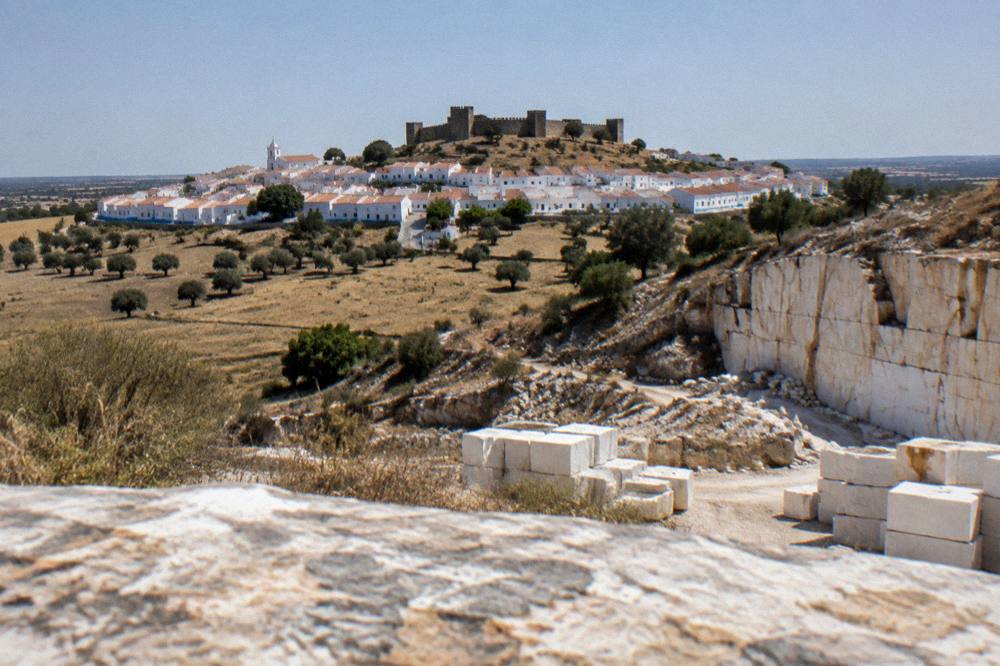
The logic of the loop is variety. Arraiolos is the carpet town, a place of wool and needlework. Estremoz is marble country, a market town whose white stone shows up in everything from staircases to pavements, with a castle of its own on the hill. Vila Viçosa is the aristocrat, home to the ducal palace of the House of Bragança and the marble quarries that supplied the region's grand buildings. One day, three registers of Alentejo life.
Done independently, the loop wants a car and a full day, with Arraiolos first as the nearest stop, then the run east to Estremoz and Vila Viçosa. Done guided, it is simpler still. The walking tour of Estremoz covers that town's heritage on foot, and the marble tours of Vila Viçosa handle the quarry country.
For the fuller picture of the region's towns, the guides to Estremoz and Vila Viçosa break down what each one offers in detail, and Évoramonte adds a small walled hill village to the same map.
What Do Guided Tours Of The Alentejo Towns Cost?
Guided tours covering the towns around Arraiolos run from $28.14 to $28.67 per person for the Vila Viçosa marble tours, both rated above 4.8 from their reviews, to $28.67 for the Estremoz heritage walk. All three are listed in US dollars on their cards, all start in the towns themselves rather than in Évora, and none carries a price in euros, because the operator cards are priced in dollars.
The table below is the honest comparison of the three guided options that fit an Arraiolos-and-beyond day. The two marble tours of Vila Viçosa are separate products with different itineraries, so read the listings to see which route suits you; one is framed around the marble trail from landscape to archaeology, the other around the quarries and the town.
| Tour | Decision Name | Price From | Rating | Reviews |
|---|---|---|---|---|
| Marble Tour in Vila Viçosa (Marble Trail) | Marble Trail, Landscape to Archaeology | $28.67 | 4.9 | 324 |
| Marble Tour in Vila Viçosa (Quarry Tour) | 2-Hour Marble Tour | $28.14 | 4.8 | 82 |
| Walking Tour in Estremoz | Estremoz Heritage Walking Tour | $28.67 | 4.8 | 19 |
For comparison, guided days that start in Évora itself run wider and cost more: the Megalithic and Cork Forest guided tour from Évora is from $50.65 per person, rated 4.9 from 41 reviews over 4 hours, and the Monsaraz and Wine guided tour from Évora is from $78.78, rated 4.6 from 51 reviews over 4 hours. Those are different days out, but they set the scale: the town walks are the cheapest guided products in the region, and the full-day excursions from Évora are the premium tier.
| Évora-Based Tour | Kind | Price From | Rating | Duration |
|---|---|---|---|---|
| Megalithic and Cork Forest guided tour | cork-wine | $50.65 | 4.9 | 4 hours |
| Monsaraz and Wine guided tour | monsaraz | $78.78 | 4.6 | 4 hours |
| Évora Walking Tour | walking | $53.90 | 4.8 | not stated |
| The Essential Free Tour of Évora | free-walk | free, tip based | 4.93 | 2 hours |
The free walk in that table is a GuruWalk product, a tip-based tour rather than a paid one, and it is listed here only for scale. Every price above sits on a real tour card in dollars; check each listing for what is included before booking.
When Is The Best Time Of Year To Visit Arraiolos?
Spring and autumn are the best times for an Arraiolos day trip, and the numbers explain why. IPMA's 1991-2020 normals for the Évora station show a July mean maximum of 33.3 C and an August mean maximum of 33.5 C, with 31.9 days a year reaching 35 C or more, while April and October sit at 20.7 C and 24.1 C mean maximum with far fewer extreme days. Winter is mild on average but wet.
The Alentejo summer is not a joke statistic. The 1991-2020 averages for the Évora station put June at a 30.2 C mean maximum with 15.1 days at 30 C or more, and July at 23.7 such days out of the month. A hill town with a castle walk means climbing in open sun, and a carpet shop crawl means town streets with little shade. If summer is when you are in Portugal, go early in the day, before the afternoon heat builds.
| Month | Mean Max (C) | Mean Min (C) | Rain (mm) | Days 30 C+ |
|---|---|---|---|---|
| April | 20.7 | 8.5 | 62.1 | 0.3 |
| May | 25.0 | 10.9 | 46.6 | 5.5 |
| June | 30.2 | 13.8 | 10.6 | 15.1 |
| September | 29.5 | 14.6 | 33.9 | 13.9 |
| October | 24.1 | 12.3 | 81.5 | 2.9 |
Every figure in that table is a 1991-2020 average for the Évora station, the nearest verified climate record for this region, and the pattern is plain: April and May give warm days without the furnace, October is pleasant but is the wettest month of the five at 81.5 mm on average, and September still carries 13.9 days at 30 C or more. The record maximum for the station is 45.4 C, set on 4 August 2018, a number worth remembering when a heatwave coincides with your trip.
Rain rarely wrecks an Arraiolos day, though. The town is compact, the shops are indoors, and a shower over the plain from the castle walls is its own kind of spectacle.
Where Does Arraiolos Fit In A Longer Alentejo Itinerary?
Arraiolos fits best as the first or last stop of a multi-day Alentejo loop based in Évora. On a three-day plan, give day one to Évora's historic centre, day two to Arraiolos plus Estremoz and Vila Viçosa as the marble loop, and day three to Monsaraz and the Alqueva lake country. Because Arraiolos is the closest stop at about 20 km, it is also the easiest town to slot into a departure day.
The reason to base in Évora is practical. The city has the rail link from Lisbon, the widest choice of accommodation, and the monuments that justify the region on their own: the Sé with its complete-visit ticket at 5.00 EUR, the Capela dos Ossos at 7.00 EUR adult, the Museu de Évora at 8 EUR, and the Évora Ticket multi-site pass at 8 EUR for one day, 10 EUR for two, and 12 EUR for three. The pass does not include the Sé, the Capela dos Ossos, or the Museu de Évora, so check its network list against your plans before buying.
| Évora Monument | Adult Ticket | Notes |
|---|---|---|
| Sé de Évora complete visit | 5.00 EUR | Cathedral, cloister, roof terrace, museum; children to 12 free |
| Capela dos Ossos museum ticket | 7.00 EUR | Youth to 25 and seniors over 65 at 5.00 EUR; family 15.00 EUR |
| Museu de Évora | 8 EUR | Closed Mondays; youth, seniors and family 50% off |
| Évora Ticket, one day | 8 EUR | Multi-site pass; free to age 12 |
With the city covered, the loop opens out. Beyond the marble towns, Elvas guards the Spanish border, Marvão sits on its mountain, and the Alqueva lake country runs down toward Monsaraz. A one-day taste of Évora itself is outlined in the one day in Évora itinerary, and the Évora day trip from Lisbon plan covers the capital-to-Alentejo run for those short on time.
Those three guided options are the ones that map most directly onto an Arraiolos-centred day, but they are not the only way to spend the afternoon. If the marble country feels like too much driving for one day, the alternative is to keep Arraiolos as a standalone morning and return to Évora for its own sights, which the city's monument list rewards with more than enough to fill the rest.
One planning note that belongs here rather than in a footnote: Évora is a European Capital of Culture in 2027, promoted by an executive board led by the municipality, and the 2026 programme is already running as a preparation year built on the concept of "Vagar". The full 2027 calendar is not yet published, so base no booking on a specific event date; treat the title instead as a reason the region's towns, Arraiolos included, will be busier than usual through 2027. The Feira de São João of 2026 ran from 23 June to 5 July at the Rossio de São Brás, which gives the shape of the city's early-summer rhythm if you want to see Évora at its most festive.
Common Questions About Arraiolos
How far is Arraiolos from Évora?
Arraiolos is about 20 km from Évora by road, the closest of the Alentejo's classic day-trip towns. That short distance is why it works as a half-day trip or as the first stop of a wider loop.
Is Arraiolos worth visiting?
Yes, if carpets, castle views, and quiet Alentejo streets appeal to you. Arraiolos is not a monument town on Évora's scale; it is a craft town, and its shops, hilltop walls, and unhurried square are the whole point. Half a day is enough to see it properly.
Can you visit Arraiolos without a car?
It is awkward. No train serves the town, and no bus timetable or fare for the route from Évora is verified in the sources for this page, so the practical car-free options are a taxi arranged in Évora or a guided tour that includes the region's towns. Check the local station board for any scheduled service before ruling the bus out.
What are the tapetes de Arraiolos?
They are Arraiolos's hand-embroidered wool carpets, stitched with a needle on canvas stretched over frames. The dense wool pile makes them famously hard-wearing, and the patterns range from geometric to floral. The craft has been the town's identity for generations and is why Arraiolos has a name across Portugal.
Can you combine Arraiolos with other towns in one day?
Yes. The classic combination is Arraiolos with Estremoz, about 45 km from Évora, and Vila Viçosa, about 60 km, as a marble-country loop. Guided tours cover Estremoz on foot and Vila Viçosa's marble country, so the loop works without a car too.
When is the best time to visit Arraiolos?
Spring and autumn. IPMA's 1991-2020 normals for the Évora station show July and August mean maximums of 33.3 C and 33.5 C, with 31.9 days a year at 35 C or more, while April averages a 20.7 C mean maximum. Summer visits are best made early in the day.
Arraiolos is the quiet end of the Alentejo: the nearest excursion from Évora, the easiest to reach, and the one built around a craft you can take home rolled under your arm. Give it a morning, add the marble towns if the day allows, and the region opens up from there.