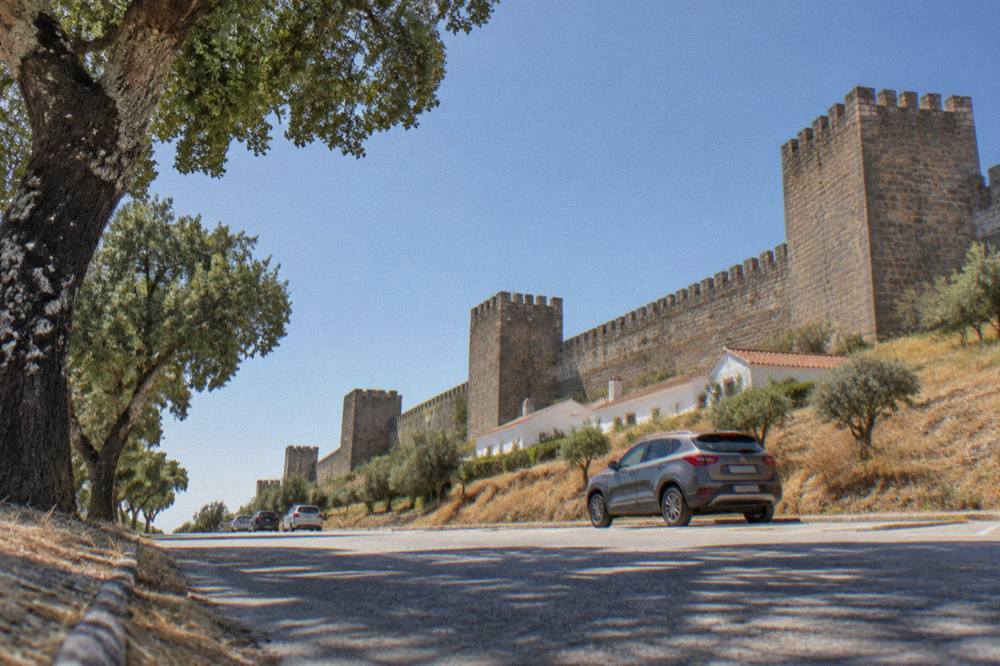
What Is Elvas Known For?
Elvas is known as a fortified border garrison city on the Alentejo plain, about 80 km east of Évora, Portugal. This guide covers its bastion walls, castle, aqueduct and how to plan the day trip.
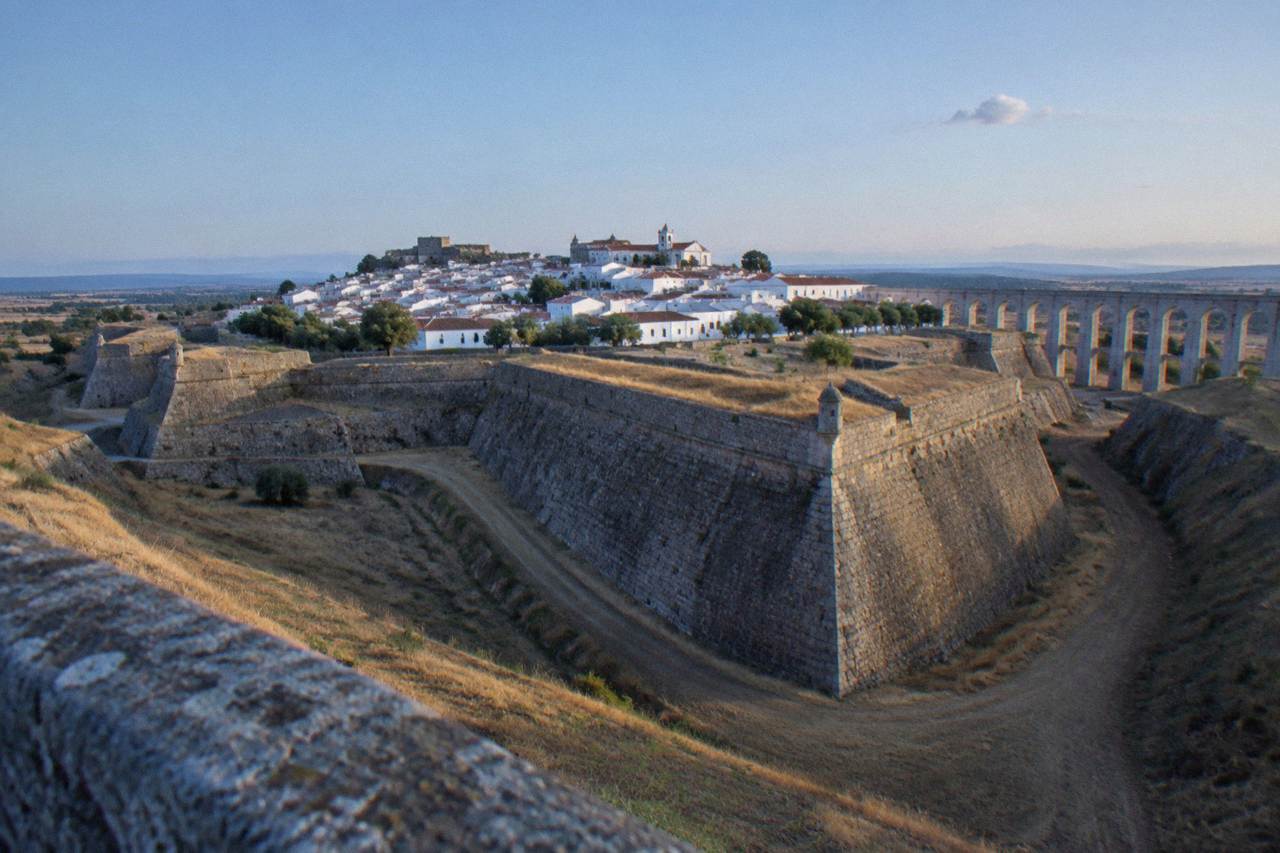
Elvas sits on the eastern edge of the Alentejo, about 80 km east of Évora, Portugal, close enough to the Spanish border that the city's whole shape and story come from that proximity. Where Évora is a museum city of churches, Roman temple and university, Elvas is a military city: walls, bastions, barracks and a castle built to guard a frontier. Visitors based in Évora usually reach it as a day trip, and the contrast between the two cities is exactly what makes the pairing work.
What Is Elvas Known For?
Elvas is known as a fortified border garrison city on the Alentejo plain, about 80 km east of Évora, standing guard over Portugal's frontier with Spain near Badajoz. Its star-shaped bastion walls, hilltop castle and great stone aqueduct define its silhouette, and its history as a military stronghold shapes every street inside the walls. The city's identity is defence, and that is what most visitors come to see.
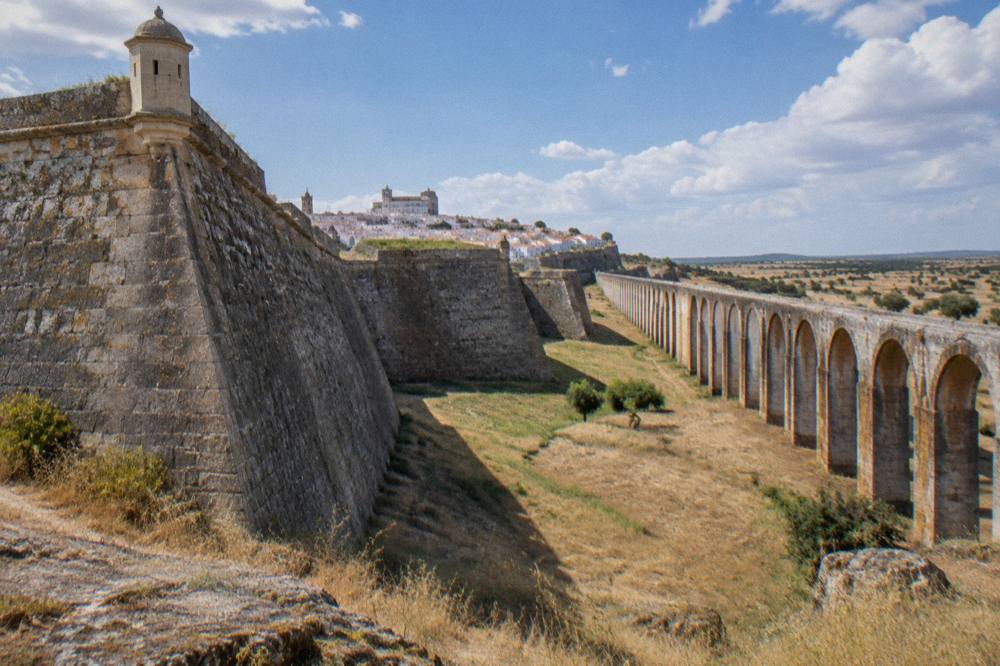
The walls are the headline. Elvas grew as Portugal's eastern shield, and the fortifications around the old town were laid out in the trace italienne style, the star-shaped design of angled bastions that evolved to counter artillery. Walking them is the city's main experience: the ramparts wrap the hilltop in a geometric outline that is best appreciated from the surrounding plain, where the whole defensive plan reads like a diagram drawn on the ground.
Inside, the scale changes. The old town is a compact grid of white houses, a main square and the castle keep at the highest point. The garrison character survives in the architecture: wide squares meant for mustering troops, barracks buildings, and churches that served a rotating population of soldiers. Elvas is a city that was built to be held, not to be pretty, and the honesty of that purpose is a large part of its appeal.
The aqueduct is the other signature. It runs across the low ground toward the city, a long line of arches engineered to bring water to a fortress that needed to survive sieges. Seen from a distance, with the walls rising behind it, the aqueduct and the bastions together make the most photographed view of Elvas.
Why Is Elvas A Border Fortress City?
Elvas is a border fortress because it faces Badajoz, the Spanish city just across the frontier, and for centuries control of this crossing decided who held the Alentejo. The city's walls, castle and outlying forts were built and rebuilt around that single strategic fact. Its military role ended only when the border stopped being a battlefield, leaving the fortifications as the city's inheritance.
The geography explains the history. Évora stands inland in the middle of the Alentejo plain, roughly 130 km from Lisbon, with no sea anywhere near it: the Atlantic coast is about 90 km away. Elvas stands further east, on the approach to the Guadiana crossing, and any army moving between Lisbon and Madrid had to pass through this corridor. Whoever held Elvas controlled the road.
That is why the fortifications took the form they did. The flat plain gives no natural defence, so the defence had to be engineered: thick angled bastions to deflect cannon fire, outworks to break up assaults, and a water supply built to survive a siege. The result is one of the most complete examples of a bastioned fortress town in the region, a city whose military plan is still legible in the street pattern.
For a traveller, the practical point is simpler. Elvas is a walking city, small enough inside the walls to explore on foot, and the fortifications are visible from almost everywhere. The visitor information available on site is the place to check current access to the walls and the castle before you go, since opening arrangements at individual monuments are not published in a form this desk can verify.
What Can You See On A Day Trip From Évora To Elvas?
A day trip from Évora to Elvas delivers the walls, the castle keep, the main square, the aqueduct and the view back across the plain toward Spain, all within a walkable old town. The drive east crosses the marble and wine country of the Central Alentejo, and Elvas lies about 80 km from Évora, far enough for a full day but close enough to return by evening.
The route itself is part of the trip. Heading east from Évora, the road passes through the rolling Alentejo landscape of cork oaks, olive groves and vineyards, with Estremoz, known for its marble and its castle, about 45 km out, and Vila Viçosa, the ducal seat of the Bragança dynasty, about 60 km out. Some travellers chain the three stops into a single loop, though that makes a long day. Everything else covered here is indexed on Évora Travel Guide.
| Day-Tip Destination From Évora | Rounded Distance | What the Day Is Like |
|---|---|---|
| Arraiolos | about 20 km | A hilltop village with a castle roundel, known for its hand-knotted carpets |
| Monsaraz | about 40 to 45 km | A walled medieval village above the Alqueva lake, one of the great Alentejo views |
| Estremoz | about 45 km | A marble town with a hilltop pousada and a lively market tradition |
| Vila Viçosa | about 60 km | A ducal town of palaces and marble, gateway to the Borba wine country |
| Elvas | about 80 km | The border fortress: bastion walls, castle and aqueduct facing Spain |
| Marvão | about 120 km | A spectacular eagle's-nest village in the Serra de São Mamede, best as its own day |
The distances are rounded estimates for planning, not door-to-door figures, and no drive time, bus timetable or ticket price for any of these towns has been verified in a form this desk can print. What the table does show is the shape of the region: Évora sits at the centre of a ring of fortress and market towns, and Elvas is the most militarily dramatic of them.
Back in Évora, the contrast is worth planning for. Évora's own headline monuments are the Templo Romano, the Sé, the Capela dos Ossos and the Museu de Évora, and their verified entry prices are modest enough that a two-city day can stay cheap.
| Évora Monument | Verified Ticket | Notes |
|---|---|---|
| Sé de Évora complete visit | 5.00 EUR | Cathedral, cloister, roof terrace and museum, children up to 12 free |
| Capela dos Ossos museum ticket | 7.00 EUR adult | Youth to 25 and seniors over 65 at 5.00 EUR, family 15.00 EUR |
| Museu de Évora | 8 EUR adult | Closed Mondays, open Tue-Sun 9:30-13:00 and 14:00-17:30 |
| Évora Ticket | 8 EUR one day, 10 EUR two days, 12 EUR three days | Multi-site pass, free to age 12, does not include the Sé, the Capela dos Ossos or the Museu de Évora |
If the Elvas day leaves you with an evening in Évora, a private guided walk is the efficient way to close the loop. The Private Best-Of Walking Tour of Évora covers the cathedral and the Chapel of Bones with tickets handled for you, from $113.53 per person and rated 5 from 256 reviews. Check availability
How Does Elvas Compare With Évora?
Elvas and Évora are both walled Alentejo cities about 80 km apart, but they answer different questions. Évora is the cultural capital, a UNESCO World Heritage city of churches, a Roman temple and a university, inscribed in 1986 under criteria (ii) and (iv). Elvas is the soldier's city, defined by bastions and frontier history. Évora rewards several days; Elvas rewards one focused day.
UNESCO's own listing calls the Historic Centre of Évora the finest example of a city of the golden age of Portugal, preserved because Évora was largely spared the 1755 Lisbon earthquake that destroyed so much of the country's architectural inheritance. That is the opposite of Elvas's story, where the architecture exists because of war rather than in spite of it.
The texture of the two visits differs accordingly. In Évora, the highlights are interiors: the Sé's cloister and roof terrace, the bone chapel of the Igreja de São Francisco, the museum in the former Archbishop's Palace. In Elvas, the highlights are exteriors and views: the walls from outside, the plain from the walls, the aqueduct from the approach road. A camera works differently in each.
The two cities also sit differently in the regional pattern. Évora is the transport hub of the Central Alentejo, the place with the train connection to Lisbon and the accommodation base. Elvas is a destination at the edge, and most visitors treat it as an excursion. That division of labour is sensible, and there is no need to fight it.
For travellers who want a guided frame for the Évora half of the comparison, the Street Stories Walking Tour, from $53.90 per person and rated 4.8 from 37 reviews, is a solid mid-priced option. There is also a genuinely free way to get oriented: the Essential Free Tour of Évora on GuruWalk, tip based, rated 4.93 from 774 reviews, led by a local guru, which several visitors use on their first evening in the city before heading east to Elvas the next morning.
How Do You Plan An Elvas Day Trip From Évora?
Plan the Elvas day trip as a full day out of Évora: leave early, walk the walls and the old town in the cooler morning hours, give the castle keep and the aqueduct view the middle of the day, and return to Évora in the evening. No verified bus timetable, drive time or monument opening hours exist for this route in the sources this desk holds, so check the operator's notice before you go.
Timing matters more here than in most of the Alentejo, because the plain gets seriously hot. IPMA's 1991 to 2020 climate normals for the Évora station show a July mean maximum of 33.3 C and an August mean of 33.5 C, with 31.9 days a year reaching 35 C or more, and the record maximum of 45.4 C was set on 4 August 2018. Elvas shares this inland climate: there is no sea breeze to rescue you, because the Atlantic is roughly 90 km away. Spring and autumn are the comfortable seasons, and the walls offer little shade at any time of year.
What to bring follows from what the day is: solid shoes for stone ramps and cobbles, water, sun protection, and a plan for lunch inside the old town, since the walking circuit fills a morning easily. The municipal and monument pages for Elvas are the place to confirm current access to the castle and walls, because this desk has no verified opening hours for any Elvas monument and will not guess at them.
Back in Évora that evening, the Golden Era of Évora walking tour with a Portuguese wine tasting, from $23.92 per person and rated 4.4 from 33 reviews, is a low-cost way to close out a fortress-and-wine day. If the Elvas walls have fired an interest in Évora's own defensive ring, the guide to Évora's Roman and medieval walls picks up the story where the day trip leaves it.
The guided options above all start in Évora itself, which keeps the logistics simple: one base city, one evening walk, and the Elvas excursion folded into a single Alentejo stay. Whichever frame you choose, the pairing of a garrison frontier and a golden-age university city is what makes this corner of Portugal worth the detour.
Common Questions About Elvas
What is Elvas known for?
Elvas is known as a fortified border garrison city about 80 km east of Évora, with star-shaped bastion walls, a hilltop castle keep and a long stone aqueduct. Its history as Portugal's eastern shield facing Badajoz defines the city.
Is Elvas Portugal worth visiting?
Yes, for travellers already in the Alentejo who want a contrast with Évora. Elvas offers one of the region's most dramatic fortress landscapes, walkable in a day. The full assessment of whether Elvas is worth visiting covers the trade-offs in detail.
How far is Elvas from Évora?
Elvas lies about 80 km east of Évora, a rounded planning estimate rather than a door-to-door figure. No verified drive time, bus timetable or train connection for this route exists in the sources this desk holds.
Can you see Elvas and Évora in one day?
It is possible but rushed. A better pattern is to give Évora its own day, using a guide such as what to do in Évora for a day, and devote a separate full day to Elvas and its walls.
What is the best way to get to Elvas from Évora?
Most visitors drive or join a private tour, since the route crosses the Alentejo plain with no verified rail link from Évora. Check the operator's notice before you go, because no bus timetable for this route has been verified.
Does Elvas have UNESCO status?
This desk holds no verified inscription facts for the Elvas fortifications and will not state a status it cannot check. Évora's own Historic Centre, by contrast, is UNESCO-inscribed, in 1986 under criteria (ii) and (iv), and that listing is verified.
Elvas answers a question Évora cannot: what the Alentejo looked like when its cities had to fight for their place on the map. Pair the garrison walls with Évora's golden-age churches and the two days together tell the whole story of the region, from the frontier to the university and back.